Skip to content
DevMeme
678 of 7435
The PR Approval Cat's Plea
CodeReviews Post #770, on Nov 1, 2019 in TG

The PR Approval Cat's Plea

Why is this CodeReviews meme funny?

Level 1: Permission Please

Think of a time when you really wanted to do something fun, but you needed an adult’s permission. Imagine you finished all your chores and then politely asked, “Can I have a cookie now, please?” or “May I go play outside?” Then you had to wait and wait because the adult was busy and didn’t answer right away. You might stand there with big, hopeful eyes – almost like a kitty waiting by the door – hoping they’ll say “Yes, go ahead.” In this meme, the cat peeking over the table is just like that child or pet waiting for a nod. It’s a cute, funny way to show how it feels to wait eagerly for someone else to say yes, so you can finally get what you were hoping for.

Level 2: Merge Button Blocked

At this level, we explain more directly what’s going on in the meme for a newer developer. The cat represents a developer who has finished writing some code and has submitted it as a pull request (PR) for review. A pull request is a way to ask your teammates to look over your code changes and eventually merge them into the main codebase (for example, on a platform like GitHub). When you open a pull request, you usually need a teammate to examine your code and give their approval before it can be merged. In the meme’s text, “approve my pull request” is basically the developer politely asking, “Hey, can someone please review my code and give me the OK so I can merge it?”

The phrase “merge button blocked” humorously describes what happens when a PR is waiting for review. Many teams have rules (called branch protections or review requirements) that disable the “Merge” button on the PR until at least one person approves the changes. So if nobody has reviewed your code yet, you literally can’t merge it – the platform won’t allow it. The merge button just sits there grayed-out, often with a note like “1 review required.” In practical terms, you’re stuck; your work can’t move forward in the project until someone else signs off on it. For a new developer, this can be a surprise: you finish your task and think you’re done, but then you hit this waiting period before the code actually goes in. It’s a bit like racing to the end of a track and then finding the gate is locked until someone else opens it.

This is where the office cat in the meme comes in as a lighthearted analogy. Instead of the developer pestering their teammate directly, the picture of a cute cat peeking over a table embodies the feeling of waiting patiently (but a bit anxiously). It’s a playful take on what could otherwise be a frustrating situation. Imagine you’re that developer: you might be sending a polite message on Slack or leaving a friendly comment on the PR to remind your reviewer. It’s a lot like a cat sitting by its food bowl, looking up with big eyes, hoping someone notices and fills it. The cat’s expression and the caption “CAN YOU PLEASE APPROVE…” capture the mix of hopefulness and helplessness you feel when you’re depending on someone else’s help. Especially if you’re junior, you don’t want to seem pushy, so you end up using extra courtesy – essentially putting on your best “kitty eyes” – when asking for the review.

For someone early in their career, this scenario is almost a rite of passage in collaborative software development. Code reviews (having peers review your code) are a normal and important part of working on a team: they help catch mistakes and improve the code quality. But they also mean your progress can stall until you hear back from others. A junior developer might worry, “Did I do something wrong? Is that why it’s taking so long to get feedback?” Usually that’s not the case – more often everyone else is just tied up with their own work or hasn’t noticed your PR yet. In other words, it’s typically a simple communication gap, not a reflection of your coding skills. Effective communication becomes key. Often the advice is to politely ping your reviewer after a reasonable waiting time. For example, you might write a comment tagging your teammate like “@Alex PTAL” (which stands for “Please Take A Look”) to gently remind them. Or you might mention in the daily stand-up meeting that your work is ready for review. These are the professional equivalents of the cat pawing at someone’s leg to get attention, essentially saying, “Hey, I’m still here and I need your help, please.”

The meme is funny to developers because it exaggerates this everyday situation with an adorable twist. It takes a slightly uncomfortable feeling – having to beg someone to do their part – and makes it easier to talk about. After all, it’s hard to be mad at a cute cat, and by the same token, it makes the real-life act of nudging your teammate feel more friendly. For a new developer seeing this meme, it’s a reassuring reminder that everyone has to wait for reviews sometimes. The shared experience of “waiting for PR approval” is so common that portraying it with a cat in an office makes people smile and think, “Yep, been there.” It highlights the human side of tech work: patience, polite communication, and using a bit of humor to deal with collaboration challenges.

Level 3: Pull Request Purgatory

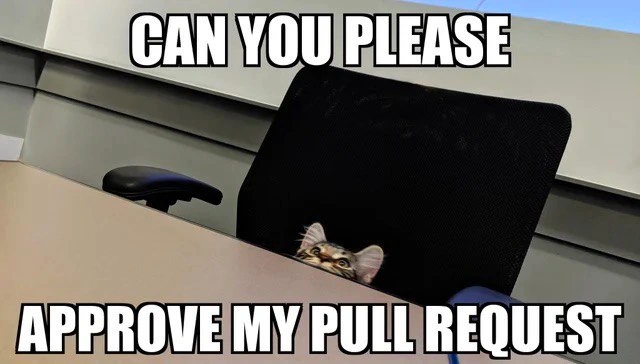
In this meme, an office tabby cat becomes the unwitting mascot of a familiar code review ordeal. In bold all-caps Impact font across the image, we see the desperate plea:

CAN YOU PLEASE APPROVE MY PULL REQUEST

This oversize caption is a classic meme flourish – turning a polite request into a playful shout. The cat’s wide, pleading eyes peeking over a conference table perfectly encapsulate the developer’s mixture of hope and frustration while waiting on approval. Every senior engineer recognizes this situation: code is written and tested, but your changes are stuck in limbo until someone else gives that green check mark. It’s the dreaded pull request holding pattern that haunts deployment timelines.

The image cleverly personifies the developer as a humble cat in a corporate meeting room. Why a cat? Because even a battle-hardened dev can feel as helpless as a kitten pawing for attention when their work is stalled awaiting review. The mundane conference room setting – sterile gray walls, fluorescent lights, empty chairs – makes the cat’s presence absurdly funny, as if frustration itself summoned this feline ally into the office. The humor lands because it’s so relatable: we’ve all been that developer, metaphorically crouching behind our desk (or Slack window) with big kitten eyes, asking a busy teammate, “Could you please take a quick look at my PR?” It’s a bit awkward to repeatedly nag coworkers for a review, so couching the plea in humor (via a cat meme or a lighthearted GIF) lets you express urgency without coming off as aggressive. The cat’s adorable desperation says what we’re all feeling, in a way that makes colleagues smile rather than bristle.

This meme spotlights a common code review pain point: the asynchronous approval workflow often becomes a bottleneck. In modern Git-based teams, pull requests serve as a gate for quality control – no code merges into the main branch until at least one reviewer hits “Approve”. It’s a valuable practice for catching bugs and spreading knowledge, but it introduces a waiting game. The process is inherently asynchronous: you, the developer, submit your code changes and then wait (sometimes hours or days) for someone else to respond. Unlike pair programming or an over-the-shoulder check, which give instant feedback, code reviews on platforms like GitHub happen on the reviewer’s schedule. If the assigned reviewer is swamped with their own tasks or tied up in meetings, your PR sits idle. This creates friction in team communication: the author doesn’t want to be pushy, the reviewer might underestimate the urgency, and everyone feels that subtle pressure. The caption “CAN YOU PLEASE APPROVE…” is something you’d never yell in the office, but it’s basically every developer’s inner monologue after waiting too long. By putting that thought in big bold letters over a cat photo, the meme voices the tension we usually only hint at in real life.

From a senior engineer’s perspective, this scenario is painfully real. An unreviewed PR can stall a feature release or delay a critical bug fix in production. We half-jokingly refer to these stuck PRs as the review backlog or the PR queue. Every experienced dev team has war stories of a pull request that languished for weeks because the only domain expert who could review it was on vacation, or because everyone kept procrastinating on it. The longer a PR stays open, the more likely it becomes stale – the codebase moves on, and now your branch has merge conflicts or outdated code. This only adds to the author’s anxiety: not only are they waiting, but by the time they get feedback they might have to dive back into code they wrote last month to resolve new issues. It’s a classic developer experience gotcha: a process intended to ensure quality (mandatory peer review) can inadvertently slow down delivery and dampen morale if not managed well. The meme exaggerates that pain by showing a developer so desperate to move forward that they’ve transformed into a begging office pet. It’s funny because it’s an exaggeration anchored in truth – one that makes you laugh and wince at the same time.

There’s also a social dynamic underlined here – code review is a human gatekeeper in the development workflow. An approval is a small act with big significance: whether it’s clicking the official “Approve” button or simply commenting LGTM (short for “Looks Good To Me”), that reviewer action represents trust, teamwork, and permission to merge. Being dependent on someone else’s sign-off can leave a developer feeling like their work is in limbo, held hostage by the merge gate until another person frees it. No matter how critical your fix or how elegant your code, you can’t deploy it until Bob or Alice from the team gives the nod. Seasoned developers have developed tactics for this: adding gentle @reviewer pings in the pull request, dropping a polite message in chat like “PTAL when you get a chance 🙏”, or bringing it up in the daily stand-up. And yes, sometimes we resort to humor – sharing a meme or sticker of a sad cat or puppy-eyed character – to politely say “I need this, pretty please.” This meme is essentially that scenario distilled: the cat represents the collective developer stance of adorable urgency. It’s the soft-power approach to a collaboration challenge: you can’t order a colleague to review, but you might charm or guilt-trip them into it with a bit of cuteness and camaraderie.

This meme slyly highlights the social and workflow hiccups of modern software teams. It shows how a simple gatekeeping mechanism – the pull request approval – can turn into a comically frustrating waiting period. The reason it resonates is because every developer, from a fresh junior to a grizzled veteran, has felt this powerless moment: everything is done on your side, and now you’re just... waiting. The office cat begging for that approval is a stand-in for all of us in those moments. We chuckle at the image because we see ourselves in that cat – hopeful that our work will finally get the nod, ears perked every time a notification pings, essentially with paws pressed together in plea.

Description

An image macro meme featuring a small, wide-eyed tabby kitten peeking cautiously over the back of a black office chair. The kitten's eyes and ears are the only parts visible above the desk partition, giving it a timid yet hopeful expression. The image is captioned with bold, white text in the Impact font. The top text reads, 'CAN YOU PLEASE,' and the bottom text reads, 'APPROVE MY PULL REQUEST.' The humor comes from the relatable scenario of a developer waiting anxiously for a code review and approval. The cute, slightly pathetic kitten perfectly embodies the feeling of being blocked and needing a senior developer or teammate to merge their work so they can move on. It's a universal experience in collaborative software development

Comments

7
Anonymous ★ Top Pick That PR has been sitting there so long, it's starting to get merge conflicts with the heat death of the universe
  1. Anonymous ★ Top Pick

    That PR has been sitting there so long, it's starting to get merge conflicts with the heat death of the universe

  2. Anonymous

    After three business days in the review queue, even the office cat has learned that ‘LGTM’ is the real deployment pipeline

  3. Anonymous

    When you've been waiting three sprints for approval on a PR that just updates a README, but the same reviewer instantly approved a 2000-line refactor that broke prod last Tuesday

  4. Anonymous

    Every senior engineer knows this feeling: your carefully crafted PR with 47 commits squashed into one, comprehensive tests, and documentation sits there for three days while your reviewer is 'investigating a production incident' (read: also waiting for their PR to be approved). Meanwhile, the feature branch has diverged 200 commits from main, and you're contemplating whether to just force-push to production and claim it was a 'hotfix.'

  5. Anonymous

    Our branch protection turns CI into a human semaphore - the only throughput optimization that consistently wins the merge queue is feline-driven LGTM

  6. Anonymous

    PR reviews: the distributed system's true single point of failure, no matter your k8s cluster size

  7. Anonymous

    Review latency is the real monolith; at this point I’d accept a drive-by LGTM from the office cat if CODEOWNERS and required checks are green

Use J and K for navigation