Explaining Your Code: Juniors vs. Seniors
Why is this DevCommunities meme funny?
Level 1: Acting Smart, Feeling Stumped
It’s like you did a magic trick by accident, and your little brother asks, “Wow, how did you do that?” You feel proud and want to seem smart, so you say, “Ah, it’s a secret, you wouldn’t understand it.” You’re basically acting like you know everything, and you’re not actually explaining anything. But later, a professional magician sees your trick and asks you to explain how it works. Now you feel stuck, because you don’t actually know the answer either! You just stand there with a silly grin and shrug your shoulders, saying “I… don’t know.” It’s funny because you went from being super confident (showing off to someone who knows less) to looking totally clueless (in front of someone who knows a lot more). This kind of situation makes us laugh since it shows how someone can pretend to be smart one moment, then admit they’re lost the next. The lesson is: it’s easy to act like you know something when talking to someone new, but when an expert asks you for details, the truth comes out. It’s a bit like telling your friend you’re an amazing chef because you got lucky with one dish, and then feeling embarrassed when a real chef asks you to recreate it. We find it funny and relatable because everyone sometimes pretends to understand something when they really don’t — until a big person (or expert) comes along and we have to tell the truth with a sheepish shrug.
Level 2: Bluff Called
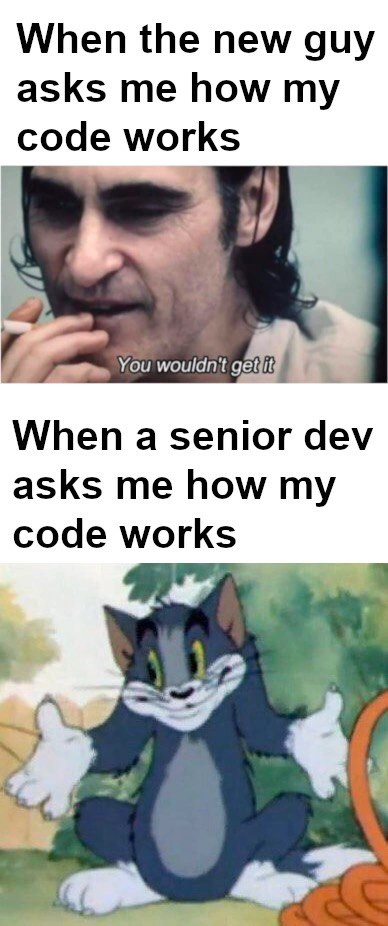
Imagine you wrote a piece of code that somehow works, but it’s not very readable (meaning other people would have a hard time understanding it). Now a junior developer – someone new and less experienced – asks you, “Hey, how does your code do what it does?” If you’re not confident in explaining it (or maybe you’re a bit proud), you might respond with a line like “You wouldn’t get it.” In other words, you’re telling the new guy that the code is too advanced or complicated for them. This comes off as you being smug (overly proud) about your work. It’s a way of dodging the question. In the meme’s top image, the Joker’s half-smile and the subtitle “You wouldn’t get it” perfectly show that smug feeling – like the developer is saying “I’m a genius, trust me,” without actually explaining anything.
Now flip the situation. A senior developer – someone with a lot more experience, maybe a tech lead or mentor – asks you the same question: “Could you walk me through how your code works?” This is basically what happens in a code review, where experienced team members examine your code to make sure it’s good quality. You can’t use the same excuse with a senior; saying “you won’t get it” to someone who’s seen it all will just sound silly (or disrespectful). They probably will get it, and in fact, they might already suspect something’s off. So now you actually have to explain your choices. And if you don’t really know or your code is a bit of a mess, you’re stuck. You might end up doing what Tom the cat does in the bottom panel – shrugging with a goofy grin, basically admitting “I have no idea what I wrote.” This shrug comes from explain_code_anxiety, that nervous feeling when you’re asked to explain something and you suddenly realize you’re not sure about it yourself.
This highlights a few important ideas in software development: Code Quality, Code Readability, and honesty about one’s work. Code Quality means writing code that is not only correct but also clear, efficient, and maintainable. Good code quality often includes Code Readability – can others easily read and understand your code? For example, using meaningful variable names, keeping functions short and focused, and adding code comments (little notes in the code) to explain tricky parts all help make code more readable. If your code is readable, you should be able to explain how it works step by step without feeling lost. On the other hand, if you wrote confusing or spaghetti code (code that’s tangled and hard to follow), you’ll have a tough time explaining it. A junior developer might not catch all the issues and would just accept if you brush them off. But a senior developer will likely notice if the code is overly complex or not following best practices. They might ask pointed questions like “Why did you choose this approach?” or “What happens if we give your function unusual input?” These questions can reveal if you haven’t thought through everything.
The humor of the meme comes from this very relatable situation. Many developers, especially when we’re early in our careers, have felt pressure to “fake it till you make it.” Maybe we give a superficial answer to a junior colleague to save face, or we assume they wouldn’t understand the technical details. It’s not a great approach — a better developer would try to explain in simpler terms (there’s even a phrase for that: ELI5, or “Explain Like I’m 5,” meaning break it down in simple ways). Not explaining at all can come across as arrogant or dismissive. But the meme jokes that some of us do it anyway to avoid the effort or embarrassment. Then comes the imposter syndrome moment when a skilled senior engineer asks something you can’t explain. Imposter syndrome is when you secretly feel like you’re not as capable as others think, and you’re afraid of being “found out.” In the bottom scenario, the developer basically gets found out. The senior’s question exposes that the code writer might not fully understand their own code or didn’t consider important details. That’s why the developer is shown with that “I’m clueless” Tom & Jerry shrug.
Tom & Jerry is a classic cartoon, and Tom (the cat) often makes that shrug when he’s been beaten or has no idea what to do next – it’s a very human-like “I give up” gesture. Seeing a normally proud character like Tom looking helpless is funny, just like seeing a normally confident developer suddenly look lost is funny (and a bit painful). The meme uses these two images – the Joker for false confidence and Tom for helpless honesty – to exaggerate how a developer’s attitude can flip based on who’s asking the questions. Communication is key here: when talking to less experienced folks, the developer in the meme fails to communicate and just shuts the conversation down. But when talking to a more experienced person, the developer would communicate if they could – but they genuinely don’t know what to say. The gap between “I won’t explain” and “I can’t explain” is the whole joke. It’s a reminder that in coding (and any field), you should strive to understand your own work well enough that you can explain it clearly to both juniors and seniors. And if you can’t, maybe the code needs cleaning up, or you need to learn more about what you just wrote. After all, writing code is not just about making the computer understand (it will execute whatever, as long as syntax is correct), but also about making other developers understand. That’s what maintainable code is all about: someone else (or you in the future) can read it and “get it.” If you ever catch yourself saying about your own code, “You just wouldn’t get it,” take a step back — it might be a sign that code maintainability and clarity need some love. And as this meme shows, you never know when a senior engineer will be the one asking questions next, calling your bluff in the most public way (perhaps in a meeting or a code review comment for all to see!). It’s always better to be prepared and honest than to be caught shrugging.
Level 3: Smug vs Shrug
This meme hilariously captures a code review comeuppance that seasoned developers know all too well. In the top panel, we have Arthur Fleck (the Joker) smugly telling a new developer “You wouldn’t get it,” exuding that dev arrogance as if his code is some arcane masterpiece. In the bottom panel, Tom the cat from Tom & Jerry stands with arms out and a goofy shrug when a senior engineer inquires about the same code — the universal “I have no idea” stance. The contrast nails a common scenario in software teams: a developer overconfidently dismisses a junior’s questions, yet freezes under a senior’s scrutiny. It’s the classic smug vs. shrug moment, where perceived expertise evaporates into humble confusion.
At a deeper level, this speaks to code quality and communication gaps. If a programmer can’t explain how their code works, especially to someone experienced, it’s often a red flag. Maybe the code is an overly clever hack or spaghetti code (tangled, hard-to-follow logic) held together by prayers and duct tape. Perhaps it was written in a late-night caffeine frenzy and lacks code readability— meaning the logic isn’t clear from the naming and structure. We’ve all seen functions so convoluted that even the author forgets their workings the next day. In such cases, saying “You wouldn’t get it” to a newcomer is a convenient cop-out for “I don’t want to admit how messy this is.” However, that bluff doesn’t fly when a senior dev reviews the code. An experienced reviewer will zero in on every unexplained decision: “Why did you choose this algorithm?” “What happens on edge cases?” “Isn’t this basically reinventing an existing library?” If the coder hasn’t thought these through, the explain_code_anxiety skyrockets. It’s a developer’s imposter moment: the sinking feeling that “Oh no, maybe I don’t get it either.”
This humor also exposes the psychological rollercoaster in engineering mentorship and peer review. A mid-level dev might pull a “you_wouldnt_get_it” act with juniors due to a mix of ego and impatience. It’s the Dunning-Kruger effect in action — with a little knowledge, you overestimate your prowess and assume others “just won’t understand” your “genius.” To the new guy, the code’s author postures as the all-knowing guru, guarding trade secrets of the codebase. But when explaining to a true expert, that illusion shatters. Suddenly you realize your “genius” solution might be full of holes. The senior dev’s question, essentially “Can you walk me through how this works?”, is the ultimate litmus test. If you can’t articulate it, do you truly understand it? Often the answer is no, and the explanation gap becomes painfully obvious. The meme’s bottom image – Tom’s helpless grin and shrug – perfectly encapsulates that caught-out feeling. It’s the “I have zero clue why this code works, please don’t judge me” face. As a result, the very confidence that shielded the developer with the junior flips into imposter syndrome under a senior’s gaze.
From an industry perspective, this scenario is a rite of passage. Code review dynamics can be brutal but enlightening. A senior engineer asking tough questions is not to harass, but to ensure code maintainability and share knowledge. If the original coder struggles to explain their own code, it signals that the code might not be self-documenting or well-structured. In healthy engineering cultures, this is a learning opportunity: maybe the function needs clearer logic or comments, or the developer needs guidance on that design pattern they half-implemented. But in the moment, it definitely feels like being on stage with the spotlight glaring. Many of us have instinctively blurted something akin to “It made sense at the time...” when pressed by a lead during a senior_code_review. It’s developer self-deprecation at its finest - we laugh because we’ve all been Tom the cat, caught between dev arrogance and imposter syndrome. The meme exaggerates it with a villainous smirk vs. a cartoon shrug, but the core truth is real: writing code is one thing, explaining it clearly is a whole different skill. It’s a cheeky reminder that if you can’t explain your code simply, you probably don’t understand it well enough — and that’s something even the Joker would get.
Junior dev: “Can you explain what this part of the code does?”
Me (waving hands like Joker): “Heh, you wouldn’t get it.”
Senior dev: “Okay, enlighten me — how does your code actually work?”
Me (Tom shrugging): “Umm… I have no idea.”
In other words, this meme is a spot-on piece of DeveloperHumor and DeveloperSelfDeprecation. It highlights a painfully RelatableDeveloperExperience: acting like a know-it-all to someone with less experience, then being humbled by someone with more experience. It playfully mocks poor CodeReadability and the folly of not documenting or structuring your code. And it reassures us that feeling lost explaining your own work isn’t just you — it’s a universal tech joke. After all, behind every “You wouldn’t get it” lie a few // TODO: explain this comments and a developer praying their bluff isn’t called by the resident code guru. When that bluff is called, all that’s left is an embarrassed grin and a silent vow to write clearer code next time.
Description
A two-panel meme contrasting a developer's explanation of their code to different audiences. The top panel is labeled, 'When the new guy asks me how my code works,' and shows a still of Joaquin Phoenix as the Joker, smoking and saying dismissively, 'You wouldn't get it.' This represents a facade of complex, superior knowledge. The bottom panel, labeled 'When a senior dev asks me how my code works,' shows the cartoon character Tom from 'Tom and Jerry' shrugging with a completely clueless and helpless expression. The joke lies in the drastic shift from feigned intellectual superiority in front of a junior to an honest admission of ignorance in front of a senior. It's a relatable commentary on impostor syndrome, technical debt, and the reality that sometimes code works through a fragile combination of luck and copy-pasted solutions that even the original author doesn't fully understand
Comments
7Comment deleted
My code's documentation is like quantum mechanics: for the junior, its state is 'too complex to understand'; for the senior, its state is 'a superposition of hope and undefined behavior'
My codebase obeys the observer effect: viewed by juniors it’s modular art, but under a senior’s breakpoint it decoheres into undefined behavior
The same developer who won't document their code because "it's self-explanatory" will spend three hours walking the CTO through every line during the acquisition due diligence
The real reason we're dismissive with juniors isn't gatekeeping - it's that explaining our code would require first explaining why we chose that architecture, which would require explaining the three previous architectures we refactored away from, which would require explaining the legacy system we inherited, which would require explaining decisions made by developers who left five years ago. By the time we reach 'You wouldn't get it,' we've already mentally traversed a dependency graph deeper than our node_modules folder. But when a senior asks? They've seen the same archaeological layers in their own codebases - they already know the 'why' behind the 'what,' so we can skip straight to the interesting parts without the existential crisis of justifying technical debt we didn't create but are now responsible for
When a junior asks I say ‘encapsulation’; when a senior asks I admit it’s temporal coupling, hidden globals, and a cron job acting as our distributed lock - aka the emergent behavior we market as features
For new hires I call it a 'domain-specific optimization'; for the staff engineer I admit it’s two race conditions in a trench coat hidden behind a feature flag I forgot to remove
Juniors get the Bardem bluff; seniors get the sweat - because peers can spot the unmocked side effects from a commit away