Skip to content
DevMeme
3182 of 7435
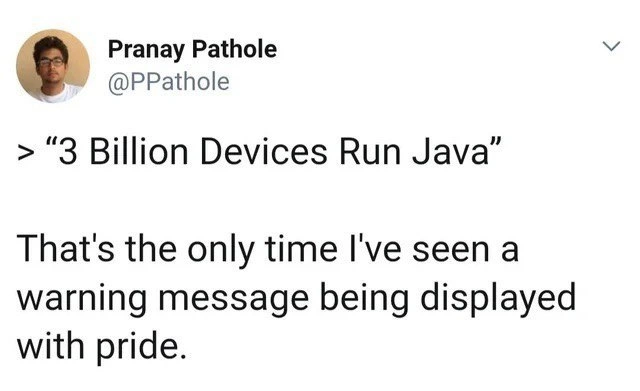
“3 Billion Devices Run Java” - the proudest warning dialog ever displayed
Languages Post #3503, on Aug 4, 2021 in TG

“3 Billion Devices Run Java” - the proudest warning dialog ever displayed

Why is this Languages meme funny?

Level 1: The Bragging Alarm

Imagine you have a fire alarm in your house that’s supposed to warn you if there’s smoke or a fire. Normally, when it goes off, it’s a serious warning – loud noise, maybe a flashing light, telling you “Attention! Something’s wrong!” Now picture that your fire alarm, before sounding the serious warning, cheerfully announces, “I’m the most popular fire alarm in the world, installed in 3 billion homes!” It’s bragging about itself right as it’s supposed to be warning you about danger. Kinda funny, right? You’d think, “Um, okay, that’s cool… but is there a fire or not?”

This meme is joking about something similar that happened with Java (a super common software that runs on lots of devices). Java would show a pop-up on your computer to warn you that it needed an update (that's like the fire alarm warning you). But at the very top of that warning, it also proudly said, “3 Billion Devices Run Java.” That’s like the alarm bragging about how many people use it. The reason this is funny is that pride and warnings usually don’t go together. A warning sign is like a serious face, and bragging is like a proud smile. Seeing them together is silly – it’s as if the computer was saying, “Something might be wrong… but wow, look how popular I am!” So the tweet is laughing at how Java managed to turn a regular caution message into a chance to boast, making it probably the most proud warning ever.

Level 2: Update Pop-up Pride

Java is a programming language (and platform) that became incredibly widespread over the past few decades. It follows a “Write Once, Run Anywhere” philosophy – you compile Java code into bytecode that a Java Virtual Machine (JVM) can execute on almost any device or operating system. Because of this, Java ended up on all sorts of devices: PCs, Macs, business servers, flip phones, ATM machines, even smart credit cards. By around the 2010s, the makers of Java proudly claimed “3 Billion Devices Run Java.” This slogan was basically a marketing banner to show how popular and ubiquitous Java was. You’d see it on Java’s official website and even during the installation or update process for Java on your computer.

Now, normally when you get a software update pop-up, it’s a somewhat annoying but important warning. For example, a little window might appear saying something like “Update available – your current version is out-of-date and has security risks.” Often it has a warning icon (like a yellow triangle with an exclamation mark) to get your attention. Java’s update dialog was similar, except it had an extra line in big bold text: “3 Billion Devices Run Java.” The tweet is pointing out how odd that is. It’s as if the update alert is bragging to you while also warning you. The first line comes off as proud advertising (“look, everybody uses Java!”) and the second line (usually something like “please update now”) is the actual warning.

For a newer developer or someone early in their career, here’s why that’s funny: We usually think of a warning message as purely serious – like an error or a security alert with no fluff. But in Java’s case, the updater combined a PR statement with the warning. It’s literally a proud statistic placed in a context that normally says “caution.” It would be like a car’s seatbelt reminder popping up saying, “Over 3 billion people buckle up!” before telling you to fasten yours. The tweet jokes that this Java message is “the only time I’ve seen a warning message being displayed with pride.” Warnings aren’t typically something to boast about, right? But Java’s team wanted to remind you of its huge presence as you were being warned to update.

Let’s break down some terms and context: Java update installer refers to the program that installs or updates the Java Runtime on your system. Many developers remember it because it ran periodically (sometimes at inconvenient times) to patch security issues or add improvements. Seeing that updater was part of the developer experience (DX) of working with Java or using Java-based applications – if you had Java installed, you’d eventually see it ask to update. And front and center, they displayed that “3 billion devices” line to assure users that Java is trustworthy and common (perhaps to encourage them not to ignore the update).

The phrase became a bit of a meme in programming circles. In playful language wars discussions (those endless debates about which programming language is best), a Java fan might say, “Well, 3 billion devices run Java, so it can’t be that bad!” Others might jokingly respond that those 3 billion devices are all busy installing the latest patch 😅. The high number underscores Java’s legacy — it’s been around since 1995 and a ton of legacy code (older software that’s still in use) is written in Java. That includes big enterprise systems and older Android apps, so indeed billions of devices rely on it. But by 2021, younger devs also see Java as “that thing that always needed updating” or that your IT department insisted you install for some old internal app. So the combination of a proud statistic with a cautionary prompt perfectly captures how Java is both widely adopted and a bit infamous in dev culture.

In summary, the tweet highlights a quirky moment in tech history: Java’s installer turning a security update notification into a chance to show off. Developers find it funny because it mixes two opposite tones in one dialog. If you’ve ever seen that actual update message, you likely smirked at it – on one hand, it’s telling you “hey, update me, there are issues,” and on the other hand it’s patting itself on the back with “by the way, I’m on 3 billion devices!” It’s a prime example of tech humor where knowledge of the platform’s history makes the joke click. Java was super proud of its reach, and developers were like, “OK, Java, cool flex, but can we please just get on with this update without the sales pitch?”

Level 3: Write Once, Warn Everywhere

The meme riffs on the infamous Java update slogan: “3 Billion Devices Run Java.” Seasoned engineers instantly recognize this as the bold line splashed across Java’s installer and update dialogs. It was originally a marketing flex by Sun/Oracle – bragging that the Java platform had permeated everything from desktops to credit-card chips. But the tweet jokes that this boast looks like a warning message, and indeed it often appeared right next to a ⚠️ icon or security prompt. The humor comes from the contrast: a line that should be triumphant marketing, presented in a context where users typically expect a grim caution.

In practice, that Java update installer popping up in your system tray felt like an alarm bell – “Update your JRE now or risk vulnerabilities!” – yet it proudly proclaimed Java’s world domination at the same time. The result was a proud warning dialog, an almost self-congratulatory alert box. For veteran developers, this triggers a knowing smirk. We remember those seemingly endless updates (Java had a reputation for frequent security patches), each arriving with that chest-thumping statistic. It’s as if the updater was saying: “Yes, this is a security nag… but hey, we’re on billions of devices, so give us some respect!”

This juxtaposition highlights a broader truth in software culture. Developer humor often points out marketing vs. reality. Here, the reality was that Java’s ubiquity also meant 3 billion potential points of failure. A senior dev might quip that “3 billion devices run Java – and every one of them just got a security patch reminder.” The sheer scale (3,000,000,000!) is both impressive and scary. Fun fact: that number is so large that a Java int type would overflow trying to count it – you’d need a 64-bit long to hold “three billion”! It’s a tongue-in-cheek reminder that sometimes our proud tech achievements become our biggest maintenance headaches. The meme captures that ironic pride: Java’s success was undeniable, but seeing it announced in a warning dialog made it feel like the tech equivalent of bragging about how many fires you have to put out.

There’s historical context too. In the early 2000s, Java was everywhere – web applets on your browser (back when those were a thing), mobile games on flip phones via Java ME, enterprise backends, even smartcards. Tech history buffs recall that Sun Microsystems loved to tout these stats to show Java’s reach. That “3 Billion devices” banner listed PCs, printers, Blu-Ray players, and more, implying Java was the lingua franca of devices. But by the 2010s, the shine had worn off: Java applets became security nightmares deprecated, and browsers began blocking them. Many legacy systems still ran Java, so we all kept that runtime installed, enduring update pop-ups. The meme’s author dryly calls it “the only time I’ve seen a warning message displayed with pride,” alluding to the fact that normally you’d never be proud to see a warning – unless you’re the Java updater showcasing its market penetration as a badge of honor.

It’s also a jab from a language wars perspective. Java has long been a heavyweight in enterprise and Android development, and its proponents often cite its massive install base (yes, those billions) as proof of importance. Meanwhile, devs in other camps (JavaScript, Python, etc.) like to poke fun at Java’s clunkier side. This meme encapsulates that friendly rivalry: Java’s bragging rights turned on their head. It suggests that boasting about “billions of devices” in 2021 comes off as a legacy flex – impressive, but also hinting that Java is everywhere largely because a lot of old stuff still depends on it. In other words, “3 Billion devices run Java” is both an achievement and, humorously, a warning that legacy code is lurking literally everywhere. The senior perspective here is a mix of admiration and gentle ridicule: Java conquered the world... and now even its update pop-ups have a swagger.

Description

Screenshot of a tweet on a white background. In the upper-left corner is a small circular avatar (face blurred) followed by bold black text “Pranay Pathole” and gray handle “@PPathole”; a tiny downward-chevron menu icon sits at the far right. The tweet’s content is two lines: the first, prefixed by the quoted-text symbol (>), reads “3 Billion Devices Run Java”; the second line says “That's the only time I've seen a warning message being displayed with pride.” All text is black in the standard Twitter font. The meme riffs on the ubiquitous Java installer banner that touts its reach across billions of devices; seasoned developers recall that message appearing in system tray updaters and browser plugin prompts, often alongside security nags - turning what should be marketing bragging rights into a tongue-in-cheek ‘warning’ about legacy runtimes


Comments

17
Anonymous ★ Top Pick “3 billion devices run Java” - awesome flex until you realize none of them can take the security patch without nuking the 2006 EJB that still closes the quarterly books
  1. Anonymous ★ Top Pick

    “3 billion devices run Java” - awesome flex until you realize none of them can take the security patch without nuking the 2006 EJB that still closes the quarterly books

  2. Anonymous

    After 20 years in the industry, I've realized '3 Billion Devices Run Java' is less of a boast and more of a threat assessment - that's 3 billion potential Log4j vulnerabilities, each requiring a committee meeting to approve the patch deployment

  3. Anonymous

    The real warning isn't that 3 billion devices run Java - it's that 2.9 billion of them are still on Java 8, running in production with a deployment pipeline that predates Docker, maintained by a team that's afraid to upgrade because 'if it ain't broke, don't touch it' (even though it definitely is broke, we just restart it every Tuesday at 3 AM)

  4. Anonymous

    The one Java warning you screenshot for the resume, not Stack Overflow

  5. Anonymous

    Whenever marketing repeats '3 billion devices run Java,' the rest of us hear 'estimated blast radius' and start scheduling transitive dependency patching until Q4

  6. Anonymous

    “3 billion devices run Java” - marketing hears adoption; SRE hears a blast‑radius estimate

  7. @ZgGPuo8dZef58K6hxxGVj3Z2 4y

    Yeah they have not updated that since a decade lol

  8. @lord_nani 4y

    Ooga booga, java bad!

    1. @RiedleroD 4y

      u saying java is good?

      1. @lord_nani 4y

        It sure is

        1. Deleted Account 4y

          +

        2. @RiedleroD 4y

          just like the time I had with your mum!

          1. @lord_nani 4y

            Linear time?

            1. @RiedleroD 4y

              nah bro it was exponential

            2. Deleted Account 4y

              Factorial 😳

          2. @lord_nani 4y

            Sounds like a valid argument against using java tho

            1. @RiedleroD 4y

              it sure is

Use J and K for navigation