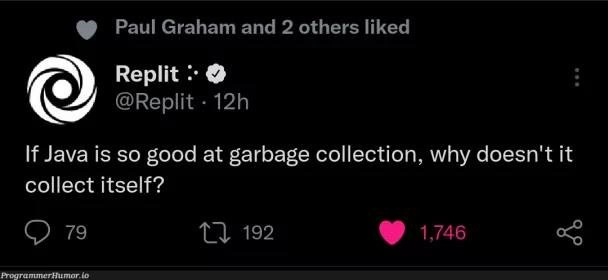
A Self-Referential Question About Java's Garbage Collection
Why is this Languages meme funny?
Level 1: Who Cleans the Cleaner?
Imagine a big garbage truck that drives around picking up everyone’s trash. That’s its job – to collect garbage and keep the streets clean. Now picture a kid joking, “Hey, that garbage truck is so good at picking up trash, maybe it should pick up itself!” 😄 In other words, they’re cheekily calling the garbage truck trash. It’s a funny, absurd idea because of course a truck can’t throw itself away! This meme does the same thing, but with a programming language (Java) and its “garbage collection” ability. It’s like saying: “Java cleans up messes so well, it should clean up its own mess – maybe Java itself is a mess!” People find it funny because it’s an unexpected twist and a bit of playful teasing. Even if you don’t know Java, you can feel the cheeky “you’re so good at cleaning, go clean yourself” vibe. It’s a way for programmers to poke fun at Java in a joking way, kind of like friends teasing each other. The joke isn’t serious – it’s just a fun little roast that makes programmers chuckle because it mixes a tech idea with a classic insult in a clever way.
Level 2: Java’s Memory Janitor
Let’s break down the technical joke for newer developers. First, what exactly is “garbage collection” in programming? In simple terms, it’s an automatic memory cleanup feature. Java, for example, has a built-in memory manager often nicknamed a garbage collector. When you create objects or variables in a Java program, they take up space in the computer’s memory (RAM). Later, if some of those objects aren’t needed anymore (say you’ve lost all references to an object), they become “garbage” – unused memory junk sitting around. Java’s garbage collector is like a janitor that periodically finds those unreferenced objects and throws them out (frees the memory) so that the memory can be used for new objects. This process runs automatically; the developer typically doesn’t have to worry about manually deallocating memory.
This is a big convenience! In older languages like C or C++, memory management is manual. If you allocate memory for something, you’re responsible for later freeing it. Forgetting to free memory causes a memory leak (the program keeps wasting more and more memory). Free the same memory twice or misuse it, and you might crash your program. Java (along with languages like C# and Python) was designed to avoid those problems by handling memory recycling under the hood. For example:
// C example: manual memory management
#include <stdlib.h>
void manualExample() {
char* buffer = malloc(1024); // allocate 1024 bytes
// ... use the buffer ...
free(buffer); // manually free the memory when done
}
In C, if you omit that free(buffer), the 1024 bytes stay allocated even after manualExample ends. Do that enough times, and you leak memory. Now compare with Java:
// Java example: automatic garbage collection
void automaticExample() {
String greet = new String("Hello"); // allocate a String object
greet = null; // drop the reference to the String
// ...no manual free needed...
} // When this function ends, Java's garbage collector will later notice
// the "Hello" String isn’t used and free its memory for us.
In the Java snippet, we never explicitly free the "Hello" string. Setting greet to null (or letting it go out of scope) means no part of the program can reach that object anymore. Java’s garbage collector will automatically detect that “greet” object is unreachable garbage and clean it up on its own schedule. The programmer doesn’t have to write a free() call. Magic, right? This MemoryManagement approach makes life easier and helps prevent many bugs. It’s one of Java’s hallmark features and often a selling point for using Java in large projects (less chance of catastrophic memory mistakes).
Now the meme takes this concept and plays a word game. The tweet says: “If Java is so good at garbage collection, why doesn’t it collect itself?” This is tech humor using a pun. Java’s “garbage collection” is meant in the technical sense (cleaning up unused memory objects). But the joke twists the meaning: “collect itself” implies treating Java as if it were garbage to be collected in the ordinary sense. In everyday language, calling something “garbage” is calling it trash or worthless. So the tweet is a snarky way to say “Java is trash” while superficially sounding like it’s talking about the technical feature. It’s like a double meaning: one meaning is technical, and one is an insult. The humor comes from knowing the technical meaning and recognizing how it’s being flipped against the subject.
For context, this kind of joke is part of a long-running friendly rivalry between programming languages and their communities. You might hear developers poke fun at each other’s favorite tools – these are the infamous language wars. One group might say “JavaScript is toy code,” another might say “Java is verbose and old,” someone else might chime in “C++ is needlessly complex,” and so on. It’s usually light-hearted DeveloperHumor, a way to bond or get a laugh, though occasionally people do get genuinely defensive about their language of choice! In this case, Java is the target of the joke. Java has been around for decades, is taught in many CS courses, and runs huge enterprise systems – but it’s also often criticized for being heavyweight or not as “cool” as newer languages. That’s why calling Java “garbage” gets a nod of recognition from many programmers – it hooks into exaggerations they’ve heard before.
The screenshot shows this joke originated from Twitter (the platform is explicitly shown with the Twitter UI elements like the heart, retweet arrows, and reply bubble). The account @Replit (a well-known online coding platform) posted it, which is notable because it’s an official company account joining in on the joking. It’s like seeing a teacher crack a joke about their own subject – unexpected and funny. The engagement numbers (79 replies, 192 retweets, 1,746 likes) indicate the tweet went a bit viral in dev circles. A lot of people found it funny enough to share or respond. Even a prominent tech personality, Paul Graham, liked it (his name is visible at the top as someone who liked the tweet), which gives the meme extra street cred in the programming world. And the tiny watermark “ProgrammerHumor.io” suggests it was reposted on a meme site, so it spread beyond just Twitter. All this to say: Dev communities across the internet were in on the joke. If you’re new to these circles, don’t be surprised – this is a common way programmers blow off steam and entertain each other. They use hyperbole and inside jokes about programming concepts, whether it’s mocking Java’s garbage collector, Python’s whitespace, or C’s pointers. It’s a playful form of TwitterHumor that brings people together over shared knowledge.
To sum up the tech behind the joke: Java’s garbage collector is a program component that collects (deletes) unused memory objects to keep the system clean. The tweet quips that if Java is so great at picking up garbage, it should pick up (delete) itself, essentially calling Java “garbage.” It’s a tongue-in-cheek way to tease a programming language. As a newcomer, remember this is said in jest – Java does its job well for countless applications, and “garbage” here is just programmer slang during some good-natured ribbing. Understanding this joke means you’ve unlocked a bit of insider wordplay: you now know what garbage collection is and how devs can twist that term for a laugh. Welcome to the club – where even the tools we use aren’t safe from a little trash talk! 😉
Level 3: Taking Out the Trash Talk
This meme cracks a developer humor one-liner by weaponizing Java’s own strength – its garbage collection – against it. In Java and similar languages, garbage collection is the automatic process of cleaning up unused objects in memory. It’s normally a bragging point: Java takes care of memory management for you, sparing you the need to manually free memory like in C or C++. But here the tweet twists that feature into an insult. It jokingly asks: “If Java is so good at collecting garbage, why doesn’t it collect itself?” – implying that Java itself is “garbage” that ought to be cleaned up. It’s a classic bit of developerTwitter banter that elicits a groan and a laugh from those in the know.
On the surface, it’s just silly wordplay. Yet, the humor lands because there’s a grain of language wars truth beneath it. Java has been both wildly successful and widely poked fun at in dev communities for years. Seasoned programmers remember the early 2000s debates: Java was the hot managed-language that promised “write once, run anywhere” convenience thanks to the JVM (Java Virtual Machine) and its garbage collector. Meanwhile, C/C++ veterans grumbled about Java’s performance overhead and memory appetite, sometimes deriding the GC as a babysitter cleaning up after “sloppy” programmers. Fast forward, and now newer-generation developers might rib Java for being verbose or “enterprise-y” compared to trendy languages. This tweet taps into that shared culture of Java slander – an ongoing tech banter where every language gets called “trash” by someone outside its fan club. The punchline works because anyone who’s dealt with Java recognizes the term “garbage collection” instantly, and turning it into a self-own for Java is an unexpected comedic flip. It’s the ultimate self-burn: using Java’s pride (automated cleanup) to say Java should trash itself. Ouch!
Technically speaking, the idea of a language collecting itself is nonsense (which is partly why it’s funny). Garbage collection runs inside a Java program to reclaim memory from objects that are no longer in use. The language runtime can’t decide that it itself is unused and then magically vanish – unless we count the program exiting as “collecting itself.” In reality, if Java actually tried to “collect itself,” it would be like a running app deleting its own foundation – a logical paradox. This absurdity is the point of the joke: it’s a snarky exaggeration to call Java worthless while riffing on a legit technical term. Experienced devs have likely seen similar jabs before. For example, a grumpy systems coder might quip “Garbage collection? Java is the garbage to collect!” when frustrated by a heavy Java process consuming memory. It’s hyperbole born from real quirks – like those infamous GC pause times when a Java app halts to clean memory mid-task, making engineers tear their hair out. We laugh because we’ve been there (waiting for a Full GC at 3 AM in production) and we cope by joking that maybe the JVM should sometimes just collect itself and spare us the trouble. 😅
What’s also interesting is the social context. The meme is framed as a dark-mode screenshot of a tweet by the official Replit account (a popular online coding platform). When even company Twitter accounts partake in programmer humor, you know it’s a widely relatable joke. In the screenshot, the engagement numbers (79 replies, 192 retweets, 1,746 likes) show that this zinger resonated with many devs. Even notable tech figures – the screenshot cheekily notes “Paul Graham and 2 others liked” – gave a nod, indicating how universal the chuckle is. This kind of developer Twitter banter is the modern water cooler for devs: a place where poking fun at our tools is a bonding experience. It’s done in tongue-in-cheek spirit. No Java engineers were actually harmed – in fact, many Java veterans might smirk at this joke too, because they’ve heard it a dozen times and might agree in half-jest on a bad day. The ProgrammerHumor.io watermark suggests the meme spread beyond Twitter onto dedicated humor forums, reinforcing that it hit a nerve (or funny bone) across the dev community.
In short, the tweet is a sly combination of technical knowledge and playful trash talk. It’s funny to senior devs because it references something we all deal with (memory management), and then crosses that with the age-old tradition of ragging on Java. We’ve seen languages rise and fall, and Java’s been pronounced “dead” or “garbage” more times than we can count – yet it’s still running strong in countless production systems (perhaps that’s why some wish it would collect itself!). This meme captures that love-hate drama in one snappy line. And as grizzled coding veterans, we can’t help but grin at the familiarity: yes, Java’s garbage collector is great... except when we jokingly wish it had a feature to uninstall Java itself for us. All in good fun, of course – Java is here to stay, and so are the jokes at its expense.
Description
A screenshot of a tweet from the verified 'Replit' account (@Replit) set against a black background. The tweet reads, 'If Java is so good at garbage collection, why doesn't it collect itself?'. Engagement metrics below the text show 79 comments, 192 retweets, and 1,746 likes, indicated by a pink heart icon. Above the main tweet, a gray text notes, 'Paul Graham and 2 others liked'. A small watermark for 'ProgrammerHumor.io' is visible in the bottom-left corner. The humor comes from applying a core technical feature of the Java programming language - garbage collection (a form of automatic memory management) - to the language itself as a criticism. It's a witty insult suggesting that Java is 'garbage' and should be removed. This type of language rivalry and critique is a common and relatable trope within the software development community, especially among senior engineers who have seen languages and frameworks come and go

Comments
20Comment deleted
If Java's garbage collector ever did collect itself, the first things to go would be the AbstractSingletonProxyFactoryBean and half the boilerplate, leaving just a surprisingly clean interface
Java can’t GC itself - there’s still a strong reference from every Fortune 500 stack and an Oracle support contract pinned in the root set
The real irony is that Java's garbage collector has probably spent more CPU cycles trying to optimize itself than most startups have spent on their entire infrastructure - yet somehow we still end up with 32GB heap dumps from a simple Spring Boot microservice that just returns 'Hello World'
The irony is that Java's garbage collector is actually quite sophisticated with its generational algorithms and concurrent marking - yet after 25+ years, the language itself has accumulated so much legacy baggage (verbose syntax, ceremony, enterprise bloat) that even the most aggressive GC tuning can't reclaim the developer productivity lost to boilerplate. Perhaps what Java really needs isn't a better garbage collector, but a 'legacy code collector' that can finally deprecate all those AbstractSingletonProxyFactoryBeans
Java's GC excels at orphans, but enterprise monoliths are immortal singletons with eternal lifecycles
Java doesn’t collect itself; it’s still strongly reachable from two decades of enterprise systems - the GC root is named “Oracle support contract,” and nobody’s allowed to set it to null
Java can’t collect itself - you can’t GC a GC root; the JVM is pinned by three decades of enterprise sign‑offs and 400 transitive dependencies
Because it collect all other trash languages ㄟ(▔ ,▔)ㄏ Comment deleted
The only thing worse than Java are attempts at English by this channels subscribers I guess Comment deleted
it is barely an insult for non-natives Comment deleted
I just like how 90% of the audience is russian yet we have "English only" rule Comment deleted
https://t.me/dev_meme/16 Comment deleted
Do translations != english only Comment deleted
谁说的90%的都是俄罗斯人? Comment deleted
Please use English in this chat. autotr (zh-cn > en): who said 90% of them are russian? Comment deleted
Yeah they care for other 10% too Comment deleted
baited Comment deleted
<language> bad ahhh meme Comment deleted
ah shit lost the opportunity Comment deleted
Going for low hanging fruits Comment deleted