The Sacred Vow of a Tech Hoarder: Never Throw Away a Cable
Why is this Hardware meme funny?
Level 1: Better Safe Than Sorry
Imagine you have a big box of old toys and favorite gadgets that you’ve collected over the years. Your mom or friend sees it and says, “You haven’t played with these in ages, let’s throw them out to tidy up.” But you suddenly remember how each toy could be useful or fun again someday – maybe you’ll want to play that old game or show it to someone. You’d probably shout “No, don’t!” and cling to that box, right? That’s exactly what’s happening in this meme, but with wires and cables instead of toys. The engineer is afraid that if those cables get thrown away, he’ll later need one and not have it. It’s like throwing away an umbrella and then suddenly it rains. He’s keeping all the wires “just in case,” because it makes him feel safe that he can fix or connect anything if needed. The scene is funny because he defends the messy tangle of cables so fiercely – like a dragon guarding treasure – when most people would see just a pile of junk. But to him, those cables are treasure: they might save the day in the future. In simple terms, the meme shows how tech folks would rather be safe than sorry – keeping every little cable around, just in case it comes in handy one day.
Level 2: Cable Hoarding 101
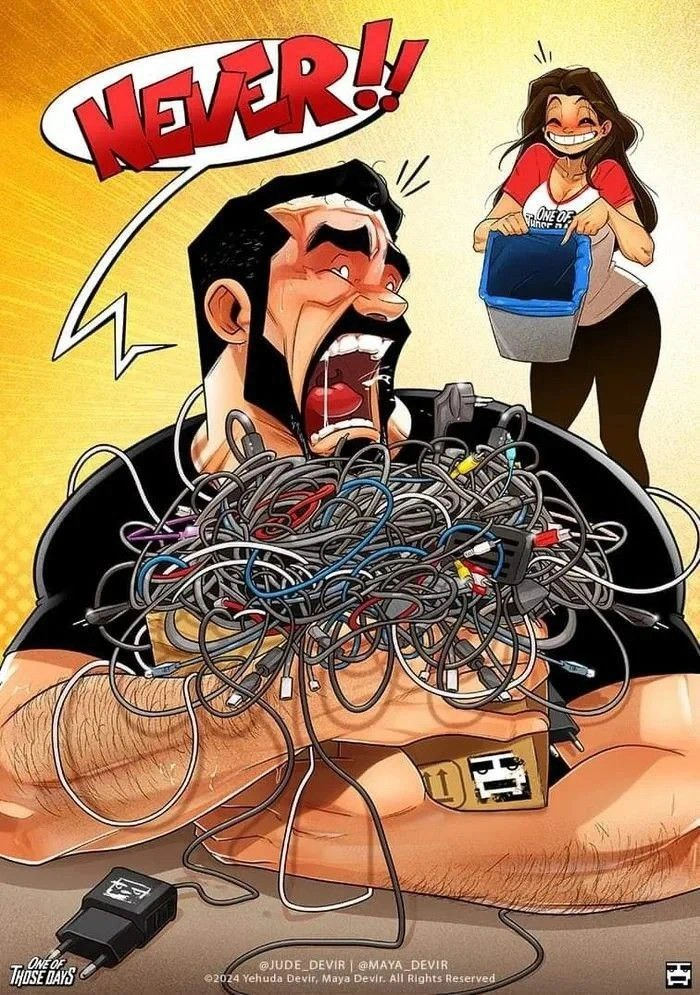
Let’s break down what’s happening here. We have an engineer on the floor hugging a giant tangle of wires and cables. He’s shouting “NEVER!!” because someone (his partner, it seems) is trying to throw those cables away in a cleanup. This hits on a classic tech habit: cable hoarding. Over years of tinkering with computers and gadgets, developers and IT folks collect spare cables of every kind. Ever set up a new monitor or printer and end up with an extra USB cable? Or upgraded your phone and kept the old charger? Those go into “the cable pile.” The meme shows that pile grown to cartoonish size – cables wildly tangled together, from power bricks (those black chunky adapters you plug into the wall for power) to old video connectors. For example, a VGA adapter is visible – VGA is an old standard for connecting monitors, usually with a 15-pin plug (often colored blue). There are RCA cables in there too – the red, white, and yellow plugs that used to connect DVD players or game consoles to TVs. These are considered legacy connectors now, meaning they’ve been mostly replaced by newer tech (like HDMI or USB-C), but some older equipment still uses them. The engineer likely gathered all these over time from different projects and devices.
Why would someone keep a nest of cables instead of neatly organizing or discarding them? Two big reasons. First, cable management is hard – if you just toss all your leads into a box or drawer, they naturally get into a tangled mess (we sometimes jokingly call it “spaghetti wiring” because of how it looks). Proper cable management would mean tying cables up nicely or using cable organizers, but not everyone has time for that, especially when you’re quickly stashing something away. Second, and most important, techies keep cables “just in case.” That weird VGA or RCA cable might seem useless now, but what if a special piece of equipment or an old computer shows up and you suddenly need exactly that connector? It’s surprisingly common: maybe a client hands you a hard drive that needs an old power adapter, or you find an old project on a device that only has a serial port. In those moments, having the right cable handy can save a ton of time. If you threw it out, you’d be scrambling to buy a new one or, worse, might not find it easily at all (especially true for really old or uncommon cables). Developers joke that the minute you throw away an “obsolete” cable, you’ll need it the very next week. It’s a kind of Murphy’s Law in tech.
So, in the picture, the woman in the red “One of Those Days” T-shirt with the trash bin is like, “Hey, let’s declutter and throw out all these old wires.” She’s well-intentioned, thinking it’s just junk making a mess. But the engineer knows the true value of his collection. He reacts as if she’s trying to throw away a stash of vital tools or treasure. His dramatic scream of refusal – “NEVER!!” – is exaggerated for humor, but it represents a real feeling. For many developers, that box of miscellaneous cables gives peace of mind. It’s like a first-aid kit for tech problems. Even if 95% of the time it just sits in a closet, the comfort is knowing that when a need arises, you won’t be stuck. This is a common DeveloperHumor and HardwareHumor scenario: the long-suffering partner rolling their eyes at the “junk” techies refuse to part with, and the techie stubbornly clinging to it. The tags like tangled_cables, cable_hoarding, and hardware_clutter all point to this everyday conflict. And yes, that lone phone charger lying on the floor in the foreground of the meme? It’s the perfect detail – who hasn’t found an extra phone charger in a random corner during cleanup? Naturally, the engineer would claim “I still need that!” even if the phone it matched is long gone. All in all, the image humorously educates anyone unfamiliar with geek culture: these “random wires” are seen as essential supplies, not trash, to those in the know.
Level 3: Tangled Dependencies
In the hardware trenches of tech, a tangled mass of cables is more than an eyesore – it’s a lifeline. This meme taps into a shared engineer instinct: never throw away adapters. The bearded engineer in the cartoon is literally making a heroic last stand, clutching a monstrous knot of cords as if it’s mission-critical infrastructure. And in a sense, it is. Each cord in that monstrous cable nest represents some legacy connector or vital link that could save a project in a pinch. We’re talking VGA adapters for that aging projector in the conference room, RCA cables for debugging an old sensor module, random USB leads (from Type-A to micro, mini, and beyond) for connecting dev kits – even obscure serial and parallel port dongles that haven’t been produced in a decade. To a non-engineer, this heap looks like pure hardware clutter. But seasoned developers see dependencies: a carefully amassed toolkit of converters and power bricks ready to interface with any ancient device or unexpected lab setup. It’s like a physical form of tech debt or backward compatibility insurance. You might not need that convoluted SCSI adapter for five years, but when you do and it’s 3 AM in the data center, you’ll be darn glad you kept it.
From a senior developer’s perspective, the humor cuts deep: we’ve all experienced the pain of that “cleanup” where someone tries to decommission what they think are useless parts. It’s analogous to ripping out “unused” code that actually was critical for a once-in-a-blue-moon feature. The smiling woman with the trash bin is the well-meaning refactorer saying “Do we really need all this?” – while the engineer’s “NEVER!!” is a battle cry we know well. He’s seen the Murphy’s Law of hardware too many times: the day after you chuck that “junk” cable, a wild legacy system appears that only works with that exact connector. It’s practically a law of DeveloperPainPoints. In coding terms, imagine deleting a seemingly dead code path, only to find out later it was handling a rare but crucial edge case. Similarly, tossing out a weird cable feels like inviting an outage or a blocked deployment when you discover nothing else fits that one port on an old router. This absurd, over-the-top defensive stance is funny because it’s so true – experienced engineers treat their box of cables like a production database backup. The meme exaggerates it to superhero proportions: veins bulging, shouting “Never!!” with spittle flying, as if defending the world’s last copy of source code. But every hardware-inclined dev recognizes a bit of themselves there.
There’s also a clever nod to the DeveloperExperience (DX) aspect: a smooth dev workflow isn’t just great frameworks and cloud environments – it’s also having the right dongle when you suddenly need to connect a device. Seen through that lens, this “cable hoarding” is part of optimizing DX for hardware projects. The categories of cables shown span decades of tech evolution, highlighting how infrastructure folks often straddle old and new systems. For instance, you might deploy cutting-edge servers, but still need a VGA or DB9 serial cable to configure a network switch’s BIOS. The meme artist brilliantly captured that mix: snarled USB cables (modern, but so many types!), chunky power bricks (every external hard drive or router adds one to the pile), and classic legacy connectors we can’t even name without googling. It’s the hardware version of having every library installed – a comprehensive arsenal for any scenario. The engineer’s dramatic pose screams what every ops veteran feels when office cleaners or spouses suggest decluttering: “Step away from my cables – you don’t understand what could go wrong if you toss them!” It’s both hilarious and oddly validating to see that desperation cartoonified.
Description
A vibrant comic illustration by artists Yehuda and Maya Devir from their 'One of Those Days' series. In the foreground, a muscular man with a dark beard and mustache has a look of sheer terror and defiance on his face, shouting 'NEVER!!' from a large, red, comic-style speech bubble. He is protectively and desperately clutching a small cardboard box that is overflowing with a ridiculously large and tangled mess of various electronic cables - USB, power adapters, audio/video cords of multiple colors. In the background, a woman with long dark hair and a red and white shirt smiles cheekily as she presents an empty trash can, clearly wanting him to throw the cable collection away. The scene is a humorous depiction of the conflict between decluttering and the ingrained habit of tech professionals to keep every single cable they've ever owned. The technical context is the deeply relatable experience for developers and IT staff of hoarding old hardware components under the justification that they 'might need it someday.' This is especially true for senior staff who have worked with numerous generations of technology and know the pain of needing a specific, obsolete adapter for a critical task. It's a visual metaphor for technical debt, but with hardware
Comments
16Comment deleted
That box isn't clutter; it's a strategic reserve of legacy interconnects. You laugh now, but wait until you need to pull data off a 20-year-old IDE drive using a USB-to-PATA adapter you can't buy anymore
Throw out my cable ball? That’s the entire DR plan for the day the last Solaris box reminds us its only interface is “9600-8-N-1” over a DB9
After 20 years in tech, I've mastered distributed systems, scaled to billions of requests, and debugged kernel panics... but ask me to find the right USB cable in my drawer and watch my entire engineering confidence crumble faster than a MongoDB cluster without proper sharding
Every senior engineer knows that cable management is just premature optimization - that rat's nest is actually a perfectly functional distributed system where each cable has organically discovered its optimal routing path through years of evolutionary pressure. Touch nothing, for you know not which USB-C cable is load-bearing for the entire infrastructure
It’s not hoarding - it’s my low‑latency, multi‑vendor rollback plan for when prod’s only console port is RS-232 at 2 a.m
That “random cables” bin isn’t clutter; it’s our backward-compatibility layer - somewhere in that spaghetti is the dongle chain that keeps the 2010 payroll daemon talking to prod. Cleanup policy: never
'NEVER refactor!' - the sacred oath of every 20-YoE engineer with a monolith wired by vibes and vendor lock-in
Engineers: let's make endpoints different so they will be incompatible with plugs that serve for other purposes. People won't be able to mess up People: let's make adapters for each n every endpoint so will be able to connect microphone and fridge Comment deleted
Also engineers: let's create a universal serial bus with a smart protocol that allows connecting anything. Let's add many different extensions so you have to solve a riddle in order to understand if a specific phone can charge quickly on a specific power adapter by a specific cable. Comment deleted
Also engineers lawyers and patent trolls Comment deleted
EU: tYPe ⭐C⭐ Comment deleted
This is me fr Comment deleted
btw, I'm expecting type C keyhole from EU Comment deleted
I literally have that box. Except it's 4 boxes sorted by type. Comment deleted
Literally me Comment deleted
That box(or, for me, bag) smelled, idk, just it was like that smell from my childhood Comment deleted