When the Dog Serves a Harsh Dose of Reality
Why is this Mathematics meme funny?
Level 1: Truth Hurts
Imagine you love watching cooking shows and you know all the funny catchphrases chefs use. You might joke about “Bam! A pinch of salt!” and feel like you really get cooking. But when you actually step into the kitchen, you realize you don’t even know how to fry an egg. If a talking dog then told you, “Hey, laughing at chef jokes doesn’t mean you can cook,” you’d probably feel upset (and a little embarrassed). That’s exactly what’s happening in this meme. The dog is basically giving a friendly reminder that just because you understand the jokes about something doesn’t mean you can actually do that thing well. It’s funny and hurts a bit at the same time, because we’ve all been that person who thought knowing the jokes meant we knew the skill.
Level 2: Punchlines vs Proofs
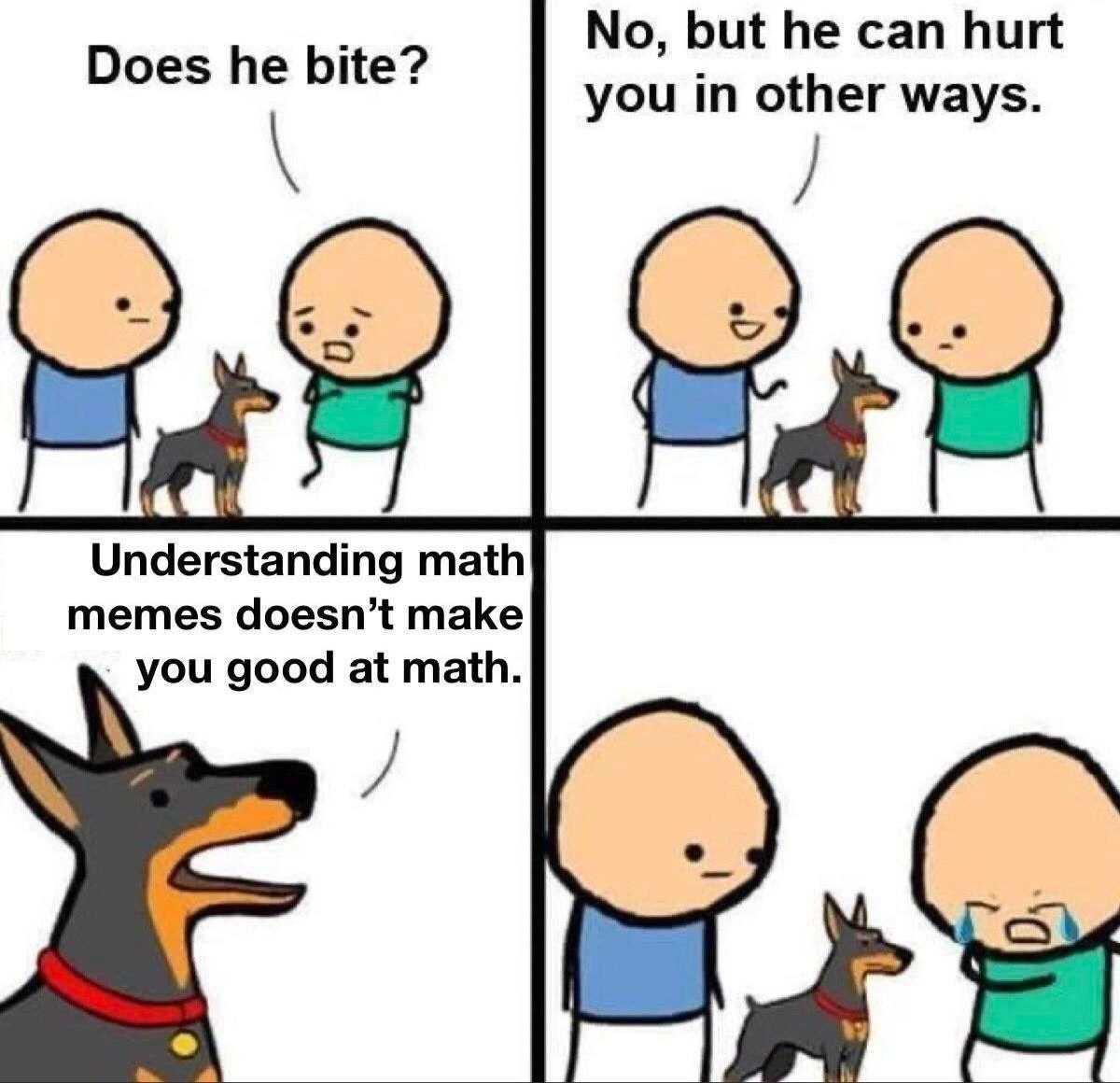
Let's break down what's happening in this meme in more straightforward terms, especially for newer developers or students. In the comic, a person asks, "Does he bite?" about a scary-looking dog. The owner says, "No, but he can hurt you in other ways." The "hurt" turns out to be the dog saying a harsh truth: "Understanding math memes doesn’t make you good at math." Now, why is this funny (and a bit painful)? Because math memes are jokes or cartoons that reference math concepts or famous problems, and a lot of us in tech love them. We share and laugh at these inside jokes (for example, a meme about how P ≠ NP – a famous unsolved problem – or a comic about the binary number system). Understanding a math meme means you recognize the concept or notation being joked about. It's a little badge of nerd honor: if you get the joke about the algorithm or the equation, you feel "in the know" with the developer community.
However, the meme is pointing out that knowing the joke is not the same as knowing the math. This is a key difference. CS fundamentals (computer science fundamentals) refer to the basic principles and theory that computer science is built on – things like algorithms (how to solve problems step-by-step), data structures (ways to organize information), and yes, a lot of underlying mathematics. A big part of those math foundations is discrete mathematics, which deals with things like logic (true/false statements), combinatorics (counting and probability), and graph theory (networks of nodes and edges). When you're in school or learning to code, you encounter these through lessons and problem sets. You might learn to solve equations, prove small theorems, or calculate the efficiency of a piece of code. Being good at math or algorithms means being able to actually work through these problems on your own: for example, given a new algorithm, figuring out its Big-O time complexity from scratch, or proving that your solution works for all cases using logical reasoning.
Now, what's a proof? In math, a proof is a step-by-step explanation of why something is true, using logic and previously established facts. For instance, you might prove that an even number plus an even number is always even by reasoning: "Let the two even numbers be 2a and 2b (because any even number can be written as 2 times some integer). Add them: 2a + 2b = 2(a+b). Since (a+b) is an integer, 2(a+b) is even. Thus the sum is even." That’s a simple proof. In computer science, you sometimes need to prove things like "this sorting algorithm always puts the numbers in order" or "this program will eventually stop and not loop forever." Doing proofs and solving quantitative problems takes practice and a deep understanding of those fundamentals. It’s not something you can do instantly just because you remember the punchline of a joke about it.
The meme jokes that plenty of developers (especially those active in programming forums or who enjoy nerdy humor on Twitter) have a stash of math or algorithm jokes they understand. Maybe you recall a funny comic about a queue and a stack (two common data structures) talking to each other, or you laughed at a function named HALT() referencing the famous Halting Problem. These show you know some vocabulary or classic problems from computer science theory. But if someone turned around and asked, "Hey, can you actually solve a problem using that concept?" or "Could you prove why a queue works in a first-in, first-out order with a formal argument?", you might find yourself tongue-tied if you haven’t done that kind of thinking in a while.
It’s common for newer developers to feel a bit of impostor syndrome around these topics. Impostor syndrome means feeling like you're not as good or knowledgeable as others believe you are, like you’re just faking competence and will be exposed. Here, "imposter_math_skills" (to use the tag) is that worry that you only seem to know math because you recognize terms or jokes, but you wouldn’t actually be able to tackle a real math problem if it came up. Developer insecurity often includes this kind of self-doubt. For example, a web developer might be fantastic at building websites but feels nervous because they’ve forgotten a lot of their college math; they might think every other "real programmer" remembers how to do proofs, even though that’s usually not true.
The idea of a learning curve comes into play as well. Math and theoretical CS have a reputation for a steep learning curve. This means when you start learning them, progress can be slow and challenging — it takes a lot of effort to reach a comfortable understanding. Many of us climbed that hill just enough to pass our exams or ace a technical interview, and then we stopped going further. And if you don’t keep practicing, those skills start to fade. It’s like learning a musical instrument: if you learned piano as a kid but haven’t touched it in years, you’ll remember what notes are and maybe a tune or two, but you won’t be ready to perform a full song confidently without practice. Similarly, you might recall what Big-O notation generally means or the concept of a binary tree from school, but if asked to analyze a new algorithm’s complexity or balance a binary tree by hand, you’d be rusty. You keep the broad idea (so you get the meme reference), but lose the step-by-step know-how.
A reality check is when you are brought face-to-face with the truth of a situation, especially if you were entertaining some comforting delusion. The dog in the meme is offering a reality check to the character (and by extension, to us viewers). It’s basically saying: "It’s cool that you’re nerdy and get the jokes, but remember, that’s not the same as actually doing the real work." This meme is actually a self-aware meme because it’s aimed at the very people who are laughing at it. In other words, the joke is on us, the developers who love these jokes. It’s playfully making us aware of our own tendency to overestimate our skills just because we’re fluent in the lingo. It’s like the meme is holding up a mirror and teasing us: “Haha, you know the punchline, but could you handle the problem yourself? Be honest!”
For a junior developer or a student reading this, the key point is: memes and references are fun and can spark your interest, but real skill comes from practice. It’s one thing to know about an algorithm or a math concept enough to laugh when it’s referenced; it’s another thing to sit down and use that algorithm or solve that math problem on your own. If this meme makes you feel called out, don’t worry — that’s a feeling almost everyone in the field recognizes at some point. In fact, it can be motivating. Maybe you’ll think, "You know what, that dog is right. Understanding a joke about sorting isn’t enough; maybe I’ll actually practice writing a sorting algorithm today." In a supportive way, the community joke is nudging us to turn a little relatable humor into a learning opportunity. After all, every expert was once a beginner who had to work through the tough bits, not just laugh at them. And if you love the memes, digging deeper into the actual math or code can make those jokes even funnier — because then you’ll truly get them on a whole new level!
Level 3: Memes ≠ Mastery
This self-aware comic strikes a chord with experienced developers because it highlights a phenomenon we've all seen (or lived) in the tech industry: being fluent in geek culture (like math memes or algorithm in-jokes) versus actually retaining and using those CS fundamentals in practice. The humor comes from that pang of self-awareness. We pride ourselves on remembering what Big-O notation means or recognizing a clever graph theory reference on Reddit, but truth be told, many of us haven’t manually solved a serious math problem or proved an algorithm correct since our college days. The combination of elements here — a seemingly dangerous dog that instead delivers a devastating one-liner of truth — is funny because it’s so real. The dog's owner warns "he can hurt you in other ways," and any engineer who has felt a bit of impostor syndrome about their math skills immediately cringes with understanding. That hurt is the sting of realizing that internet familiarity doesn’t equal real mastery.
In the software world, there’s an unspoken pattern: as developers, we often learn just enough math to get by, then lean on libraries, frameworks, and Google for the heavy lifting. We might joke about a recursive algorithm or drop the term NP-hard in conversation to sound savvy, but if we were asked to actually implement a dynamic programming solution from scratch or formally prove why a certain algorithm works, many of us would stall out. Why does this happen? Because outside of specialized fields (like graphics, machine learning, or cryptography), a lot of everyday programming jobs don’t demand constant use of advanced math. Over time, those skills get rusty. But the culture of programming still idolizes the whiz who knows their CS_Fundamentals. There’s peer prestige in being able to laugh at an esoteric math joke — it signals "I’m part of the club; I remember this stuff." It's relatable humor precisely because so many devs are in on the reference, even if they'd panic at the prospect of actually deriving that formula on a whiteboard.
This meme specifically pokes fun at that gap. When the dog says "Understanding math memes doesn’t make you good at math," it's delivering a reality check to any developer who has smugly scrolled past an algorithm humor post thinking, "Ha, I get that," while secretly hoping they never have to prove it. The green-shirt character’s cartoon tears in the last panel perfectly capture that mix of embarrassment and developer insecurity. It's the same feeling you get when you laugh at a joke about, say, pointer arithmetic or off-by-one errors, and then remember the production bug you had last month because of one. Here the subject is math: you chuckle at a category theory pun or a discrete mathematics meme on Twitter, then sheepishly recall that you barely passed that class, or that you haven’t done long division without a calculator in years. It's funny because it’s true — the humor comes from recognizing ourselves. The meme is basically saying, "Deep down, we all know we’re a little out of our depth pretending to be math gurus." And by laughing, we collectively acknowledge it.
One real-world scenario that mirrors this joke: picture a team meeting at a tech company. Someone makes a quip referencing xkcd (the famous nerdy webcomic) about how a certain problem is like "NP-hard, squared" and everyone chuckles. At face value, the team looks mathematically literate and witty. But later that day, when they actually face a nasty optimization problem (say, scheduling tasks or debugging a combinatorial issue), there's an awkward silence. Eventually they all turn to the one team member who still remembers their college algorithms or they just brute-force a solution and hope for the best. The earlier laughter at the meme doesn’t translate into ability to solve the real problem on the spot. Senior developers know this exact situation well: most of us have been that person quietly Googling math we should know, after confidently nodding at a high-level discussion. It’s a humbling experience. The contrast between knowing of it versus knowing it deeply becomes crystal clear whenever theory hits practical reality.
The reason this resonates is that it’s gentle self-mockery shared across the industry. It’s not meant to shame anyone harshly; even the blue-shirt character (the dog’s owner) looks neutral, almost empathetic. It’s more like the community winking at itself. In many tech circles, people will banter about whether P=NP over coffee or joke that "it's $\sqrt{-1}$ o'clock" (imaginary time, get it?), but those same people probably haven’t sat down to do actual algebra or prove something by induction in a long while. And that’s okay! Modern development often abstracts away the need for heavy math in day-to-day work. We use high-level languages and powerful libraries. The trade-off is that our formal math muscles aren’t as toned as they used to be. Fixing that — re-studying math, practicing algorithms regularly — is like dealing with any sort of technical debt: it takes extra effort outside the normal demands of our jobs. So, much like how legacy code accumulates quirks over time, our math skills accumulate a bit of dust. We joke about it (because humor makes the pain easier), and occasionally a meme like this comes along to remind us with a smirk that yeah, you’re not alone — we all feel a bit like phonies sometimes when it comes to math.
So when this Doberman of truth "bites" with words, veteran devs smirk and nod because they’ve felt that bite before. Chances are, every experienced programmer has a memory of being unexpectedly humbled by a supposedly "basic" math task or an algorithm challenge they thought they’d handle. The meme captures that universal moment of comeuppance: the instant you realize that quoting Fibonacci or laughing at a binary tree pun is easy, but actually inverting a binary tree or writing a Fibonacci algorithm without errors is a different ball game. It’s funny and a tad painful — exactly the blend that makes developer humor hit home. In the end, we laugh, we maybe groan in self-recognition, and we carry on coding... perhaps with a renewed resolve to brush up on those dusty math skills (right after checking the latest memes, of course!).
Level 4: Proof by Meme
In theoretical computer science and mathematics, knowing of a result is wholly different from proving or deriving that result yourself. This meme’s canine deliverer is effectively stating a fundamental truth: passive familiarity with mathematical concepts (gleaned from internet jokes or casual reading) doesn't equate to active problem-solving skill. It's highlighting the gap between recognition and reproduction — a well-documented phenomenon in learning. Merely recognizing a reference in a math meme (say, chuckling at the elegant identity $e^{i\pi} + 1 = 0$ on a t-shirt) engages declarative knowledge (knowing what something is). But being able to derive, prove, or apply that concept requires procedural knowledge and rigorous practice — a completely different mental muscle. Psychology even has a term for this disconnect: the illusion of competence. When you read a solved proof or a meme’s punchline, it all seems obvious, tricking you into feeling “I understood that” even though you didn’t do the hard part yourself.
The painful humor here stems from the way CS fundamentals actually work. In mathematics (and by extension, fields like algorithms and discrete math), understanding truly comes from struggling through the problem. A meme gives you the final insight or an inside joke on the topic without showing the hours of brainwork behind it. It’s like being handed the last page of a complex proof and thinking you grasped the whole thing. In reality, mathematical problem-solving involves methodically building up from first principles, testing edge cases, and often getting it wrong many times. If you've ever tried to formally prove something like a combinatorial identity or the correctness of an algorithm, you know it’s an exercise in logical endurance. Skipping straight to the answer (as memes do) can be entertaining, but it bypasses the very process that builds skill. As the tongue-in-cheek phrase goes, "Proof by meme is not a valid proof technique" – it might win you internet karma, but it won't help when you're faced with an unsolved problem in the real world.
Consider a concrete example from theoretical CS: the infamous P vs NP problem. Many developers can laugh at a one-liner about P ≠ NP or recognize that NP-complete problems (like the Traveling Salesman Problem) are supposedly intractable. This surface-level knowledge turns into AlgorithmHumor memes about how "finding a good regex is NP-hard," and so on. But ask a meme-enlightened engineer to actually prove something is NP-complete or even just rigorously explain why an algorithm is $O(n^2)$ vs $O(n \log n)$, and you'll often see panic. Proving NP-completeness, for instance, requires constructing a polynomial-time reduction from a known NP-hard problem – a meticulous process of discrete mathematics reasoning that isn't obvious until you've studied and practiced it. It’s a far cry from the quick dopamine hit of recognizing a joke. Similarly, one might enjoy a relatable DeveloperHumor comic about an off-by-one error in a summation or a quip about proof by induction ("assume it's true for n, then it's true for n+1, boom, done!"). Yet when it’s time to do an induction proof in a real algorithm or to work through a tricky recursive problem, just knowing the meme offers no actual help. The meme references the outline of these techniques, but not the detailed reasoning needed to execute them.
This tongue-in-cheek dog is, in a way, administering a pop quiz on humility, echoing something educators and seasoned engineers often encounter. We see it when interviewees who memorized trivia about algorithms struggle to solve a new coding challenge, or when self-taught developers realize that recognizing discrete math terminology isn't the same as wielding it. It's reminiscent of the old joke, "I understand the theory; I just can’t solve the problems" — which is exactly backwards, since in math, solving problems is understanding the theory. A famous real-world example is Fermat’s Last Theorem: for centuries, people knew the statement (it was almost a meme in math circles because Fermat cheekily wrote in a margin that he had a proof he couldn’t share). But it took over 350 years and the work of a prodigy (Andrew Wiles) to finally prove it. Knowing the claim was easy — schoolkids could recite it — yet completing the proof required inventing whole new branches of math. This starkly illustrates why the Doberman’s verbal bite rings true: understanding a concept’s pop-culture presence is effortless; mastering the concept is profoundly non-trivial.
Ultimately, the meme is a playful reminder of a serious principle: there are no shortcuts to expertise in math or algorithms. Appreciating a witty math reference online doesn't automatically confer the ability to solve real quantitative problems. That gulf between meme literacy and math literacy is where this humor lives. It's equal parts a reality check (for anyone coasting on surface knowledge) and an encouragement — because it implicitly says, "Hey, if this stings, maybe it's time to crack open that old textbook or do some coding puzzles." The dog might hurt your feelings, but it's telling you a truth every experienced engineer or mathematician knows: you only get good at math by actually doing math. And in a strange way, that message can inspire developers to move from just laughing at the joke to finally understanding the math behind it.
Description
This is a four-panel comic strip meme from 'Cyanide & Happiness'. In the first panel, a character in a green shirt encounters a man in a blue shirt with his Doberman-like dog and asks, 'Does he bite?'. In the second panel, the owner replies, 'No, but he can hurt you in other ways.' The third panel is a close-up of the dog, who states, 'Understanding math memes doesn't make you good at math.' The final panel shows the character in the green shirt bursting into tears, emotionally wounded by this blunt truth. This meme humorously attacks the idea of performative intelligence. In a tech context, it's highly relatable for senior engineers who see complex topics like system design, advanced algorithms, or esoteric language features trivialized in memes. The joke is that enjoying or sharing a meme about a difficult concept is not a substitute for the deep knowledge required to actually implement or debug it, a pointed critique of surface-level understanding in a field that demands expertise
Comments
15Comment deleted
Knowing all the Kubernetes failure memes doesn't mean you can fix a CrashLoopBackOff at 3 AM without just deleting the pod and praying
Quoting every “NP-hard” meme in Slack is cute - right up until the CTO asks for an actual proof and you realize Big-O isn’t just a punchline template
It's like being fluent in Docker memes but still running everything as root in production - you can quote Dijkstra about goto statements all day, but your recursive function still blows the stack on n=1000
Same energy as starring distributed-systems papers on GitHub: the dog would add 'forking Raft doesn't mean you've reached consensus.'
This cuts deep for every senior engineer who's watched junior devs confidently discuss Big O notation in Slack after binge-watching algorithm memes, only to submit O(n³) solutions in code review. Understanding the joke about why bubble sort is slow doesn't mean you can implement a performant distributed system - it just means you're fluent in our collective coping mechanism for the actual hard parts of computer science
Knowing the punchlines to category-theory and Big-O memes doesn’t asymptotically optimize your code; it just tightens the lower bound on your imposter syndrome
Understanding CAP theorem memes doesn’t make you good at distributed systems; it just makes your postmortems more eloquent about why you picked availability over consistency - again
Math memes: Big O(1) laughs for theorists, exponential cringe for the rest
Sigh...Same with programming Comment deleted
Well... To understand some memes in math or programming you need to be veeeeery good in this) Comment deleted
I rarely see programming memes that require more than entry level knowledge Comment deleted
I think the next one should be one Comment deleted
Profunctor is for you Comment deleted
They are not really about programming tho, but more about (neat) parts of Maths often tough as part of CS education But they are not really about programming per se Comment deleted
Remove word "memes" and it is still true Comment deleted