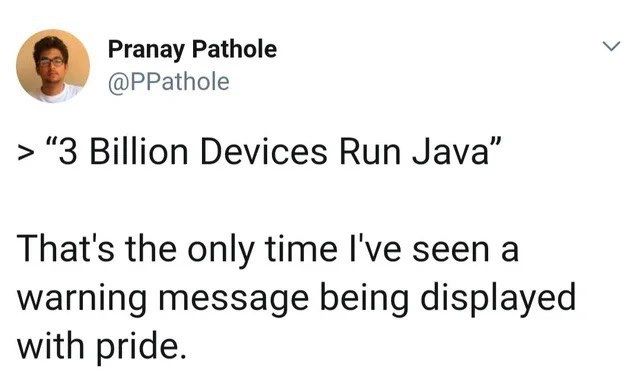
When Java’s “3 Billion Devices” splash screen reads like a proud warning
Why is this Languages meme funny?
Level 1: Bragging About a Warning
Imagine a candy maker happily announcing, “3 billion people got cavities from our candy!” They say it like it’s something to be proud of. Sounds silly, right? Usually, getting a cavity is a bad thing, and you wouldn’t boast about it. This Java meme is just like that. Java is a super common computer program that runs on a lot of devices (billions of them!). The company bragged about that fact. But developers joke that this brag feels more like a warning sign — kind of how a cavity warning on candy would be nothing to celebrate. In simple terms, the joke is that Java telling everyone “I’m on 3 billion devices!” comes off like saying “I’m causing trouble on 3 billion devices!” It’s funny because someone is proud of something that sounds like a problem. Even if you’re not a programmer, you can laugh at the idea of a warning message being treated like a trophy. It’s as if a fire alarm company bragged, “Our alarms have rung in 3 billion buildings” — you’d think, “umm, is that good news or bad news?” That little confusion and irony is what makes the meme goofy and fun to laugh at.
Level 2: From Slogan to Punchline
The meme highlights a famous Java slogan and pokes fun at it from a developer’s perspective. Java is a popular programming language and software platform that gained fame for running on almost any device. In fact, for years the Java installer or update screen would display the proud message “3 Billion Devices Run Java.” This was basically a marketing slogan meant to impress users with how widespread Java is. A splash screen (the graphic or message you see during installation/startup) would boldly show that line to give you confidence that Java is everywhere and well-supported.
Now, normally, when you see a warning message on a computer, it’s something like “Caution: This file may be harmful” or “Warning: Low battery.” It’s usually an alert about a potential problem, not a brag. The tweet in the meme is joking that “3 Billion Devices Run Java” is the only time a message that sounds like a system warning is presented with pride, as if it’s an achievement. Why would it be a warning in the first place? Well, to many developers, that statement also reads as “if Java has a problem, it will be on 3 billion devices.” In other words, having software on that many machines is a double-edged sword: it’s great coverage… but also a huge responsibility. If a serious bug or security flaw appears in Java, an enormous number of computers, phones, and gadgets need a fix. That is a bit scary! So the meme humorously treats the boast as if it were highlighting a danger.
Think about the typical developer experience (DX) with Java in the 2000s and 2010s: Every so often, you’d get a pop-up on your computer saying “Java Update Available” with that tagline plastered on the dialog. It became an almost ubiquitous part of using a PC. Many developers grew to associate the phrase “3 Billion Devices Run Java” with those nagging runtime update pop-ups. And often those updates were due to security patches (for example, to fix vulnerabilities that could let viruses in). So after a while, seeing “3 Billion Devices Run Java” doesn’t feel purely reassuring — it reminds developers of all the times they had to urgently update Java on their machines (or even on thousands of company servers!). It’s a bit like if your car proudly displayed “Used in 3 Billion Trips” while you’re thinking, “Hmm, I hope the brakes never fail, because that would be 3 billion dangerous trips.”
The tweet format of the meme is also common in tech humor circles. Someone takes a witty thought — in this case, Pranay Pathole’s quip — and shares it on Twitter. The meme is literally a screenshot of that tweet. By doing this, the joke spreads quickly because it’s short, punchy, and relatable. You don’t need more context than knowing the Java slogan. If you’re in the programming world (especially familiar with CodingHumor or TechHumor memes), you probably have seen the “3 billion devices” line enough times to groan or laugh at it. It’s a LanguageQuirk of Java’s culture that turned into a community joke.
Let’s break down the elements so junior developers or those new to Java get the joke:
“3 Billion Devices Run Java” – This is an official motto used by Java’s creators (originally Sun Microsystems, later Oracle) to advertise Java’s popularity and reach. It literally means Java software is installed on 3,000,000,000+ devices worldwide. That count includes computers, phones, smart cards, etc. It’s like a burger chain saying “Over 3 billion served.”
Java’s ubiquity – Java was designed to be platform-independent. Through the Java Virtual Machine (JVM), a Java program can run on Windows, Mac, Linux, and lots of other devices without changing the code. This is summed up by the phrase “Write Once, Run Anywhere.” Over the years, Java ended up in all sorts of places: enterprise servers, Android phones (which use Java-like languages), credit card chips (Java Card), Blu-ray players (for interactive menus), and more. That’s how they could claim billions of devices.
Why a warning? – In computing, if something is everywhere, any serious flaw becomes a big problem. Java in particular had some infamous security issues (especially with the old Java browser plugin and applets that ran in web pages). For example, malware could exploit Java on your machine if you didn’t update it in time. Because of these risks, seeing a boast about “3 billion devices” can make tech-savvy people think “uh oh, if something goes wrong, that’s 3 billion broken things.” It’s similar to knowing a disease is widespread – you’d see that fact as a concern, not a brag.
Warning messages vs. marketing – Usually, marketing messages are upbeat (“Look how great our product is!”). Warning messages are cautionary (“Be careful, something’s not right.”). Here the tweet jokes that Java’s slogan sounds like it belongs in the second category even though it’s meant as the first. It’s a corporate marketing slogan that, to a developer who has dealt with Java problems, reads like an ominous alert.
Tweet’s text – The tweet says:
“
"3 Billion Devices Run Java"
That’s the only time I’ve seen a warning message being displayed with pride.”The
>in the tweet indicates a quote of the slogan, and the punchline follows, calling it a “warning message... displayed with pride.” The author is effectively saying: Normally, warning messages are something you hide or apologize for, but here they are putting it front and center like a trophy. This contrast is what makes it funny.
For a junior developer or a student, the humor also touches on the idea of “be careful what you wish for.” Yes, you want your software to be widely adopted, but when it’s literally everywhere, any issue becomes massive. The meme taps into a bit of lighthearted paranoia that experienced devs have: widespread technology can mean widespread headaches.
Also, this joke is somewhat part of the language wars and tech culture wars. Fans of other programming languages (like Python, JavaScript, Go, etc.) sometimes tease Java for being seen as old or bloated or requiring constant updates. A Java proponent might say, “Well, Java runs on billions of devices!” And a skeptic might quip, “Yeah, and that’s 3 billion devices telling me to update Java again.” It’s all in good humor, poking fun at Java’s expense.
In summary, this meme takes a well-known Java catchphrase and flips the perspective. Instead of hearing it as a reassuring “Java is everywhere, so it must be good,” the developer community joke is to hear it as “Java is everywhere, that’s kind of scary.” The tweet format makes it easy to share and get a quick laugh from anyone who has ever rolled their eyes at that Java splash screen. It’s a gentle roast of Java’s proud marketing by the people who have spent years dealing with Java in practice.
Level 3: Write Once, Exploit Everywhere
"3 Billion Devices Run Java"
Seasoned developers smirk (or shudder) whenever they see that Java installer splash proudly proclaiming "3 Billion Devices Run Java". This slogan is supposed to impress, but in the programming world it’s a bit of a running joke. Why? Because it feels less like a boast and more like a global warning. When you’ve lived through enough production outages and zero-day exploits, you start reading that line as: “3 Billion Devices are now one giant attack surface.”
Java’s incredible ubiquity means any security vulnerability or critical bug in its runtime could affect an absurd number of systems. It’s the ultimate example of monoculture in tech: a single flaw in Java is like a genetic weakness in 3 billion clones. In the early 2010s, we actually saw this play out—serious Java vulnerabilities led to panicked security alerts on a worldwide scale. The US Department of Homeland Security once bluntly advised disabling Java in browsers because malware writers were drooling over all those install bases. In other words, “3 Billion Devices Run Java” can translate to “3 Billion devices need emergency patching when Java breaks.” It’s the only time you might hear a warning message (in spirit) delivered as a flex.
This meme riffs on that exact irony. The tweet reframes Oracle’s marketing brag as if it were a gigantic system alert banner. After all, developers have been conditioned by years of ubiquitous runtime pop-ups: those nagging update dialogs with the Java coffee cup logo, cheerfully informing you that a new version is available (and often accompanied by that motto). We’ve all clicked “Remind me later” on a Java update that boasts how many billions use it, while secretly thinking, “Great, and now all 3 billion are going to bug me for this update.” It’s marketing-as-warning in action – an almost dystopian pride in being everywhere, even where you might not want it.
Let’s not forget the historical context: the Java Virtual Machine (JVM) was revolutionary in letting one program run on any device (“Write Once, Run Anywhere” was the mantra, quickly amended by wags to Write Once, Debug Everywhere). That WORA ambition succeeded wildly – Java runs on PCs, servers, phones, Blu-ray players, credit card chips, you name it. It even powered billions of flip-phone apps and ATM software. But the flip side of such success is technical debt and risk at scale. An old version of Java lingering on some of those 3 billion devices is basically a welcome mat for exploits. The veteran developers among us have learned (sometimes the hard way at 3 AM) that “widely deployed” can mean “widely vulnerable”. So when we see a splash screen bragging about being installed on billions of devices, we chuckle – it reads like a bragging red flag.
In developer culture, this disconnect between marketing and reality is prime humor material. It’s a classic case of DeveloperHumor: take an official slogan and flip its meaning. We know that corporations love big numbers as proof of success (cue the LanguageWars, where each camp touts stats about usage). But developers, being a skeptical bunch, immediately think about maintenance nightmares hidden behind those numbers. Oracle’s boast just highlights to us how many places we’ll have to troubleshoot Java when things go sideways. It’s a proud announcement that basically says “if there’s a problem, it’s everywhere.”
To illustrate the mindshift, consider how devs mentally rewrite the splash screen:
| Oracle’s Boast | Developer’s Translation |
|---|---|
| “3 Billion Devices Run Java” | “3 billion devices are at risk if Java fails.” |
| “Write Once, Run Anywhere” | “Write once, debug everywhere.” |
The meme’s tweet nails this sentiment: “That’s the only time I’ve seen a warning message being displayed with pride.” It lampoons the fact that Java’s ubiquity is a double-edged sword. On one hand, Java’s presence on 3 billion devices is an astounding feat of engineering and adoption. On the other hand, any seasoned engineer knows that when a single platform is that universal, a “warning” for it can spell trouble on a planetary scale. The tweet condenses a whole lot of shared industry pain into one snappy one-liner. It strikes a chord with anyone who’s experienced the joy of managing Java in production or who remembers the constant security prompts in web browsers asking, “Do you trust this Java applet?” (We learned to hesitate for good reason!).
In summary, the humor here comes from a dark, knowing place. Java’s marketing department saw “3 Billion devices!” and thought “Victory!”; developers saw the same phrase and thought “Yikes, that’s a lot of patching.” When an installer splash chest-thumps about ubiquity, devs can’t help but read it as a subtle threat. The meme takes that lingering unease we’ve all felt and spells it out bluntly. It’s a techie inside joke turning a proud slogan into a cautionary tale — all in one tweet-length package.
Description
Screenshot of a tweet from user “Pranay Pathole @PPathole”. The tweet reads: “> “3 Billion Devices Run Java” That’s the only time I’ve seen a warning message being displayed with pride.” The author’s circular avatar is blurred, standard Twitter UI elements (name in bold, handle in gray, small down-chevron menu icon) appear on a white background. The humor riffs on the long-standing Java installer splash screen that proclaims “3 Billion Devices Run Java,” re-framing it as a system warning rather than a marketing boast. Developers familiar with ubiquitous Java runtime pop-ups and the language’s security prompts will recognize the joke as commentary on how widespread deployment can also signal technical risk
Comments
7Comment deleted
Whenever marketing brags “3 billion devices run Java,” my on-call brain just hears “3 billion Log4Shell alerts waiting for your patch window.”
Oracle's "3 billion devices run Java" is basically a CVE score that marketing somehow turned into a flex
3 billion devices run Java - and 3 billion sysadmins have clicked 'remind me later' on its security update since 2007
The real warning should be: '3 billion devices run Java, and 2.9 billion of them are still trying to update to the latest JRE version from that persistent browser plugin notification.'
When marketing says “3 billion devices run Java,” my threat model hears “denominator for the next CVE.”
"3 billion devices run Java" - the only installer splash screen that doubles as the blast radius estimate for the next CVE
Java: the language where @SuppressWarnings is a daily ritual, but Oracle's 3B device flex is the one warning you frame on the wall