Skip to content
DevMeme
254 of 7435
“Algorithmic trading in under 100 Python lines” and other FinTech fairy tales
FinTech Post #308, on Apr 9, 2019 in TG

“Algorithmic trading in under 100 Python lines” and other FinTech fairy tales

Why is this FinTech meme funny?

Level 1: Magic Beans of Code

Imagine someone tells you that you can plant a handful of magic beans and by tomorrow you’ll have a giant beanstalk growing into the sky, leading you to a pot of gold. Sounds like a fairy tale, right? You’d smile and think, “Sure, that would be nice, but real life doesn’t work that way.” This meme is making fun of a similar kind of wishful thinking, but in the world of coding and money. It’s as if an article is saying, “Hey, just write a little Python program (not even 100 lines, super short!) and it will automatically make you rich through stock trading.” For people who know how trading and programming really work, that claim is as silly as believing in magic beans that grow money trees overnight. The joke’s emotional core is about skepticism: we all secretly wish getting rich could be that easy, but we also know it’s not. So when we see a bold promise like that, we react with a laugh and an eyeroll. It’s funny in the same way a get-rich-quick infomercial is funny – the idea is so over-the-top and optimistic that you can’t help but chuckle. In simple terms, the meme is saying: “Don’t be fooled by fairy tales. Making money, whether it’s in a fairy tale or with code in the stock market, takes more than a quick, magical trick.”

Level 2: But Did You Backtest It?

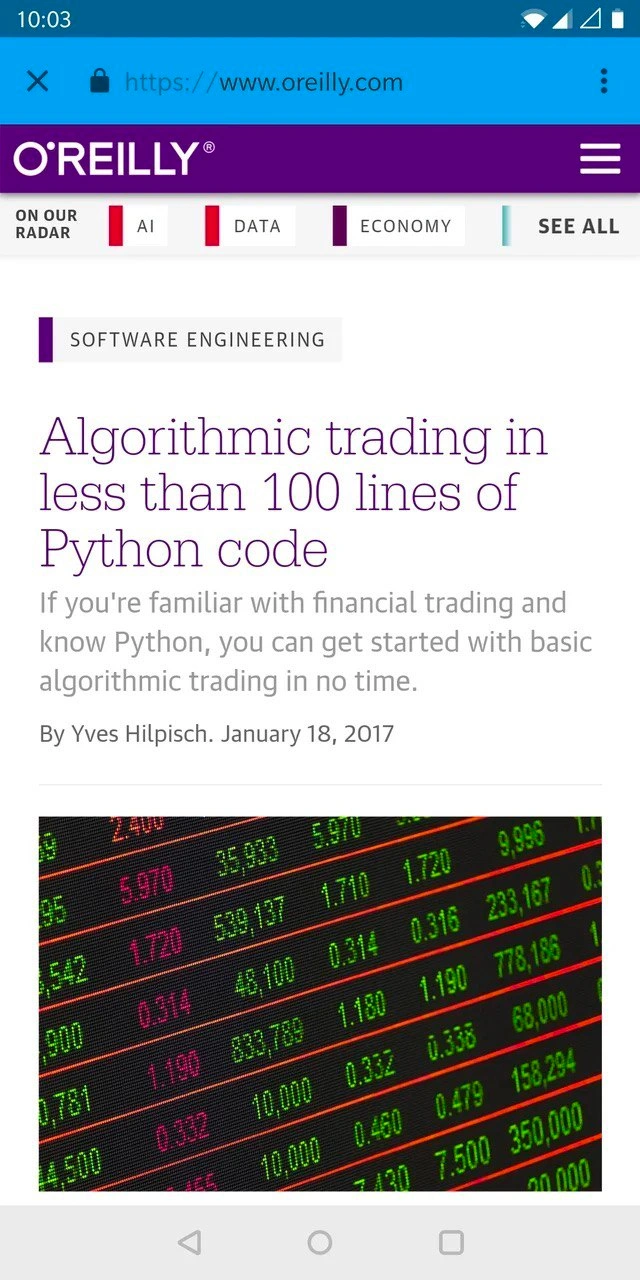
Let’s step back and explain some of these terms and why this meme makes tech folks smirk. The image is an article headline claiming a full algorithmic trading solution in very few lines of code. For a newcomer, that sounds awesome – who wouldn’t want to write a quick program and watch money roll in? But here’s what’s behind those buzzwords:

  • Algorithmic trading: This means using a computer program (an algorithm) to automatically make trades (buying or selling stocks, currencies, etc.) without human intervention each time. Instead of a person manually clicking “buy” or “sell,” the program decides based on logic or data patterns. For example, an algorithm might say “if the stock’s price goes 5% lower than yesterday, buy 10 shares.” Such trading algorithms are part of FinancialTechnology (FinTech) – applying tech to finance. They can execute many rapid trades, follow trends, or even do complex strategies that humans find hard to execute fast. It’s a big field in finance, used by hedge funds and banks. The meme jokes about doing this complex task with just a tiny bit of code, which sounds suspicious to anyone who knows the usual effort involved.

  • Python: Python is a popular programming language, especially in DataScience and finance. It’s loved for being relatively easy to read and write. In finance, Python is often used to prototype trading strategies or analyze data because it has lots of libraries (pre-built tools) to handle math, stats, and data. The article headline specifically says “in Python code.” That’s not surprising – Python, combined with powerful libraries like Pandas, is a common choice to write a trading bot or do data analysis on stock prices. When a headline brags about accomplishing something in <100 lines of Python, it implies that using these high-level libraries makes the task super concise. For a junior developer, it’s important to realize that few lines of code doesn’t necessarily mean the task is actually simple; it often means the heavy work is hidden in those libraries. Python can give you a false sense that a problem is easy, because so much is happening behind a one-liner like df.mean().

  • Pandas: This is a Python library used for data manipulation and analysis. It’s extremely useful for dealing with tables of data (like time-series of stock prices). In one or two lines, Pandas can do things that would take many lines to code from scratch. For example, calculating a moving average of a stock’s price over 50 days can be one line in Pandas (df['Close'].rolling(window=50).mean()). The O’Reilly article likely leverages Pandas or similar libraries to condense logic. A newbie might see that and think, “Wow, only one line to do that!” not realizing Pandas itself is thousands of lines of sophisticated code. In context, Pandas is one reason they can claim “less than 100 lines” – because they use it to crunch a lot of numbers quickly. It’s a great tool, but knowing how to use it properly (and understanding the results) is key. The humor is that the article glosses over everything Pandas is handling for you (like reading data, doing math correctly, etc.) as if those weren’t big tasks on their own.

  • Backtesting: Imagine you come up with a rule for trading, like “buy a stock when its price hits a 30-day low because maybe it’ll bounce back.” How do you know if that rule is any good? That’s where backtesting comes in. You take historical data (say, past 5 years of stock prices) and test your rule: apply those buy/sell signals in the past and see what would have happened to your money. If your algorithm would have lost money on past data, that’s a warning sign it might fail in real markets too. Backtesting is a critical step in developing any trading algorithm: it’s like practicing in a simulator to check if your idea has merit or if it’s just a fluke. Now, the meme hints that our magical 100-line Python trading bot probably didn’t do rigorous backtesting. That’s a bit like a newbie driver deciding to race after just reading a manual, without ever practicing on the road – pretty risky! When the meme asks “But did you backtest it?”, it’s pointing out that many quick-and-dirty trading scripts skip this essential safety test. A junior developer should understand that while writing the code is one thing, verifying the strategy with historical data (and doing it correctly) is what separates a hobby script from a serious algorithm. The joke is, skipping backtesting is a surefire way to potentially lose money fast, because you’re essentially going in blind. There’s even a saying in trading: “Everyone has a strategy until they get punched in the portfolio,” meaning you better test your idea before betting real cash on it.

  • Risk management: This is a fancy term for “don’t put all your eggs in one basket, and have a plan for when things go wrong.” In trading, risk management includes things like setting a maximum amount of money to trade per decision, using stop-loss orders (automatically sell if the price falls by a certain amount to cap your loss), or diversifying so one bad trade doesn’t ruin you. It’s like if you were carrying precious glass items, you’d wrap them in padding – here, your money is the fragile thing, and risk rules are the padding. A simple Python trading script written in under 100 lines likely overlooks risk management. For instance, a naive script might keep buying more of a stock as it falls, thinking “hey, it’s even cheaper now!” until you run out of money – oops. Proper risk controls would say “only invest 5% of your money on any single trade” or “stop buying if you've lost X amount”. The meme jokes that these quick-start guides don’t mention those safeguards. For a junior programmer, the lesson is: whenever you automate decisions that can cost real money, you have to think about worst-case scenarios and put in safeties. If a tutorial doesn’t mention risk, be very cautious – it’s like driving a car that has no brakes. Sure, it’s easy to get it moving (just hit the gas, simple!), but stopping... that’s important too!

  • FinTech hype and quickstart promises: Often, especially a few years ago, there were headlines like “Build a machine learning model in 5 minutes” or “Become a blockchain developer overnight.” FinTech (financial technology) had its share of hyped headlines because mixing coding with money sounds exciting. The meme is making fun of the “get rich quick with code” vibe. An article that says “you can get started in no time” is selling the idea that this is fast and easy. It’s not saying you’ll be a millionaire overnight explicitly, but it definitely encourages that fantasy. The person who posted the meme jokes about leaving their 9-to-5 job to live lavishly because that’s the dream being dangled – write a bit of code, kick back as it earns you passive income. As a newcomer, it’s crucial to recognize these quickstart_promises often ignore many real-world steps. It's not that you can’t start learning algorithmic trading with a short Python example – you can, and it’s a fine way to learn concepts. The issue is believing that’s the whole story. It’s like those ads that say “Learn guitar in a day!” – you might learn a couple of chords in a day, but you won't be rocking a concert anytime soon. The trading_bot_hype works similarly: you might get a basic bot running in 100 lines, but a basic bot is likely to be a losing bot if you take it straight to the market.

  • “Millennial style” and breaking the economy: This part of the meme caption is tongue-in-cheek. Millennials (the generation born roughly in the 1980s-90s) are often stereotyped as being tech-savvy and sometimes looking for unconventional or quick solutions. The phrase “How to lose money and break an economy – millennial style” is a humorous exaggeration. No, a 100-line Python script from one person won’t actually break the entire economy. However, it hints at a real concern: if lots of inexperienced people start deploying algorithms without understanding them, collectively they might cause weird market effects. In fact, there have been incidents where automatic trading programs (even by big firms) malfunctioned and caused very bad market events (like a sudden crash). For example, one famous event is the 2010 Flash Crash, where automated trading contributed to a huge, rapid drop in the stock market within minutes – and then it bounced back. These things happen when algorithms go wild or all follow the same flawed logic. The meme humorously suggests a millennial with a Python script could trigger such chaos by accident. It’s an exaggeration, but it is poking fun at the idea that today anyone with some coding skills might unwittingly create a mini disaster by skipping the proper precautions, all because an article made it look easy.

In essence, to a junior developer or someone not in finance, this meme is saying: “Be careful of over-simplified promises in tech, especially in FinTech.” AlgorithmicTrading is fascinating and definitely something you can do with Python and data science skills, but it’s not as plug-and-play as a catchy headline makes it sound. The joke comes from knowing that a lot of critical work (data quality checks, testing, risk controls, understanding of markets) is being completely skipped in that rosy picture. It’s a bit of shared industry wisdom packaged as humor: if it sounds too easy to be true, it probably is. The seasoned folks find it funny because they’ve seen newbies get burned chasing these promises. As a newcomer, you don’t have to be discouraged from experimenting with a Python trading bot – just don’t bet your life savings on a 100-line script you found in a blog. Build knowledge step by step, and you’ll start to see why professionals smirk at those “fairy tale” one-click solutions.

Level 3: High-Frequency Fantasies

The meme shows an O’Reilly article titled “Algorithmic trading in less than 100 lines of Python code”. Seasoned developers see this and immediately smirk – it's a classic case of FinTech fairy tales. The bold promise (less_than_100_lines!) triggers our headline_driven_development alarm. Why is it funny? Because anyone who’s actually tried AlgorithmicTrading or built a serious trading bot knows that claiming a full strategy in under 100 lines is like claiming you built a space rocket in your backyard over the weekend. Sure, maybe you taped some Mentos to a soda bottle – but a real rocket? Not quite. This article’s title epitomizes trading_bot_hype that glosses over mountains of complexity lurking beneath a few slick lines of code.

Let’s break down the 100-line illusion versus reality:

  • Market Data Ingestion: Real market data comes as a firehose of ticks and trades. A production trading system has to parse live feeds, handle missing data, reconnect on drops, and cope with different formats (CSV, JSON, binary protocols like FIX). In “100 lines of Python”, they probably call pandas.read_csv() on a neatly provided dataset. Voilà, market_data_parsing solved! In reality, hooking up to a live exchange and getting reliable, low-latency price feeds is a whole project of its own (think message queues, websockets, and servers co-located near exchanges). 100 lines won't even cover the config for a production feed handler.

  • Latency and Execution Speed: High-frequency trading (extremely fast automated trading) is mentioned here tongue-in-cheek – because doing HFT in pure Python is a joke in itself. Python is wonderful for many things, but raw speed isn’t one of them. Serious trading firms use C++, specialized hardware (FPGA network cards), or even move closer to the exchange data centers to shave off milliseconds. A Python script making decisions might be fine for a basic strategy on daily data, but if you naively try to compete in intraday markets, by the time your 100-line Python code calls buy() the opportunity has evaporated. The meme’s underlying dark humor: a novice will write a short Python bot and dream of outsmarting Wall Street, while professionals are measuring cable lengths to reduce nanoseconds of delay.

  • Backtesting and Validation: The article’s subheading says “get started with basic algorithmic trading in no time”. In no time, eh? But did you backtest it? In real algorithmic trading, backtesting is not optional – it's the process of testing your strategy against historical data to see if it would have made money (or more likely, gone broke). A 100-line tutorial might show you how to write a strategy, but probably skips showing robust backtesting frameworks or warning that a strategy that fits past data might overfit or simply not work in live markets. Experienced quants roll their eyes here: skipping proper testing is how you achieve “How to lose money and break an economy - millennial style”. Many of us have seen a newbie proudly deploy a strategy that looked good on one cherry-picked example but crashes spectacularly on real market conditions. Without rigorous backtests (across bull, bear, and volatile conditions) and forward testing, that <100-line wonder is basically a time bomb attached to your brokerage account.

  • Risk Management (or lack thereof): Real trading systems have numerous safety checks. Risk management means limiting how much money is at stake on each trade, setting stop-loss orders to cut off massive losses, and ensuring one bad loop iteration doesn’t bankrupt you. The cutesy tutorial likely doesn’t dive into position sizing (how big each trade is relative to your capital), or what happens if your code starts sending crazy orders (“oops, my loop executed 1000 times and now I bought 1000 shares instead of 10”). A veteran reading “in no time” knows that “risk_management_overlooked” is an understatement – novices have blown up accounts by forgetting a single abs() or not accounting for leverage. There’s dark humor in the idea of a millennial coding away on a lunch break, deploying 100 lines to their brokerage, and then discovering at 10:03 AM (note that timestamp in the screenshot) that their Python_finance_example is now the proud owner of 10000 shares of a plunging stock because the code had no brakes. As the meme caption quips, “What could go wrong?” – experienced folks know exactly what could go wrong.

  • Oversimplified Strategy: If you read the fine print of such articles, the strategy is usually something trivial like “buy if the price went up two days in a row, otherwise sell” or a basic moving average crossover. The code might literally be:

    # Pseudo-code of an oversimplified trading strategy
    prices = load_price_data('AAPL')
    if prices[-1] > prices[-2]:
        buy('AAPL')
    else:
        sell('AAPL')
    

    This is headline_driven_development at its finest – implement a toy idea from a headline without considering if it makes any sense. Did they account for transaction fees or trading commissions? Probably not. Did they consider that everyone reading the same O’Reilly article might try the exact strategy, and whatever slight edge it had evaporates instantly? Definitely not. In real markets, if it’s published in an article and easily coded by thousands of readers, you can bet the Efficient Market Hypothesis will kick in – any profit opportunity gets arbitraged away or was never real to begin with. Seasoned devs joke that these “fairy tale” strategies work great on past data in classroom examples, but once deployed, Mr. Market has a way of humbling you. It’s a bit like copying an answer key without understanding the problems; as soon as the exam (live trading) changes the questions, you’re sunk.

  • Hidden Complexity in Libraries: How do they manage to do it in under 100 lines? They lean heavily on powerful Python libraries like Pandas or maybe a specialized trading library. For instance, a single call to pandas.DataFrame.mean() or a pandas_datareader can condense a lot of logic that would otherwise be many lines of code. Under the covers, Pandas itself is tens of thousands of lines of C and Python. In other words, the “100 lines” claim is a bit of a magic trick – they outsourced the hard work to big libraries. It's akin to saying "I built a house with just 10 bricks!" when those bricks are actually prefabricated wall sections. The code you write is short, but only because the heavy lifting (network calls, mathematical computations, etc.) is done by others. A Cynical Veteran chuckles at this because counting lines is meaningless bragging; what matters is whether the strategy is sound and the system robust. Banks don't count lines of code; they count dollars at risk.

In summary, the humor here targets the FinTech hype where complex tasks are sold as quick and easy. FinancialTechnology is a field where a lot of young developers (the meme even jabs with "millennial style") get excited by buzzwords like MachineLearning and quick wins, only to discover that trading is a brutal arena with its own unforgiving physics. The meme’s author sarcastically says, “I guess now I can leave my 9-5 job and live lavishly.” This is poking fun at that common daydream: "I'll write a little Python script and become a millionaire trader." Every senior engineer or quant has heard some wide-eyed beginner say that, right before the reality check. In true cynical fashion, the meme’s quote reply – “How to lose money and break an economy” – underscores that if enough clueless scripts run wild, things can go really wrong. (One rogue algorithm at a major firm did cause a mini-crash – Google “Knight Capital 2012” for a horror story of a software engineering bug losing $440 million in 45 minutes). So the meme lands as dark humor: it’s a warning that algorithmic trading isn’t a fairy tale where a few lines of code conjure riches. More often, it’s an arms race of math, tech, and risk management – one not won by the person with the shortest script. Consider this meme a cautionary tale told by battle-scarred developers who have seen too many “magic” trading bots turn back into pumpkins when the clock strikes the market open.

Description

Mobile screenshot of an O’Reilly webpage at 10:03 showing a bold purple header and hamburger menu. Navigation pills read “ON OUR RADAR”, “AI”, “DATA”, “ECONOMY”, and “SEE ALL”. A light-gray label says “SOFTWARE ENGINEERING” above the article headline, rendered in large purple serif text: “Algorithmic trading in less than 100 lines of Python code”. The sub-heading states, “If you're familiar with financial trading and know Python, you can get started with basic algorithmic trading in no time.” By-line: “By Yves Hilpisch. January 18, 2017”. Below, a stock-market ticker image shows green and red numbers on black, evoking live price feeds. Technically, the page promises a full trading strategy in minimal code - an example of FinTech hype that seasoned developers recognize as an oversimplification of market data ingestion, back-testing, latency, and risk management
Comments

7
Anonymous ★ Top Pick “Algorithmic trading in <100 lines of Python”: 25 lines to wrangle pandas, 1 line to market-order the entire book, and 74 lines for the post-mortem explaining how a 40 µs GC hiccup triggered a $20M SEC investigation
  1. Anonymous ★ Top Pick

    “Algorithmic trading in <100 lines of Python”: 25 lines to wrangle pandas, 1 line to market-order the entire book, and 74 lines for the post-mortem explaining how a 40 µs GC hiccup triggered a $20M SEC investigation

  2. Anonymous

    The other 99 lines are just try-except blocks wrapping a market buy order with your entire 401k

  3. Anonymous

    The trading bot is 100 lines; the risk management, backtesting bias, and explaining the margin call to your spouse are left as an exercise for the reader

  4. Anonymous

    Ah yes, algorithmic trading in 100 lines of Python - because what could possibly go wrong when you compress decades of quantitative finance theory, market microstructure, risk management, regulatory compliance, and production-grade fault tolerance into a weekend tutorial? Just add `import money` and watch your retirement fund speedrun bankruptcy. The real algorithm is the friends we bankrupted along the way. Senior engineers know that those 100 lines are just the 'Hello World' before the 100,000 lines of error handling, circuit breakers, audit logging, and the therapy bills from your first flash crash

  5. Anonymous

    100 lines of Python for algo trading? Adorable prototype - until prod demands colocation, FPGAs, and a dedicated SRE pod

  6. Anonymous

    Algorithmic trading in 100 lines is real - the other 50,000 are for FIX adapters, clock sync, slippage and fees, risk limits, and the compliance team’s blood pressure

  7. Anonymous

    “Algorithmic trading in <100 lines of Python? Sure: 1 imports pandas; 2 - 95 handle slippage, latency, and FIX retries; 96 - 99 flip the kill‑switch; 100 emails compliance.”

Use J and K for navigation