The Java Version Chasm: From Cutting-Edge to 'Still on 8'
Why is this Languages meme funny?
Level 1: Wait, There's More?
Imagine you and your friends love a video game series. Every year, a new version of the game comes out with better graphics and new levels. Now picture this: one friend excitedly says, “The Game 21 just came out! It has awesome new features!” But you blink in surprise and reply, “21? I only have Game 17.” Then another friend overhears and gasps, “17? I’m still playing Game 11!” And then your oldest friend, who hasn’t bought a new game in forever, chimes in confused, “There’s a game newer than 8?!”
Pretty funny, right? It’s like each friend is using a way older game and didn’t realize how many new versions they missed. The first friend is talking about super cool new stuff that the others can’t use or haven’t even heard of. The last friend is so far behind that the news of a “21st version” sounds crazy – they’re basically living under a rock with their old game.
This meme is doing the same thing but with Java, a programming language. New versions of Java come out a lot, kind of like new game editions or new phone models. But many people or companies keep using their old version because it still works for them. The joke is showing four people, each stuck with an older “edition” of Java (like having old toys), looking shocked that there’s something much newer. It’s funny in a simple way: no one wants to feel left behind, and here we have folks realizing they’re really left behind. The last guy saying “There is a newer version than 8?” is like a kid saying, “Wait, there’s an iPhone 14 now? I’m still using an iPhone 8!” It makes us laugh because we understand the feeling of seeing new things come out while we’re still using the old stuff. The meme takes that everyday feeling of being out-of-date and makes it extreme and silly with the numbers (8 to 21 is a big jump!). Even if you don’t know Java, you can relate: technology moves fast, and sometimes we look around and go “Wait, there’s more? I’m not even caught up with the last one!” That mix of surprise and panic – shown in a funny way – is what makes the joke work.
Level 2: Long-Term Support, Short-Term Panic
Let’s break down the joke in simpler terms. Java has a concept of Long-Term Support (LTS) versions – think of these as “stable” versions that companies rely on for years. Examples? Java 8, Java 11, Java 17, and now Java 21 are all LTS editions. They get updates and bug fixes for a long time, so businesses feel safe using them. Non-LTS versions (like Java 9, 10, 12, 13…20) are released in between but disappear from support quickly (in about 6 months). Many organizations skip those and only upgrade when the next LTS arrives. It’s a bit like only buying a new phone model every few years rather than every incremental release – you wait for the ones known to be reliable.
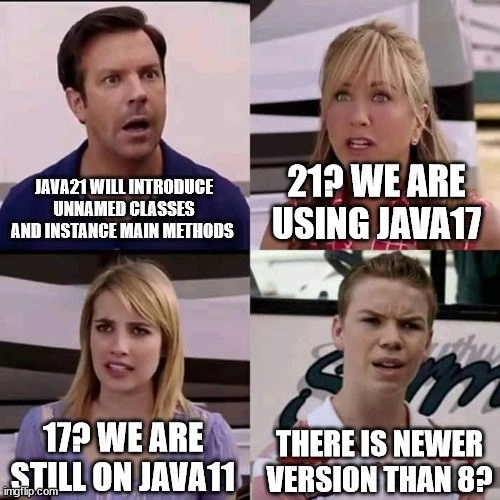
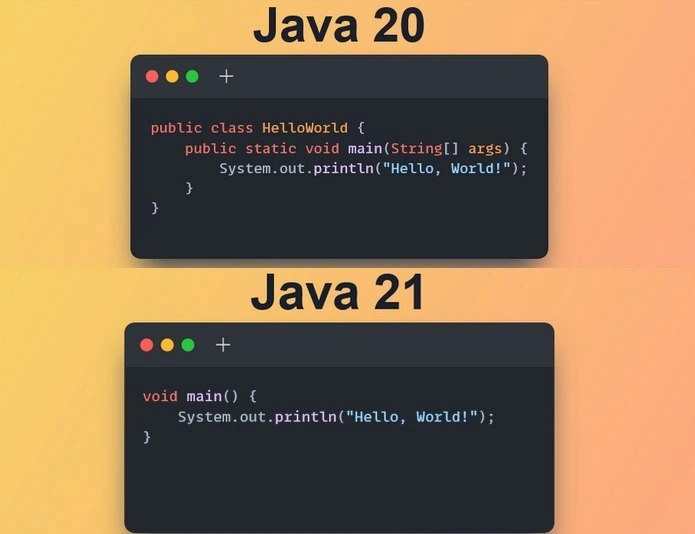
Now, the meme’s four panels show a chain reaction of surprise and alarm at a Java21 announcement. Why are they freaking out? Because each person in the meme is using an older Java version and hadn’t planned for a new one so soon. The top-left panel mentions “Java21 will introduce unnamed classes and instance main methods.” These are new language features in Java 21. In plainer words: Java 21 is adding some cool shortcuts for programmers – unnamed classes let you create small throwaway classes without naming them (useful for quick tasks or scripting), and instance main methods mean you might be able to run a program with a regular object’s method instead of the traditional public static void main. For a Java developer, that’s a notable change: since forever, we’ve needed a class with a static main method to start a program. Java 21 is bending that rule to make things easier.
But here’s the catch: the developers in the other panels haven’t even reached Java 21 – not even close. The top-right woman says “21? We are using Java 17.” In her team’s world, Java 17 is the latest (it came out in 2021). She’s basically saying, “We just got comfortable with 17, and now you’re telling me 21 is here?” That’s like someone telling you the newest smartphone model is out when you just bought last year’s model. It creates a bit of panic – did you already fall behind?
Then the bottom-left exclamation “17? We are still on Java 11.” Here, another team is even further behind. They’re on Java 11 (released in 2018) and haven’t upgraded to 17 yet. For them, hearing that someone is on 17 is surprising – let alone that 21 is out! This would be like you’re proudly using an iPhone X, and you find out someone else is on iPhone 14, and now iPhone 18 just launched (numbers exaggerated, but you get the idea). They feel two steps behind the cutting edge. This panel highlights how some teams upgrade slower than others, often due to reasons like compatibility issues or simply not having time to do a big migration (upgrade_migrations can be a project on its own). Moving from Java 11 to Java 17 might require testing everything to ensure nothing breaks – it’s not a trivial “click update” if your application is large.
Finally, the bottom-right panel (with the young man’s confused face) says “There is newer version than 8?” This is the punchline. This guy’s team is way back on Java 8 (from 2014!) and seemingly hasn’t even heard about newer versions. It humorously suggests they’ve been in a bubble maintaining some old system and genuinely don’t realize Java has progressed past 8. For context, Java 8 introduced big things like lambdas (which was revolutionary then), and many enterprises standardised on it for a long time. Java 8 is practically the definition of legacy at this point – it’s two LTS cycles behind the newest. If a team is still on Java 8, it might be because their application is super stable there or because upgrading it is like trying to rebuild a brick wall without taking it down (risky and complex). They might also have vendor software or frameworks that only support Java 8. The meme exaggerates that such a team is so out-of-date that news of Java “9 and beyond” never even reached them. It’s funny in the way it’s funny to find out someone is using a decade-old cell phone and didn’t know what a smartphone is. But in tech, this happens – critical internal apps sometimes run on very old software because it ain’t broke, so why fix it?
In simpler terms, each panel represents a generation gap in Java versions:
- Java 21 team: Cutting-edge, talking about the newest features.
- Java 17 team: One step behind, on the latest stable version they know.
- Java 11 team: Two steps behind, starting to feel old.
- Java 8 team: Several steps behind, basically living in the past (and maybe comfortable there).
This speaks to LegacySystems and how companies manage VersioningStrategy. New Java versions come out twice a year (that’s the release train), but companies often only hop on every few years. Why? Upgrading can introduce bugs, require updating libraries, and retraining staff on new features. It’s a classic case of TechDebt: the longer you avoid the upgrade, the more your environment ages, and the scarier it becomes to change. Eventually, you’re so far behind that catching up feels overwhelming – exactly the “panic” shown in the meme as people realize just how out-of-date they are.
For a junior developer or someone new to this scenario, imagine you learned Java on version 17 in school, excited about using var or new API improvements. Then you join a company only to discover their codebase is on Java 8 – no var, no newer Date API by default (they might still use the old Date and Calendar classes), and none of the cool stuff you learned. It can be shocking and a bit frustrating. This meme captures that feeling in a lighthearted way. Each person’s shocked expression and the text is basically saying: “Wait, you’re already there? We haven’t even gotten here yet!” It’s a relatable DeveloperHumor moment for anyone who has had to work with out-of-date technology.
Level 3: Release Train Whiplash
Java’s rapid release cadence has given many developers a case of whiplash. In this four-panel meme, each person’s reaction highlights an almost painful industry truth: while Java 21 is rolling out with shiny new features, plenty of teams are years behind, stuck on older Long-Term Support (LTS) versions. Consider a hypothetical stand-up meeting when the Java21 announcement drops:
Architect: “Java 21 will introduce unnamed classes and instance main methods!”
Team Lead A: “21? We’re still using Java 17…”
Team Lead B: “17? We haven’t left Java 11 yet.”
Senior Dev: “Wait, there’s a newer version than Java 8?”
This escalating dialogue is humorous because it’s scarily relatable. Java’s six-month release_train_model means versions tick up quickly: after Java 8 (2014) came 9, 10, then Java 11 (2018) as LTS, followed by 12…16, then Java 17 (2021) LTS, and now Java 21 (2023) LTS. Many enterprises deliberately skip versions to leapfrog from one LTS to the next. The meme exaggerates this by showing one person utterly unaware of anything beyond Java 8 – a version nearly a decade old, but still incredibly common in production. It’s poking fun at how LegacySystems accumulate and how TechnicalDebt can freeze technology in time. The Java developer community has been buzzing about features like unnamed classes (a preview feature from JEP 445 allowing quick, no-name class definitions for convenience) and instance main methods (finally letting a main be non-static, making Java feel a smidge more modern). But those stuck on Java 8 or 11 hear these terms and react with a mix of confusion and panic – they haven’t even adopted simpler improvements from intermediate versions, let alone these futuristic-sounding enhancements.
From a senior developer’s perspective, the humor cuts deep: it satirizes the version lag in big organizations. Why are so many teams two or three versions behind? Because upgrading a mission-critical application from Java 8 to 17 (or beyond) is no small feat. You’ve got huge, tangled LegacyCode bases, third-party libraries that might break on newer JDKs, and managers who ask “If it works, why change it?” Upgrading can feel like defusing a bomb – one wrong cut (or a deprecated API) and you’re debugging a production outage at 3 AM. The result is a conservative upgrade culture: stick to proven LTS versions and move up only when absolutely necessary. Java’s release train model (regular time-boxed releases) was meant to speed up LanguageEvolution, but for teams with slow-moving processes it’s like watching an express train roar by while they wait safely on the platform. Each panel of the meme reflects a layer of this reality: the top excited voice represents cutting-edge adopters or Oracle’s announcements; the middle voices are “current” enterprise teams (already one or two versions behind latest); and the bottom voice is that one legacy system nobody’s touched in years, still happily running on an ancient JDK in some corner of the data center. The punchline “There is a newer version than 8?” lands because we all know a system (or colleague) that stopped updating ages ago and acts genuinely surprised that the world moved on. It’s a comedic take on Enterprise Java inertia.
There’s rich irony in Java 21’s new features being announced with fanfare while so many devs are debugging apps on Java 8 – as if someone is unveiling a spaceship while the audience is still driving Model-T Fords. LanguageAdoption in enterprises notoriously lags behind language innovation. You get this fragmented ecosystem where one team is excited about seal classes and var, and another team down the hall still writes StringBuffer and raw Thread code like it’s 2006. The meme nails that cross-generational dissonance. It underscores the divide between Modernization efforts and real-world constraints: sure, Java adds cool features on paper, but LegacySystemsAndModernization don’t always move at the same speed. In fact, many organizations deliberately choose an LTS like Java 17 and plan to stay on it for years – skipping all the interim releases – because LTS versions get updates and support (often critical for security compliance) while non-LTS versions are here and gone in six months. This VersioningStrategy is pragmatic but leads to scenarios where by the time you’re ready to jump to the next LTS, you suddenly find out there have been like 10 versions in between! No wonder the mention of “Java 21” elicits panic and incredulous responses. Senior devs chuckle (perhaps darkly) at this meme because they’ve lived this. They remember the promises: “We’ll upgrade someday, just not this quarter.” Multiply that by a few years and you have entire departments effectively frozen on an older Java, eyes widening when they discover how far the train has moved.
In essence, Java21 arriving isn’t just a technical event – it’s almost an existential one for teams weighed down by TechDebt. The meme humorously compresses the industry’s version gap into a four-panel comic. It’s funny because it’s true: keeping up with Java’s evolution can feel like running up a down escalator. Today it’s unnamed classes making headlines, but some codebases haven’t even adopted Java 8’s lambdas or Java 11’s var. The contrast is absurd and familiar. As new features whiz by, those lagging behind experience a mix of FOMO and dread – perfectly captured in those shocked faces. “Release Train Whiplash” is real: the Java release train keeps chugging every six months, and if you don’t hop on occasionally, you’ll be left at Java 8 station wondering where everyone went. This meme takes that heavy truth and makes us laugh (or cry) about it.
Description
This is a four-panel comic meme using the 'We're the Millers' or 'You Guys Are Getting Paid?' format, featuring four characters with progressively more shocked or out-of-touch reactions. In the first panel, a man announces, 'JAVA 21 WILL INTRODUCE UNNAMED CLASSES AND INSTANCE MAIN METHODS'. In the second, a woman asks with concern, '21? WE ARE USING JAVA 17'. The third panel shows another woman looking confused, stating, '17? WE ARE STILL ON JAVA 11'. The final panel features a young man with a bewildered expression asking, 'THERE IS NEWER VERSION THAN 8?'. The meme humorously illustrates the significant version fragmentation within the Java ecosystem. It highlights the stark contrast between the rapid release cycle of new Java versions and the slow adoption rate in many corporate environments, where teams are often stuck on much older Long-Term Support (LTS) versions like Java 11 or even the ancient, yet still widely used, Java 8 due to legacy codebases, migration costs, and risk aversion
Comments
7Comment deleted
Java's new features are cool and all, but most of us are still dealing with a `pom.xml` file that's old enough to have its own pension plan and thinks `Optional` is a cutting-edge concept
Java’s six-month release train keeps whizzing by while every team is still arguing over which LTS car to board - meanwhile ops is sprinting alongside clutching a Java 8 WAR and a “-XX:PermSize” post-it
The guy defending Java 8 has been writing "final" on his variables for so long, he thinks Java versions should be too
The real tragedy isn't that enterprises are stuck on Java 8 - it's that they've convinced themselves that 'if it ain't broke, don't fix it' applies to a language that's had 13 years of improvements including records, sealed classes, pattern matching, and virtual threads. Meanwhile, they're paying premium support costs to avoid a migration that would literally make their developers' lives easier and their code more maintainable. But sure, let's keep writing verbose boilerplate because someone in 2014 decided Java 8 was 'good enough' and now it's fossilized into the architecture
Java 21's unnamed classes? Perfect for enterprise codebases too ashamed to admit they're forever on 8
Oracle ships a JDK every six months; enterprises ship an upgrade request every six fiscal years
Java 21 promises “unnamed classes”; our CAB replies with an unnamed ‘change request denied’ because the vendor hasn’t certified past 8u201 - and the moment we try, CI dies with Unsupported class file major version 65