The Bliss of Good Docs vs. the Pain of Unhelpful Advice
Why is this Documentation meme funny?
Level 1: Alien Language
Imagine you open up a booklet that’s supposed to tell you how to do something, like build a new toy or set up a game, but it’s written in a secret code or a totally made-up language. The letters and words on the page don’t make any sense to you at all – they look like random symbols. You’d probably feel confused and a bit frustrated, right? You might even laugh because it’s so silly: “How am I supposed to follow these instructions if I can’t read them?!” That’s exactly the feeling this meme is joking about. It’s saying that sometimes the guides for computer programmers (the documentation) are written in such a complicated or unclear way that trying to read them feels like trying to read an alien language. It’s funny in a goofy way because instructions are supposed to help, but these might as well be magic runes from Minecraft. The meme makes us picture a developer staring at a page of gibberish and feeling the same confusion as if they were trying to decode a fantasy game’s enchantment book. In simple terms: the joke is that the documentation is so hard to read, it’s like getting help text that you just can’t read at all. That mix of frustration and “this is absurd!” is what makes it humorous and relatable, even if you’re not a programmer.
Level 2: Jargon Jungle
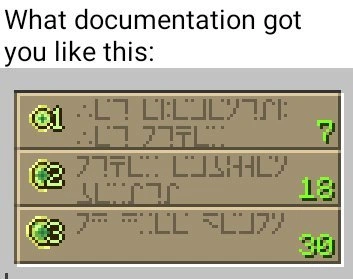
Let’s break it down in simpler terms. This meme is saying sometimes reading developer documentation feels like reading a foreign language. The image used is from Minecraft, specifically the enchanting table interface. In the game, when you use the enchanting table, you see text written in a made-up symbolic script known as the Standard Galactic Alphabet. These symbols look cool and mysterious, but they’re intentionally not meant to be read easily — they’re basically unreadable glyphs for flavor. (Fun fact: you can actually translate SGA to regular letters, but the words you get are random and don’t tell you what enchantment you’ll get. So effectively, it’s gibberish even when decoded.)
Now, think of those weird Minecraft runes as a metaphor for bad documentation. Documentation is supposed to explain how software or an API works, like a manual for developers. But we’ve all seen poor documentation that’s so unclear or overly technical that, if you’re not already an expert, it might as well be nonsense text. This meme jokes that reading such documentation feels just like staring at the Minecraft enchantment text — you know it’s supposed to have meaning, but you just can’t figure it out. It’s a perfect CodingHumor reference: mixing a popular game’s quirky feature with a programmer’s everyday struggle.
In developer terms, a “jargon jungle” is what you get when documentation is full of specialized terms, acronyms, and buzzwords with little explanation. For a junior developer (or really anyone new to the topic), trying to navigate that can be overwhelming. Imagine opening a guide and every sentence has something like “Utilize the TLS handshake with X.509 certs via the PKI module” — if you don’t already know those terms, that sentence is just noise. That’s an incomprehensible doc to you. The meme is highlighting this exact frustration in a visual way. The top text of the meme even asks, “What documentation got you like this?” implying there’s some manual or reference out there that left the reader utterly confused, as confused as if they were reading a fantasy language.
This is a very relatable developer experience. Newcomers often expect that official docs will be easy to understand (after all, they’re meant to help), but often they encounter walls of text that assume too much knowledge. Even experienced devs can feel this pain when venturing into a new technology with sparse or messy docs. It’s one of those common developer pain points: you want to learn or fix something, you go to read the docs, and you come away more baffled than before. You might find yourself re-reading the same paragraph multiple times, or searching the web for a simpler explanation, thinking “Surely someone translated this into plain English.” In fact, developers often end up looking for blog posts, tutorials, or Q&A threads on forums (like Stack Overflow) for clarity, essentially looking for a “translation” of the official documentation.
What about the numbers and icons in the meme image? In the Minecraft UI, those green numbers (7, 18, 30) are the experience levels you need to use each enchantment, and the little green icons with 1, 3, 8 indicate resource costs (like how many lapis lazuli gems you need). In our comparison, you can think of those as a cheeky detail: it’s as if the meme is saying “this documentation requires level 30 experience to decipher” – meaning you’d have to be pretty advanced or experienced to make sense of it. The whole thing humorously suggests that understanding the docs is an enchantment of its own, and you don’t have the needed XP. It’s a playful exaggeration, of course. But it underscores a real point about Developer Experience (DX): documentation should lower the level requirement for understanding a technology, not raise it. When docs are written in plain, accessible language, they welcome newer folks. When they’re filled with unexplained technical lingo, they effectively set a high entry barrier (like needing “level 30” knowledge).
In summary, at this level we see that the meme is pointing out a common scenario in programming: documentation humor about not understanding the docs. It combines a gaming reference (Minecraft’s secretive enchanting language) with a developer issue (hard-to-read docs) to make a joke. If you’re a developer who has ever felt lost reading a manual or API reference, you’ll instantly get the joke. And if you’re not a developer, just imagine any instructions that are so confusing they look like gibberish — that’s what’s going on. The tags like DocumentationWoes and DeveloperFrustration are basically saying “Yep, this is making fun of how frustrating documentation can be when it’s not well-written.” It’s a light-hearted way to commiserate over a real problem: the struggle to understand complex or badly written documentation.
Level 3: Arcane Documentation Runes
Ever crack open official docs and feel like you’re staring at an alien spellbook? That’s exactly the vibe here. The meme shows a Minecraft enchanting table GUI with unreadable glyphs from the Standard Galactic Alphabet (SGA) – basically Mojang’s version of ancient runes. It’s comparing that encoding of enchantments to those times when developer documentation is so cryptic, it might as well be written in an extraterrestrial script. For seasoned developers, this image triggers flashbacks of documentation woes: pages of jargon-heavy text that leave you squinting as if you’re trying to unlock a secret level. It’s a darkly funny, painfully relatable developer experience because we’ve all been there, muttering “What does this even mean?!” under our breath.
Why is this so on point? Because poor documentation can feel exactly like a puzzle in a fantasy game. Instead of clear instructions, you get something akin to enchanted runes that require a cipher (or a senior dev) to decipher. The humor lands as a tongue-in-cheek nod to the developer frustration of trying to glean meaning from impenetrable text. We’re talking about those official guides that are theoretically in English but might as well be Martian. Heck, even if you manage to decode all the acronyms and ten-dollar words, you often discover the actual content is either minimal or helpful utterly unhelpful. It’s like finally translating the SGA glyphs only to reveal nonsense words – you did all that work and still learned nothing useful.
This meme screams “I’ve lost hours in this jargon jungle.” Seasoned devs know the pattern: you dive into some framework’s docs hoping for enlightenment, but each sentence spawns more questions. It’s a classic developer pain point. Instead of straight answers, you get lines that read like "Apply the flux reverse under heterodyne conditions." – what?! You start wondering if you need a Rosetta Stone or maybe to sacrifice some Lapis Lazuli for clarity. By 3 AM, you’re picturing the documentation in unreadable glyphs exactly like the meme, and you half-expect a green number “30” in the margin indicating the level of wizardry needed to proceed.
Let’s be real: writing good docs is hard, and many projects treat it as an afterthought. The result? Incomprehensible docs that feel as cursed as an enchanted tome. Here are some reasons dev docs turn into arcane gibberish:
- Unexplained Acronyms & Jargon: Pages littered with terms like “SLA”, “TLSPS integration”, or “initialize the FactoryBean in the IOC container” without ever explaining them. It’s as if the author assumes you already speak their secret language.
- No Real Examples: Instead of a simple code snippet showing how to use the function, you get abstract theory. It’s like trying to learn a magic spell by reading pure arcane theory, with no step-by-step incantation.
- Outdated Information: The doc talks about features or flags that disappeared two versions ago. You’re essentially reading an old scroll – historically interesting maybe, but practically useless for your current quest.
- Auto-Generated Text: Ever read docs that just list API methods with one-line definitions copied from code? They provide zero context. It’s basically the Standard Galactic Alphabet of documentation: technically text, but it doesn’t enlighten you at all.
All of these turn documentation into a riddle. They’re supposed to guide you, but end up gatekeeping knowledge behind cryptic prose. The meme nails this irony by visually equating a developer guide to a Minecraft enchantment screen – something meant to empower you, yet presented in an indecipherable form. For a veteran dev, it elicits a chuckle and a wince. We laugh because it’s true: we’ve poured over confluence pages or API references that felt like cursed scrolls, desperately searching for the one line of meaningful insight. And we wince because we remember the wasted time and the looming deadlines during those treasure hunts for clarity.
On a meta level, there’s even a bit of gallows humor here about Developer Experience (DX). Good DX means you have great docs, smooth onboarding, and fewer WTF moments. When docs read like an enchantment table, DX has gone down the drain. It’s a sardonic reminder that no matter how cutting-edge our tech is, if the documentation is incomprehensible, developers will end up casting random spells (a.k.a. trial-and-error coding) and praying for good results. And trust me, every senior dev has done that dance – summoning Stack Overflow incantations when the official docs were about as useful as ancient hieroglyphs. In short, this meme hits a nerve: the arcane runes of documentation are a shared industry joke and a shared trauma. We’ve all earned a few XP in deciphering them, and it’s oddly comforting (and comical) to see that struggle perfectly captured in pixelated Minecraft form.
Description
This is the 'Two Guys on a Bus' meme format. On the left, a character sits in the shadowed side of the bus, looking miserable. A caption points to him, reading 'the "the docs" guy'. On the right, another character sits on the sunny side, smiling as he looks out at a beautiful landscape. His caption reads 'the docs'. The meme contrasts the experience of having clear, useful documentation with the frustrating experience of being told to 'read the docs' by someone who is unhelpfully cheerful and detached from the actual problem. The joke critiques a common and often frustrating dynamic in developer communities. While documentation is essential, it can be incomplete, outdated, or poorly written. The phrase 'read the docs' is sometimes used dismissively to shut down a request for help. The meme captures the despair of a developer who is not only stuck on a problem but is also receiving unhelpful, generic advice from a colleague who seems oblivious to the struggle (and the poor quality of the documentation itself)
Comments
30Comment deleted
Good documentation is like a well-factored API: it gives you exactly what you need. Bad documentation is a REST endpoint that just returns '418 I'm a teapot' for every request
Opening the auto-generated Swagger for our 7-year-old “legacy microservice” feels like peering at a Minecraft enchanting table - pure glyphs, and you still need 30 XP of tribal knowledge before you can cast a single curl
After 20 years in the industry, I've learned that documentation doesn't prevent legacy code - it just provides archaeological evidence of exactly when and why someone decided that 'temp_final_v2_REAL' was a perfectly reasonable variable name
This perfectly captures the inverse relationship between documentation quantity and quality in legacy codebases. You start with 'HELLO I'M A FUNCTION' - clear, self-documenting code from an optimistic junior. Fast forward through a few refactors, and you're left with 36 instances of 'HELLO' scattered across the codebase like archaeological artifacts, each one more cryptic than the last. The real kicker? The original author left three years ago, the function now handles authentication, and that 'HELLO' comment is the only clue you have before the 3 AM production incident. At least Minecraft lets you stack items logically
Mojibake docs: the only time you'd rather debug production fires than decode the README
If the docs look like the Minecraft enchantment table, stop chanting and start tracing - write a failing integration test and let the packets explain the API
Enterprise SDK docs are the enchantment table of software: choose your cost - 7 minutes guessing params, 18 broken links, or 30 pages of auto‑generated Swagger where every field is string and the required x-api-version header is never mentioned
my own lmao Comment deleted
Sauce? Comment deleted
Any Google-developed library, service, API or repository Comment deleted
Typical open-source. Comment deleted
After a solid decade navigating the complex realms of Gentoo, I genuinely thought I'd seen it all. But then I encountered the pulse-audio configuration. All I wanted was to mix some game and microphone audio. But it was a journey through a maze of incomprehensible inhuman chaos that tested the very limits of my patience and skill. Comment deleted
and so they made pipewire Comment deleted
Still way too baroque for my tastes. I'm pretty hapy with sndio (Linux port from OpenBSD) so far. If I'll ever need full multimedia thing I'll probably go for Arcan instead. Hell, I'll probably go for Arcan anyway eventually. Comment deleted
wth do you mean by baroque Comment deleted
Convoluted. It tries to be a better implementation than PA but it keeps practically all of the API. Comment deleted
well… kinda? there's a compatibility layer that translates pulse API to pw API, and it's far from a perfect emulation. It's like wine in that sense Comment deleted
the upside of that though is that pulse has horrible perf and pw has near-jack perf Comment deleted
Ha yup, and everyone who had a two bits of sense (sadly not many) told Lennart to fuck off right then. And it got worse with each following thing, culminating in polkit which drags along three quarters of Chrome to evaluate configuration in JavaScript. Comment deleted
are these java versions ? Comment deleted
Actually no, Gentoo is like Void but compile based, Pulseaudio is just an audio driver Comment deleted
fuj no its not Comment deleted
What is void and what is Gentoo? Comment deleted
wym? Comment deleted
They're both Linux😂😂 Comment deleted
Mesa Comment deleted
It literally says: •1 wet elemental wet other •2 other embiggen berata •3 of free demon Comment deleted
which language ? Comment deleted
enchantment table Comment deleted
It's English, but with SGA (Standard Galactic Alphabet) Comment deleted