Java 21's Drastic Simplification of 'Hello, World!'
Why is this Languages meme funny?
Level 1: Just Say Hello
Imagine you want to say hello to the world, but before you do, you’re told you must stand on a stage, introduce yourself with your full name and title, and then finally get to say “Hello, World!”. 😅 That’s how Java used to be – very formal and a bit overcomplicated just to greet everyone. Now, Java decided it doesn’t need all that formality for a simple greeting. It’s like Java can just wave and say “Hello, World!” without wearing a tuxedo and bow tie. The meme is funny because Java took a really long time to relax these strict rules. In plain terms, Java finally made it easy to just say hello without all the extra fuss, and everyone’s having a little laugh of relief about it.
Level 2: Bare-Bones Hello
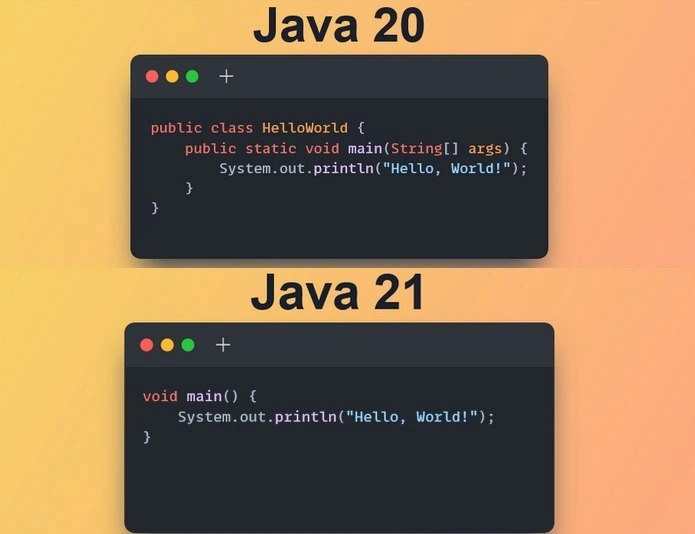
If you’re a newer programmer, here’s what’s going on: The meme shows two code snippets side by side (well, top and bottom) to compare Java 20 vs. Java 21 when printing "Hello, World!". The top part labeled "Java 20" is what you traditionally had to write in Java: a bunch of required extra code – often called boilerplate code – wrapped around the real action of printing. You see public class HelloWorld { ... } which defines a class, and inside it public static void main(String[] args) { ... } which defines the main method. In Java, the main method is the special entry point where the program begins. It had to be public (accessible to the JVM), static (so it could run without creating an object), and it had to accept a String[] args (an array for command-line arguments) even if you didn’t use it. All that just to print a line of text to the screen! That’s a lot of formalities, often confusing to beginners who ask, "Why do I need all these words just to say Hello?"
Now look at the bottom part labeled "Java 21". It’s much shorter: just void main() { System.out.println("Hello, World!"); } and nothing else. This is made possible by a new Java 21 language feature (still in preview) often referred to as the unnamed class and implicit main. What that means is you don’t have to explicitly write a class or the public static keywords for the main method anymore – Java will handle those behind the scenes. You write a bare-bones main function, and it works. In essence, Java 21 is letting you write a quick program in a more Python-like or script-like style. The code is cleaner and focuses only on what you want to do: print "Hello, World!"
This boilerplate reduction is a big improvement in Java’s developer experience. For new Java learners, it means less intimidating code to wade through for a simple first program. For example, compare the two versions:
// Java 20: the old way
public class HelloWorld {
public static void main(String[] args) {
System.out.println("Hello, World!");
}
}
// Java 21: the new way (preview feature)
void main() {
System.out.println("Hello, World!");
}
As you can see, Java 20’s version has to declare a class (HelloWorld) and a bunch of keywords around the main function. Java 21’s version drops all that extra stuff – no class declaration, no public static, no String[] args unless you actually need inputs. Both will output Hello, World! to the console, but the Java 21 code is much more concise. This change is currently a preview feature (which means it’s being tested and might change a bit in the future), but it shows how Java is simplifying its syntax. It’s a direct language simplification aimed at making Java more approachable and quicker for simple programs.
The meme is funny to developers because it’s basically saying, “Look, Java finally caught up and made Hello World easy!” Seasoned Java devs have been joking for years about all the unnecessary stuff you had to write. Now Java is simplifying things, and the meme cleverly illustrates that by literally trimming the code in the picture. It’s a lighthearted way to celebrate a long-awaited change.
Level 3: Class Dismissed
In Java 21, the language designers finally kicked out a long-standing houseguest: the boilerplate code around the Hello, World! program. This meme spotlights JEP 445 – the preview feature for unnamed classes and implicit main methods. In the top half labeled Java 20, we see the traditional ceremony: a public class HelloWorld wrapper and the notorious public static void main(String[] args) method declaration. In the bottom half labeled Java 21, almost all that fluff is gone – just a plain void main() and a print statement remain. Java has essentially said "class dismissed!" for simple programs.
Why is this funny (and exciting) to seasoned developers? Because for over two decades, every Java programmer had to write those exact five lines just to get a single line of output. It became the poster-child of Java’s verbosity. Meanwhile, languages like Python could print "Hello, World!" with one simple line, and even C# (as of version 9) introduced top-level statements to drop its own Program class boilerplate. Java was one of the last holdouts insisting “everything must be inside a class, and main must be static.” Finally, with Java 21’s preview feature, the language is trimming that fat. This is a small change on paper, but a huge symbolic leap in Java’s ongoing language evolution toward conciseness and better developer experience (DX). It’s almost like Java looked at modern developer expectations and said, “Fine, I’ll loosen up a bit.” 🎉
Under the hood, what’s happening is that the Java compiler now implicitly provides a class for you when it sees this new form. The void main() in Java 21 is actually an instance method in an unnamed class. The runtime will instantiate that hidden class and call your main, so you don’t have to mark it static or name the class at all. The String[] args parameter is optional now – if you don’t need command-line arguments, you can omit it entirely (as shown in the meme). In short, same output, far less setup. This boilerplate reduction aligns Java with the more beginner-friendly style of scripting languages, making quick scripts and examples less of a hassle. Seasoned devs are chuckling because we’ve joked for years about writing “Hello World” in Java being almost an essay – and at long last, Java is in on the joke and doing something about it.
Let’s break down what Java 21’s unnamed class feature gives us compared to Java 20:
- No explicit class declaration: In Java 20, you must write
public class HelloWorld { ... }. In Java 21, you can omit that; the compiler creates an unnamed class behind the scenes. - No
staticneeded on main: The newmainmethod can be an instance method (void main()with nostatic). The Java runtime will handle creating an object and invoking it. - No
String[] argsrequired: If your program doesn’t use command-line arguments, you don’t have to declare that parameter. The classicString[] argsis optional now. - Dramatically simpler syntax: The result is a syntax comparison like the meme shows – from 5-6 lines down to 2 lines – with no impact on what the program does. It still prints "Hello, World!" to the console, just with far less ceremony.
This change is part of a preview feature (meaning you enable it with a special flag and it might evolve in future versions). But it marks a clear shift in Java’s design philosophy: prioritizing simplicity and pragmatism, especially for newbies and quick tasks, without sacrificing the language’s core. The meme humorously celebrates this triumph over needless verbosity. As experts, we appreciate how it maintains backward compatibility (the old way still works) while moving the language forward. It’s a small step for HelloWorld, one giant leap for Java-kind! 🚀
Description
The image presents a direct visual comparison of a basic 'Hello, World!' program written in Java 20 versus Java 21. The top half, labeled 'Java 20,' displays a dark-themed code editor window containing the traditional, verbose Java entry point: a `HelloWorld` class with a `public static void main(String[] args)` method. The bottom half, labeled 'Java 21,' shows the same program in a dramatically simplified form: just a `void main()` method containing the print statement, without the need for a class definition or the `public static` modifiers. This meme highlights JEP 445, a key feature in Java 21 that introduces unnamed classes and instance main methods. The goal is to lower the barrier to entry for new programmers by removing ceremonial boilerplate, making Java more approachable for teaching and simple scripting, much like Python or JavaScript
Comments
7Comment deleted
Java 21 finally lets you write a 'Hello, World!' without first having to write a novel. Now, if you want to center a div in a GUI, you still need to implement three abstract factory patterns and consult a star chart
Java 21 drops ‘public static void’, yet my Spring Boot container still needs 12 starters and @EnableEverything just to echo the same “Hello, World!” in 700 MB
After 25 years of explaining why "public static void main(String[] args)" isn't a magic incantation, Java finally admits it was just hazing the whole time
After two decades of explaining to beginners why they need 'public static void main(String[] args)' just to print a string, Java finally admitted that maybe - just maybe - requiring a full class declaration, access modifiers, static context, and array parameters for 'Hello World' was a *bit* much. Java 21's simplified main methods are essentially Oracle saying 'We've been gatekeeping with ceremony, and Python was right all along - but we'll never admit it publicly.'
Java 21 lets HelloWorld be two lines, but running it needs more --enable-preview flags than lines of code - boilerplate that migrated to the CLI
Java 21: Proving even enterprise JVMs can slim down after 25 years of bloat - Go devs, hold our coffee
Java 21 lets you write void main(), and then Maven reminds you the real ceremony now lives in the --enable-preview flags