Skip to content
DevMeme
757 of 7435
Java to Newer Languages: 'Hold My Beer'
Languages Post #862, on Nov 26, 2019 in TG

Java to Newer Languages: 'Hold My Beer'

Why is this Languages meme funny?

Level 1: Hold My Juice Box

Imagine two kids on a playground trying to outdo each other with cool tricks. One little kid proudly says, “Look what I can do!” and maybe they do a small jump off a step. Then an older kid comes along, pats the little one on the head and says, “Aww, you’re like a little baby. Watch this!” The older kid then does a big leap off the jungle gym or a crazy flip – something way more impressive. The little kid’s trick suddenly looks tiny in comparison, and everyone goes “Whoa!”

This meme is just like that, but with programming languages acting as the kids. Java is the older kid who thinks it’s the toughest on the block. When Java says “you are like a little baby, watch this,” it’s the same as the older kid saying “Ha, that’s nothing. Hold my juice box and see what I can do!” It’s funny because we all recognize that kind of bragging from childhood – someone always wants to show they can do something bigger and better. In the picture, Java is basically bragging that it can do a really big, awesome stunt (in a coding sense) while treating the others like nursery school kids. The humor comes from that exaggerated show-off attitude. Even if you don’t know coding, you know the playground feeling: one kid upping the other. Here, Java’s the kid saying, “Step aside, kiddos, the big kid’s gonna show you how it’s done.” It’s a playful joke about showing off and trying to be the best.

Level 2: Sandbox Showdown

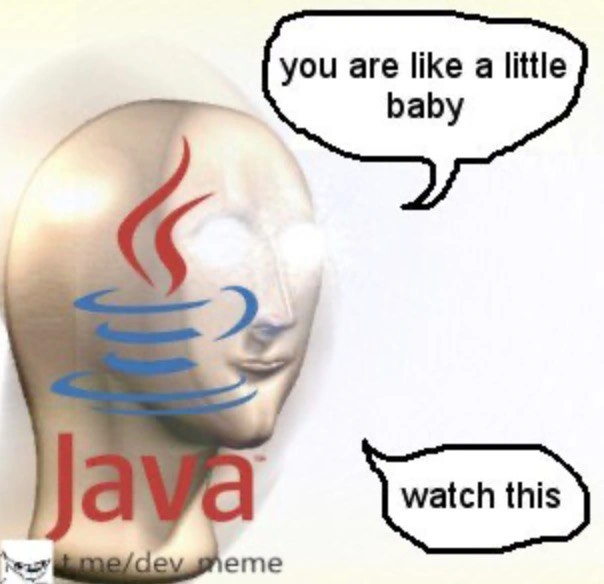
In this meme, the programming language Java is depicted as a character basically telling all the other languages, “You’re just little babies compared to me — watch what I can do!” The image is using a popular meme format where one person says, “you are like a little baby,” and then boldly goes, “watch this.” It’s a way to show someone bragging that they can outdo others by a huge margin. Here, Java (represented by its red logo text and iconic coffee cup symbol on a mannequin head) is the one doing the bragging. The two speech bubbles in the picture contain the only text, and that’s exactly what Java is saying.

Java is a very widely-used programming language, especially known in big companies and large applications. It’s been around a long time (since the mid-1990s) and has a reputation for being solid, scalable, and a bit heavyweight. When we say a language is “heavyweight,” we mean it might use more memory or have a lot of features and setup, but it can handle big tasks. By contrast, some newer languages like Python or JavaScript are often called “lightweight” or “scripting” languages – they can be easier to write and great for quick tasks, but they might not be as fast or strict in how they run. These differences lead to a lot of playful banter in the programming community about which language is better for this or that. Those debates are nicknamed the “language wars.” It’s kind of like sports team rivalries, but for coders – Python vs Java, Java vs C++, JavaScript vs everybody, and so on, each with fans claiming their favorite is superior. It’s a common source of DeveloperHumor and very relatable because almost every coder has their favorite language (and possibly a least favorite!).

In the meme’s joke, Java is cast as the cocky older kid on the block, full of bravado (i.e. swagger and confidence). The phrase “you are like a little baby” is trash-talking other languages, implying they’re childish or weak. When Java says “watch this,” it’s about to demonstrate something impressive. The humor is that Java often is indeed used for huge projects – think about banking systems, large-scale web servers, Android apps – so it’s bragging that it can do things on a much bigger scale than those “baby” languages. For example, a Java program might handle millions of users or run non-stop for months. Java has features like a powerful virtual machine (the JVM) and strong typing that make it reliable for these giant projects. So in a joking way, the meme suggests Java is going, “Ha! Your little script is cute. I run the big leagues. Step aside and let me show real power.”

To put it in concrete terms, imagine a conversation between developers:

  • A Python developer might say, “Wow, I wrote this neat tool in just 10 minutes with a few lines of code!”
  • A Java developer responds with this meme, essentially meaning: “That’s nice and all, but Python is like a kid’s toy. Watch this – I can write a full-blown application that might take more code and time, but it will run faster and handle way more users without crashing.”

The meme uses Java’s actual logo on the mannequin head to make it clear Java is the one talking. (Fun fact: Java’s logo involves a coffee cup with steam, and even the name “Java” comes from a type of coffee. That’s why we often associate Java with coffee imagery, like the phrase “Java is brewing something cool.”) The speech bubbles are drawn in a simple, almost cartoonish style, which is common in meme images. This simplicity makes it instantly recognizable and funny – you have a blank-faced “Java head” delivering a smack-down line in a deadpan way.

This is a form of programming language humor where we personify languages as if they’re people with personalities. Java in this scenario is the boastful, experienced one. The “watch_this” meme format is basically the internet’s way of showing someone doing a dramatic flex (slang for showing off). So Java is flexing its programming muscles. It’s saying other languages are “little babies” – maybe they’re easier to use or newer, but Java sees them as not as serious or capable for the really tough jobs. And then “watch this” implies Java will now do something jaw-dropping, presumably to prove its point.

It’s important to note that this is all in good fun. In reality, every language has its pros and cons. But developers like to tease each other about these things. If you’ve ever heard developers chatting, you might catch them joking like, “Oh, you used that tiny script language for this task? We should’ve used RealJava™, it would handle it no problem.” They don’t literally mean one language is a baby, but it’s a tongue-in-cheek way to poke fun at the differences.

So, summarizing the meme in simpler terms: Java is portrayed as a confident show-off telling other programming languages, “Haha, you’re kids stuff; stand back and watch me work my magic.” It resonates with programmers because it dramatizes the kind of playful boasting we see in tech communities. The joke works even if you’re a relatively new coder: you just need to know Java is a major language and that programmers often compare languages as if they’re competing. Seeing Java call others “little baby” is unexpected and silly, which is exactly why it’s funny.

Level 3: Hold My Coffee()

Experienced developers immediately recognize the humor here: this meme is Java’s equivalent of a “hold my beer” moment. In the programming world’s never-ending LanguageWars, each language’s fans love to claim theirs is the most powerful, the fastest, or the most “professional.” The two-panel format with the phrase “you are like a little baby – watch this” is a popular way to depict one-upping someone else’s achievement. By plastering the Java logo on the mannequin head, the meme personifies Java as that senior developer who smugly tells the younger ones to step aside. It’s as if Java is saying, “Aw, that’s cute, kid. Let the grown-up show you how it’s done.”

This strikes a chord with veteran engineers because it satirizes a very familiar scenario. Many of us have seen (or been in) debates where, for example, a Python or JavaScript developer is proud of how quick and easy their language is, and then a Java expert chimes in about robustness or performance. Consider a chat between programming languages as developers often jokingly imagine:

Python: “Look, I built a web app in a day with just 50 lines of code!”
Java (sips coffee): “You are like a little baby. Watch this – my enterprise server handles 10,000 simultaneous users without breaking a sweat.”

It’s a playful exaggeration of real attitudes. Java has been around since 1995, and in that time it’s grown into a sort of industry heavyweight. Seasoned devs remember the days when Java itself was the upstart, being dismissed by old C/C++ veterans as a “toy” because it handled memory for you. Fast forward a couple of decades, and now Java is the establishment, sometimes looking down on newer languages. The line “you are like a little baby” captures that elder-generation condescension perfectly. Java’s basically pulling rank on the newer kids (be it Python, JavaScript, Ruby, or any trendy language du jour), implying they’re naïve and weak.

The humor also comes from Java’s well-known bravado in real life. Java is used in huge, mission-critical systems – think banking software, large-scale e-commerce, Android apps – so its proponents often tout its scalability and maturity. There’s an in-joke among developers about “enterprise Java” being capable of just about anything (given enough memory and servers!). When this meme says “watch this,” we imagine Java whipping out some massive, over-engineered solution – like spinning up a robust 12-layer architecture or firing up the JVM to perform some heavyweight feat that would make a simple script language quiver. It’s relatable humor because many devs have witnessed the scenario: a simple solution in a newer language versus a heavy-duty solution in Java that, while more complex, can handle far more load.

Another layer to the joke is the absurd confidence. Java, represented by a blank-faced mannequin with a smug aura, is basically flexing its proverbial muscles. The speech bubbles in the image come from a known meme template, so anyone steeped in internet culture and coding humor gets the reference – it’s deliberately over-the-top. The top bubble (“you are like a little baby”) belittles the competition, and the bottom bubble (“watch this”) sets the stage for a dramatic demonstration. Senior devs find this funny because it captures the tone of countless online flame wars and water-cooler arguments: Language X is scoffing at Language Y. It’s a caricature of those programming holy wars where every programmer has a proud story of why their language conquers all.

Crucially, the meme isn’t truly advocating that Java is the best at everything; it’s poking fun at the tribalism of programmers. A seasoned engineer knows that every language has strengths and weaknesses – there’s no real “alpha” language that’s objectively best. But the persona of Java in this meme is that stereotypical braggart who ignores nuance. That’s what makes it funny! It’s Java playing the role of the confident old-timer who has “seen it all.” For a developer who has been around, the meme works on two levels: you chuckle at the ridiculous swagger, and you nod knowingly because, yeah, you’ve met developers (and languages) with exactly that attitude.

Even the visual choice – slapping the official Java logo (red letters and the steaming coffee cup icon) on a featureless mannequin head – is part of the joke. It’s common in dev memes to represent languages or technologies with their logos as characters. Here Java is literally given a face (albeit a creepy mannequin face) to speak with. The bland, glowing-eyed head makes the scene even more surreal and humorous. It’s like Java is portrayed as an impassive, unblinking entity that majestically declares superiority. The faint watermark “dev meme” suggests this image was shared in developer circles, where everyone immediately recognizes the silliness of a programming language smackdown.

In essence, the senior-perspective joke is: Java, that big enterprise workhorse many of us have worked with, is flexing as if to silence the upstarts. It’s a comic reminder of those times a colleague or online commenter said, “Sure, your Python script is neat, but wait till you see what our Java system can do.” The meme distills that pride (and mild arrogance) into one quotable moment. And because it’s such a relatable scenario in tech – practically every programmer has witnessed a “my language can beat up your language” debate – it gets a knowing laugh. Java saying “you’re a baby, watch this” manages to be both absurd and true to life, which is exactly the sweet spot for developer humor.

Level 4: Bytecode Bragging Rights

At the deepest technical level, Java's bravado rests on serious computer science underpinnings. In theory, any Turing-complete programming language can compute the same functions given enough time and memory. But in practice, languages differ in how efficiently and safely they execute tasks. Java packs several sophisticated features into its runtime that give it plenty to boast about:

  • JVM and Bytecode: Java code is compiled into an intermediate form called bytecode which runs on the Java Virtual Machine (JVM). This design makes Java programs portable across operating systems. The JVM abstracts away the hardware details, acting like a universal CPU. Write your code once in Java, and the JVM lets it run anywhere (Windows, Linux, Mac) without modification – the famous "Write Once, Run Anywhere" flex. This cross-platform muscle was a huge bragging point when Java emerged, showcasing a level of versatility many languages lacked.
  • Just-In-Time Compilation (JIT): The JVM isn’t just an interpreter; it’s an optimizing beast. Java’s HotSpot JVM monitors the program as it runs, and when it notices certain code getting executed a lot (so-called "hot" code paths), it Just-In-Time compiles those parts down to native machine code. Essentially, Java brews up custom optimized instructions on the fly for its critical sections. As a Java program runs longer, it can actually speed up, approaching the performance of lower-level languages like C++ in long-running server applications. This dynamic optimization gives Java a big "watch this" flex against purely interpreted languages (which must re-interpret code every execution instead of optimizing it).
  • Garbage Collection & Memory Management: Java automatically handles memory through a garbage collector. Under the hood, the JVM employs advanced algorithms (like generational GC, which assumes most objects die young and reclaims those quickly) to free up memory used by objects that are no longer needed. This means Java programs manage a huge heap of memory without developers manually wrestling with pointers or malloc/free as in C/C++. It’s backed by decades of academic research in memory management. So when Java boasts, "watch this," one subtext is how it can juggle a vast amount of memory and still avoid entire classes of bugs (like buffer overflows or use-after-free errors) that lower-level languages have to handle carefully. The trade-off is that Java’s runtime is heavier (and sometimes the garbage collector will pause the program briefly), but for many scenarios that’s a worthwhile price for safer memory handling.
  • Static Typing and Compile-Time Checks: Java is a statically-typed language with a strict compiler. All variables and functions have declared types, and the compiler won’t let the program even compile if type rules are broken. This is like having a safety net or a referee always checking your code before it runs. It prevents a whole category of runtime errors – you’ll never get a type error in the middle of running a Java program because those were caught during compilation. In a theoretical sense, Java’s type system is doing a bit of formal verification (ensuring, for example, that you don’t try to call a method on an object that doesn’t support it). The payoff is reliability in large codebases: a 100,000-line Java program might be verbose, but many bugs are squashed before the code ever goes live. Java can brag here: “My code might be longer and verbose, but at least I know it’s type-safe and solid before it starts.” In academic terms, this reflects a design philosophy valuing early detection of errors (something languages in the ML or Haskell families push even further with advanced type theory).
  • Concurrency and the Java Memory Model: From its early days, Java was built with multithreading in mind. It has a well-defined Java Memory Model that dictates how threads interact with memory, and it provides high-level concurrency utilities in java.util.concurrent. In practice, this means Java can effectively utilize modern multi-core processors by running many threads in parallel. There’s no Global Interpreter Lock limiting execution to one thread at a time (unlike CPython, where the GIL means only one thread runs Python bytecode at once). A Java program can spawn, say, 100 threads to handle 100 tasks concurrently on a 32-core machine, truly running in parallel. This gives Java bragging rights in scalability – it’s saying to some lighter-weight languages, "Oh, you can’t use all the CPU cores easily? You are like a little baby. Watch me handle real parallel workloads." The robust thread model and tools like thread pools, concurrent collections, and lock-free algorithms mean Java can tackle high-throughput, enterprise workloads (like processing thousands of transactions per second) with confidence.

In short, Java’s meme-worthy flex isn’t just empty bravado – it’s grounded in real technical strengths engineered over decades. The language brings a virtual machine powerhouse, self-optimizing execution, automated memory management, strict type safety, and proven scalability. It’s like an old heavyweight champion with a high-tech training regimen: Java has the raw technical muscle and clever tricks under the hood to back up its boastful claim.

Description

A surreal meme featuring a glowing-eyed Meme Man's head with the Java logo superimposed on it. A speech bubble from the character says, "you are like a little baby," and a second, smaller bubble below says, "watch this." A watermark for "t.me/dev_meme" is visible in the bottom left corner. This meme format humorously depicts Java as an older, more established programming language condescendingly addressing newer, simpler languages. The joke plays on Java's reputation for being powerful, verbose, and suitable for large-scale enterprise applications, suggesting it's about to demonstrate a capability that "lesser" languages lack. For experienced developers, it's a relatable jab at language wars and the perceived arrogance of a language that, while powerful, is often criticized for its boilerplate and complexity

Comments

7
Anonymous ★ Top Pick Java telling a Python script 'watch this' before spinning up a ThreadFactory, a dependency injection container, and three design patterns just to print 'Hello, World!'
  1. Anonymous ★ Top Pick

    Java telling a Python script 'watch this' before spinning up a ThreadFactory, a dependency injection container, and three design patterns just to print 'Hello, World!'

  2. Anonymous

    Java: “You’re like a little baby - watch this: I’ll add records, lambdas and virtual threads, keep 25 years of byte-code compatibility intact, and the only thing that breaks is your build because you pinned Maven to 3.0-beta-1.”

  3. Anonymous

    When the junior dev complains about your three-layer architecture, so you introduce them to AbstractSingletonProxyFactoryBean and watch their soul leave their body

  4. Anonymous

    When a Rust evangelist calls Java outdated, but then Java casually mentions it's still running 90% of Fortune 500 backend systems, has a 25+ year battle-tested ecosystem, and doesn't require rewriting your entire codebase every time the language committee decides to 'improve' the borrow checker. Sure, it's verbose - but at least the JVM won't make your junior devs cry during code review over lifetime annotations

  5. Anonymous

    Java’s party trick isn’t speed, it’s archaeology: “watch this” - boot a 2005 WAR on JDK 21 like time never passed, then greet you with the traditional NullPointerException

  6. Anonymous

    Java: watch this - spin up an XML-driven EJB that builds a factory for builders behind seven AOP proxies just to log Hello World

  7. Anonymous

    Java dev: 'Watch this' *deploys hello world as a 500MB Spring Boot JAR with full observability stack.*

Use J and K for navigation