Enterprise Java Naming Conventions Be Like
Why is this Languages meme funny?
Level 1: Too Many Words
Imagine you had a toy box, and you gave it a name by listing every single toy inside it. You might call it the "ActionFigureLegoDollCarTruckBuildingBlocksPuzzleGamesBox". That’s a silly name, right? It’s so long that it’s hard to say or even understand. You’d probably giggle if someone seriously called a toy box that.
This meme is joking about a similar idea, but with the name of a piece of code. The name is stuffed with words – basically every fancy programming idea the person could think of. It’s like a job title with every title in the book: “Senior Executive Manager Director Chief of Everything Honorable Etc. Etc.” At some point, it just becomes funny because it’s too much. The core of the joke is that the class name is ridiculously overcomplicated, and anyone who sees it can tell something is not quite right. In simple terms: the name is so unnecessarily long and complicated that it makes people laugh, much like an overly long made-up word or a person with 20 middle names.
Level 2: Naming Convention Overload
In Java (and programming in general), naming conventions are guidelines for how to name your classes, methods, and variables. A good name is typically concise yet descriptive of the class’s purpose. For example, a class that handles database access might be called DatabaseManager or UserRepository. You usually aim for a name that gives other developers a quick idea of what that class does.
Now, what’s going on in this meme is that someone has taken that to an extreme – instead of one or two words, they’ve crammed an entire sentence of technical terms into the class name. Let’s break down one of these behemoths:
EnterpriseAbstractIntegerInputGlobalSanitizerSQLServiceRunnerManagerAgileImpl.class
That is a mouthful! Piece by piece:
- Enterprise – often used to imply "for big business use" or just to sound important. In code, this word doesn’t have a technical function; it’s pure fluff to say “this is part of the big enterprise system.”
- Abstract – in Java, this likely means it’s an abstract class (one that isn’t meant to be directly instantiated). We often prefix class names with
Abstractwhen it’s a base class providing common functionality to subclasses. - IntegerInputGlobalSanitizer – sounds like it sanitizes (cleans/validates) input, specifically integers, and does so in a “global” way (maybe across the whole application). Input sanitization is important, e.g. preventing SQL injection by cleaning input data. But usually you might name a class
InputSanitizerorIntegerSanitizer, not this gigantic phrase. - SQLServiceRunner – possibly suggests this class runs some kind of service related to SQL (databases). Maybe it executes SQL queries or starts a database service.
- Manager – a very common suffix meaning this class "manages" something (could be coordinating workflows, managing resources, etc.).
- AgileImpl –
Implis short for Implementation, often used in Java to name a concrete class that implements an interface. For example, you might have an interfacePaymentServiceand a classPaymentServiceImpl. Here, they slappedImplat the end, implying there’s probably an interface with the same gigantic name minusImpl. But they also included the word Agile right before that, which is bizarre – “Agile” is a development methodology (how you organize your team work), not something that belongs in a class name. It seems thrown in as a buzzword, since companies love saying “Agile”. In a class name it has no technical meaning; it just adds to the confusion.
So this one class name is trying to be an Abstract base class, a Sanitizer of input, a Service Runner, a Manager, and an Implementer of some interface, all at once. That’s five different roles in one name! In good object-oriented design, one class usually has one clear responsibility. If you find yourself adding word after word, it might mean your class is doing too much.
Another example from the meme:IBaseEnterpriseVisitorOutputPrintableContextGeneratorSingletonMiddlewareStrategyConfiguratorFactoryReturner.class
This one is even more stuffed. Notice it starts with I – that likely means it’s an Interface (IBase...), a convention borrowed from languages like C# or older Java code where interface names start with "I". So IBaseEnterpriseVisitor... is probably an interface, and then maybe there’s a class implementing it with the same monstrous name minus the "I" (or plus Impl). They also put Base and Enterprise at the start, again redundant words to sound important. Inside the name we see:
- Visitor – referring to the Visitor pattern, where an object (visitor) is passed through elements of a structure to perform operations on them. Classes implementing a visitor might have Visitor in their name (e.g.,
ReportVisitor). - OutputPrintableContextGenerator – suggests it generates some context that is printable for output. That’s very specific. Usually you might have a
ReportGeneratororContextBuilder, but here it’s "OutputPrintableContextGenerator" – maybe a class that generates context which can then be printed? - Singleton – implies the Singleton pattern, meaning only one instance of this class should exist. It’s unusual to literally put "Singleton" in the class name (usually you enforce that pattern in code, not in the name), but they wanted to tick that box too.
- Middleware – Middleware is software that connects different parts of an application, often processing data in between (like middleware in a web server that handles requests in a pipeline). So this suggests the class might act in the middle of some process.
- Strategy – referring to the Strategy pattern, where you have interchangeable algorithms or behaviors encapsulated in classes. They’ve tossed "Strategy" in there, implying this class could be one of many strategies.
- Configurator – implies it configures something, maybe sets up objects or a system (configuration pattern).
- Factory – the Factory pattern creates objects. Having both Factory and Returner is redundant; a factory by definition returns objects. Maybe they thought “Factory” alone wasn’t enough and added Returner to really drive home that it returns something. This is definitely interface prefix overuse and suffix overuse to the extreme.
Finally, we have AdvancedLoopStateManipulationResultRetrievalViaExternalBusinessClientPayloadRunner.class. Breaking that down:
- Advanced – just a adjective to sound fancy. Often not helpful in a name (what makes it advanced? No idea).
- LoopStateManipulation – suggests the class manipulates the state of a loop? Perhaps it controls an iterative process or manages state in a looping computation.
- ResultRetrievalViaExternalBusinessClient – indicates it retrieves results through an external business client. This sounds like it’s interacting with an external system or service (maybe calling a business client API) to get some result. It’s very specific, as if describing an entire process in the name.
- PayloadRunner – implies it "runs" a payload (maybe executes some data through a system). "Runner" is often used for classes that execute tasks (like
JobRunner,ScriptRunner). So maybe this class takes a “payload” (data package) and runs it through some external client to retrieve a result, and does some advanced loop state manipulation while at it. Phew! That’s a lot to digest in one identifier.
The meme exaggerates these names to highlight poor naming practices. In real life, you might not frequently see one quite this long, but you do see overly verbose names in some codebases, especially older or very bureaucratic enterprise projects. Often it happens when developers try to make the name super descriptive or when a class’s scope has grown over time but nobody refactored or renamed it. It’s also a side effect of combining multiple layers of functionality. For example, in an enterprise backend, you might have a pipeline: input comes in -> it gets sanitized -> goes through business logic -> data access -> output returned. Instead of keeping each step separate and naming each class clearly, someone might create one giant class to handle multiple steps and then give it a concatenated name to reflect everything. This leads to code bloat and headaches for anyone reading it.
From a code quality perspective, these names are code smells. A code smell is a hint that something might be wrong in your code structure. If you see a class named SomethingSomethingManagerProcessorHandlerFactoryBeanImp, it's a strong sign the design might need rethinking. Maybe that class should be split into smaller classes or simplified. Maintainability suffers because the next developer (or your future self) will struggle to remember what this class does without opening it up and reading through its implementation. It’s also very error-prone – imagine trying to type that name correctly to use it, or searching for it in your project. Typos and misunderstandings are almost guaranteed.
Good naming conventions in Java (or any language) usually encourage clarity and brevity:
- Use CamelCase (capitalizing each word, like
CustomerService). - Avoid redundant words. You don't write
UserUserManagerClassClass. - Don’t include implementation details or multiple patterns in the name. The class name doesn’t need to spell out how it does its job, just what it is. e.g.
DatabaseConnectornotSingletonDatabaseConnectorFactoryAgileImpl.
This meme is funny to developers because it’s a caricature of real issues. It’s developer humor with an edge of truth. We laugh, but only to keep from crying – because many of us have indeed seen a DataAccessObjectFactoryManager or an AbstractProxyServiceBean and had to deal with that legacy code. It teaches even junior developers an important lesson: Just because Java allows long names, doesn’t mean you should create a ridiculously long class name. Keep it readable. If your class name looks like a novel, consider refactoring!
Level 3: Design Pattern Frankenstein
It's like someone went on a design pattern shopping spree and stitched together a monster. The first class name, IBaseEnterpriseVisitorOutputPrintableContextGeneratorSingletonMiddlewareStrategyConfiguratorFactoryReturner.class, reads like a who’s who of Gang of Four patterns and enterprise jargon:
- Visitor pattern? Check.
- Singleton? Of course.
- Factory? Why have one when you can have two (they even tacked on "Returner" for good measure).
- Throw in Middleware, Strategy, a Context and a Configurator for that extra enterprise flavor.
This isn’t just overkill – it’s overengineering on steroids. In seasoned developer terms, this is a naming anti-pattern symptomatic of classic enterprise Java bloat. The codebase likely has so many layers and abstractions that the class name ended up as a buzzword bingo card. We’re basically looking at a beautiful monstrosity where a single class name tries to telegraph an entire architecture. It’s class name hell: the God Class from the ninth circle, doing too much and telling too little.
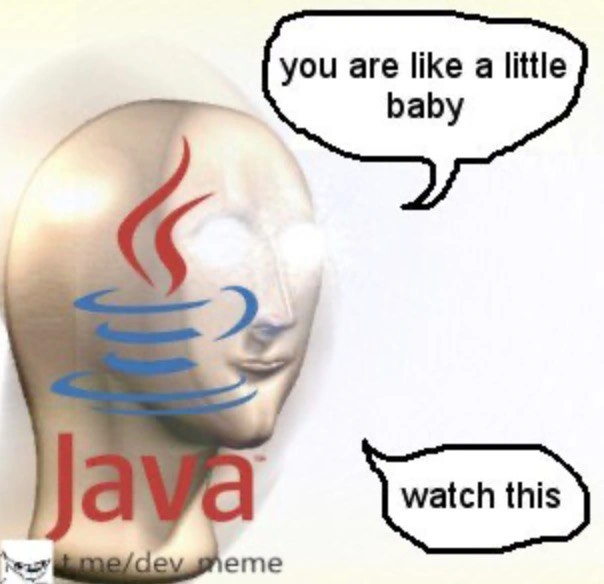
The meme’s purple head with text plastered over it even evokes those expanding brain memes – except here the brain is crammed with acronyms and design patterns instead of cosmic enlightenment. The humor cuts deep for senior devs because we’ve seen this in real life. Legacy code in many a corporate backend project often contains artifacts of ambitious architects who jammed every pattern they knew into one module. The result? A 150-character Java class name nobody can fully remember or pronounce without taking a coffee break mid-way. When you’re on-call at 3 AM trying to debug production and the stack trace points to EnterpriseAbstractIntegerInputGlobalSanitizerSQLServiceRunnerManagerAgileImpl.class, you can practically feel your soul leaving your body. ("AgileImpl"? – There's nothing agile about wading through that.)
Notice the irony: terms like Abstract, Factory, Manager, Impl are all present, often used to organize code – but mashed together like this, they create chaos instead of clarity. It’s a code smell you can detect from orbit. A well-architected system might use one or two of these patterns in different places, each class neatly named for its single responsibility. But here we have the single class seemingly claiming multiple responsibilities, violating the very first principle of good design (hello, Single Responsibility Principle!). In other words, this name hints that the class inside is a Frankenstein of features – likely a maintenance nightmare where one file does far too many things. The overengineering is so extreme that it loops back around to absurdity – and that absurdity is exactly what makes developers smirk and groan. We’ve all encountered that one enterprise library or old EnterpriseJavaBeans style project where class names looked auto-generated by combining every tech buzzword. This meme just cranks it to 11 for comedic effect.
For those of us who survived the era of bloated Java enterprise frameworks, the meme triggers a mix of PTSD and humor. Yes, Java is verbose by nature (getters, setters everywhere), but this is on another level. It satirizes the tendency to equate long, elaborate names with good architecture. Seasoned devs know that simplicity is key for code maintainability. Seeing something like AdvancedLoopStateManipulationResultRetrievalViaExternalBusinessClientPayloadRunner.class in a code review would make any senior engineer do a double-take and then gently suggest the author lay off the interface prefix overuse and perhaps consider refactoring. After all, if you need to concatenate every known pattern into the name, maybe – just maybe – your design itself is the problem.
And yet, this isn’t pure fantasy. The joke lands because it caricatures a real phenomenon. (Anyone remember Spring’s infamous AbstractSingletonProxyFactoryBean? That class name is practically minimalist compared to these.) The meme exaggerates to make the point: ridiculously long class names are a sign that your code has gone off the rails into over-engineered territory. It’s poking fun at a certain enterprise culture where more layers, more patterns, and more words were seen as the hallmark of "architectural maturity". The result is code that is harder to read than War and Peace, and about as fun to maintain as diffusing a bomb. In short, this meme hits on a truth every experienced developer learns: just because you can shove every pattern into one class (and name), doesn’t mean you should.
Description
A surreal meme featuring a translucent, purple-hued Meme Man head. Faintly visible in the background is the red and blue Java logo. Overlaid on the image are three excessively long, satirical Java class names, each ending in '.class'. The names are: 'IBaseEnterpriseVisitorOutputPrintableContextGeneratorSingletonMiddlewareStrategyConfiguratorFactoryReturner.class', 'EnterpriseAbstractIntegerInputGlobalSanitizerSQLServiceRunnerManagerAgileImpl.class', and 'AdvancedLoopStateManipulationResultRetrievalViaExternalBusinessClientPayloadRunner.class'. The meme humorously exaggerates the verbosity of Java, particularly in large-scale enterprise environments where developers often create extremely descriptive class names by chaining together design patterns and functional descriptors. This is a classic inside joke for senior developers who have worked with or maintained complex, over-architected systems where such naming conventions are common, reflecting a culture of excessive abstraction and boilerplate

Comments
7Comment deleted
The author of the top class name probably thought they were being clever, but all they did was exhaust the IDE's autocomplete suggestions and the patience of the next developer
Team guideline: the moment a class name breaches the JVM’s 64 KB constant-pool limit, we call it a microservice boundary
The best part about these class names is that somewhere, there's a junior dev who just spent three days debugging why BaseEnterpriseVisitorOutputPrintableContextGeneratorSingletonMiddlewareStrategyConfiguratorFactoryReturner returns null, only to discover it's working as designed because nobody remembered to implement the actual Returner part
The genie grants your wish for 'enterprise-grade architecture,' but the monkey's paw curls: every class name now requires a full sprint's worth of typing, your IDE's autocomplete crashes from exhaustion, and junior developers need a PhD in design pattern archaeology just to understand what a class does. The real magic trick? Convincing management that 'BaseEnterpriseVisitorOutputPrintableContextGeneratorSingletonMiddlewareStrategyConfiguratorFactoryReturner' is somehow more maintainable than 'PrintService' - because nothing says 'scalable enterprise solution' like needing a line break in your import statement
Class names so over-abstracted, they violate SRP just by existing
Senior heuristic: if the class name exceeds 80 characters and ends in Impl/ManagerRunnerFactory, you’ve found the monolith hiding in your package‑by‑layer
If your class name already says VisitorSingletonStrategyFactoryRunnerManagerImpl, the only pattern you’ve implemented is God Object