Skip to content
DevMeme
2664 of 7435
The Original Dark Theme for Planet Earth
UX UI Post #2943, on Apr 11, 2021 in TG

The Original Dark Theme for Planet Earth

Why is this UX UI meme funny?

Level 1: Switching Off the Sun

Imagine you have a big light in your room. In the daytime, the light is turned on and everything is bright. At night, you flip a switch and turn the light off, making the room dark. This meme joke says the world does the same thing: during the day the “light is on” (it’s bright outside), and at night someone just hit the dark mode switch, so it becomes dark. It’s a silly way to describe day and night. People who make computer programs often use “dark mode” to make the screen dark with light writing because it can feel nicer on the eyes – kind of like dimming the lights before bedtime. So the joke is comparing real life night-time to the computer’s dark theme. It’s funny because we know night isn’t actually caused by a settings button, but thinking about the night as if the whole sky just changed its theme colors is a goofy idea. It’s like saying the sun has a on/off button! The reason this makes us smile is that it mixes something very ordinary (day vs. night) with computer talk (light mode vs. dark mode). Even if you don’t know much about coding, you know turning off the lights makes things dark – so calling night “dark mode for day” is a playful twist that anyone can giggle at.

Level 2: Light vs Dark Showdown

For a less seasoned developer (or someone new to this meme), let’s break down the key ideas. Dark mode (aka dark theme) is a setting in applications where the background is dark (usually black or gray) and the text is light (white or colored). Light mode is the opposite: dark text on a bright background (often white, like a traditional document). This meme jokes that nighttime in the real world is basically the planet using a dark theme – as if the sky turned black and the world’s “UI” switched its color scheme from day to night. It’s a playful comparison, because in development we often talk about toggling themes in apps, and here someone is saying the entire world toggles its theme.

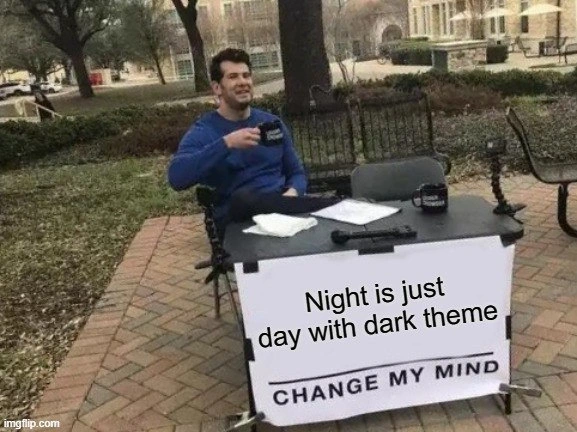
The scene in the image is from the popular “Change My Mind” meme template. Typically, a person sits behind a sign that states an opinion, inviting others to debate it. In this case, the sign says: “Night is just day with dark theme.” It’s a deliberately funny, somewhat ridiculous statement. The humor comes from mixing everyday reality (day vs night) with tech jargon (dark theme). Developers find it relatable because toggling between dark and light mode in apps is a daily experience – we even have heated discussions about which is better for coding or design. Seeing that concept applied to literal day and night is unexpected and silly, which is why it’s amusing. It’s tech humor making fun of our own tendencies.

Let’s clarify some terms and context:

  • UX/UI: Stands for User Experience / User Interface. In design, providing a dark mode is considered good UX, since it gives users a choice for what’s comfortable. UI design often involves creating two sets of colors, one for light theme and one for dark theme, and letting the user toggle.
  • Developer Experience (DX): This refers to the tools and environment that developers use. A dark-themed code editor or terminal is often part of a comfortable developer experience, especially for those coding into the night. Many dev tools default to dark mode now because of popular demand.
  • Frontend: The part of software that users directly interact with (like websites or apps) – front-end developers are usually the ones implementing theme toggles and making sure the design looks right in both light and dark modes. For example, a frontender might define CSS variables for colors and then switch those values when the user chooses dark theme.
  • Accessibility & contrast: Accessibility in design means making sure as many people as possible can use the interface comfortably, including those with visual impairments. Contrast preference is a part of that – some users need high contrast (very clear differences between text and background colors) to read easily. Dark mode can sometimes improve contrast (white text on black is high contrast), but it depends on the context and the person. For instance, someone with astigmatism might find white text on black a bit fuzzy; someone else with light sensitivity might find a bright white screen painful. That’s why offering both themes is useful.
  • Dark mode debate: If you hang around developers, you’ll quickly notice they love to debate almost anything trivial – including whether dark mode or light mode is superior. It’s half joking, half personal preference. There are countless memes and jokes (like this one) about how “real developers use dark mode” or how opening a light-themed IDE at night is like opening the Ark of the Covenant (blindingly bright!). It’s an ongoing, tongue-in-cheek argument, similar in spirit to arguing over which text editor is the best.

To illustrate the core comparison the meme is making, consider this table:

Real World Cycle UI Theme Setting
Daytime (bright sky, sun) Light Theme (bright background, dark text)
Nighttime (dark sky, stars) Dark Theme (dark background, light text)
Caused by Earth’s rotation (natural) Caused by user preference or app setting (manual/automatic)
Transition at sunset/sunrise (gradual) Instant toggle or scheduled “night mode” in software (timed)

In reality, night isn’t just a color swap – the sun actually isn’t lighting our side of the Earth. But describing it as a mere “theme change” is funny because it’s such a software developer way to think about things. It’s the kind of cheeky simplification you might hear from a programmer who spends all day working with themes and settings. We often anthropomorphize our tools and then project that logic onto the real world as a joke.

For a junior dev, this meme is also a gentle introduction to the importance of considering themes in design. If you build a website today, you might get requests from users for a dark mode. On the web, implementing a theme toggle could be as simple as adding a button that adds a class like .dark-theme to the HTML <body> element, which triggers alternate color styles. For example, you might have CSS like:

body.dark-theme {
  background: #2e2e2e;
  color: #f1f1f1;
}

And a script that toggles this class when a user clicks a “🌙” icon for dark mode. So in actual development, “day vs night” can be switched with code. Many apps also let you set it to automatic, so at a certain hour (say 7pm) the app goes dark – mimicking the real day/night cycle! This is partly for convenience and partly to align with how people’s eyes adapt in the evening. It’s a neat practical feature rooted in the same idea the meme jokes about.

Lastly, the Change My Mind meme format implies the person at the table is challenging others: “Go ahead, prove me wrong.” In this case, it’s funny because no one in their right mind would seriously equate night and day to just a theme setting – it’s clearly a joke. But if a fellow developer walked by, they might play along and say something like, “Actually, have you seen the contrast ratio of moonlight? We might need a higher ratio for accessibility!” or “Alright, who has the admin rights to toggle the sun back on?” – continuing the gag. The meme invites this kind of nerdy banter. It’s tech humor through and through, riffing on a concept every coder deals with (dark mode) and exaggerating it to the scale of the whole planet.

Level 3: The Dark Mode Doctrine

On the surface, this meme proclaims a mock-serious philosophy that dark mode is all-encompassing – so much so that even nighttime itself is just daytime with a global dark theme applied. This absurd equivalence is what makes developers smirk. It’s poking fun at how passionately programmers debate light vs dark theme in their tools, as if it’s a battle of cosmic significance. The image uses the classic “Change My Mind” meme format – a person at a table with a sign – to boldly state: “Night is just day with dark theme.” The humor lies in applying a UI design concept (themes) to the real world. We’re essentially seeing a developer’s worldview leak into everyday life. Experienced devs find this hilarious because it satirizes how we sometimes over-index on trivial tech preferences (like editor color schemes) and frame everything in those terms.

In practice, dark mode has indeed become a near-doctrinal part of developer experience (DX). Many of us spend long nights coding, and a bright white screen at 2 AM feels like staring into a supernova. Turning on dark theme is almost a ritual – a sign you’ve joined the coder tribe. There’s a running joke in tech communities that if you see someone coding with a white background, they must be a sociopath or trying to summon eye strain demons. It’s developer humor, of course, exaggerating a common preference. This meme takes that inside joke to the extreme: implying the entire universe switches to “dark mode” at sundown.

Why is this so relatable? Seasoned developers recall the countless debates on forums and team chats about the merits of dark background with light text versus light background with dark text. It’s a bit like the “tabs vs spaces” or “Vim vs Emacs” holy wars – intense opinions on something that ultimately comes down to personal taste and comfort. The dark_mode_debate has practical roots: dark themes can reduce glare at night and may be easier on the eyes for some, while light themes can appear cleaner in bright environments or print previews. Frontend teams and UX design guidelines now commonly include a theme toggle because user preference is split. Apple, Microsoft, Google – all added system-wide dark modes around 2018-2019, and developers cheered as if a major bug had been fixed in real life. By the time this meme was posted in 2021, dark mode was everywhere from IDEs, browsers, Slack, Stack Overflow, to your code deployment dashboards. It was no longer a niche; it was an expectation. The meme humorously exaggerates that mindset: “if everything in software can have a dark theme, why not the sky?”

From a senior perspective, there’s subtext about accessibility and contrast preference too. In UI/UX circles, it’s known that offering a dark theme isn’t just trendy, it can improve readability for those sensitive to light or with certain vision conditions. High contrast themes (whether light-on-dark or dark-on-light) help different folks. This meme’s statement plays on that contrast thinking: night (dark background, light stars) vs day (light background, dark trees and buildings) – it’s a cheeky analogy to color inversion. Veteran developers might chuckle and also recall the historical cycle: early computer terminals were actually dark mode by default (green or amber text on black screens in the 1970s-80s). Then GUI applications and Word docs made black-on-white text standard (like paper). Now we’ve come full circle asking for dark backgrounds again! It’s a little ironic and shows how developer preferences evolve and often swing like a pendulum.

Technically, implementing dark mode today is part of any senior frontend developer’s toolkit. We use CSS tricks or platform APIs to toggle themes seamlessly. For example, many sites utilize the prefers-color-scheme CSS media query to detect if a user’s OS is in dark mode and automatically switch styles:

/* Automatically apply dark theme if user prefers dark mode */
@media (prefers-color-scheme: dark) {
  body {
    background-color: #121212;
    color: #e0e0e0;
  }
}

In code editors or IDEs, a theme toggle might just swap a stylesheet or activate a predefined palette. Under the hood, it’s like flipping a boolean flag from light to dark, not unlike how nature flips from day to night. Of course, the real world doesn’t actually work by a single boolean flag – Earth’s rotation is a bit more complex than a config switch! – but that’s exactly why the meme is funny. It reduces a complex reality to a simple developer setting. Senior devs appreciate the layered joke: it’s simultaneously making fun of our sometimes overzealous love for dark mode and nodding to the very real considerations of UX/UI design in software.

Description

This meme uses the popular 'Change My Mind' format, featuring political commentator Steven Crowder sitting at a table outdoors with a smug expression, holding a mug. A large white sign on the table presents a challenge: 'Night is just day with dark theme', with the phrase 'CHANGE MY MIND' underlined below it. The image is set in a park or campus-like area. The humor stems from applying a common software development concept - UI themes - to the natural world. It's a classic example of tech professionals viewing everyday phenomena through the lens of their work, making a simple yet clever analogy that resonates with anyone who has ever toggled a dark mode setting in their IDE or application

Comments

12
Anonymous ★ Top Pick The Earth's OS has had automatic theme switching based on ambient light sensors for millennia. We just finally implemented it in CSS with `prefers-color-scheme`
  1. Anonymous ★ Top Pick

    The Earth's OS has had automatic theme switching based on ambient light sensors for millennia. We just finally implemented it in CSS with `prefers-color-scheme`

  2. Anonymous

    “Night is day with dark theme” sounds easy - until the PM files a “quick toggle” ticket and you watch 2,000 design tokens, six micro-frontends, and the email templates declare a production incident at 03:00 UTC

  3. Anonymous

    After 15 years of arguing about tabs vs spaces, we've finally reached enlightenment: the real holy war is whether your retinas prefer searing white backgrounds at 3 AM or trying to debug invisible gray-on-black comments in broad daylight. Meanwhile, the senior architect just uses vim in terminal with default colors because 'themes are bloat.'

  4. Anonymous

    This is the kind of profound architectural decision that gets debated in pull request comments at 2 AM. Senior engineers know that 'dark theme' isn't just a preference - it's a lifestyle choice that reduces eye strain, saves battery life, and signals to management that you're working late. Though let's be honest, the real controversy isn't night vs. day; it's whether Solarized Dark or Dracula is the objectively correct theme, and we all know that's a hill worth dying on during code reviews

  5. Anonymous

    Night is just day behind a feature flag; sunrise is the canary rollback

  6. Anonymous

    Night is just day with dark theme - like production is just staging with feature flags, SLOs, and PagerDuty

  7. Anonymous

    Dark theme: hides legacy code better than any feature flag, even nature reboots daily

  8. @zherud 5y

    Actually it is day that is night with the light theme. Not the other way. Night is the default. You can uninstall Earth and download Asteroid with no "Star near" mod to confirm.

    1. @Supuhstar 5y

      hehehe

    2. @Bender666 5y

      +1

  9. @saeed_rbd 5y

    primitive 😒

  10. @ANTICHRISTUS_REX 5y

    Day is just night with "light" fonts. Night is just day with black background.

Use J and K for navigation