Skip to content
DevMeme
1491 of 7435
I'm PS/2 Ports Old
TechHistory Post #1670, on Jun 6, 2020 in TG

I'm PS/2 Ports Old

Why is this TechHistory meme funny?

Level 1: Back in My Day

Imagine your friend asks, “How old are you?” Instead of telling them a number, you pull out a really old gadget that only someone from years ago would have used – like a big floppy disk or a cassette tape. Your friend might not even know what that is, but it makes them laugh because it shows you’re from an older generation without you saying a number. That’s what’s happening in this meme. Someone is asked their age, and they answer by showing those old-style computer plugs for a keyboard and mouse. It’s like saying, “I’m from the time when we used these things.” The joke is simple: only an “old” tech person would recognize those funny purple and green ports. It’s a friendly way of saying, “I’ve been around a long time,” by using an object from the past. Just like a grandparent might jokingly show a rotary phone to highlight their age, a developer is showing ancient computer ports to humorously prove how old-school they are.

Level 2: Plugging Into the Past

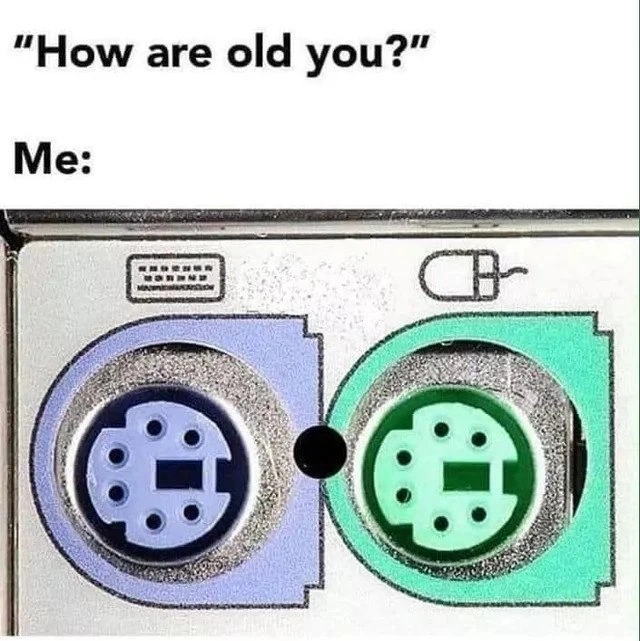
Let’s unpack why two little round connectors can answer “How old are you?” for a developer. The image shows two PS/2 ports on a computer. A port is just a socket where you plug in a device. PS/2 ports were the standard way to connect a keyboard and mouse to a PC before USB existed. They’re round with 6 little holes (for 6 metal pins on the plug). The one with a purple color (and a tiny keyboard icon above it) is for the keyboard_ps2, and the green one (with a mouse icon) is for the mouse_ps2. This color scheme wasn’t random – by the late 90s, PC makers used purple and green to help people plug in the right device. If you’ve only used USB keyboards and mice, you might not have seen these, except maybe on an old dusty computer in a school or your parents’ attic.

PS/2 is actually named after IBM’s “Personal System/2” computers from 1987, which introduced this port style. Back then, things weren’t as plug-and-play as today. You had separate, dedicated ports: one just for the keyboard and one just for the mouse. If you plugged a keyboard into the mouse port or vice versa, it simply wouldn’t work because the computer expected a specific device on each connector. Also, these ports weren’t hot-swappable on older systems – meaning you couldn’t just yank out a keyboard or mouse and plug a new one in while the computer was on. Often, the PC wouldn’t recognize it until a reboot (and in worst cases, you could even short out the port by plugging in at the wrong time!). This is very different from modern USB ports which are universal and designed for hot swapping (you can plug in any USB keyboard or mouse anytime and it usually just works).

To put it simply, the PS/2 ports are legacy hardware now – old technology that has been mostly replaced by newer standards. Modern PCs use USB connectors for keyboards, mice, and almost everything else; many new computers don’t even include these round PS/2 sockets anymore. So, seeing them instantly tells you that the computer (or the person using it) comes from an earlier generation of tech. That’s why the meme caption is essentially saying: “I’m so old-school that I recognize (and use) these ports.” It’s a nod to TechNostalgia – a fond reference to how things were in the past. Younger developers or folks new to computers might not even recognize those purple and green ports, since they grew up with USB and wireless devices. But older developers see them and remember building PCs that had floppy drives, dial-up modems, and these exact sockets for mouse and keyboard. It’s a quick visual way to communicate, “I’ve been using computers since the 90s era.”

Here’s a quick comparison to make it clearer:

Old Setup (PS/2 Ports) Modern Setup (USB)
Separate round port for keyboard (purple) and another for mouse (green). Universal rectangular ports that any device (keyboard, mouse, etc.) can use.
Not hot-swappable – you’d plug in before turning the PC on. Hot-swappable – plug in/out anytime while running.
In use from late 1980s through 1990s, early 2000s. Became standard in 2000s to now (USB largely took over).
Mostly found on older or specialized motherboards today. Found on all modern computers (many PCs have only USB for peripherals).
Example devices: PS/2 mechanical keyboard, PS/2 ball mouse. Example devices: USB gaming keyboard, USB optical mouse, wireless USB mouse.

So, the meme is a playful tech history lesson. When someone asks “How old are you?” the answer shown is a picture of those old PS/2 connectors. In other words, “I’m so old that I used these to plug in my mouse and keyboard.” It’s a joke that those who recognize the ports will get immediately. If you don’t recognize them, well… that kind of proves you’re younger! This is why it’s funny – it’s a little generational wink.

Level 3: DINosaurs of I/O

The meme plays on hardware nostalgia as an inside joke for seasoned developers. The prompt asks “How old are you?” and the reply is not a number but an image of two classic PS/2 ports – one purple, one green – on an old PC motherboard. Instantly recognizing these 6-pin mini-DIN connectors (purple for keyboard, green for mouse) is basically a tech-age litmus test. Only those who built or used PCs in the 1990s or early 2000s will grin, because back then every desktop’s backside had this distinctive duo. It’s a witty generational_hardware_reference: if you look at those round ports and feel a wave of familiarity (or PTSD from plugging in the wrong one), you’ve just proven your veteran status.

In an era before USB became universal, the PS/2 interface (named after IBM’s Personal System/2 computers) was the standard way to connect your keyboard and mouse. Each device had its own dedicated port – and heaven help you if you mixed them up or tried to hot-swap without rebooting. The meme’s humor is that instead of saying “I’m X years old,” the developer simply shows a piece of legacy_hardware that quietly screams “I’ve been around since the Pentium II days!” It’s akin to flashing a membership card to the RetroComputing club. The text is phrased like a QA: “How old are you?”Me: [picture of PS/2 ports].” The answer is implied: old enough to remember these.

For senior tech folks, this brings a chuckle of recognition. It satirizes the fact that in tech, knowing obscure old connectors is a bragging right and a sign of age. We’ve lived through the evolution from PS/2 to USB to wireless. We remember when a misplaced adapter or a bent pin on these ports could ruin your afternoon. (Fun fact: PC99 standards in 1999 even dictated the purple/green color-coding to help users – a small mercy for our backs as we crawled under desks.) Seeing those ports now is like an archaeological find: a reminder of chunky CRT monitors, ball mice you had to clean, and BIOS messages like:

BIOS: Keyboard not found. Press F1 to continue.

Yes, that was a real error – asking you to press a key on the very keyboard it couldn’t detect. Classic. This meme taps into that shared memory. It’s laughing at how fast tech ages: one day you’re bragging about a 56k modem, blink and you’re the “old guy” who remembers when mice had tails. The question “Feeling old?” in the post caption playfully nudges those of us who do recall these ports. In short, the meme is funny because it uses a vintage tech artifact as a tongue-in-cheek ID card for “old-school developer.” It’s a celebration of TechHistory: if you chuckle, you just verified your dev age without saying a word.

Description

A 'tell me without telling me' style meme that uses legacy hardware to indicate age. The meme starts with the text, '"How are old you?"' followed by 'Me:'. Below this, there is a close-up photograph of the back of a PC, showing two PS/2 ports. One port is color-coded purple with a small keyboard icon above it, and the other is green with a mouse icon. These 6-pin mini-DIN connectors were the standard for connecting keyboards and mice to PCs before being superseded by USB. The joke is that the person's age is equivalent to the era when PS/2 ports were ubiquitous, a reference immediately understood by anyone who built or used computers in the 1990s and early 2000s

Comments

7
Anonymous ★ Top Pick I'm old enough to remember when the most stressful part of plugging something in wasn't the USB orientation, but trying to align 6 tiny, fragile pins in the dark behind a desk
  1. Anonymous ★ Top Pick

    I'm old enough to remember when the most stressful part of plugging something in wasn't the USB orientation, but trying to align 6 tiny, fragile pins in the dark behind a desk

  2. Anonymous

    I’m old enough to remember when the keyboard owned IRQ 1, the mouse squatted on IRQ 12, and “hot-plugging” meant rewriting your CV after frying the motherboard

  3. Anonymous

    Nothing says 'I've debugged kernel panics from bent PS/2 pins' quite like remembering when hot-swapping your keyboard meant risking a motherboard replacement, and the only plug-and-play was Russian roulette with your IRQ assignments

  4. Anonymous

    Nothing says 'senior engineer' quite like instinctively knowing which PS/2 port is which without checking the color coding - and having war stories about IRQ conflicts when someone hot-swapped them. Bonus points if you remember the existential dread of realizing you needed to reboot just to plug in a keyboard

  5. Anonymous

    Old enough to read those PS/2 ports as purple = IRQ1, green = IRQ12, and to remember that “hot‑plugging” was the 8042 reminding you who actually owns the A20 gate

  6. Anonymous

    Old enough to have fixed “press F1 to continue” by enabling USB legacy support - with a PS/2 keyboard, obviously

  7. Anonymous

    Old enough that 'hot-plug' meant risking a system lockup and IRQ Armageddon

Use J and K for navigation