A Deal with the Technical Devil
Why is this TechDebt meme funny?
Level 1: Jumbled Instructions
Imagine your friend excitedly hands you a recipe they wrote for a “simple pie.” You expect it to be easy to follow, but when you look at it, the steps are all out of order, some instructions are indented weirdly like they belong under the wrong step, and a crucial mixing instruction is written off to the side in tiny letters. The recipe technically uses all the right ingredients, but it’s so mixed up that you can’t tell when to do what. You feel a bit of panic and despair trying to understand it. It’s like, on the outside everything seemed fine – “simple pie, no problem!” – but now you’re secretly asking yourself, “How on earth am I going to make this thing?” That feeling of seeing a messy, confusing set of instructions and getting a knot in your stomach is the same feeling this meme is joking about. Your friend’s code was supposed to be simple, but reading it is as frustrating as trying to follow a jumbled recipe. It makes you want to cry or quit cooking – or in this case, quit coding – even though a moment ago you were totally fine. That contrast is what makes it funny and relatable: sometimes something called “simple” turns out to be a tangled mess, and your initial excited smile turns into a silent, stunned stare. In non-tech terms, it’s basically showing how a cheerful offer can hide a big frustrating surprise, and the look on your face when you realize it is the real punchline.
Level 2: Indentation Matters
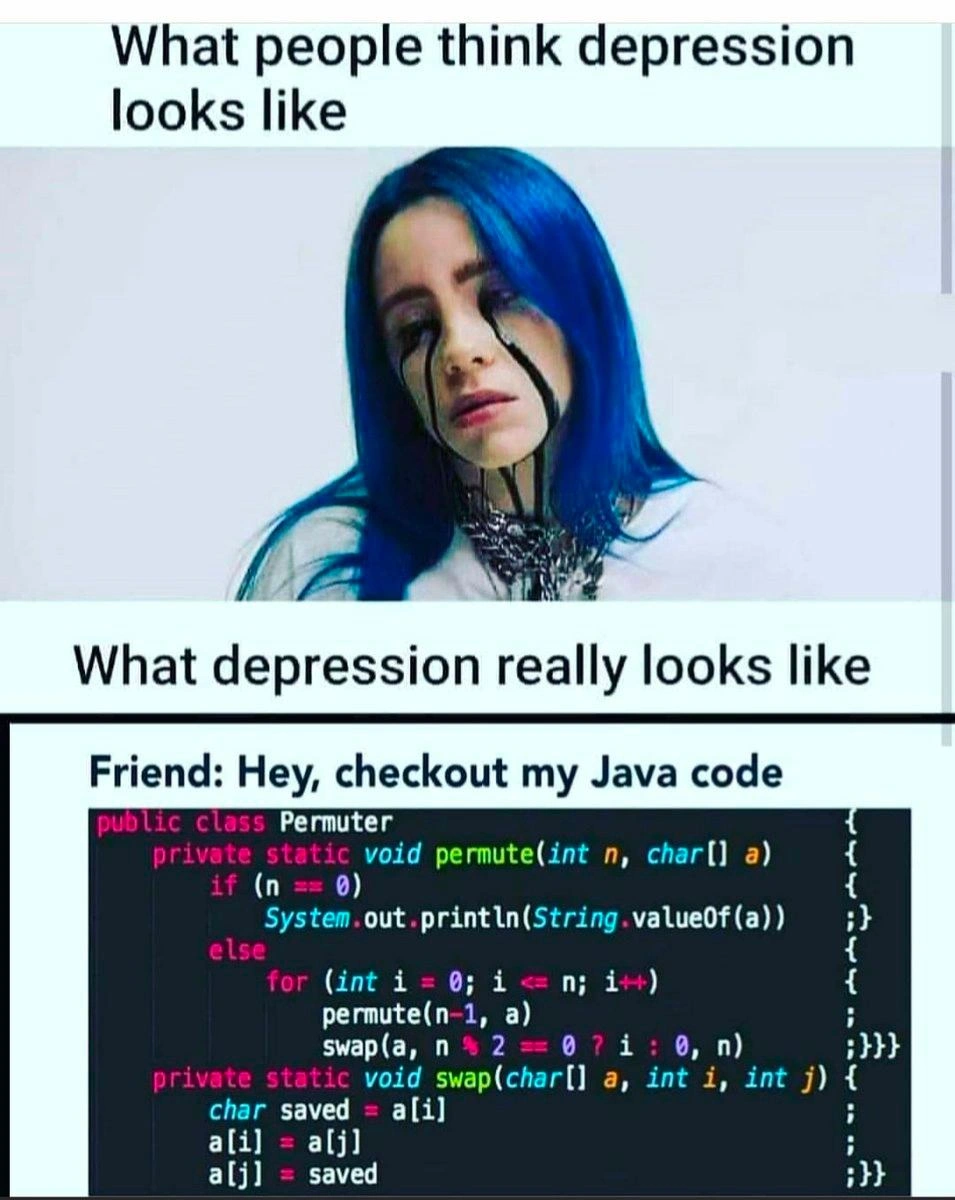
For a newer developer (or a curious onlooker), let’s break down why this Java code snippet is causing such grief. The code in question is trying to list all permutations of a set of characters. A permutation is just a fancy word for a unique arrangement or ordering of elements. For example, given letters A, B, C, the permutations would be ABC, ACB, BAC, BCA, CAB, CBA – every possible ordering. There are a lot of these combinations even for small sets (3 letters -> 6 permutations, 4 letters -> 24, 5 -> 120, and so on, growing factorially). The friend wrote a method permute(int n, char[] a) that uses recursion to generate these. Recursion means a function calls itself to solve a smaller piece of the problem. Here, permute(n-1, a) is the recursive call, which presumably generates permutations for a smaller value of n (like taking one less element to arrange). The idea is that the function keeps calling itself reducing n until n hits 0, which is the base case: at that point there’s nothing left to permute, so it prints the current contents of array a (that’s what System.out.println(String.valueOf(a)) does – it prints the characters as a string). On the way back up from this recursion, the code swaps characters around (swap(a, i, j)) to try different orders. The swapping is a typical trick: fix one position and permute the rest, then swap to change the fixed position, and so on, ensuring new orders are tried. The specific swap logic swap(a, n % 2 == 0 ? i : 0, n) is a bit advanced – it’s using a ternary (?:) operator. It says: if n is even, swap indices i and n; if n is odd, swap indices 0 and n. This is a known technique to generate permutations without duplicating results (it’s actually implementing a known algorithm).
So, conceptually, the code is based on sound principles. So why is it so painful to look at? Because the code formatting and structure are bungled. In languages like Java, indentation (spaces or tabs at the start of lines) is supposed to make the code easier to read, but it doesn’t affect how the code runs. What does affect the code’s behavior are the curly braces {}, which define blocks of code. When you see an if (...) or a for (...) without braces, by Java’s rules it only applies to the very next statement. This is crucial. In the friend’s code, they wrote an if and an else without braces and a for-loop without braces. The way they indented it suggests that the for loop includes both the recursive permute(n-1, a) call and the swap(…) call inside it. But because they omitted { }, the Java compiler doesn’t see it that way. It pairs the for with only the next statement. Let’s illustrate the difference:
// Friend's code structure (implicit, due to missing braces)
if (n == 0)
System.out.println(String.valueOf(a));
else
for (int i = 0; i <= n; i++)
permute(n-1, a);
swap(a, n % 2 == 0 ? i : 0, n);
In the above, because there are no braces:
- The
ifapplies only to theSystem.out.printlnline. - The
elseapplies only to theforloop that immediately follows it. - The
forloop, lacking braces, applies only to thepermute(n-1, a);line as its body.
That means the swap(...) line is not actually inside the loop or the else! In fact, as written, after the loop finishes, a single swap will execute once, using whatever the final value of i was (if that i is even in scope; if not, this code might not even compile). The friend likely intended the swap to occur each iteration inside the loop, but forgot to put { } around those two statements. The correct intended structure would use braces, like:
// Corrected structure with braces
if (n == 0) {
System.out.println(String.valueOf(a));
} else {
for (int i = 0; i <= n; i++) {
permute(n-1, a);
swap(a, (n % 2 == 0 ? i : 0), n);
}
}
Now the for loop clearly encompasses both the recursive call and the swap. Indentation is aligned with the braces, making it easy for a human to see which code belongs to the loop or the if/else. This highlights a key point in CodeQuality: consistently using braces and proper indentation (even when a single statement would suffice) prevents these kinds of bugs and makes code readable. Many style guides insist on always using braces for if/for statements precisely because it’s easy to accidentally add a line and create a bug if you don’t. In code review, a senior dev would immediately point this out as a required fix.
Now, imagine being a junior dev or an intern encountering this in a codebase. You’d probably feel confused and maybe a bit disheartened: “Is it me, or is this code actually really hard to follow?” Spoiler: it’s not you – the code is objectively hard to follow! CodeReviewPainPoints like this are common early in one's career, both as the author (learning the hard way about proper formatting) and later as the reviewer (learning how to gently guide others to write cleaner code). The meme exaggerates by calling it “depression,” but there’s truth in the feeling of DeveloperFrustration: you expect a quick glance at a friend’s work, and instead you’re faced with unraveling a confusing recursive function. It’s akin to getting a simple homework question but finding it’s written in nearly illegible handwriting – frustrating and tiring. The DeveloperHumor here is that programmers often joke about wanting to cry or give up when dealing with such code, even though we persist and fix it in reality. It also touches on MentalHealthInTech in that a barrage of these experiences – constantly dealing with messy, unmaintainable code – can wear a person down over time. It’s a reminder that part of taking care of yourself as a developer is learning good practices (like clear code structure) and also supporting your colleagues (maybe gently showing your friend how to auto-format their code or use an IDE that flags these issues). In short, at this level we’re learning that code readability matters a lot. Proper use of braces {} and indentation isn’t just cosmetic – it’s crucial for understanding and maintaining code. When someone says “simple Java code” but it triggers groans, it’s often because what’s simple to the computer (it will run, or at least compile) can be a convoluted puzzle for the human reading it. And as every developer learns sooner or later, we write code for humans to read as much as for computers to execute.
Level 3: Brace for Impact
Now let's drop down to a senior developer’s perspective – where the horror is less about raw theory and more about CodeQuality and hard-earned scars. The meme’s bottom panel – “What depression really looks like” – hits painfully close to home for anyone who’s done a code review on a friend’s project and discovered a tangle of misaligned braces and logic. That Java snippet is supposed to generate permutations, but its formatting is a crime scene of poor CodeReadability. The braces and indentation are so inconsistent that the code’s actual behavior is obscured. As a result, what should be a straightforward recursive algorithm becomes a source of confusion and CodingFrustration. Seasoned devs immediately spot the red flags: an if/else without braces, a for loop indented as if the swap is inside it, but without curly braces swap is actually executed after the loop, not inside it. In other words, the code is lying about its true structure. This kind of bug is the stuff of legend – remember Apple’s infamous goto fail bug? In Apple’s TLS implementation, a misplaced brace (or rather, a lack of one) caused a critical security check to be bypassed, all because an if statement’s scope was mis-structured by an accidental duplicate line. Brace misplacement horror is real: one wrong { or } can make your program do the exact opposite of what you think. In our friend’s Java code, the incorrect indentation likely means the swap runs at an incorrect time – probably leading to only partial permutation generation or lots of duplicates. A senior engineer has seen this pattern before: a newbie writes a neat little recursive function from a textbook, but forgets to format it properly or handle edge cases. The result? A piece of code that technically compiles (maybe), but is logically broken and a nightmare to debug.
The humor here also comes from the social scenario: Friend: “Hey, check out my Java code!” – said with the innocent enthusiasm of someone who thinks they’ve solved a problem – and You, the veteran reviewer, feeling a wave of existential dread wash over you as you behold the mess. It’s a mix of DeveloperHumor and actual DeveloperFrustration. Code reviews are a normal part of development, intended to catch issues exactly like this. But reviewing a friend’s code can be extra tricky: you don’t want to crush their spirit, yet you can’t unsee the chaos on your screen. That sinking feeling – let’s dub it friend_code_review_syndrome – is the realization that you’re going to have to be the bearer of bad news (or spend your evening untangling their logic) when you’d hoped this would be a 5-minute look. The meme equates that feeling to depression in a tongue-in-cheek way. While real MentalHealth issues are no joke, the comparison here is dark humor: outsiders think depression is glamorous sadness (cue the goth-looking blue-haired individual in the top panel), but for devs, sometimes “depression” is seeing CodingPain like this and internally screaming. It’s an exaggeration, of course – code won’t literally give you clinical depression – but the DeveloperExperience of dealing with bad code can certainly drain your joy temporarily. The bottom line: every senior dev knows that CodeReviewPainPoints are real, and few things induce a coding existential crisis faster than encountering a method your colleague or friend swears is “simple” while the code is actually an unreadable, logically flawed bowl of spaghetti. The meme gets its punch because it’s relatable: we laugh, perhaps a bit nervously, because we’ve all opened a file like this at 2 AM and thought, “I might quit programming and become a gardener.” It underscores the importance of CodeQuality not just for the software’s sake, but for the sanity of the humans who have to read that code. The veteran in us has been there, felt that: one moment you’re doing a routine review, next moment you’re questioning all your life choices as you attempt to trace through a recursive call that seemingly swaps things at random. In a sick twist of irony, the friend called this code “simple” – and that’s the final joke: what one dev thinks is straightforward, another dev sees as a maintenance nightmare. Brace yourself indeed – one look at those misaligned curly braces and any experienced reviewer knows an early night has just turned into a debugging deep-dive. This is what developer depression really looks like: not a crying face with mascara running, but a deadpan stare at a screen, 500 lines into a poorly-indented method, muttering “why…why would you do this?” under your breath.
Level 4: Permutation Purgatory
At this lofty level, the existential dread comes from the computational abyss hidden in that "simple" Java code. What the friend has likely attempted is an in-place permutation algorithm (it looks a lot like Heap's algorithm from 1963), which systematically generates every arrangement of the array a by recursively swapping elements. In theory, it's a clever method using a parity trick: swap the first element with others in turn when the remaining length is odd, or swap the current element when it's even. Done correctly, this algorithm produces each permutation exactly once. But here’s the kicker: generating all permutations of even a modest set is a combinatorial explosion. The number of permutations grows as n! (n factorial). For example, for a mere n=10 characters, there are $10! = 3,628,800$ possible permutations – and the code will try to print them all. In Big-O notation that's roughly O(n · n!) operations just to list them, which is astronomically expensive. In other words, "simple" quickly spirals into "practically unbounded" as n increases. An experienced developer sees that one innocent-looking recursive method can summon a factorial-time nightmare that no amount of coffee or cloud-computing will save you from if n is large. This is algorithmic angst: the friend’s code naively walks into the combinatorial explosion buzzsaw. And ironically, thanks to a misplaced brace, it’s not even walking the intended path – it's stumbling in a logic minefield. One stray brace (or lack thereof) in a recursive algorithm can break the delicate logic and send you into either an infinite loop or missing half the permutations. The code as shown is flirting with such a disaster: the swap call’s placement is likely wrong due to indentation, meaning the algorithm isn't correctly undoing swaps between recursive calls. That subtle bug could lead to duplicate outputs or an incorrect permutation sequence – effectively undermining the mathematical beauty of the algorithm with a silly mistake. seasoned engineers know that tiny syntax errors can undermine even the most elegant algorithms. It's the stuff of nightmares: you have the right formula on paper, but one { in the wrong place turns order into chaos. This is where theoretical computer science meets pragmatic despair. The humor bites extra hard because behind the joke is a truth: underneath that sloppy code is a profound idea (generating permutations), but it's been implemented so carelessly that all the elegant theory in the world can’t save you from the brutal reality of debugging a broken recursive function. In short, the meme’s "existential dread" isn’t just a joke – it’s a reminder that combinatorics + bad code is a one-way ticket to Permutation Purgatory for any developer’s sanity.
Description
This meme uses the 'Trade Offer' format, featuring a well-dressed man offering a handshake. The meme presents a humorous, yet painful, trade-off that developers often face. On the left, under 'I receive,' it says 'A quick and dirty solution that meets the deadline.' On the right, under 'You receive,' it says ' crippling technical debt that will haunt you for years.' The meme humorously captures the short-term thinking that can lead to long-term problems in software development. For senior engineers, this is a tragically familiar scenario, representing the constant battle between immediate business pressure and the professional responsibility to build sustainable, maintainable systems
Comments
18Comment deleted
Technical debt is the only debt that's fun to accumulate and hell to pay back. It's like a credit card for features, but the interest rate is your sanity
Nothing like a depth-first search on your sanity tree every time someone forgets which brace closes the recursion
After 20 years in the industry, you realize the real depression isn't from burnout or impostor syndrome - it's from maintaining the permutation algorithm your colleague wrote at 3 AM that somehow made it to production because 'it works' and now powers half your recommendation engine
After 15 years in the industry, you realize the real depression isn't the legacy COBOL system you inherited - it's when a senior engineer sends you a 'quick permutation algorithm' that uses a ternary operator to determine swap indices, recursively calls itself with n-1, and somehow passes code review because 'it works on my machine.' The base case checks n == 0, but the real base case is your faith in humanity reaching zero when you see 'char[] a' being mutated through a swap method that takes three parameters when Java has Collections.swap(). This is the code that makes you question whether that $400k FAANG offer was worth the psychological toll of explaining why 'private static void' methods in a public class named 'Permuter' violate every SOLID principle while your PM asks 'but does it scale?'
Base case recurses on itself, j ghosts the swap - classic junior backtrack that'd OOM prod before anyone notices
The only thing worse than O(n!) permutations is watching n moonlight as an array index - Heap’s algorithm plus i <= n guarantees one more output: ArrayIndexOutOfBoundsException
Nothing triggers enterprise-grade melancholy like reviewing Heap’s algorithm written with i <= n, no braces, and a ternary swap - O(n!) permutations, O(∞) comments
Never seen weirder bracket placement Comment deleted
python-style lmao Comment deleted
this is how code is written in hell Comment deleted
exactly Comment deleted
It's not depression, it's perversion. Comment deleted
Wow, that's über-depressing! 😩 Comment deleted
I wonder if you could set up an autolinter which let you write java as python, and just automatically added all the braces and semicolons on the right like that, juuust off screen. It would be absolutely hell, but I wonder if it is possible Comment deleted
There's like thousands of them for Lisp. So I don't see why not. Aside of most folks wanting that will pick up or write new language targeting JVM instead. Comment deleted
Yeah, there is no good reason to build such a thing, was just a thought experiment in finding a backstory for that bracket style, I guess Comment deleted
No, the next level of hell would be to still write all those braces and semicolons explicitly by hand, like on the screenshot, but to put them farther to the right so that they go off-screen on most displays (provided that line-wrapping is not enabled). Comment deleted
what about legacy (5 years old) node code ? Comment deleted