Skip to content
DevMeme
4040 of 7435
The Infinite Loop of Unclear Requirements
Stakeholders Clients Post #4403, on May 31, 2022 in TG

The Infinite Loop of Unclear Requirements

Why is this Stakeholders Clients meme funny?

Level 1: Focus on the Wrong Thing

Imagine a kid in school who does something truly amazing, like solving a big problem that saves the whole class from trouble. For example, say water was leaking in the classroom and about to ruin everyone’s projects, but one clever student found the leak and fixed it just in time. You’d think the teacher and principal would be super grateful, right? Now picture instead that the principal gets mad at that student just because they stepped out into the hallway without a hall pass while fixing the leak. That would feel completely unfair and silly! The student did an awesome, life-saving job, but all the principal saw was a small rule that got broken. This meme is showing a real story like that: Alan Turing saved millions of lives by solving a giant secret code (a very good thing), but the people in charge only cared about a personal detail (a very unfair thing). It’s funny in a shocked way because the reaction is so wrong. It’s like seeing someone ignore the big, wonderful picture and fuss over a tiny, irrelevant smudge. Everyone can understand how goofy and unjust that is — and that’s why we shake our heads and maybe laugh, even though it’s also a bit sad.

Level 2: Brilliance vs Bigotry

Let’s break down why this meme hits so hard, especially if you’re not familiar with the history. Alan Turing was a British mathematician widely considered one of the founding figures of modern computer science and cryptography. During World War II, Turing worked at a secret facility called Bletchley Park, where he and fellow codebreakers tackled the challenge of the German Enigma_machine. The Enigma machine was essentially a complex cipher device that Germany used to encrypt military communications. Think of it as a sophisticated encryption algorithm in hardware form: you type a message like “ATTACKATDAWN” and it scrambles it into gibberish that only someone with the same machine and correct settings can decode. The Germans believed Enigma was unbreakable. Alan Turing proved them wrong. He played a key role in cracking the Enigma code, meaning the Allies could read secret enemy messages and gain a huge tactical advantage. This breakthrough had a direct impact on the war’s outcome — by knowing the enemy’s plans, Allied forces could avoid traps and win battles, potentially saving millions of lives and shortening the war. In terms of TechHistory, Turing’s work on Enigma wasn’t just a war victory; it was also a milestone for computing. To solve Enigma, he effectively built one of the first electro-mechanical computing devices (the Bombe) designed to run through possibilities automatically. This is one reason Turing is often called the “father of computer science.” He introduced the idea that machines could systematically process information — a concept at the heart of all modern computers and cryptography algorithms we use today.

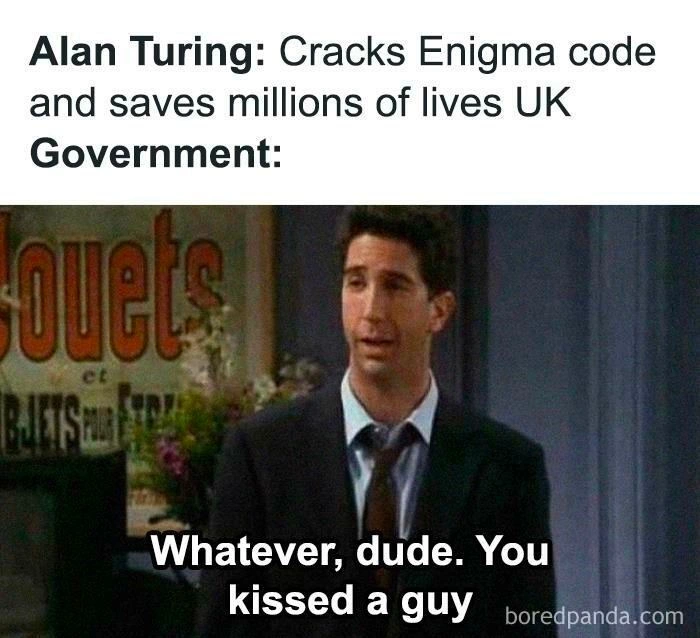
Now, the meme contrasts that incredible achievement with how Turing was treated after the war. In the 1950s, the UK had laws that made homosexuality a crime. These laws were definitely legacy rules — holdovers from an older era (Victorian times) — and they reflected the prejudices of the day. In 1952, Turing was charged under one such law, ironically named “gross indecency” (essentially criminalizing gay relationships). The meme’s bottom caption, “Whatever, dude. You kissed a guy,” summarizes that attitude in a blunt, sarcastic way. It’s like the government was saying: “We don’t care if you saved the world, you broke our rule.” Instead of celebrating Turing, they chemically castrated him (forced him to take medication that would suppress his libido as a punishment) and made it impossible for him to continue his secret cryptographic work. This was a devastating turn of events for Turing personally and is now recognized as a historical_injustice. At the time, though, it was the official stance – showing just how skewed government_priorities were. They valued enforcing an old morality law over retaining a war hero and genius engineer. In tech terms, imagine calling an emergency fix “unauthorized” because the hero coder didn’t follow the usual change request process. It’s the same kind of shortsightedness: focusing on procedure or bias instead of outcome.

For a junior developer or someone new to these concepts, let’s put the technical and historical pieces in simpler terms:

  • Enigma Machine: A device used in WWII to encode messages. It worked like a super-complicated secret code maker. Turing helped break that code. This is a famous example in cryptographyAlgorithms (the study of secret codes and how to break them).

  • Alan Turing: A brilliant mathematician often credited as one of the inventors of modern computing. Besides codebreaking, he came up with the idea of a “Turing Machine” (an imaginary computer model that helped define what computable problems are) and the Turing_test. The Turing Test, proposed in 1950, is an experiment to see if a machine can imitate human intelligence: if you chat with a computer and can’t tell it’s not human, it passes the test. This concept is foundational in artificial intelligence. So Turing contributed a lot to science and tech: AI theory, computation theory, and practical cryptographic engineering. He’s like a legend in computer science history.

  • UK Government in the 1950s: Had laws that today seem unethical and outdated. One such law made being gay a criminal offense. This reflects the HistoricalContext – back then, unfortunately, a lot of societies had similar prejudiced laws. So even though Turing was a war hero, those in power looked past his achievements and instead prosecuted him for his sexuality. It’s an example of engineeringEthics (or the lack thereof) in a broader sense: how engineers or contributors are treated by society. In this case, society failed ethically.

  • Historical Injustice: This term means something that happened in history which we now view as a grave wrong. Turing’s persecution is a prime example. People look back and say, “Wow, that was not only unfair but truly shameful, given what he did for everyone.” Many decades later, the British government formally apologized. They even introduced a so-called “legacy_refactor” in legal terms: in 2017 the UK passed the “Turing Law” which pardoned men who had been convicted under those old laws. Think of it like finally updating (refactoring) a very buggy piece of legacy code (old law) in the nation’s rulebook – a fix that came way too late for Turing, sadly.

The meme uses this story to make a point that still feels relevant to tech folks: Sometimes, decision-makers completely overlook the importance of a technical accomplishment due to bias or trivial issues. It’s the extreme case of an engineer doing something amazing and management responding with something irrelevant or backwards. The humor is in the absurd contrast: it is absurd to ignore saving millions of lives because of an unrelated personal detail. For an analogy, imagine a firefighter saves an entire building from a blaze (a heroic act), and instead of getting a medal, the city fines him because he parked the firetruck in a no-parking zone. Ridiculous, right? That’s essentially what happened to Turing. The engineering world laughs at this meme (a bit grimly) because we recognize a truth in it: technical brilliance isn’t always appreciated as it should be, especially when prejudice or politics come into play.

It’s also a reminder of how far we’ve come. Today, not only do we celebrate Alan Turing’s contributions (with things like the Turing Award, biographies, movies like “The Imitation Game”), but we also value inclusion and ethics more openly in the tech community. We discuss topics like EngineeringEthics, diversity, and fair treatment to avoid repeating mistakes of the past. In short, this meme packs a history lesson and an ethical lesson into one punchline. It tells newcomers that even the giants of tech history weren’t immune to ignorance — which is why we must remember their stories and do better going forward.

Level 3: Government Fails Turing Test

So how does the UK government respond in this meme’s retelling? With a reaction so petty and myopic it’s literally the punchline. The meme’s top caption sets up Turing’s monumental achievement: “Alan Turing: Cracks Enigma code and saves millions of lives”. The bottom panel then imagines the UK Government’s response as the dismissive quote: “Whatever, dude. You kissed a guy.” Ouch. This stark juxtaposition is both darkly funny and painfully true to history. After WWII, instead of being celebrated like a national treasure, Turing was prosecuted in 1952 under Britain’s archaic law against homosexuality (the charge was “gross indecency”). The man who helped defeat Nazi Germany’s encryption was brought down by his own country’s moral code — a tragically misguided priority. It’s a classic case of historical injustice: the government fixated on Turing’s personal life while ignoring his colossal contributions to national security and TechHistory. Essentially, the system failed a basic empathy and logic check — or in nerdier terms, the government failed the Turing Test (exhibiting less basic decency than one would expect even from a well-programmed machine).

Engineers and developers see a biting analogy here that resonates with workplace experiences: no good deed goes unpunished. How many times have we seen a brilliant engineer pull off a near-impossible feat — like refactoring a gnarly legacy system or averting a production meltdown at 3 AM — only to get reprimanded for something trivial or political? It’s the worst performance review ever syndrome. In Turing’s case it’s taken to an extreme: he effectively helped “debug” WWII by decrypting Enigma, but the only feedback he got from authority was a catastrophic focus on an unrelated “policy violation” (his romantic relationship). This rings painfully true to anyone who’s dealt with managers or organizations that value bureaucratic rules or image over actual impact. The meme uses Ross from Friends (suited up with a deadpan face) to embody that clueless authority figure saying “Whatever, dude...” — it’s comedy through obvious injustice. Engineers often joke about dealing with non-technical bosses or clients who ignore the hard stuff you solved and instead nitpick something superficial. Here, the UK government is the ultimate non-technical manager, utterly blind to the real achievement. Their priorities were so warped that they penalized the very person responsible for a massive technological victory.

This scenario also highlights a failure in engineering ethics and leadership. By any rational standard, Turing deserved honor and support, not persecution. Yet institutional prejudice overrode scientific merit. It’s an extreme reminder that the human side of tech (societal values, biases, politics) can negate even the greatest technical triumph. In more modern terms, imagine a superstar developer who open-sources a life-saving software tool, but their company fires them because their personal life or identity doesn’t fit some outdated corporate image. It sounds absurd — and it truly is — but that’s effectively what happened to Turing. The humor in the meme comes from how ridiculously out-of-balance the two panels are: world-saving cryptographic genius vs. petty homophobic critique. It’s like an epic bug fix followed by a code review comment focusing on a single missing semicolon. We laugh (or cringe) because we recognize the pattern: brilliant solutions being undervalued due to ignorance or bias. It’s a shared tech industry eye-roll moment, scaled up to historic proportions.

Historically, the aftermath of this government priorities failure was devastating. Turing was forced to undergo chemical castration (a hormone “treatment” with terrible side effects) as an alternative to prison, all for the “crime” of being gay. His security clearances were revoked, meaning he could no longer work on the very projects he pioneered. Within two years, in 1954, Alan Turing died by suicide (at age 41), a tragic end that many believe was precipitated by the mistreatment. The very country he helped save drove him to despair. This dark outcome underscores the meme’s biting point: the UK government’s reaction wasn’t just a lame joke — it was a catastrophic failure to do the right thing. It’s galling and absurd, much like a company losing a brilliant engineer because of internal politics or discrimination.

Over time, society has recognized this as a monumental wrong. Decades later, there was a legacy refactor of sorts: the British government apologized and posthumously pardoned Turing. In 2013, Queen Elizabeth II granted him a royal pardon, and by 2017 the UK enacted what’s informally called the “Turing Law,” pardoning thousands of others convicted under those old laws. It’s as if the system finally issued a long-overdue patch to correct a bug in the code of law. The computing community had long since acknowledged Turing’s brilliance — the Turing Award, the highest honor in computer science, is named after him — but it took over half a century for the government to catch up and update its outdated rules. This is cold comfort, of course, given that Turing never lived to see his name justly honored. Yet, the story serves as a powerful reminder (especially to engineers and technologists) that who we value and how we treat them matters just as much as the breakthroughs they create. In the end, the meme lands as both a humorous take and a cautionary tale: even the greatest historical references in tech can be overshadowed by ignorance. And if a war-hero codebreaker can get a “Whatever, dude” from his bosses, imagine what lesser miracles might get in a dysfunctional office! It’s a call to appreciate substance over prejudice — and to ensure our “performance reviews” (be they in companies or society) actually recognize the real achievements.

Level 4: Permutation Pandemonium

At its core, the meme touches on one of the most legendary cryptographic feats in history: Alan Turing’s cracking of the Enigma machine cipher. Enigma was a WWII-era electro-mechanical encryption device that generated an astronomical number of letter substitutions (permutations) for every message. Each keystroke on Enigma encrypted a letter via a complex path through rotating rotor wheels and plugboard cables, effectively scrambling plaintext into ciphertext. The number of possible configurations was mind-boggling: on the order of $10^{\mathbf{14}}$ (100 trillion+) possible keys each day, thanks to multiple rotors with interchangeable positions, rings settings, plugboard pairings—the combinatorial explosion was deliberate. This made Enigma messages computationally infeasible to brute-force with pencil-and-paper alone; it was a moving target as the machine’s state advanced with each character typed.

Breaking Enigma required both theoretical insight and practical engineering. Turing and the Bletchley Park team exploited known plaintext patterns (called cribs, like predictable weather report phrases ending in "Heil Hitler") and a clever assumption: Enigma never encrypted a letter as itself (e.g., A never maps to A). Using these insights, Turing helped design an electromechanical computing device known as the Bombe. The Bombe was essentially an early parallel processing machine; it systematically searched through Enigma’s rotor settings to uncover the day’s secret key. Instead of trying every $10^{14}$ possibilities blindly (which would take longer than the war itself!), Turing’s algorithms pruned the search space by logically eliminating impossible settings. This was cryptanalysis turned into an algorithmic process. In modern terms, he created a hardware-accelerated brute-force with heuristics – a precursor to the idea of using computing power to solve complex cryptography algorithms. It’s as if Turing hand-crafted a special-purpose computer to invert a one-way function: given encrypted text, find the key that produces meaningful plaintext. The feat was so advanced that it remained classified for decades, but we now recognize it as a foundational moment in TechHistory that foreshadowed digital computing and cybersecurity.

From a theoretical standpoint, this task showcased key principles of computer science and mathematics. Turing’s background in logic and the emerging field of computation (he formulated the concept of a universal Turing machine in 1936) informed his approach to Enigma. He effectively anticipated how to harness computational complexity: trade massive, repetitive calculation work to gain critical information, a concept at the heart of modern computing. In breaking Enigma, Turing also demonstrated an early example of automation vs. human capability: repetitive mechanical computation outperforming what a room of humans could do by hand. This was war-time parallel processing in an era of vacuum tubes and relays. It’s no exaggeration to say the success at Bletchley Park was a triumph of both mathematical reasoning and engineering ingenuity. The cryptographic victory allowed the Allies to read Nazi communications in near-real time under the code name ULTRA, fundamentally altering strategic decisions. Historians estimate that Turing’s work shortened WWII by about two years, saving countless lives. In a just world, such a cryptanalysis breakthrough would merit every accolade imaginable — a hero’s recognition for solving one of history’s greatest encryption enigmas (pun intended).

Description

This meme uses the 'Panik Kalm Panik' format to depict the emotional rollercoaster of a software development cycle plagued by poor communication. The first panel shows a panicked character with the caption, 'The client is not happy with the result.' The second panel shows a calm character with the caption, 'The client explains what they want.' The final panel returns to the panicked character with the caption, 'The client doesn't know what they want.' This meme perfectly encapsulates the frustration of trying to build software for stakeholders who have not clearly defined their own requirements. For experienced developers, it's a deeply relatable scenario that highlights the critical importance of a skilled product manager or business analyst to bridge the gap between business needs and technical implementation, and to prevent the endless cycle of rework and frustration

Comments

9
Anonymous ★ Top Pick The three certainties in software are death, taxes, and a change request from a client that begins with 'Just one small tweak...'
  1. Anonymous ★ Top Pick

    The three certainties in software are death, taxes, and a change request from a client that begins with 'Just one small tweak...'

  2. Anonymous

    Shipping the ultimate patch for World War II still couldn’t get past the 1950s compliance gatekeeper

  3. Anonymous

    The same government that couldn't decrypt Enigma without Turing somehow managed to perfectly decode his private life - proving once again that legacy systems always outlive their architects, especially when the architect inconveniently invents the entire field first

  4. Anonymous

    The ultimate code review failure: Turing delivers production-ready cryptanalysis that literally saves civilization, passes all acceptance criteria, and ships on time - but management rejects the PR because they don't like his personal commit history. Classic case of bikeshedding at a civilizational scale, where the architecture that won WWII gets deprioritized because someone focused on the developer instead of the code. Even the Turing Test couldn't have predicted this level of organizational dysfunction

  5. Anonymous

    Proof that you can resolve a Sev‑0 with flawless cryptanalysis and still get rejected in prod by a failing ‘culture‑fit’ gate - the most expensive severity/priority inversion in tech history

  6. Anonymous

    Turing cracked Enigma in polynomial time; decoding 1950s government 'culture fit' was the true NP-hard problem

  7. Anonymous

    Enigma’s keyspace was finite; HR’s policy automaton is PSPACE-complete with a single accepting state: “culture fit = no.”

  8. @Box_of_the_Fox 4y

    Alan Turing invented fuckton of stuff but cracking enigma was work of a lot of people throughout and even before ww2. So I'm not sure if I'd give him that

  9. @Box_of_the_Fox 4y

    But the government part is true and ridiculous

Use J and K for navigation