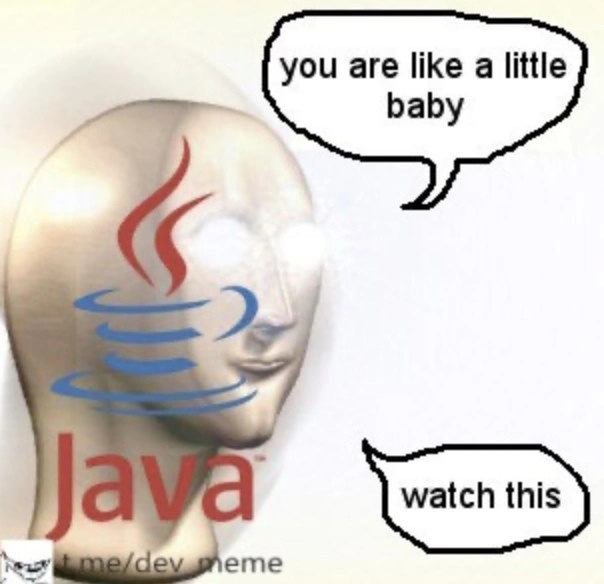
Java's Transcendence Through Infinite Abstraction
Why is this Languages meme funny?
Level 1: Too Many Wrappers, Silly Java 😅
Imagine you want to open a present, but your gift is wrapped in five different boxes, each inside the other. You open one box, and oh! — there’s another box inside. Open that, and there’s another box inside, and so on. By the time you get to your toy, you’re probably laughing and thinking, “Why so many layers for one little toy?!” This meme is joking that Java sometimes does exactly that with its code. Java programs can put simple tasks inside layer after layer of “wrapping” (like those many boxes). It’s funny because it feels over-the-top – kind of like if someone put a tiny cookie in a huge stack of nested boxes. In the picture, Java (the person with the coffee cup logo face) looks all shaken up when asked “how many layers of abstraction are you on?” because, well… Java knows it has a lot of layers! The joke is basically saying: Java, you put way too many wrappers on things, and it’s both crazy and comical.
Level 2: The Abstraction Onion
So what is a “layer of abstraction,” and why do Java coders end up with so many? In programming, an abstraction is a way to hide complexity by providing a simple interface to do something complicated. Imagine a car: you turn the steering wheel (simple interface) instead of manually controlling each wheel’s angle (complex details). In code, a layer of abstraction might be a function or class that wraps up some detailed logic so other parts of the program don’t have to worry about how it works internally. Java being an object-oriented language is big on this idea. Java developers love to organize code into neatly separated parts: one part might handle web requests, another part handles business logic, another part talks to the database. This is known as a layered architecture. Each layer only interacts with the layer directly below or above it, which makes the system easier to think about... in theory.
However, the joke here is that Java’s culture often goes too far with this. Beginners learning Java are taught to use interfaces and classes, maybe following principles like SOLID or "program to an interface, not an implementation." These are good code abstraction principles meant to make code flexible. For example, you might have an interface PaymentProcessor and two classes PayPalProcessor and StripeProcessor that implement it. That way the rest of your app doesn’t care which one is used – it just talks to PaymentProcessor. That’s one layer of abstraction hiding the specific payment gateway.
But in enterprise projects, it doesn’t stop there. You might also add a factory pattern to create the PaymentProcessor (hiding the new PayPalProcessor() behind a factory), and maybe a proxy or decorator that wraps the processor to add logging, and so on. Before you know it, a simple payment action goes through 5 different objects! This is where framework_fatigue sets in – dealing with so many classes, files, and libraries just to accomplish basic tasks. It’s not uncommon in a big Java codebase to click through a dozen files to trace one flow of logic. New developers often feel overwhelmed because the actual work is hidden under layers of “Manager”, “Factory”, “Helper” classes that mostly just pass things along to the next layer.
To visualize it, here’s a common scenario in a Java web application when you ask for some data (say, a user profile). The call flows through multiple layers of abstraction:
// Fetching a User goes through layers in a typical Java app:
userController.getUser(id) // 1. Controller (handles HTTP request)
-> userService.findUser(id) // 2. Service (business logic)
-> userRepository.fetch(id) // 3. Repository/DAO (data access)
-> entityManager.find(User.class, id) // 4. ORM layer (object-relational mapper)
-> databaseDriver.query("SELECT ...") // 5. Database layer (actual data)
Each arrow (->) represents one layer calling the next. The Controller might be a Spring MVC controller or Servlet that takes an incoming web request and calls the Service. The Service contains business logic but often just calls a Repository (or DAO, Data Access Object) which is responsible for talking to the database. The Repository might use an ORM (Object-Relational Mapping) tool like Hibernate’s EntityManager to fetch data using objects instead of SQL directly. That, in turn, uses a lower-level database driver to execute the actual SQL query. Phew! 😅 By the time you get your User data back, it has traveled through five different modules, each abstracting the one below.
For a junior developer, this might be pretty confusing at first. Why not just write SELECT * FROM users WHERE id=42 right where we need it? The reason is those abstraction layers each have a purpose:
- The Controller doesn’t need to know how to query a database, it just handles web/API logic.
- The Service can contain business rules (like “only admin users can fetch this data”) separate from database code.
- The Repository/DAO abstracts the database so you could swap databases or reuse that data logic elsewhere.
- The EntityManager/ORM saves you from writing raw SQL by mapping tables to Java objects (OOP convenience).
- The database driver handles the nitty-gritty of talking to the specific database.
These layers follow Design Patterns & Architecture best practices like Separation of Concerns. Each piece has a single responsibility, which is normally a good thing. The DeveloperExperience downside is when you just want to find “where the heck is the user actually fetched?”, you have to jump through all these hoops to trace it. That’s why this meme resonates: the DeveloperHumor is in exaggerating this situation. It’s saying Java has so many wrappers and indirections that even asking “How many layers are you on?” might itself bounce through a couple of interfaces before getting an answer!
Let’s decode the meme image a bit. The left panel shows a mannequin-like head labeled Java (with that familiar coffee cup logo) being blurred as if smacked or spinning. The right panel’s speech bubble asks, “how many layers of abstraction are you on”. It’s like someone asking Java (or a Java programmer) how deep their code rabbit hole goes. The visual of the head in motion blur humorously suggests being knocked senseless by the question – as if Java itself is dizzy from all its abstraction. This is a playful jab at oop_inheritance_abuse – making class inheritance and interface implementation so over-complicated that even Java’s personification might feel attacked.
For a newcomer, the key takeaway is: Java projects often use multiple layers to organize code, which can be good for big applications, but it easily gets over-engineered. The meme is funny because it exaggerates that feeling when you’re new on a Java team and think, “Jeez, do we really need this many levels of indirection to do something simple?” It’s a mix of frustration and comedy – poking fun at the way Java developers (affectionately) complicate their own lives.
Level 3: Turtles All The Way Down
"All problems in computer science can be solved by another level of indirection... except the problem of too many layers of indirection."
– Old programming proverb
Seasoned engineers read this and nod knowingly (with a pained chuckle). The meme lampoons the Java ecosystem's love affair with endless abstraction layers. In enterprise Java applications, it's common to see a simple task broken into a whole Matryoshka doll of components. DesignPatterns_Architecture principles like separation of concerns and loose coupling mean you end up with something like: Controller → Service → Repository → DAO → EntityManager → JDBC → Database (and perhaps a few Factories and Proxies sprinkled in for good measure). Each of these is a layer of abstraction: a way to hide lower-level details behind a higher-level interface. In theory, this makes code flexible and modular. In practice, when taken to extremes, it means debugging a null pointer involves spelunking down 12 layers of indirection just to find where the real work happens.
The humor here comes from familiarity with java_enterprise_meme culture. Enterprise Java (think J2EE of the early 2000s and modern Spring/Hibernate stacks) has a reputation for framework_fatigue – you peel back one layer (say, a web controller) only to find another beneath (a service class), and another (a DAO), and another (an ORM), ad infinitum. This meme’s text “how many layers of abstraction are you on” riffs on a popular meme format, but also on the exasperation of developers who have grokked that perhaps their codebase has one wrapper too many. It's referencing that classic joke among battle-scarred programmers: “You are on layer 7 of abstraction, my dude.” The blurred beige head with the Java logo – the iconic blue-and-red steaming coffee cup – represents Java personified, seemingly being shaken awake or slapped. It's as if someone confronted Java with its own excessive layering and Java's just recoiling in stunned, blurry-eyed realization.
Why Java specifically? Well, LanguageQuirks and conventions in Java encourage a very formal, OOP-heavy style. Java was built around OOP (Object-Oriented Programming) ideals: code is organized into classes, which can implement interfaces or extend other classes (inheritance). Over time, this led to patterns where even trivial operations involve multiple classes talking to each other. For example, older Java Enterprise recipes had things like an EJB (Enterprise Java Bean) that required a local interface, a remote interface, and an implementation class – three layers right off the bat for one component! And have you ever looked at some Spring framework classes? There’s an actual class named AbstractSingletonProxyFactoryBean – no joke. That name alone stacks Abstract + Singleton + Proxy + Factory + Bean into one glorious monstrosity, like an Inception-style dream of abstractions within abstractions. A veteran dev can’t help but smirk at that because it’s emblematic of the problem: Java folks sometimes stack so many design patterns together that the names themselves become onion layers.
The meme is poking fun at this oop_inheritance_abuse and over-engineering. The question “how many layers of abstraction are you on?” is phrased like a challenge. The implicit punchline: whatever your answer (5? 10? 15 layers?), Java’s response would be “you are like a little baby, watch this” followed by adding yet another layer. 🤣 It’s a hyperbole, of course – not every Java project is that bad – but it hits home because many of us have opened a codebase and felt exactly like that mannequin head: our brain jolted by the realization that a simple feature is buried under an avalanche of indirection. This is a shared DeveloperHumor experience: the framework fatigue of trudging through class after class, interface after interface, just to follow one data flow. The senior perspective acknowledges there are valid reasons for those layers (testing, flexibility, CodeAbstractionPrinciples, etc.), but also knows the DeveloperExperience (DX) pain is real when you're five interfaces deep at 3 AM chasing a bug. The meme succeeds because it exaggerates a truth every experienced Java dev understands all too well – sometimes our elegant abstractions get so deep that even Java itself looks dazed.
Description
This meme features the surreal 'Meme Man' character, whose head is shown with a motion blur against a light purple background, giving him an ethereal, vibrating appearance. The official Java logo (the steaming coffee cup) is superimposed on his face. A crudely drawn speech bubble next to him contains the question, 'how many layers of abstraction are you on'. The meme satirizes the Java programming language and its ecosystem, particularly in enterprise applications, which are notorious for using numerous layers of abstraction (e.g., controllers, services, repositories, factories). The joke is that this tendency towards over-engineering is so extreme it becomes a kind of psychedelic or metaphysical state, a plane of existence only reachable through excessive indirection

Comments
7Comment deleted
Some say that if you reach the seventh layer of a Spring application, you don't find the data access object, you find inner peace and a ticket to refactor the whole thing
Debugging a Spring Boot NPE: Controller → Service → Facade → Manager → Repository → DAO → Hibernate proxy → database… by layer six my IDE suggested I replace the stack trace with carbon dating
Just enough layers that the original business requirement is now archaeologically significant and requires carbon dating to understand
When your Java architect insists on implementing AbstractSingletonProxyFactoryBean just to instantiate a String, and you realize you're seven layers deep into a framework that wraps another framework that abstracts a library that delegates to an interface that proxies the actual business logic - which is literally just 'return user.getName()'. At this point, you're not writing code anymore; you're performing enterprise-grade archaeology through a stack trace that reads like a Russian nesting doll of design patterns
JVM classloaders alone add five layers - because one namespace wasn't bureaucratic enough
How many? Spring Boot → AOP proxy → @Transactional → JPA → Hibernate → JDBC → driver - so many layers my stack trace comes with pagination
Currently at controller->service->manager->repository->JPA proxy->JDBC->driver->socket; PM asked for an observability layer, so we renamed it Hexagonal and called it simpler