Skip to content
DevMeme
5053 of 7435
Java Demonstrating Its Veteran Status to Newer Languages
Languages Post #5533, on Sep 29, 2023 in TG

Java Demonstrating Its Veteran Status to Newer Languages

Why is this Languages meme funny?

Level 1: Grandpa vs Toddler

Imagine a grandpa who’s been doing something for a very long time, and a toddler who’s just learned how to do it. The toddler might proudly say, “Look what I can do!” Maybe the little kid can ride a tricycle or stack four blocks. That’s cute and impressive for the kid’s age. Now picture the grandpa chuckling and replying, “You are like a little baby – watch this.” Then Grandpa hops on a big motorcycle and does a fancy trick, or builds a whole tall tower of blocks in one go. 😄 The grandpa has years of experience, so he can easily outdo the child.

This meme is basically the same idea, but with programming languages. Java is like the grandpa who’s been around forever and done everything, and the new languages are like the toddlers just learning neat tricks. It’s funny because the grandpa (Java) playfully calls the kid a baby and then shows off. The big joke is just that huge difference in experience: the older expert easily doing something that the newbie thought was hard. It’s a lighthearted way to say “the old, experienced one can still show the youngsters a thing or two,” which makes people smile.

Level 2: Language Wars 101

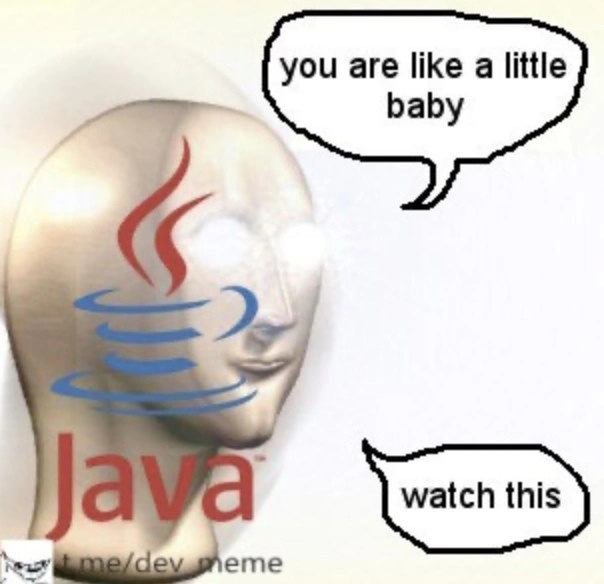
What’s going on here is a playful comparison between programming languages, with Java taking on the role of a wise old champion. The meme shows a head (like a dummy or mannequin head) with the Java logo (that blue-and-red coffee cup) on it, speaking out of two speech bubbles. The text in the bubbles says “you are like a little baby” and “watch this.” This is a popular meme format on the internet where someone basically says, “You’re a newbie, watch how a pro does it.” In the context of programming, Java is speaking to newer programming languages and jokingly calling them infants in comparison to itself.

Let’s break down the elements for someone new to these concepts:

  • Java: Java is a very popular programming language that’s been around since 1995. It was created by Sun Microsystems (now owned by Oracle). Java is known for its “Write Once, Run Anywhere” philosophy – meaning you can write Java code on one machine and run it on almost any other kind of machine without changing the code, thanks to the Java Virtual Machine. The Java logo is a steaming cup of coffee because “Java” is a nickname for coffee (the language was indeed named after coffee!). Java is especially famous in BackendDevelopment, which means it’s often used to write the server-side logic that powers websites, business applications, and Android apps. It has a reputation for being a sturdy, general-purpose language – sometimes called a workhorse of the industry because it reliably handles a lot of heavy lifting in big applications.

  • “you are like a little baby, watch this”: This phrase isn’t something specific to coding – it’s a meme phrase used to mockingly say “you’re a beginner, now see how I (the expert) do something amazing.” It usually implies someone is about to demonstrate a far superior skill or feat. In internet culture, it’s often accompanied by a humorous image (in this case, the mannequin head). Here, Java is the one saying the phrase. So effectively, Java is claiming to be the expert and is about to show up the “little babies” (the newer languages) with its capabilities. It’s like a teacher or an older sibling saying to a kid, “Aw, that’s cute. Now watch this!”

  • Language Wars: This is a lighthearted term for the debates and arguments programmers have over which language is better. It’s very common in developer communities (and often a source of BackendHumor) to jokingly argue “My language is the best and your language is trash.” Of course, in reality every language has its pros and cons, and the “wars” are usually just in good fun or friendly rivalry. In this meme, the LanguageComparison being made is Java versus all the newer trendy languages. Java’s stance is comically arrogant: it’s basically saying it’s far superior because of its age and experience.

  • Java’s reputation as a veteran: Java is nearly 30 years old, which is a long time in tech! Many people have learned it in school, and huge companies use it. Because it’s been around, it’s very stable and optimized. There are tons of libraries and frameworks (like Spring, Hibernate, etc.) built for Java to do almost anything you need in back-end systems. It’s also known for being object-oriented (everything in Java is structured around classes and objects) and statically typed (you have to declare the type of variables, which the compiler checks, catching a lot of errors before the code even runs). These qualities can make Java code a bit verbose (you write more code to do something compared to some newer languages like Python), but they also make Java programs robust and easier to maintain in huge projects. That’s why we call Java a “seasoned, all-purpose workhorse” – it might not be the trendiest or flashiest tool these days, but it’s strong and reliable for many jobs.

  • Newer languages (“little babies”): Who are the “babies” Java is talking to? The meme doesn’t name them, but in context it’s poking fun at any newer programming languages that claim to be the next big thing. For example, Python is newer relative to Java and is very popular because it’s simple and great for quick development (it’s dynamically typed and has a concise syntax). JavaScript (Node.js) became a big deal for back-end web development in the 2010s, letting developers use one language for both front-end and back-end. Even newer, languages like Go (Golang), Rust, or Kotlin often get hype among developers for being faster, safer, or more modern. In these ongoing “language wars,” fans of each language often playfully claim theirs is the best. This meme imagines Java listening to all that and then confidently asserting that those others are just rookies or “babies” compared to what Java can do.

  • Why it’s funny: It’s basically a joke of exaggeration and personification. We’re treating Java like it’s a person – an experienced older programmer – who is showing up a bunch of newcomers. The phrase “you are like a little baby” is deliberately over-the-top and a bit absurd, which makes it humorous. No programmer would literally say this to another (at least, not in a serious way!), but we imagine the programming language Java itself saying it to newer languages. It’s funny because there’s a grain of truth wrapped in hyperbole: Java does have a lot of credibility due to its age and usage, so it could “flex” its muscles if it had an ego. At the same time, the idea of a programming language having an ego is silly, and that contrast makes the meme entertaining. Developers who see this will typically chuckle and think, “Haha, classic Java – acting like the grumpy old-timer who’s still got it.” It’s a form of BackendHumor because many back-end developers have seen technologies come and go, and Java is one of those steady technologies that’s still around, which gives the joke a relatable foundation.

In summary, this meme is a language_superiority_meme where Java is shown as an old pro claiming dominance over newer languages. The context is the long-running friendly feud in tech about which programming language is best. If you’re new to programming, just know it’s all in jest – each language is good for different things – but we like to joke about them as if they’re action heroes challenging each other. Here, our action hero is Java, pulling rank on the newbies and saying “Watch and learn.” It’s a bit like a legend of the past coming out of retirement to show the young stars how it’s done, and everyone in the audience (the developers) gets a good laugh from the boasting.

Level 3: Bytecode Bravado

In this meme, Java is portrayed as a battle-hardened veteran of the programming world, bragging to younger languages with the classic one-upmanship line “you are like a little baby, watch this.” This format (a popular Language Wars meme) is essentially the tech equivalent of “hold my beer” – but here it’s more like “hold my coffee” given Java’s steaming cup logo. The humor hits home for seasoned developers because it taps into decades of LanguageComparison debates in back-end development. Java has been around the block: it’s the all-purpose workhorse that has powered enterprise servers since the late ’90s, so it playfully calling newer languages “little baby” resonates with anyone who’s seen hyped-up technologies come and go.

Java’s flex is grounded in real technical muscle. As a language and platform, it boasts features and battle scars earned over ~28 years of widespread use. For instance, Java’s JVM (Java Virtual Machine) is a powerhouse of bytecode execution and just-in-time compilation – it optimizes code at runtime with advanced heuristics that many newer languages are still catching up to. A senior developer chuckles at this meme because they know Java’s performance is often underestimated: once the JVM warms up, its HotSpot JIT can make Java code blaze as fast as lower-level languages by dynamically optimizing hot code paths. Java also has a well-defined memory model and mature garbage collection algorithms that have been tuned through countless production deployments. In other words, Java earned the right to flex. It’s like an old champion weightlifter casually lifting a weight that the new kids on the block struggle with. The meme exaggerates this dynamic for comedic effect: Java’s saying “I’ve handled massive multithreaded applications and scaled monolithic servers before you even had a GitHub account – watch and learn.”

This tongue-in-cheek BackendHumor also riffs on Java’s longevity in BackendDevelopment. Over the years, many “Java killers” have emerged – and Java has outlived or even absorbed lessons from most of them. A grizzled dev might recall how in the early 2000s, C#/.NET was touted as the Java slayer, or how mid-2000s scripting languages like Ruby on Rails and PHP were the cool kids for startups. Then came Node.js in the 2010s, with JavaScript invading the server room and people heralding the end of Java’s reign. Most recently, systems languages like Go and Rust or higher-level JVM alternatives like Kotlin have sparked fresh rounds of language wars. Yet here we are: Java is still everywhere, quietly running bank transactions, processing millions of Android devices, and anchoring big data frameworks. Each time a new language popped up claiming superior simplicity or performance, Java evolved (adding generics, lambdas, improved garbage collectors, modular JDKs, etc.) or simply stayed reliable while some hyped technologies fizzled out. That shared industry history is what this meme winks at – experienced devs have seen the cycle: “new language X is so much better than Java!” – only to find a few years later that Java is still out there, scaling and chugging along, sometimes even incorporating the best ideas of its “rivals.”

The image itself adds to the joke’s absurdity. The mannequin-style head with glowing eyes and the Java logo superimposed on it give Java an almost godlike, enlightened appearance – a nod to the surreal “you are like a little baby” template often used in memes. By stamping the Java coffee cup logo on the head, the meme creator gives Java a literal brainy persona (“Java brain”), implying it has the wisdom and power that newbie languages lack. Seasoned devs recognize the language_superiority_meme trope and can almost hear Java’s smug, fatherly tone. It’s the same tone an old sysadmin might use when a junior engineer says, “Look, I deployed a web app in this new framework!” – the senior chuckles and replies, “That’s cute. Watch how I’ve been scaling an app to thousands of users with Java since before you learned to code.” The combination of the bold text “you are like a little baby” / “watch this” and Java’s emblem encapsulates that sentiment perfectly.

Ultimately, the meme is funny to veteran developers because it rings true in an exaggerated way. It satirizes the LanguageWars: each new tool or language often comes with brash claims, but the old guard like Java has seen it all. Java’s not actually saying other languages are worthless – it’s poking fun at the incessant bragging in tech. After all, Java itself was once the upstart (“why use C++? Java does memory management for you, watch this!” one could imagine Java saying in 1996). Now, Java has the gray hairs, and it’s taking a turn as the boastful elder. The role reversal (Java as the smack-talking elder rather than the butt of jokes about being old or verbose) gives experienced folks that “haha, touché” moment. We’ve all met technologies (or colleagues) that underestimate the boring, tried-and-true solution until it outperforms expectations. This meme simply gives Java a swaggering personality to make that point with humor. It’s a veteran language flexing its legacy muscles and telling the young ones: “Step aside kiddos, the grown-up is in the room.”

Description

This is a surreal meme featuring a bald, grey, 3D mannequin-like head with intensely glowing white eyes, representing a powerful or god-like entity. Superimposed on its face is the official Java logo, with the characteristic red steaming coffee cup and the blue swirling saucer, along with the 'Java' wordmark below it. There are two crudely drawn speech bubbles. The top one says, 'you are like a little baby'. The bottom one says, 'watch this'. This image uses the 'You Are Like a Little Baby' meme format. A small watermark for 't.me/dev_meme' is visible at the bottom left. The meme personifies the Java programming language as an experienced, powerful, and somewhat arrogant veteran. It humorously captures the sentiment within developer communities where Java, despite criticisms of being verbose or slow to evolve, remains a dominant force in enterprise systems due to its robust ecosystem, platform independence (JVM), and vast libraries. The dialogue implies Java is about to perform a complex feat that newer, 'simpler' languages might struggle with, mocking the endless 'language wars' and the perception of Java's heavyweight capabilities

Comments

7
Anonymous ★ Top Pick A Node.js dev calls Java 'old and slow.' The JVM, having just JIT-compiled the insults into native machine code for the 10,000th time, simply replies: 'watch this' and casually spins up a thread pool that consumes more memory than the entire Express app
  1. Anonymous ★ Top Pick

    A Node.js dev calls Java 'old and slow.' The JVM, having just JIT-compiled the insults into native machine code for the 10,000th time, simply replies: 'watch this' and casually spins up a thread pool that consumes more memory than the entire Express app

  2. Anonymous

    Java to every shiny new language: “Cute zero-dependency binary; watch me live-reload a 20-year-old banking app, add virtual threads, and still clear the auditors before your Docker build finishes.”

  3. Anonymous

    Java watching your async/await code allocate memory like it's 1999 while the JVM has been doing escape analysis and TLAB allocation since before your framework was born

  4. Anonymous

    Java's about to demonstrate its 'superiority' by writing a 47-line AbstractSingletonProxyFactoryBean just to print 'Hello World' - because nothing says 'watch this' quite like enterprise-grade verbosity that makes Python's one-liner look like child's play. The real punchline? Both languages will still be arguing about this while Rust developers rewrite it in unsafe blocks for 'performance.'

  5. Anonymous

    Java: "You are like a little baby - watch this: the 2007 EJB/SOAP WAR still runs on JDK 21 after three app servers, type-erased generics, classpath hell, and 40 GC flags - write once, run anywhere."

  6. Anonymous

    Java’s “watch this” is turning a simple POST into a @Transactional AbstractFactoryBean behind three proxies and a dozen interceptors

  7. Anonymous

    You: quick Python one-liner. Java dev: 'Watch this' *boots Spring Boot with Lombok, Hibernate, and a dozen annotations*

Use J and K for navigation