Java 8 Refuses to Become Outdated Despite Every Developer's Wishes
Why is this Languages meme funny?
Level 1: Stubborn as a Toddler
Imagine you have a really old toy that you’ve been playing with forever. Your parents have bought you a shiny new toy that’s much better, and they gently say, “Hey, maybe it’s time to put the old toy away and play with the new one.” But you just refuse — you hold on tight to the old toy and start screaming because you don’t want to change! In this analogy, the developers are like the parents who want to use the new toy (a new version of Java), and Java 8 is like the stubborn child who won’t give up the old toy. It’s funny because we’ve all seen how kids throw tantrums when asked to change something they’re comfortable with. Here the “kid” is an old piece of software throwing a tantrum. The meme makes us laugh because it’s a lot like dealing with a stubborn friend or child who just won’t do something that seems obviously needed. The feeling is universal: whether it’s a kid screaming over a new toy or an old program “screaming” with errors, it’s that mix of frustration and humor when something old just won’t step aside for the new.
Level 2: The Upgrade Standoff
On a more straightforward level, this meme is about a programming language version that just won’t go away. Java 8 is a version of the Java language released in 2014. It became super popular and was designated a Long Term Support (LTS) release, meaning it would receive updates and fixes for many years. Companies love LTS versions because they’re stable and supported for the long haul. The joke here is that it’s now 2025, and even though Java has released many newer versions (Java 11, 13, 15, 17, 21, etc.), a lot of companies are still using Java 8. Essentially, Java 8 has refused to become “outdated” in the corporate world.
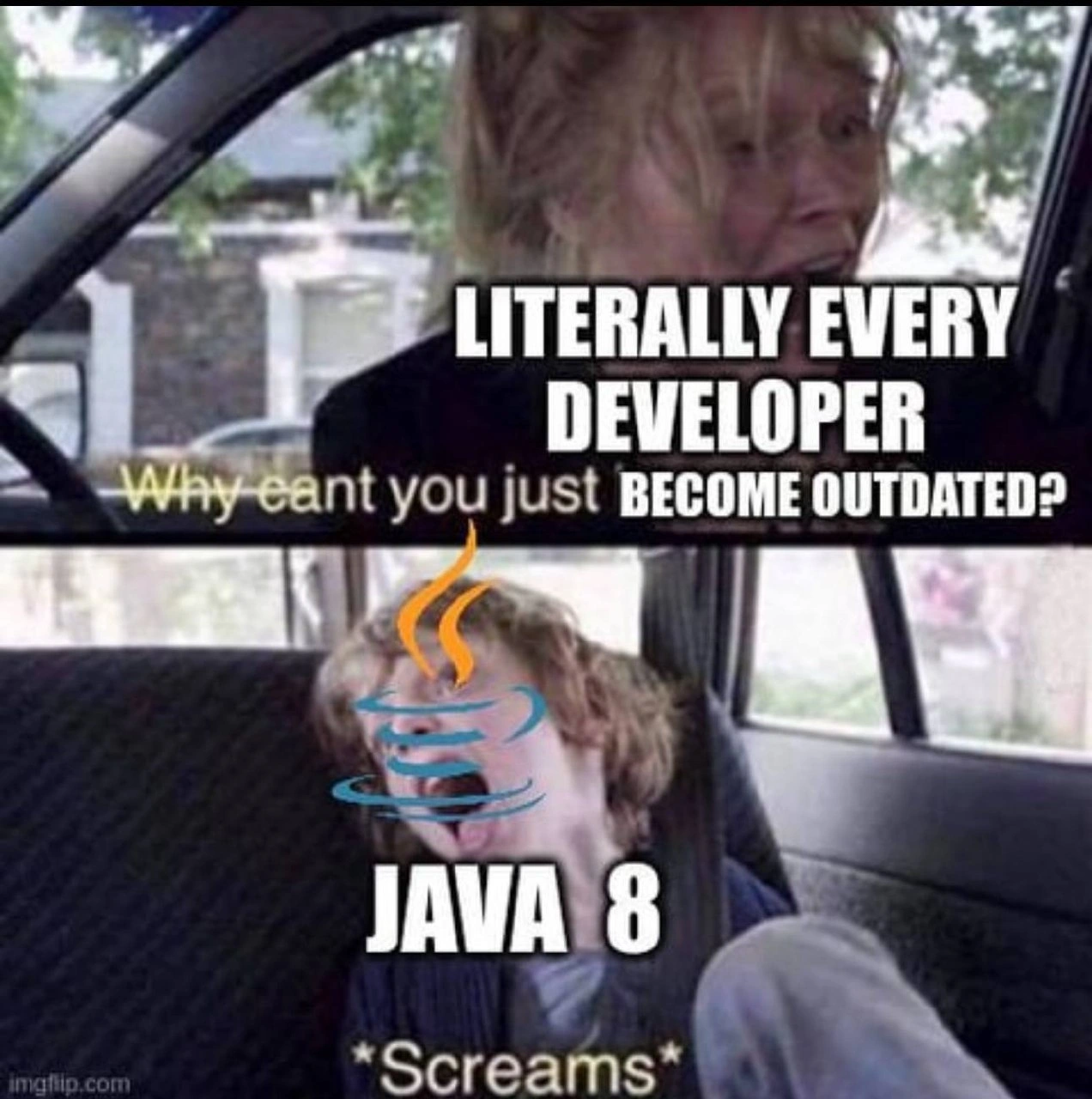
The meme uses the familiar “Why can’t you just be normal?” format where a parent yells and a child screams. In this tech twist, “Literally every developer” (the parent) is yelling “Why can’t you just become outdated?” at Java 8 (the child). In plain terms, developers are frustrated and asking: “Why can’t Java 8 just quietly go away so we can use new stuff?” The child’s response is just “Screams”, indicating that Java 8 isn’t going quietly at all. This reflects a real-life scenario: when developers try to move on from Java 8, they encounter a lot of resistance and trouble (the system “screams” in protest).
Let’s break down some terms and context:
- Legacy System: This refers to an old system or technology that is still in use. Java 8 in many places is now a legacy platform – it’s old, but a lot of critical software is built on it.
- Technical Debt: This is a concept meaning “deferred work” or the extra effort we’ll eventually have to do because we chose an easier, short-term solution now. Sticking with Java 8 for years creates technical debt – eventually, someone will have to do the hard work of upgrading, and it’s going to be even harder by then.
- Upgrade Inertia: Inertia means resistance to change. So upgrade inertia is when a team or company is slow and resistant to upgrading their tools or software. Here, upgrade inertia is why Java 8 is still around. People think, “It works, we don’t need to touch it,” which leads to no upgrades happening.
- Enterprise: This refers to big companies or organizations. In enterprise environments, changes happen slowly. They often have long review processes, concerns about stability, and many interconnected systems. In such places, you often find very old software still running because updating it is like trying to turn a huge ship – it’s slow and difficult. Java 8 is common in enterprise applications and big legacy systems because those systems were built years ago and “ain’t broke (yet)”.
So, the meme is relatable to developers because it highlights a common enterprise software challenge: newer versions of a language exist with cool features, but you’re stuck using an older version from 10+ years ago. For example, Java 8 lacks some handy modern Java features (like the var keyword for easier variable declarations, or newer library improvements). Developers feel a bit frustrated and left behind since they can’t use the latest tools and have to maintain code in the old style. It’s like being forced to use an old smartphone while a brand-new model is sitting right there on the shelf. You’d probably make a joke or two about it to cope – and that’s exactly what this meme is doing. It’s tech satire about legacy codebases.
The car scene meme format amplifies that feeling: it’s a parent-child power struggle. The developers (parents) are at their wit’s end saying, “Please, just be obsolete so we can move on!” And Java 8 (the child) responds with an uncooperative scream – meaning the old technology isn’t letting go without a fight. Anyone who’s tried to retire an old system or push a new upgrade in their company can recognize this comedic exaggeration.
Level 3: LTS Life Sentence
LITERALLY EVERY DEVELOPER: Why can’t you just BECOME OUTDATED?
JAVA 8: Screams
This meme nails the collective groan of developers stuck maintaining systems on Java 8 in the year 2025. The scene references the famous “Why can’t you just be normal?” car meme (from the horror movie The Babadook, fittingly enough). Here, Java 8 is the screaming child in the back seat, and “Literally every developer” is the frazzled parent begging it to retire already. The humor hits home for senior engineers because we’ve all been there: it’s a comedic exaggeration of how legacy platforms refuse to die in enterprise environments.
From a seasoned perspective, the joke underscores the absurd longevity of Java 8 LTS (Long Term Support). Java 8 was released in 2014, and yet, over a decade later, countless enterprise applications cling to it for dear life. New Java versions come out every six months, with major LTS releases (Java 11 in 2018, Java 17 in 2021, etc.), but many companies act like those versions don’t exist. The meme’s “Why can’t you just become outdated?” is a sarcastic plea: developers want Java 8 to finally be considered old news, so they can justify upgrading. Instead, Java 8 just “screams” – metaphorically representing all the headaches, errors, and corporate pushback that erupt whenever an upgrade is even attempted.
Why does Java 8 stick around like a ghost that won’t move on? A cynical veteran knows the answer: enterprise inertia. Large companies have mission-critical systems running on Java 8 that are “working just fine.” Upgrading the Java version in a giant monolithic application can feel as risky as open-heart surgery. There’s a “if it ain’t broke, don’t fix it” mentality entrenched in many IT departments. Every time someone suggests, “let’s update the JVM,” management’s response is a collective scream: “No! What if something breaks? Do we get any new features our customers care about? Not really? Then forget it.” The result is a kind of stalemate — a Long-Term Support life sentence. Java 8 isn’t officially the newest tech anymore, but in practice it’s immortal, refusing to gracefully age out.
The screaming in the meme also represents the technical pain that occurs if you dare touch that legacy setup. Try to compile or run the code on a newer Java and the codebase practically throws a tantrum. For example, attempt to use a modern Java feature in a Java 8 codebase and you’ll get build failures and runtime exceptions yelling at you:
Exception in thread "main" java.lang.UnsupportedClassVersionError:
com/enterprise/LegacyApp (class file version 55.0)
...
# (Translation: This was compiled for Java 11+, but you’re running it on Java 8!)
That cryptic UnsupportedClassVersionError is basically Java 8’s way of screaming “I don’t understand this new stuff! Get it away from me!” In real life, “Java 8” screaming might be dozens of unit tests failing, deprecated libraries crashing, or the old application server refusing to start after an attempted JDK upgrade. It’s the same energy as a kid having a meltdown when you try to change their routine. The meme captures this perfectly with humor: the devs just want the old platform to calmly accept retirement, but instead it kicks and yells.
Seasoned developers will also recognize the TechnicalDebt angle. Every year that a team postpones upgrading Java, the mountain of necessary changes grows. Java 8 has had a good long run, but staying on it indefinitely means you accumulate outdated libraries, unsupported frameworks, and security vulnerabilities (hello, endless patch backports). Upgrading from Java 8 straight to Java 17 or beyond becomes a nightmare project — akin to leaping a chasm — because so much changed in between (the module system in Java 9, removed APIs by Java 11, new language features, etc.). It’s a vicious cycle: the longer you wait, the louder the “screams” when you finally attempt it. Senior devs chuckle (or maybe grimace) at this meme because it’s too real: we’ve sat through meetings about “modernizing the legacy Java 8 monolith” that always end in nervous excuses and deferrals. The meme succinctly personifies our exasperation: we’re literally begging this outdated platform to step aside, and it just won’t.
There’s an element of dark humor in how stubborn Java 8 is portrayed. It’s like the industry’s inside joke: Java 8 is the new COBOL – not in syntax, but in how it just will not die in the enterprise. Many of us have war stories of trying to retire an old Java 8 service only to discover five other systems secretly depend on it, screaming in protest if you touch it. By 2025, Java 8 is practically the aging rock star of corporate IT: way past its prime, yet still on stage for an encore because the fans (or rather, the enterprise apps) aren’t ready to say goodbye. The meme’s humor comes from recognizing this pattern and laughing so we don’t cry. It’s a shared catharsis for developers: “Yep, I’ve begged an ancient system to sunset, and it metaphorically bit my head off, just like that.”
Description
A two-panel meme from a movie scene showing a woman in a car yelling at a child. The top panel has the woman labeled 'LITERALLY EVERY DEVELOPER' with text 'Why cant you just BECOME OUTDATED?' The bottom panel shows the child with the Java logo superimposed on their face, labeled 'JAVA 8' with '*Screams*'. The meme captures the frustration of Java 8 persisting in production environments despite numerous newer Java versions being available. Watermark: imgflip.com
Comments
27Comment deleted
Java 8 is like a cockroach in production -- it survived the Docker migration, the Kubernetes migration, three CTO changes, and will probably outlive the heat death of the universe on some forgotten EC2 instance
Java 21: ‘I have records, pattern matching, and virtual threads.’ Finance monolith on Java 8: ‘Cute. Talk to me again in 2030 when my LTS expires.’
The real reason Java 8 won't die isn't the lambda expressions or Stream API - it's because somewhere, a Fortune 500 company has a critical billing system written by a contractor in 2015 that nobody understands, and the last person who tried to upgrade it is still in therapy
Java 8 is the COBOL of our generation - except instead of mainframes running critical infrastructure for 60 years, it's Spring Boot microservices that were supposed to be 'temporary' in 2015. Every architect knows they should migrate to Java 17 or 21 for performance gains, better GC, and pattern matching, but between the Oracle licensing labyrinth, that one critical library that hasn't been updated since 2016, and the 847 integration tests that would need rewriting, Java 8 has achieved what no other technology has: making technical debt feel like a strategic decision. It's not legacy code - it's 'battle-tested production stability.'
Java 8: The LTS that lambdas its way through every 'modernize or die' RFP
Java 8 isn’t a version; it’s a compliance requirement hard-coded into 300 POMs and seven vendors’ “certified on JDK8” PDFs - no GC can collect that
Pitch Java 17 and procurement replies, 'our payroll vendor’s SAML toolkit only supports 1.8,' and suddenly the upgrade is archaeology through JAXB-era JARs
And like a jesus comes kotlin that you can compile into java 8 while having all new stuff :p Comment deleted
Why does it sound like js, that's funny Comment deleted
Don't compare kotlin to that mess called programming language >:( Comment deleted
Unlike JS, Kotlin can make syscalls without relying on runtime or hacks. Comment deleted
Isn't kotlin just an abstractoin? It's even more hacky than js in that regard. Comment deleted
Only machine codes are not Comment deleted
Correct me if I'm wrong, but kotlin (if not transpiled to other languages) runs on jvm. That's a runtime, isn't it? Comment deleted
There were ways to run Java bytecode in silico🙂 Comment deleted
There is Kotlin/Native, by which Compose runs on iOS Comment deleted
well there’s react native, isn’t it all just the same thing? Comment deleted
No. Kotlin/Native use a llvm backend, without a JIT VM. You can say it more similar to Go. Comment deleted
I mean, that doesn't make this phrase any better, it's just wrong. Comment deleted
I used it half a year ago to play dungeons dragons and space shuttles minecraft modpack lol Comment deleted
Same Comment deleted
When I installed GTNH a while ago, I found out they have a mod that provides a compatibility layer (lwjgl3ify), so you can play an older Minecraft (java8) version with modern 17/21 java. I'm assuming there potentially is a way to apply that for other modpacks, if someone really likes tinkering. Comment deleted
I remember those dark ages that I used to code on android studio 😭 Comment deleted
Reminder that virtually all contactless cards run Java. Comment deleted
As does any phone which emulates them. Comment deleted
Java 6 Comment deleted
30 billion+ devices run Java! Comment deleted