Skip to content
DevMeme
6465 of 7435
Happy Sunday Greeting With Sun Microsystems Java and SPARC Puns
TechHistory Post #7088, on Aug 31, 2025 in TG

Happy Sunday Greeting With Sun Microsystems Java and SPARC Puns

Why is this TechHistory meme funny?

Level 1: Sunday Morning Coffee

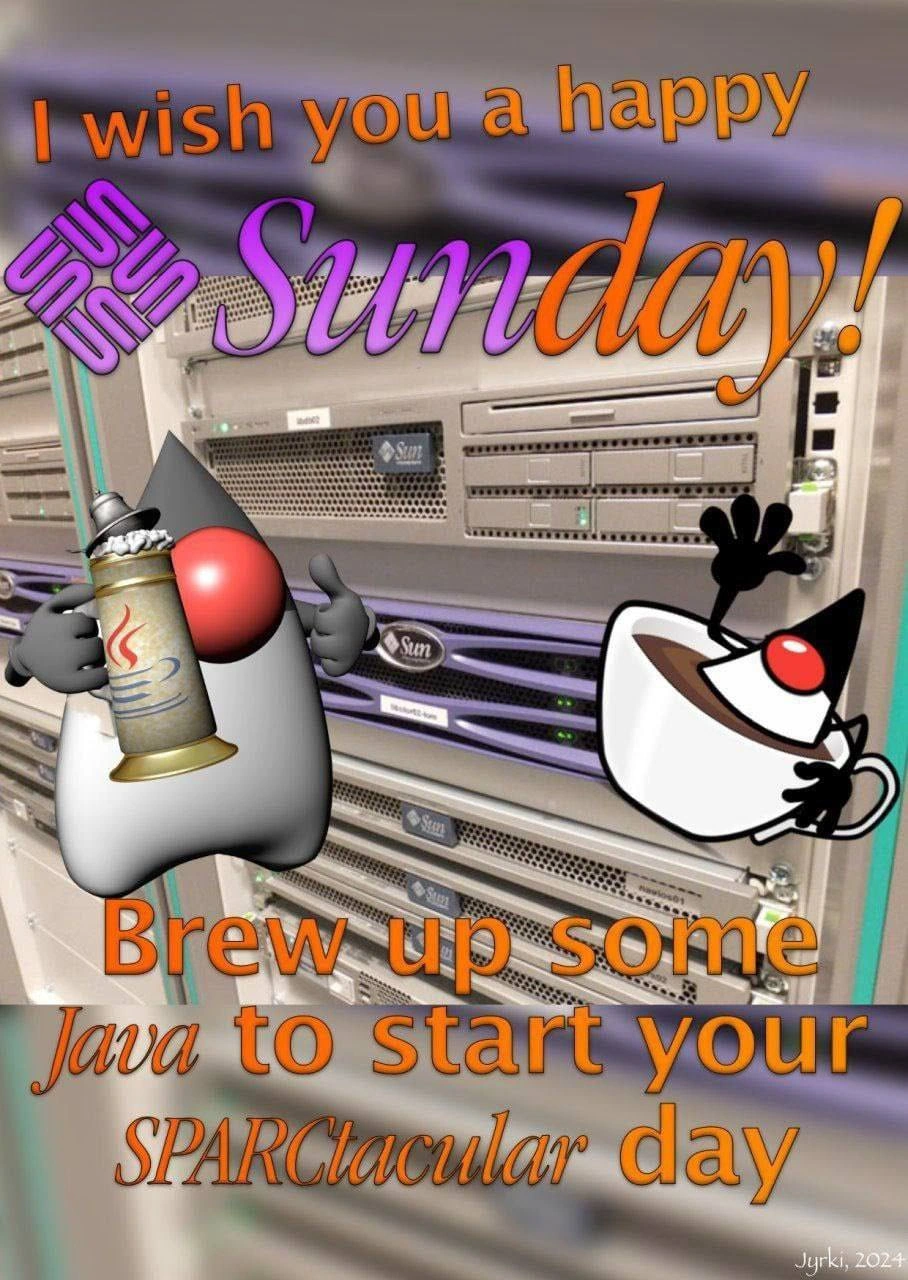
Imagine it’s a Sunday morning and you walk into a room full of big, important computers. The picture is wishing you a happy Sunday, but it’s doing it with a bunch of fun word jokes. It’s like a cartoon where the sun in the sky is replaced by the logo of a company named “Sun,” and two cute mascot characters (they look like friendly little triangles with arms and a red nose) are really excited, waving at you. One of them is holding a pot of hot coffee. Why coffee? Because the word “Java” means coffee and also is the name of a computer language. So the picture says, “Brew up some Java to start your SPARCTacular day.” That sounds like “brew up some coffee to start your spectacular day,” right? They snuck in the word SPARC (which is the name of those big servers) into the word “spectacular.” So it’s a big friendly pun: Sunday with the Sun logo, Java as coffee, and SPARCtacular instead of spectacular. The feeling it gives is the same as when someone hands you a warm cup of coffee on a Sunday morning and says, “Have a great day!” It’s cheerful and playful. Even if you don’t know anything about the computers or the Java language, you can sense it’s a bunch of happy tech jokes piled together — basically saying let’s start this Sunday with energy (like a strong coffee) and something awesome (like a spectacular tech day with cool computers). In the end, it’s just wishing you a fun and SPARCTacular Sunday in a geeky way, blending coffee and sunshine and a dash of computer magic. Enjoy your day!

Level 2: Coffee and Computers

So what exactly are we looking at in this meme? Let’s break down the tech references for someone who might not have been around for the RetroComputing era:

  • Sun Microsystems – This was a big technology company (founded in the early 1980s) known for making powerful computer hardware and software. The purple Sun logo you see (that square of intertwined letters) was its iconic mark. Sun built fancy servers and workstations that companies used before the age of cloud computing. Think of Sun as the “cool tech giant” of the 90s that was all about serious business machines. They also created the slogan “The Network is the Computer,” believing that their hardware would underpin connected computing worldwide. Fun fact: Sun was acquired by Oracle in 2010, so the name is now part of TechHistory, but their influence lives on.

  • SPARC servers – The rack of machines in the background are Sun’s SPARC servers. SPARC is a type of computer processor architecture (the design of the CPU’s brain) that Sun developed. The word stands for Scalable Processor ARChitecture. In simple terms, SPARC chips were the engine inside Sun’s servers, similar to how Intel or AMD chips power PCs, but they were optimized for reliability and multi-user performance in things like databases or big UNIX systems. These servers are legacy hardware now – they were super popular in the 90s and early 2000s for running things like websites, company databases, or scientific simulations. They often ran an operating system called Solaris (Sun’s version of UNIX). The grey-and-purple color scheme you see was Sun’s signature look — if you entered a server room or a university computer lab back then, those colors on a machine meant “high-end Sun equipment here.” Seeing them in 2025 is mostly for nostalgia; modern data centers use different gear. So, the meme showing a whole rack of SPARCs is definitely leaning into LegacySystems vibes.

  • Java and DukeJava is a very popular programming language that was originally created by Sun Microsystems in the mid-90s. If you’ve heard the phrase “write once, run anywhere,” that was Java’s big selling point: you could write a program and run it on any computer (Windows, Mac, or Sun’s own SPARC servers, etc.) as long as it had the Java Virtual Machine installed. Java’s logo is a steaming coffee cup because it’s named after a type of coffee (Java coffee). Hence, we often use coffee terms when talking about Java things (for example, a .jar file, which packages Java code, evokes a jar that might hold coffee beans, though it actually stands for Java ARchive). Now, Duke is the name of that little cartoon character (the black and white blob with a red nose and spindly arms) you see twice in the meme. Duke was Java’s mascot. In many old Java tutorials and conferences, Duke would appear doing fun stuff – kind of like Mickey Mouse for Disney, Duke was for Java. In the image, one Duke is holding a steaming coffee brewer with the Java logo on it, and the other Duke is waving excitedly. This immediately signals “Java is here, and it’s about coffee!” The phrase “brew up some Java” literally means make a cup of coffee, but here it’s a classic pun implying “start up some Java code” or “get coding in Java”. Java developers humorously talk about the Java compilation or startup process as “brewing” because of the coffee theme.

  • “Happy Sunday” / Sun pun – The text at the top says, “I wish you a happy Sunday!”, but notice the Sun logo is used in place of the letters S-U-N. This is a visual pun. It highlights the word “Sun” in Sunday to reference Sun Microsystems. The whole meme was likely posted on a Sunday (the context suggests it’s for a weekend greeting), making it timely. Basically, it’s saying both “have a nice Sunday” and “remember Sun Microsystems.” It’s a cheerful greeting from the tech world.

  • “SPARCTacular day” – At the bottom, the meme text reads, “Brew up some Java to start your SPARCTacular day.” This is a play on the word “spectacular.” By capitalizing SPARC, it sneaks in the name of Sun’s server technology right into a common positive phrase. So SPARCTacular day implies a day that’s as awesome as a SPARC server (to a Sun fan, that’s very awesome!). It’s a classic example of wordplay where a technical term is inserted into a normal word to make a tech joke.

Putting it all together in simpler terms: The meme personifies technology as characters wishing you a good Sunday. The Duke mascots (representing Java, and indirectly Sun Microsystems since Sun created Java) are encouraging you to enjoy both coffee and coding. One Duke literally brewed coffee (Java), while standing in front of Sun SPARC servers — the machines that might “serve” Java programs or websites. It’s referencing the idea that on a Sunday morning, maybe you (the sysadmin or developer) should prepare a nice cup of coffee and maybe even fire up some old Sun server projects or Java code for a “SPARC-tacular” (spectacular) start to your day. The use of the Sun logo in “Sunday” and SPARC in “spectacular” is just the meme having pun-filled fun with branding.

If you’re newer to tech, know that this meme is mixing hardware humor with programming jokes:

  • Hardware side: calling back to the days of big Sun servers and the folks who maintained them (ServerRoomStories often involve those exact machines).
  • Software side: referencing Java’s coffee theme that’s still very much alive (you’ve probably seen the coffee cup icon if you’ve ever installed Java).

The combination makes the meme a little love letter to old technology and a friendly greeting all at once. Even if you didn’t live through the Sun/Java heyday, you can appreciate that Sun-day is literally a day of the week and here also a nod to an old company, and Java is both your morning coffee and a coding language. It’s a jovial way to say “Happy Sunday, techie, enjoy your coffee and code!”

Level 3: Caffeinated Nostalgia

This meme hits experienced devs and sysadmins right in the nostalgia. It’s Sunday morning in a server room circa the late 90s or early 2000s: you’re greeted by the cheery phrase “I wish you a happy Sun*(Microsystems)*day!” as a pair of enthusiastic Duke mascots frolic in front of a rack of classic Sun SPARC servers. The humor here comes from layering multiple inside references:

  • Retro hardware pride: Those grey and purple Sun server racks (with model names like Enterprise or Blade in tiny labels) were once the crown jewels of enterprise IT. They’re iconic LegacyHardware in TechHistory – to anyone who racked and stacked these 50-pound monsters or lugged a Sun Ultra workstation onto their desk, the visual is instantly recognizable. Seeing them now evokes a “they don’t make ’em like this anymore” sentiment. It’s the same feeling as spotting a vintage sports car in a modern garage, but for tech folks. The meme’s background screams RetroComputing and unix_workstations_nostalgia (Sun’s Solaris OS ruled those machines), which is inherently funny when contrasted with today’s world of invisible cloud servers. An old-timer might chuckle remembering the whirr of those SCSI drives spin up, or the heat blasting out of the back of a SunFire rack, thinking “Ah, the good old days of on-prem, where SysadminHumor often meant praying the backup tapes would restore on Monday.”

  • Java’s coffee humor: Java is both a programming language and a slang for coffee. Sun leaned into that pun heavily when marketing Java in the ’90s: the steaming coffee cup logo, the name “Java” itself (a type of coffee bean), and Duke often depicted with a mug. The meme doubles down on this metaphor: Duke is literally holding a coffee_brew_metaphor contraption (a fancy brass coffee brewer emblazoned with the Java logo) as if he just brewed a fresh pot of code… er, coffee. The text “Brew up some Java to start your SPARCTacular day” rides on that same double meaning. For a senior dev, this is a comforting throwback to countless JavaOne conference schwag items and Sun marketing puns. It’s Wordplay at its finest: we’re implicitly told to run some Java programs on a SPARC server to kickstart the morning, but also to drink some strong coffee to have a spectacular (SPARC-tacular) Sunday. It’s the kind of groan-worthy dad-joke pun that only techies could love — and we do love it, because it’s interwoven with the tools of our trade.

  • Sun + Sunday pun: Replacing the “Sun” in “Sunday” with the actual vintage Sun logo is a playful graphic touch. It’s visually sparc_servers + sun_logo_pun + day = Sunday. For anyone who remembers Sun Microsystems, that purple logo in place of text is like a secret handshake. It says “This meme is made by someone who remembers dial-up internet, UNIX workstations, and when Java was the hot new thing.” There’s also irony in wishing a “happy Sunday” to presumably an audience that might be working on their day off: a lot of production deployments or maintenance windows happen over weekends. The meme’s cheerful tone (“I wish you a happy Sunday!”) with waving Duke mascots could be tongue-in-cheek encouragement to the on-call sysadmin or the developer squeezing in some weekend coding. It’s like your servers (personified by Duke) are telling you, “Hey buddy, I know you’re here with me in this frigid data center instead of sleeping in. Let’s start the day with some coffee and code, and make it SPARCtacular!” As someone who’s done a 6 AM Sunday maintenance, that mix of painful duty and coffee-fueled optimism is all too real. ServerRoomStories often start with exactly that scene.

  • Enterprise meets Cartoon: The juxtaposition of staid enterprise hardware and cartoonish mascots is itself funny. Those Duke characters are literally bouncing in front of serious, expensive machines that powered banks and telcos. It’s a whimsical reminder that behind all the LegacySystems and high-tech gear, tech folks maintain a sense of humor. Seasoned developers recall that Sun Microsystems not only built serious tech (Java runs on billions of devices, and many core internet services ran on SPARC servers), but also had a lighter side — Duke was everywhere, from conference stages to documentation cartoons. This meme channels that forgotten friendly corporate culture vibe, when tech giants had quirky personalities (think SGI’s cube logos or IBM’s OS/2 warp mascots).

The senior perspective appreciates how all these elements — Java programming, legacy hardware, weekend admin life, and punny wordplay — come together seamlessly. It’s a mini time-travel: back to an era when you might actually “brew” a new pot of coffee while waiting for a giant Solaris server to reboot after an OS patch. It pokes gentle fun at that old normal. The phrase “SPARCTacular day” even hints at how Sun used to brand everything with “SPARC” for hype (there were SPARCstations, SPARCservers… why not SPARC-tacular performance in press releases?). Ultimately, this level of humor lands because it’s affectionate. It winks at the absurdity of the past — the grand Sun vision of networked computing, the Java coffee marketing frenzy — while simultaneously acknowledging that we loved it. The people who get this joke have probably written Java code on a Sun machine at some point or racked a SPARC server while running on pure caffeine. It’s a caffeinated nostalgia, reminding us where today’s tech landscape came from (and perhaps making us a bit sentimental for when “the cloud” was just a fancy term for someone else’s Sun server).

Level 4: RISCy Roast

In the depths of computer architecture history, Sun MicrosystemsSPARC servers represent a high point of RISC design — that’s Reduced Instruction Set Computing, not just a play on “risky.” These hefty grey-and-purple machines in the background are powered by a RISC CPU architecture known for its streamlined instructions and register window innovation. Under the hood, a SPARC processor handled computations with a minimalist elegance: simple operations executed in a single clock cycle, deep pipelining, and multiple sets of registers sliding like overlapping coffee filters for each function call. This design, born from 1980s academic projects, prioritized efficiency at the hardware level, reducing the complexity of each instruction so the chip could brew up results faster (much like focusing on one good cup of coffee at a time). The meme’s punny directive to “brew up some Java” playfully bridges software and hardware: Java, a language invented by Sun, runs on a virtual machine (the JVM) that abstracts away the physical CPU differences. Whether that JVM was interpreting bytecode on a SPARC Solaris server or on an Intel-based PC, the Java program logic stays the same—write once, run anywhere was Sun’s battle cry. But beneath that promise, the JVM’s HotSpot engine was busy performing just-in-time compilations and optimizations tailored to each architecture. On SPARC hardware, HotSpot would dynamically compile Java bytecode down to SPARC’s RISC instructions, just-in-time to squeeze out Spectacular (or should we say SPARCTacular?) performance. This dynamic “brewing” of code into native instructions is analogous to percolating coffee: the Java source is the raw bean, bytecode is the ground coffee, and the JIT compiler is the brewer extracting a potent shot of machine code espresso specifically optimized for the SPARC’s pipeline. It’s a deep-cut reference that blends hardware architecture and language runtime theory—the kind of detail that a true TechHistory buff or a systems architect might savor with a wry smile. The sun_logo_pun in “Sunday” is not just cute wordplay; it’s a nod to how Sun’s legacy permeates both the machinery (SPARC servers) and the software (Java), thanks to design decisions made decades ago. Indeed, Sun’s motto “The Network is the Computer” foresaw a world where distributed systems run everywhere—Java was meant to unify that world, and SPARC was engineered to power it. The meme’s brilliance is in taking these heavy concepts (cross-platform virtual machines, CPU design philosophies, legacy hardware still humming in data centers) and wrapping them in a friendly Sunday morning greeting. It’s a LegacySystems tribute brewed from the perfect blend of bytecode and silicon, academic theory and coffee-fueled practicality.

Description

A retro-styled greeting card image with the text 'I wish you a happy Sunday! Brew up some Java to start your SPARCtacular day'. The image features Sun Microsystems branding prominently, with the Duke Java mascot holding a coffee cup with the Java logo, and another cartoon mascot holding a coffee cup. The background shows Sun Microsystems server hardware in a data center rack. The word 'Sunday' cleverly incorporates the 'Sun' logo, 'Java' references both the programming language and coffee, and 'SPARCtacular' is a pun on Sun's SPARC processor architecture. Signed 'Jyrki, 2024'

Comments

8
Anonymous ★ Top Pick This has the same energy as your uncle who worked at Sun in '98 sharing minion memes, except somehow it's nerdier and more wholesome -- and the only person who laughed is running Solaris on bare metal to this day
  1. Anonymous ★ Top Pick

    This has the same energy as your uncle who worked at Sun in '98 sharing minion memes, except somehow it's nerdier and more wholesome -- and the only person who laughed is running Solaris on bare metal to this day

  2. Anonymous

    Remember when our "cloud" was a rack of SunFire V240s and the only pods we scaled were the coffee ones?

  3. Anonymous

    Nothing says 'relaxing Sunday' quite like reminiscing about the days when your SPARC servers cost more than a house, required a dedicated AC unit, and you still had to explain to management why Java wasn't just about coffee

  4. Anonymous

    Nothing says 'relaxing Sunday' quite like the gentle hum of a Sun Fire server farm and the existential dread of maintaining Java 1.4 applications on SPARC hardware that predates your junior developers. At least the coffee's still hot - unlike those end-of-life support contracts

  5. Anonymous

    SPARCular Sundays: When 'java -version' still spits out 1.4.2 and your coffee's cold

  6. Anonymous

    Classic Sunday change window: brew coffee, watch patchadd crawl on Solaris, and hope the 32‑bit Java heap on UltraSPARC stays under 2G so ulimit and permgen don’t stage a production incident

  7. Anonymous

    SPARC-era truth: deploy Java on Solaris and you’ll rediscover every "portable" JNI endian assumption - HotSpot warms the heap while the SunFire warms the room

  8. @VolkovCoppermine 10mo

    This sparks nostalgic joy.

Use J and K for navigation