The Agony of Writing and Maintaining Ruby Code
Why is this Languages meme funny?
Level 1: Crying Over Spaghetti
Imagine you have a big bowl of spaghetti that got all tangled up. You try to pick up some noodles, but everything is so jumbled that a whole clump comes up at once and sauce splatters everywhere. It’s super messy and frustrating! You might even feel like crying if you’re really hungry and now dinner is a disaster.
This meme is saying that writing a computer program can end up like that messy bowl of spaghetti. When a programmer doesn’t organize their code (their instructions to the computer), the program becomes one big confusing tangle – just like a bowl of mixed-up noodles. Later on, when the programmer tries to “eat” that spaghetti (meaning, try to fix a bug or add a new feature to the code), they have a really hard time. They get frustrated and upset, kind of how you would feel trying to deal with a bowl of spaghetti that’s spilling everywhere.
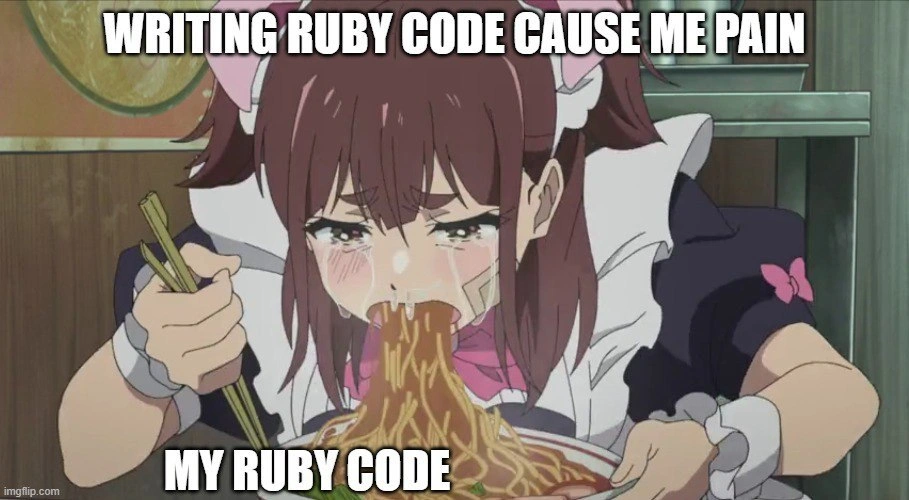
In the picture, the character is an anime maid who is crying while eating a mound of messy noodles. That’s a funny way of showing the idea: the coder wrote a messy, tangled program (the noodles represent the messy code), and now the coder is suffering through it, almost in tears. It’s like they’re saying, “Oh no, what have I done? This is so hard to swallow!” It’s both sad and comical because the person in the image is basically being forced to eat their own chaotic creation.
So, the simple joke is: messy code is like messy spaghetti. If you make a huge mess while coding, you’ll feel the same frustration as someone facing a sloppy bowl of noodles. The programmer is essentially crying over their spaghetti, meaning they regret making such a mess but now have to deal with it. Even if you don’t know Ruby or programming, you can understand that feeling – it’s the pain of trying to clean up a mess you made yourself. The meme makes us smile because it uses a relatable everyday mess (spaghetti dinner gone wrong) to explain a techie problem in a very down-to-earth way.
Level 2: Untangling the Noodles
This meme shows a developer’s frustration in a really funny, visual way by comparing messy code to a messy bowl of spaghetti. The top text says “Writing Ruby code cause me pain” and the bottom says “My Ruby code” over an image of an anime maid crying into a huge bowl of noodles. Essentially, the programmer is joking that their own Ruby code turned into a tangled mess (spaghetti), and it’s causing them a lot of pain (frustration). It’s a form of developer self-deprecation – meaning the developer is poking fun at themselves for writing bad code.
Let’s break down the key ideas here. Ruby is a programming language (one of the popular Languages used by developers, especially for web development with Ruby on Rails). Ruby is known for being very flexible and dynamic. Dynamic means you don’t have to declare the type of each variable or object – the language figures it out as it runs. You can even modify parts of the program while it’s running (for example, you can add new methods to built-in classes or change how something works on the fly). This makes Ruby really powerful and fun to write because you can solve problems in creative ways and get working results quickly. The community often emphasizes developer happiness and DeveloperExperience (DX) – Ruby code, at its best, reads almost like English and lets you be very expressive.
However, that same flexibility can lead to problems with CodeQuality if you’re not careful. Without strict rules, it’s easy for a program’s code to become disorderly or unstructured. That’s where the term “spaghetti code” comes in. Spaghetti code is a common slang term in programming for code that has a very tangled and confusing structure. Just like a bowl of spaghetti noodles all wound around each other, spaghetti code is when the logic in a program is all over the place, twisted in knots. There’s no clear organization: maybe one giant function does tons of things, or the flow of the program jumps back and forth in a way that’s hard to follow. If you’ve ever pulled one noodle from a spaghetti bowl and seen half the bowl come out with it, you know how tangled things can get – imagine a codebase like that, where changing one part of code unexpectedly affects many other parts. DeveloperPainPoints often include having to work with spaghetti code because it’s difficult to debug, extend, or even understand.
In Ruby, a few factors can contribute to spaghetti code. Because Ruby doesn’t force a particular structure, a beginner might write everything in one file or one big method. For example, a new Ruby programmer might write a single script that opens a file, processes data, updates a database, sends an email, all in sequence with no separation. That script can quickly become long and complex – that’s spaghetti. Also, Ruby allows things like monkey patching, where you can change existing classes or add global methods. If overused, it can make it unclear which part of the program is doing what. Imagine you read a Ruby class and don’t see a certain method defined, but somewhere else the code has opened that class and added the method – you might be scratching your head about where that behavior comes from. That confusion is exactly what spaghetti code causes. It’s a mess, and developers generally try to avoid it by organizing code into separate functions, classes, or modules and by following best practices (like the SOLID principles or design patterns). When those practices are ignored (often due to tight deadlines or lack of experience), the result can be a codebase that’s as messy as a noodle bowl.
Now, the anime meme aspect adds a flavor of dramatic humor. The character is a maid with tears streaming down her face, struggling with a bowl of noodles. Anime reaction images are popular in programming memes because they exaggerate emotions in a cute or absurd way. Here, her tears and overwhelmed expression amplify how a developer feels internally when dealing with a chaotic codebase. The bandage on her face might even hint she’s been “hurt” in the process – just like a programmer might feel mentally “bruised” after fighting with tough bugs or messy code for hours. The noodles spilling out of her mouth and bowl visually represent “messiness” and lack of control. It’s a direct analogy: my Ruby code is like this out-of-control pile of noodles, and it causes me pain to deal with it.
The text on the meme uses a kind of broken English (“cause me pain” instead of “causes me pain”), which is actually a common style in memes to mimic a dramatic or simplistic voice. It makes the statement feel more raw and desperate, almost like a caveman talk or someone so tired they drop proper grammar. That exaggeration fits the joke – the developer is so in agony that they’re just exclaiming “Writing Ruby code cause me pain!”. It’s both humorous and relatable. CodingPain and DeveloperFrustration are being communicated in a very straightforward way.
To a less experienced developer or someone new to Ruby, the meme is basically a cautionary tale and a shared joke. It says: Ruby is cool and fun, but be careful! If you’re not organized, your code can turn into a big bowl of spaghetti, and you’ll be miserable trying to work with it later. Many of us have had that experience. For instance, you might rush to finish a school programming assignment or a quick script by writing a lot of code in one go without structure. It works at first, but when you look back at it a week later or when something breaks, you realize you created a monster. You find yourself muttering, “Oh no, this code is so bad… how do I even fix it?” – maybe not literally crying like the anime character, but definitely feeling the frustration. This meme captures that moment in a humorous way.
In terms of DeveloperExperience_DX, dealing with spaghetti code is one of the worst experiences. It slows you down and can turn a simple update into a detective mission through your own code. That’s why clean code and refactoring are emphasized in real life: to keep the “noodles” from tangling. A positive developer experience means code is clean and easy to work with; a negative experience (like here) means the code itself is causing pain and suffering. And while it’s painful, developers often cope by joking about it – hence memes like this. It’s a form of bonding among developers, saying “hey, we’ve all been there.” If you share this meme with other programmers, especially those who use Ruby, you’re likely to get knowing nods or laughs. They might even share back war stories of their own spaghetti code incidents.
So, put simply: writing Ruby code can be super enjoyable, but if you’re not careful, you might write code that’s a jumbled, hard-to-maintain mess (the spaghetti). Then you’ll be stuck eating that mess — in other words, suffering through fixing or updating your own tangled code. The image of the crying anime maid slurping noodles is an exaggerated, funny metaphor for that exact situation. It’s highlighting a code quality issue (spaghetti code) through developer humor. And while it’s tongue-in-cheek, there’s a real lesson behind it: good code structure matters if you want to avoid tears later!
Level 3: Monkeypatch Meltdown
In this meme, a sobbing anime maid hunched over a bowl of tangled noodles perfectly personifies a programmer confronting their own spaghetti code. The Impact caption spells it out in blunt, memetic fashion:
WRITING RUBY CODE CAUSE ME PAIN
MY RUBY CODE
This is senior developer humor at its finest – a dramatic, self-inflicted facepalm. The Ruby language is beloved for its elegance and dynamic power, but that freedom is a double-edged sword. Here, the visual chaos of noodles stands in for a codebase so unstructured and intertwined that maintaining it feels like slurping a never-ending tangle of pasta while crying. It’s a scenario many experienced devs know too well: you enthusiastically hack together a solution in Ruby’s flexible syntax, and a few late nights later you’re staring at a convoluted mess wondering, “Who wrote this? Oh right… me.”
The term spaghetti code is no accident – it’s a classic metaphor dating back decades. Code that flows like a plate of noodles (twisting, turning, entangling everything) was first used to describe nightmare GOTO-laden programs of the 70s. In modern Ruby, spaghetti code often comes from overusing the language’s openness and syntactic sugar without discipline. Ruby lets you monkey-patch anything: you can reopen fundamental classes or definitions at runtime and modify them. Need an Array to have a second method? You can just inject it into class Array on the fly. This power is fun (even thrilling for a Rubyist) until multiple parts of your system start changing the same things and you can’t trace which piece of code is doing what. It’s a CodeQuality hell: each monkeypatch or meta-programming trick adds another noodle to the bowl. Before long, the code’s logic is all knots and loops – a true Monkeypatch Meltdown.
Ruby’s famous metaprogramming capabilities and internal DSLs (Domain Specific Languages) add to the mix. Frameworks like Rails let developers write code that reads almost like English sentences – super convenient, but under the hood there’s a ton of hidden magic. For example, calling User.find_by_name("Alice") might dynamically create a method based on your database fields. It feels clean and simple when you write it, but if something goes wrong, you’re left digging through Rails’ metaprogramming internals to figure out why find_by_name mysteriously broke. This kind of “invisible” structure can turn debugging into a spelunking expedition through a cave of spaghetti. It’s a running joke (tinged with truth) among senior Ruby developers that with great Ruby magic comes great responsibility. If you abuse the magic, you end up trapped in it – just like our poor maid drowning in her own noodle concoction.
The pain in the meme’s caption isn’t just physical (though the maid’s teary, reddened face really sells the agony). It’s the psychic damage of dealing with technical debt. Spaghetti code is a notorious DeveloperPainPoint: every fix or feature feels like pulling one noodle in a tangled heap – you risk bringing the whole codebase crashing down. Seasoned devs have learned (often the hard way) that quick hacks and “clever” one-liners accumulate into a maintenance nightmare. The meme’s humor lies in this shared trauma. It’s developer self-deprecation: we do it to ourselves, know we shouldn’t, and yet late nights and looming deadlines lead us right back into the spaghetti bowl. The top text “WRITING RUBY CODE CAUSE ME PAIN” combined with the bottom “MY RUBY CODE” is basically the programmer admitting, “My own work is the source of my suffering.” There’s an almost masochistic irony that Ruby, a language designed for programmer joy (Matz, Ruby’s creator, famously said he wanted to “make programmers happy”), can facilitate such misery when misused. DeveloperHumor often leans on these ironies – here we’re laughing (and crying) at the gap between Ruby’s beautiful syntax and the ugly reality of a poorly structured program.
On an architectural level, this meme highlights the importance of structure and code quality practices. Well-factored Ruby code can be gorgeous – concise, readable, almost like poetry. But stray from best practices, and dynamic typing plus creative freedom can produce a monster. Imagine methods hundreds of lines long, global variables sneaking around (a quick $global here, a class variable there), five layers of if/else nesting – that’s the spaghetti recipe. No clear separations of concern, no single responsibility, just everything glommed together. It’s the opposite of beautiful code. And when you or your teammates return to it, the DeveloperExperience is downright painful: “Why is this not working? Where is that method defined? Oh no, it was added via method_missing in some meta-programming black magic!” The DeveloperFrustration is real. You can almost hear the internal scream: “Why did I do this to myself?!”
The anime imagery amplifies this to comedic effect. A prim maid character sobbing while shoveling messy noodles is absurd, but that’s what makes it DeveloperHumor gold – it externalizes the internal breakdown every coder has had at some point. It’s the perfect anime_meme dramatization of a dev’s emotional state when wrangling a disastrous codebase. The bandage on her face, the tears, the sheer mess of noodles everywhere – it screams “I got hurt doing this!” In truth, writing bad code does kind of hurt later: it hurts your brain to untangle it, it hurts your team’s productivity, and it might even hurt your reputation during code review. This meme resonates because it takes a universal scenario (engineer versus their own messy code) and cranks it up to 11 with a painfully literal metaphor. SpaghettiCode isn’t just an abstract idea here – you can see it, and it’s being begrudgingly swallowed with chopsticks and tears.
For veteran programmers, the humor has a bittersweet edge. We’ve all been that developer, grimly consuming the consequences of rushed or overly clever coding. We joke about it now – “Ha ha, classic me, turning a simple script into a bowl of noodles!” – but only because we survived the refactor (or at least lived to tell the tale). This meme winks at those in the Ruby community (#ruby) who have felt this exact pain. It’s a playful reminder that writing Ruby code is as much about discipline as it is about expressiveness. Without proper care, the flexibility that makes Ruby fun can lead straight to a monkeypatch meltdown, leaving you with spaghetti on your face (literally, in the maid’s case). And as every battle-hardened coder knows, there’s nothing quite like the flavor of technical debt – it’s bitter, it’s salty (like tears), but at least memes let us smile through the pain.
Description
An anime meme featuring a close-up of a female anime character with brown hair, dressed in a maid-like outfit. She is crying profusely, with tears streaming down her face, as she forcefully shoves a large amount of noodles into her mouth with chopsticks. The noodles are spilling out, creating a messy and distressing scene. The top text overlay reads, 'WRITING RUBY CODE CAUSE ME PAIN'. The messy noodles spilling from her mouth are explicitly labeled, 'MY RUBY CODE'. This meme uses the visual metaphor of force-feeding oneself to represent the painful and frustrating experience a developer might have when working with Ruby, especially on a legacy project. The resulting messy, spilling noodles perfectly symbolize the concept of 'spaghetti code' - code that is tangled, difficult to manage, and painful to produce or maintain
Comments
10Comment deleted
This is me monkey-patching a critical gem in a 10-year-old Rails monolith at 3 AM. The tears are just part of the ORM's callback cycle
The moment you alias_method_chain in production, you’re basically serving future-you a bowl of method_missing ramen garnished with untraceable stack traces
After 15 years in the industry, I've learned that Ruby's 'principle of least surprise' only applies if you were raised by Matz himself and think method_missing is a perfectly reasonable way to implement an API
The real tragedy isn't writing Ruby code - it's maintaining Ruby code you wrote six months ago when you thought `method_missing` and monkey-patching core classes was 'elegant metaprogramming.' Now you're debugging why `String` has a `to_blockchain` method and crying into your ramen while `bundle update` runs for the 47th time today
Ruby feels elegant until open classes, method_missing, and six Concerns later - now the noodles and the call stack are both impossible to untangle
Ruby lets you reopen classes, sprinkle method_missing, and call it a DSL - then during a 2am incident you realize the spaghetti was object‑oriented
Writing pasta-code doesn't cause pain. *Reading* does 😄 Comment deleted
And don't get me started on changing it... Comment deleted
Rubocop calling me out. Comment deleted
Find the clip where she vomits Comment deleted