When security awareness points reward total inbox avoidance at work
Why is this Security meme funny?
Level 1: Laziness Pays Off
Imagine your teacher gives the class a tricky assignment with a hidden trap in it, to teach everyone a lesson about paying attention. If you avoid the trap, you get a gold star. Now, you didn’t do the assignment at all – you didn’t even look at it. The next day, the teacher is really happy with you and gives you a gold star for not falling into the trap. It’s funny because you didn’t avoid the trap on purpose – you just didn’t do the work! You kind of “won” by being absent.
That’s exactly what this meme is joking about. The company’s IT teacher (the boss or IT department) is praising the employee for not clicking a dangerous email link (like giving a gold star for not falling for a trick). But the only reason the employee didn’t click it is because he never saw the email – he ignored his mailbox, like skipping the assignment. It’s like getting credit for being safe and careful when really you were just lucky or lazy. The humor is in that mix-up: getting rewarded for doing nothing at all.
Level 2: Awareness vs Avoidance
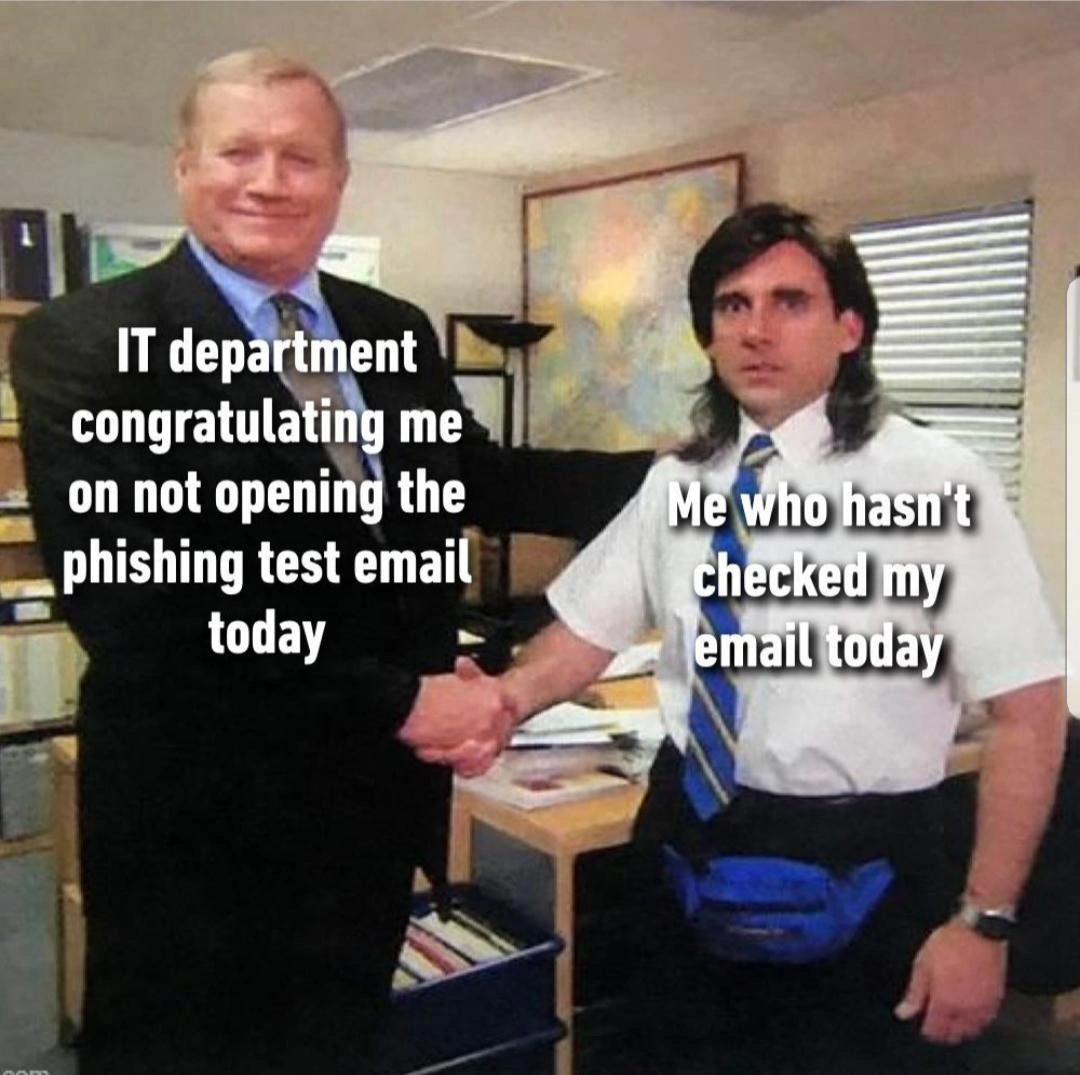
This meme puts a funny twist on a common workplace scenario involving phishing emails and security awareness. In the image, a manager from the IT department is enthusiastically shaking hands with an employee. The text jokes that the IT department is “congratulating me on not opening the phishing test email today.” The other guy (the employee) has text by his face that says “Me who hasn’t checked my email today.” In other words, the company thinks the employee did a great job avoiding a dangerous email, but actually he just didn’t read his email at all that day!
Let’s unpack what that means. Phishing is a type of online scam where someone sends a fake email that looks legitimate (like pretending to be your bank or your boss) to trick you into clicking a bad link or giving away passwords. Companies worry about phishing a lot, because one careless click can infect the entire company network with malware or reveal confidential data. To help employees practice spotting these scams, many companies run phishing_training exercises. They send out a phishing test email (a pretend scam email crafted by the company’s security team or a training vendor) to see who falls for it. It’s like a fire drill but for phishing: if you click the link or enter your password on the fake site, the system records that. Usually you’ll get a friendly reminder or have to redo a SecurityAwareness course if you get tricked. If you don’t click it, it’s considered a success — you spotted it (or at least you didn’t take the bait).
Now, in a perfect world, not clicking the link means you recognized the email was phony. Maybe you saw obvious signs of a phish: the sender’s address was weird, the message had odd spelling, or it was offering something too good to be true. Phishing detection in the human sense is all about noticing those red flags. Companies often reward departments or employees who consistently avoid these traps. They might even give out points, certificates, or just public kudos for being “security aware.” That’s what the meme means by “security awareness points.” It’s basically exaggerating the idea that employees get brownie points for not falling for a phishing simulation.
The funny part is how this particular employee avoided the phish. He didn’t cleverly spot it or report it — he simply ignored all his email. This is the email_inbox_neglect strategy: if you don’t read any messages, you technically won’t click a bad one. Of course, this is not the intended method to pass a phishing test! The IT department in the meme, though, is shown applauding him, totally unaware that his “good behavior” was unintentional. This highlights a goofy reality of corporate life: sometimes people care more about checking the box than the actual lesson. The company’s security team was running a security_simulation to raise awareness, but their success metric (no click = good) is a bit shallow.
Visually, the meme uses the popular handshake_meme format: two people shaking hands with text labels to represent who they are or what they stand for. Here we have the suited manager (labeled as the IT department) and the slightly disheveled employee (labeled as “Me” – the meme’s narrator). The setting is a bland, cluttered office with filing cabinets and fluorescent lights – typical corporate vibe. The employee is wearing a white shirt and tie but also a bright blue fanny pack, which is a pretty silly accessory in an office. This detail, along with both faces being pixelated, adds to the humor. It’s almost like a scene from The Office (the famous workplace comedy TV show) or some parody of corporate life. In fact, the employee’s look and the overall awkward-yet-official handshake situation feel like an the_office_reference – it’s the kind of absurd situation Michael Scott or another character might end up in. Fans of that show would recognize the awkward humor of being praised for something you totally didn’t mean to do.
For someone new to office IT culture, the meme is highlighting the difference between awareness and avoidance. Awareness means you’re actively careful – you check your emails and can spot a malicious one and avoid it on purpose. Avoidance (in this joke) means you just don’t engage at all – you didn’t check your email, so you couldn’t have clicked anything bad (but you also didn’t do your actual work or learn anything about security). The humor comes from the company treating both outcomes the same when they give out praise. It’s a lighthearted jab at how corporate security training can miss the mark. After all, the goal is to teach people good habits, not just to get “zero clicks” by any means. The meme uses OfficeHumor to make IT folks and regular employees alike chuckle and think, “Yeah, that is pretty silly, isn’t it?”
Level 3: Security by Neglect
At first glance this looks like a proud moment in a corporate security awareness program: the IT department manager is heartily shaking an employee’s hand for acing a phishing drill. But the punchline? The employee “succeeded” simply by doing nothing – he never even opened his inbox. This meme humorously exposes how phishing training metrics can be gamed and how superficial security measures can be in a big company. It’s a perfect slice of CorporateCulture satire wrapped in Security humor.
In many enterprises, the IT or security team will send out a fake phishing test email to see who takes the bait. They measure things like click-through rates and boast about improved phishing_detection if fewer people fall for it. Ideally, a low click rate means employees spotted the scam and ignored it. However, as any cynical veteran of corporate life knows, those numbers can be deceiving. Here, the IT department is thrilled because “nobody clicked the phishing link today.” Yet our employee didn’t outsmart a hacker – he just neglected his email inbox altogether. It’s security by absence rather than by vigilance, a textbook example of security theater where the metric (no clicks) is met, but the spirit (actually recognizing a phish) is not.
Why is this so funny (and painful) to experienced devs and IT folks? Because it rings true. We’ve seen employees find unintended “hacks” to pass these security simulations. Some offices even joke that the easiest way to get a 100% score on a phishing test is to ignore all emails until the test is over. It’s like achieving zero bugs in your code by never shipping any – technically effective, but completely missing the point. In the meme, the suited manager represents the well-meaning but metrics-obsessed IT department, ready to dole out praise for a perfect score. The casually dressed employee with the bright blue fanny pack (evoking a goofy The Office vibe) represents the worker who stumbled into compliance by accident. The absurdity is that both are shaking hands as if a great feat in security_simulation has been accomplished.
To a seasoned developer, this scenario screams “check-box compliance.” The company can pat itself on the back for high SecurityAwareness scores, but did anyone actually learn how to spot a malicious email? Probably not. It highlights a real corporate culture problem: sometimes the appearance of SecurityAwareness (like a low failure rate on phishing tests) gets more focus than true understanding. The handshake in the meme perfectly captures this hollow congratulations. It’s reminiscent of a boss applauding you for avoiding a disaster that you didn’t even know about. In other words, “Congrats for not falling into the trap – by sheer luck!”
Veterans in IT will recall countless meetings where leadership was thrilled about hitting a target (“Only 1% of employees clicked the phishing link this quarter!”) without asking why it was low. Was it improved phishing_training or just people on vacation? The meme’s scenario is basically a comic exaggeration of that doubt. It’s CorporateHumor with an edge of truth: the best way to not get hacked might sarcastically be to stop using email entirely (just kidding, don’t try this at work). In practice, we want an engaged workforce that recognizes threats, not one that avoids communication. But this joke hits a nerve because, as every jaded IT pro knows, when metrics become the goal, people find funny ways to hit them.
Let’s break down the “win” conditions being poked at here:
- Genuine vigilance: You spot the phishing clues (weird sender address, generic greeting, urgent tone) and wisely avoid clicking.
- Total inbox avoidance: You open nothing, click nothing, and thus also avoid danger – not by skill, but by absence. (Not exactly what the security team had in mind!)
Both approaches yield the same statistic (no phish clicked), but only one means you’d catch a real attack next time. The meme exaggerates the second approach to highlight how ridiculous it is to reward it. It’s office humor at its finest: pointing out the gap between policy and reality. The handshake_meme format underscores the agreement: the company and the employee are literally in sync for all the wrong reasons. Seasoned folks chuckle (or cringe) because they’ve seen this movie before – where security_simulation results look great on paper even if actual security hasn’t improved a bit.
In short, the meme is a nod to every phishing_training program that became a trivial game to beat. It’s laughing at how corporate systems can be gamed: you can practically hear the employee thinking, “Sweet, I’ll just not check my email and get a perfect score!” And you can imagine the IT team triumphantly announcing, “Zero failures this time, folks!” without realizing half the office was just ignoring that test message. This blend of Security protocol and OfficeHumor hits home for anyone who’s dealt with mandatory trainings and knows how hollow those congratulatory handshakes can sometimes be.
Description
Meme uses the classic handshake template: a suited manager and a casually dressed employee shake hands in a cluttered corporate office. Both faces are pixelated. White overlay text on the left figure reads, "IT department congratulating me on not opening the phishing test email today" while text on the right figure reads, "Me who hasn't checked my email today." Visual details include filing cabinets, binders, fluorescent ceiling panels, and the employee’s bright blue fanny pack. Technically, it pokes fun at corporate phishing-simulation programs and how user metrics can be gamed by simply not opening email, highlighting real-world challenges of measuring security awareness within enterprise cultures
Comments
7Comment deleted
Achieved 0% phishing clicks this quarter by pointing the company MX record at /dev/null - metrics green, attackers baffled, marketing still thinks Outlook just got faster
The most effective security measure against phishing emails is the same one that protects us from meeting invites and JIRA notifications: treating Outlook like a write-only database that we query once per sprint retrospective
Inbox zero is a productivity strategy; inbox unread-since-Q2 is a zero-click phishing defense with a 100% pass rate
Ah yes, the classic 'security through apathy' approach - where your best defense against phishing isn't vigilance, but rather treating your inbox like production logs: ignored until something catches fire. IT celebrates a 0% click-through rate while you're just practicing aggressive inbox bankruptcy. It's the enterprise equivalent of passing all tests because you never deployed to the environment they're monitoring
Security finally hit 0% phish clicks via “Inbox Airgap Architecture” - nobody opened email; great control until the P1 incident sits unread for six hours
Phishing tests: Where IT rewards the one true defense-in-depth layer - developers' email avoidance
I aced the phishing drill by putting a circuit breaker on my email consumer - no pulls, no clicks, all the security OKRs magically green