When the boss tracks even your bathroom breaks like uptime metrics
Why is this CorporateCulture meme funny?
Level 1: No Breaks Allowed
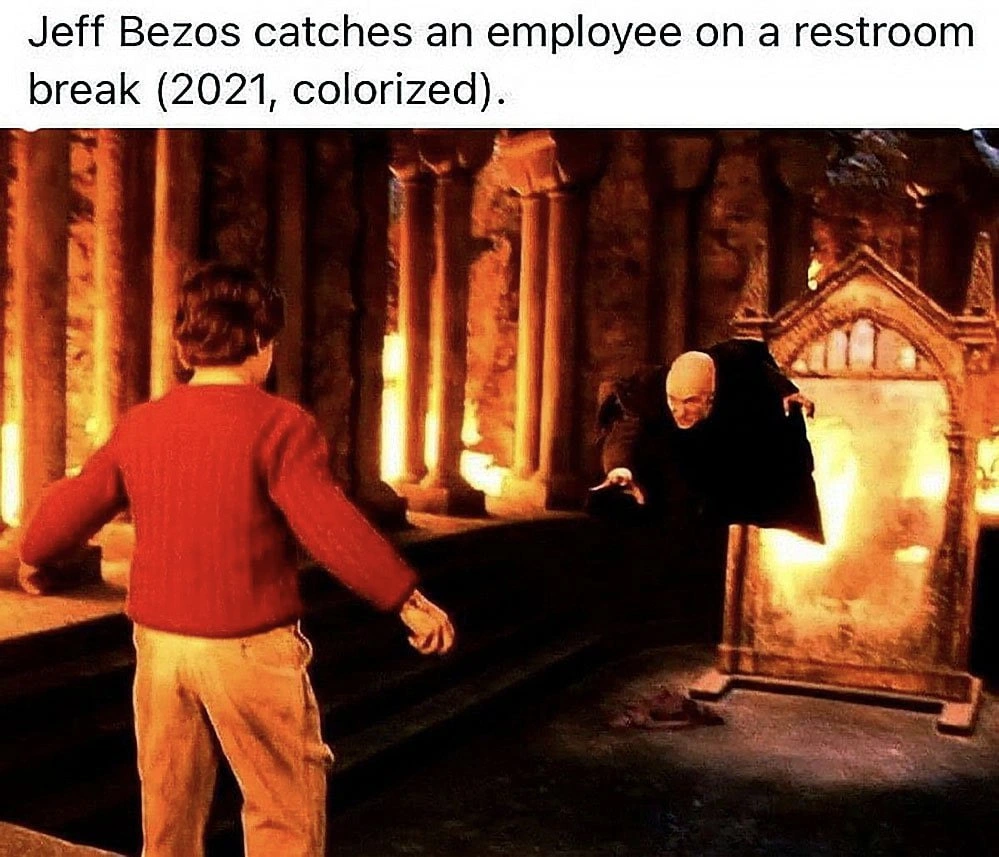
Imagine you’re at school and you really need to go to the bathroom, but there’s a super strict teacher who is always watching the clock. The second you step out of class, the teacher jumps out and yells, “Hey, where do you think you’re going? Get back to work!” Sounds exaggerated and silly, right? That’s exactly what this meme is showing, but in a grown-up workplace. In the picture, a scary bald villain (from a Harry Potter movie) is leaping out at a kid who’s in front of a mirror. The meme pretends that villain is a boss, and the kid is an employee who just took a moment to use the restroom. The joke is that the boss is treating a normal bathroom break like a huge offense — as if the employee stopped working and the sky is falling. It’s funny because it’s such an extreme, cartoonish version of a boss. In real life, everyone knows people need bathroom breaks. But sometimes employees feel like they’re being watched too closely at work, and this meme turns that feeling into a silly scene. The core idea: a boss tracking your every move is as ridiculous (and unwelcome) as a monster jumping out of nowhere when you just gotta go pee. It’s humor that says, “Hey, we’ve all had moments where we just need a break, and having someone hover over you at that time is both scary and absurd.” Even if you’re not a developer or haven’t worked in an office, you can laugh at how over-the-top this situation is – it’s basically saying no one should be so serious that a little bathroom trip becomes a big drama.
Level 2: KPI Overkill
Let’s break down the key ideas here in simpler terms. The meme is joking about a boss who monitors an employee’s every second, even timing their bathroom breaks. The phrase “like uptime metrics” refers to how we measure computer systems’ reliability. Uptime is the percentage of time a system (like a website or server) is running and available. For example, an uptime of 99.9% means the system is working almost all the time, with maybe only a few minutes of downtime in an entire month. Companies love high uptime – Amazon, for instance, wants its website and services running 24/7 for customers. They use fancy dashboards to watch this, with graphs and alerts that go off if something is down.
Now imagine treating a person the same way. That’s what the joke is highlighting. The boss is tracking an employee’s presence as if the employee were a server that should never be “down.” A “down” moment for a person here is when they are not actively at their workstation – in this case, stepping away to use the restroom. It’s an exaggeration of micromanagement, which means a boss is trying to control or check in on every tiny thing you do. In a healthy workplace, you have some trust and freedom: you take short breaks, get coffee, or use the bathroom when you need, and nobody’s counting the minutes. But in a hyper-strict environment (like the one this meme mocks, often associated with rumors about Amazon’s work culture), even those natural breaks feel like they’re under a stopwatch. There have been reports and anecdotes (especially about Amazon’s warehouse jobs) where every second of “time off task” is tracked. This meme applies that idea to a developer in an office setting, making it a piece of WorkplaceHumor many in tech find both funny and a little scary.
The image chosen is key to the joke. It’s a scene from the first Harry Potter movie where a young Harry is standing in front of the Mirror of Erised (a magical mirror), and the villainous Professor Quirrell (with Lord Voldemort on the back of his head – yes, it’s creepy) is leaping out to attack him. In the meme, they label the characters humorously: Jeff Bezos (Amazon’s former CEO) is essentially being compared to that scary villain jumping out, and the poor employee is like Harry, caught off-guard in a vulnerable moment. The top caption even jokes it’s “2021, colorized” – a meme-y way of saying “here’s a modern scenario presented as a dramatic old movie scene.” It’s like saying, this is how it feels when your boss busts you for taking a bathroom break: as startling and terrifying as a dark wizard ambush. The orange-lit, dim scene from the movie creates a dramatic effect – as if the bathroom itself is a dungeon and the mirror is actually a high-tech surveillance mirror (or maybe a screen showing your productivity stats). It’s a playful visual exaggeration of a real feeling.
For a junior developer or someone new to office life, let’s clarify a few terms. KPI stands for Key Performance Indicator. That’s a business term for a metric or number that a company decides is important to measure success or performance. For a developer, a KPI might be something like “number of features implemented per quarter” or “tickets closed per week”. In bad cases, some managers use trivial KPIs like “lines of code written” (which, by the way, isn’t a good measure of quality or productivity). In this meme, the “uptime” of a person is treated as a KPI – which is intentionally ridiculous. It suggests the boss cares about the quantitative measure of time-at-desk more than the quality of work. That’s why the meme falls under DeveloperFrustration and RelatableHumor: many developers feel frustrated when managers focus on the wrong metrics. You might hear jokes about bosses who think “if your IDE isn’t open, you must not be working.” The meme is basically that joke on steroids: “if you’re in the restroom, you must be hurting our productivity stats!”
Another term: corporate surveillance. This refers to companies keeping an eye on what employees do. It can be as simple as a boss glancing at who’s at their desk or as high-tech as software installed on your work laptop that takes screenshots or logs your activity. Some offices use ID card swipes or login times to see when you come and go. In the tech world, communication tools like Slack or Microsoft Teams show a little green dot when you’re “active” online. While that’s meant for convenience, some micromanagers obsess over those dots – if it’s not green, they assume you’re slacking. (Fun fact: some developers have gotten so annoyed by this that they use “mouse jiggler” devices or software to keep their status green even when they step away, just to avoid scrutiny. That’s how silly it can get.) So, corporate surveillance in this context means the boss is watching your every move, even your restroom trips, through some kind of metric or tracking system. It’s an invasion of privacy and trust, turned into a joke here.
Finally, let’s talk about work-life balance quickly. You might see the tag WorkLifeBalanceTips attached ironically. Work-life balance is the idea that you should have a healthy split between your job and your personal life, and even during the workday, you shouldn’t be 100% work robot. Taking short breaks, stretching, staying hydrated – these actually make you a better, healthier worker (and human!). This meme highlights an environment with poor work-life balance: if you can’t even take a bathroom break without fear, that’s a serious red flag. A junior dev reading this meme might feel shocked – “do workplaces like this really exist?” The sad answer: yes, some do, though it’s more common in very strict companies or certain industries. Good employers trust their team and care about results, not hawk-eyed monitoring of breaks. So the meme is also a bit of a cautionary tale: Don’t be that boss, and if you have that boss, know that the tech community sees the humor in how wrong it is.
Level 3: Zero Downtime Humans
In the twisted world of data-driven corporate culture, this meme hits like a monitoring alert at 3 AM. It mashes together the fantasy villainy of Harry Potter with the all-too-real villain of corporate surveillance. The caption sets the tone: "Jeff Bezos catches an employee on a restroom break (2021, colorized)." It’s a tongue-in-cheek nod to a popular meme format that pretends a movie scene is historical footage (“colorized”)—and here our Workplace Humor comes from reimagining the Amazon founder as a dark wizard ambushing a worker who dared to take a bio-break. The humor is grimly relatable: in some offices, particularly those infamous for micromanagement, even a trip to the bathroom feels like triggering a production incident.
For seasoned developers, the phrase “tracks even your bathroom breaks like uptime metrics” immediately sparks a knowing wince. We’ve spent years tweaking dashboards and chasing five nines (99.999%) uptime, but applying that to humans? That’s pure absurdist TechHumor, highlighting the dystopian endgame of misapplied metrics. It satirizes how some companies abuse productivity metrics—KPI Overkill where every second must be accounted for. It’s a sly jab at Amazon’s reputed obsession with efficiency: remember those news stories about warehouse workers afraid to take bathroom breaks? Here that idea gets the DeveloperProductivity spin. The boss (Bezos as the archetype) is essentially treating a developer like a server in a data center: expecting zero downtime, 24/7 availability, and immediate alerting if they go offline. (If only we could horizontally scale ourselves to handle restroom failover, right?)
Consider the scene itself: in the image from Harry Potter and the Sorcerer’s Stone, young Harry (red sweater, back turned) stands before the Mirror of Erised, and Professor Quirrell (possessed by Voldemort) lunges out in a jump-scare moment. The meme repurposes this to depict a dev looking into a “mirror” (perhaps a metaphor for a monitoring dashboard or maybe just the bathroom mirror), only to find the boss lunging at them like a noseless Dark Lord yelling “Gotcha!” The dramatic irony is strong. The Mirror of Erised shows one’s deepest desire; here, maybe the boss’s desire is catching employees “slacking,” while the employee’s only desire was a brief respite. That reversal creates a darkly comic scene that any overworked engineer can appreciate. It’s corporate misery re-cast as a fantasy horror moment—DeveloperFrustration visualized with wand-wielding flair.
On a deeper level, this meme jabs at the abuse of metrics in modern workplaces. Uptime metrics are great for websites and services – you want Amazon.com or your cloud app to have as close to 100% uptime as possible. We use tools like Amazon CloudWatch, Grafana, or custom dashboards to track every blip in service availability. But when managers start treating humans like services – monitoring bathroom breaks, keystroke counts, or green dots on Slack – they’re committing a category error of Gandalfian proportions. Developers are not microservices: you can’t just scale up another instance when one needs a break, and we have garbage collection requirements (e.g., coffee and bathroom time!). The result of this corporate surveillance overreach is a toxic environment where people feel guilty for being human. It’s poking fun at a real trend: some companies install spyware-like “productivity” software on engineers’ laptops, or demand minute-by-minute account of your day. It’s WorkplaceHumor with an edge, because while we laugh, we’re also thinking “yeah, that hits close to home.” The developer community often shares such memes as a coping mechanism – a way to commiserate about burnout, micromanaging bosses, and the farce of treating creative work as an assembly line.
From an industry perspective, this resonates as commentary on CorporateCulture gone awry. It suggests an environment where management has a dashboard for everything – maybe the boss literally has a live chart of “# of minutes since last commit” or “developer idle time (ms)”. It’s ProductivityMetrics Abuse: turning normal breaks into “incidents” that might show up in your performance review. A senior engineer reading this might chuckle and recall Goodhart’s Law: “When a measure becomes a target, it ceases to be a good measure.” If you’re measuring bathroom time, employees will find ways to beat the metric (hello, pee bottles “extreme multitasking”) rather than actually becoming more productive. In other words, focusing on the wrong KPI ends up with code that’s worse and developers who are miserable. The meme captures that folly with a single image and a one-liner. It’s dark Corporate Humor: we laugh, but only to keep from crying about how some managers just don’t get it.
Description
Image meme with a white text caption at the top reading, "Jeff Bezos catches an employee on a restroom break (2021, colorized)." Beneath the caption is a dim, orange-lit scene from the first Harry Potter film: a young boy in a red sweater (Harry) stands with his back to the viewer, facing an arched stone mirror; a bald, dark-robed figure (Professor Quirrell/Voldemort) lunges aggressively out of the mirror toward him. The dramatic fantasy screenshot is re-contextualized to imply an Amazon CEO ambushing a worker for taking a short restroom break, poking fun at hyper-monitoring, time-tracking dashboards, and the pressure on engineers to log every productive minute. Technically, the meme satirizes corporate KPIs and developer productivity metrics that ignore basic human needs, highlighting the darker side of data-driven workplace culture
Comments
11Comment deleted
At Amazon, anything over a 300-second restroom call eats into your service’s error budget - hit P99 bladder latency and Bezos himself materializes as the incident commander
When your bathroom break exceeds the 6-minute SLA and triggers a PagerDuty alert to the C-suite dashboard
When your monitoring dashboard shows an employee's 'idle time' metric spike and you realize they had the audacity to engage in biological functions without submitting a Jira ticket first. Next sprint: implementing bladder-as-a-service with SLA guarantees and automated escalation to leadership for any bathroom break exceeding the p95 latency threshold
Bezos tracks bathroom breaks more reliably than CloudWatch alarms your idle EC2 instances
At Amazon, a restroom break is logged as a multi‑AZ outage in the human cluster - leadership suggests active‑active bladders with zero RPO
Optimize humans for 99.99% utilization and a bio break becomes a P1 SLO breach - show leadership the queueing-theory latency curve before PagerDuty summons Voldemort
Is that some kind of new trend — to suddenly joke time and time again about the stuff that's long been known and not even actual anymore (since Bezos is no longer in charge)? Comment deleted
demonizing bezos is the trend - using a person for a joke is mandatory because …idk you just need it. Not everyone knows bezos isn't in charge anymore and bending reality to make a joke work is normal as well. Comment deleted
Yeah, I get why people tend to joke about this or that. The question is, why now of all times? Why not, like, 1 year ago, 3 years ago? It's as if everyone was blind to the fact, and then suddenly boom. Comment deleted
God works in mysterious ways Comment deleted
reddit, for instance, is full of jokes and cry-posts about Amazon unhuman requirements for workers. And it was started long time ago Comment deleted