Skip to content
DevMeme
1314 of 7435
The Eternal Enigma of JavaScript
Languages Post #1468, on May 2, 2020 in TG

The Eternal Enigma of JavaScript

Why is this Languages meme funny?

Level 1: Mixed Signals

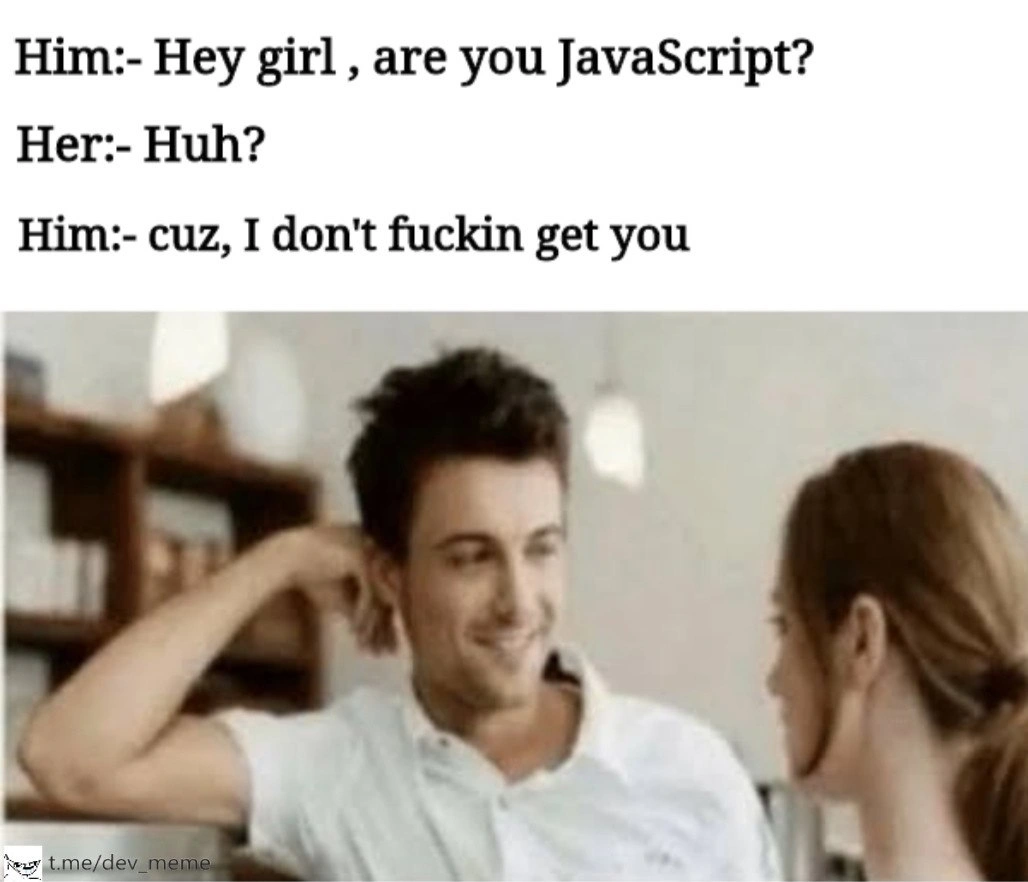
Imagine you have a friend who one day acts one way and the next day totally different – you never know what to expect. You ask a simple question and sometimes they give you a straight answer, but other times they give you a weird, unexpected answer that leaves you scratching your head. You might finally throw up your hands and jokingly say, “I just don’t get you!” That’s exactly what’s happening here, but with a programming language acting like that confusing friend. JavaScript is the language used to make websites do things (like buttons click, menus pop up). It’s super helpful, but it often behaves unpredictably, almost like it’s changing its mood. In the meme, the guy pretends to use a cheesy pick-up line on a girl – “Are you JavaScript?” – and then says “because I don’t get you,” meaning he finds JavaScript totally confusing. It’s funny because he’s comparing his brain pain about coding to the feeling of not understanding a confusing person. We’ve all had moments where something (or someone) just doesn’t make sense to us, right? Here, JavaScript is the “someone” that’s hard to figure out. The joke makes tech people laugh because it’s a very relatable way to say “Ugh, this thing is so confusing!” in a lighthearted, playful manner. It’s basically turning frustration into a silly joke: the guy isn’t actually trying to flirt – he’s just venting that dealing with JavaScript is as baffling as trying to decode mixed signals from a crush. And that little “Huh?” from the girl in the meme? That’s the cherry on top, because it shows she doesn’t get him either – just like JavaScript doesn’t give clear answers. It’s a fun way to say, “JavaScript, you make no sense to me!” and have a good laugh about it.

Level 2: Dynamic Typing Drama

This meme is written like a little dialogue – almost like a script from a rom-com scene – but it’s actually a joke about JavaScript the programming language. The guy asks the girl, “Are you JavaScript?” and then says, “Because I don’t freaking get you.” Instead of a sweet pickup compliment, he delivers a punchline complaining that JavaScript is hard to understand. The Her: "Huh?" in the middle indicates the woman is confused by the question (which mirrors how developers feel confused by JavaScript!). It’s a fun mix of a dating scenario with developer humor about coding. The categories Languages, Frontend clue us in that this is about a programming language used in front-end web development, and sure enough it’s JavaScript – the main language that runs in web browsers to make pages interactive.

So why joke that "I don't get you" to JavaScript? Because JavaScript has some notorious language quirks that can really puzzle developers. It’s a dynamically typed language, meaning you don’t declare types for variables. A variable in JavaScript can hold a number at one moment, a string (text) the next, an object later, etc. The language is very flexible – too flexible sometimes. It also does something called type coercion, which means it automatically converts values from one type to another in certain situations. The idea is to be helpful – like, if you try to add a number to a piece of text, JavaScript will convert the number into text rather than error out. But this helpfulness can backfire and create a lot of confusion for someone who doesn’t expect it. For example:

  • If you write "5" + 3 in JavaScript, you might think, “Hmm, adding 5 and 3 should give 8.” But one of these is a string ("5" is text, not the number 5). JavaScript will say, “Oh, you’re adding a string, I’ll make the other thing a string too,” and you end up with the string "53" as the result (it concatenates or glues the values instead of doing math).
  • If you write "5" - 3, JavaScript does the opposite for subtraction: it says, “You’re trying to subtract a number from text, I bet that text is actually a number in disguise,” and it treats "5" as the number 5, does 5 minus 3, and gives you 2. So "5" - 3 magically results in 2.

See how the language’s logic can zigzag? This is what we mean by JavaScript being hard to “get.” You have to remember a lot of these special cases. Another example: in JavaScript, the concept of truthy and falsy values can be unintuitive. A falsy value is something that counts as “false” in an if-statement even if it’s not literally the Boolean false. For instance, 0 (zero) is falsy (treated like false), and so is "" (an empty string) and undefined (an undefined value). Most objects are truthy (treated like true). An empty array [] is an object, so it’s truthy if you check it in a boolean context. However, if you compare an empty array to false using the loose equality ==, JavaScript will coerce the array to a number (weird, I know) — and that empty array becomes 0, so [] == false ends up true! Confusing? Absolutely. These little inconsistent rules are what we call language quirks or gotchas. A new developer might run into these and go “Huh? Why on earth…?” – exactly like the “Her: Huh?” in the meme.

All this dynamic trickery is why people throw up their hands and say “I can’t understand you, JavaScript!” It’s not that JavaScript is impossible to learn – it’s that it has many surprising behaviors if you assume things will work like in other languages or plain math. In a stricter language (say Java or C#), adding a string and a number would be a compile error, forcing you to handle the incompatibility. But JavaScript tries to be accommodating and does something rather than error – and that “something” can be quite unexpected. This leads to a lot of DeveloperHumor where we poke fun at how wacky it can be. The tag LanguageComplexity is basically pointing to this idea: JavaScript’s simplicity on the surface hides a lot of complex, sometimes illogical-seeming rules under the hood. And SyntaxHumor means the joke comes from how the code or language syntax behaves oddly.

The meme’s format is also part of the joke. It’s styled as a cringey pick-up line scenario. The guy is smiling casually, like he’s delivering a flirtatious line, but instead he uses it to gripe about code. This dating_analogy makes the tech joke more relatable: even if you’re not a coder, you know what “I don’t get you” means in a relationship context. Here JavaScript is humorously personified as an inscrutable girl the guy is trying to chat up. It’s an absurd comparison – which is why it’s funny. Essentially, the developer is equating JavaScript to that perplexing person who just doesn’t make sense to him. And the woman’s puzzled reaction (“Huh?”) doubles as JavaScript not understanding the developer either, or simply the target of the line being baffled because it’s not a typical flirt. This little pickup_line_meme encapsulates a common feeling in the programmer community: JavaScript is super useful and everywhere, but wow it can be confusing sometimes! By dressing that complaint up as a cheesy flirt, it softens the frustration into a laugh. It’s a way of saying “I’m so frustrated that I have to joke about it.” Every frontend dev has been there, so we laugh in solidarity.

Level 3: Mismatch Making

At first glance this looks like a goofy dating one-liner, but every experienced JavaScript developer immediately recognizes the deeper developer humor. The guy in the meme says, “Hey girl, are you JavaScript? ...cuz I don’t fuckin get you.” It’s a pickup line subverted into a frustrated rant. Seasoned devs are nodding knowingly here because understanding JavaScript can indeed feel like deciphering an inscrutable crush. The humor comes from combining a flirty pickup_line_meme format with raw technical frustration. Usually, pickup lines are cheesy compliments (like “Are you Google? Because you have everything I’m searching for”), but here it flips to vent about JavaScript’s quirks. The incongruity is hilarious: instead of wooing the “girl,” he’s basically roasting JavaScript for being confusing. And the kicker is the woman’s response, “Huh?” – she’s as confused by the question as developers often are by JavaScript. It’s a perfect meta-joke: JavaScript (personified) doesn’t even understand why we’re upset, which is exactly how devs feel when the language behaves illogically.

For veteran engineers, this hits home because we’ve all been in a love-hate relationship with JavaScript’s LanguageQuirks. The meme’s punchline — “I don’t fuckin get you” — is phrased with the kind of exasperation heard at 2 AM when yet another weird bug surfaces. Why don’t we “get” JavaScript? Well, it’s known for some oddball behavior due to being dynamically typed and having funky type coercion rules. In JavaScript, variables can change type on the fly and the language will silently convert values behind the scenes to try to make things work. This leads to results that defy common sense. Seasoned devs have entire lists of these WTF moments:

console.log("5" + 3);      // "53"  (string concatenation – it glues them as text!)
console.log("5" - 3);      // 2     (subtraction triggers numeric conversion)
console.log(NaN == NaN);   // false (NaN is never equal to itself, seriously)
console.log(typeof null);  // "object" (a famous bug that became a 'feature')

These examples are classic SyntaxHumor fodder. Adding a string "5" and number 3 yields "53" because the + operator favors string concatenation if either operand is a string. But subtracting '5' - 3 forces a numeric context, so "5" becomes the number 5 and you get 2. It’s as if JavaScript can’t make up its mind on how to add versus subtract. The NaN == NaN example is another head-scratcher: NaN (Not-a-Number) is a special numeric value that, by rule, is not equal to anything – not even itself. That’s why NaN !== NaN, a quirk that trips up anyone expecting basic math logic. And check typeof null: it prints "object", which is just wrong (null isn’t an object!), but this is a well-known language bug from the early days that can’t be fixed without breaking the web. These quirks are the kind of things that make even senior frontend devs throw their hands up and say “I don’t get it!”. In other words, JavaScript often sends mixed signals.

So the guy in the meme is basically every developer who’s been baffled by JavaScript’s LanguageComplexity. The humor works on multiple levels. On one level, frontend devs bond over shared confusion – “Haha, yes, JavaScript’s type coercion is absurd sometimes.” On another level, the dating analogy adds a human twist: dealing with JavaScript’s inconsistencies is like dating someone who’s impossibly hard to understand. We even have communal terms like “WTFJS” for these bizarre cases (there’s an infamous collection of “What the... JavaScript?” examples). The meme’s cathartic because it lets us laugh at our frustration. It’s saying: Yeah, JavaScript, you’re powerful and popular, but what the heck are you doing? The DeveloperHumor here turns our daily coding pain into a joke we can share. As a senior dev, you’ve learned to expect these odd behaviors or use tools (linters, TypeScript, etc.) to cope, but you still remember the early days of being utterly perplexed. This meme playfully encapsulates that veteran sentiment: JavaScript, I love you, but I just don’t understand you sometimes.

Description

A meme featuring a stock photo of a young man smiling and talking to a woman. A three-line dialogue is superimposed over the image: 'Him:- Hey girl, are you JavaScript?', 'Her:- Huh?', 'Him:- cuz, I don't fuckin get you'. This meme uses a pickup-line format to humorously express a sentiment widely shared among software developers: the frustration and confusion caused by JavaScript's notoriously quirky and often unintuitive behaviors. The joke resonates with experienced engineers who have grappled with aspects like type coercion (e.g., '[] + {}'), the unpredictable nature of the 'this' keyword, and other language design choices that defy conventional logic from other programming languages. It's a timeless expression of the love-hate relationship many developers have with JS
Comments

7
Anonymous ★ Top Pick Explaining JavaScript's 'this' keyword on a date is a great way to ensure you'll have plenty of 'this' to yourself for the rest of the night
  1. Anonymous ★ Top Pick

    Explaining JavaScript's 'this' keyword on a date is a great way to ensure you'll have plenty of 'this' to yourself for the rest of the night

  2. Anonymous

    JavaScript on a first date: “Don’t worry, I’m single-threaded.” Five minutes later the event loop, microtask queue, and a dangling ‘undefined’ all show up like exes at the same restaurant

  3. Anonymous

    This pickup line works about as well as trying to explain to a PM why '0' == false but Boolean('0') == true, and why [] + [] equals an empty string but {} + [] equals 0. At least in dating, rejection is deterministic

  4. Anonymous

    JavaScript is the only language where you can spend 15 years mastering it and still have a junior dev ask 'why does `[] + {} !== {} + []`?' and watch you question every life choice that led to this moment. It's not you, it's definitely JavaScript - where `typeof null` returns 'object' and the documentation just shrugs

  5. Anonymous

    Her 'Huh?' mirrors every dev staring at `0.1 + 0.2 === 0.3` - close enough to fool ya, but never quite right

  6. Anonymous

    JavaScript dating: TypeScript says we’re compatible, but at runtime 'this' is undefined, '==' lies, and I’m ghosted by a Promise stuck in the event loop

  7. Anonymous

    Senior JS advice: '==' is flirting, '===' is commitment - without types you’re just letting the runtime coerce your intentions into another production incident

Use J and K for navigation