Skip to content
DevMeme
6675 of 7435
IPv6 Address Exposure: Fake Law Firm Ad for Networking PTSD
Networking Post #7316, on Oct 21, 2025 in TG

IPv6 Address Exposure: Fake Law Firm Ad for Networking PTSD

Why is this Networking meme funny?

Level 1: New Address, Who Dis?

Imagine you’ve always had short, simple phone numbers – say, just 4 digits long – and you’ve memorized all your friends’ numbers easily. One day, the phone company says, “We have so many new phones that we’ve run out of 4-digit numbers! Starting tomorrow, everyone will get new 16-digit phone numbers with both numbers and letters in them.” 📞😱 Now your best friend’s number isn’t “1234” anymore – it’s “1A2B:3C4D:5E6F:778G”! How would that feel? Probably pretty confusing and annoying at first, right? You might even get mad and say, “Why are they doing this to us? The old numbers were fine! I hate these new codes!”

This meme is joking about that kind of feeling among computer people. The old phone numbers are like the old Internet addresses (IPv4) – short and familiar. The new crazy 16-digit numbers with letters are like the new Internet addresses (IPv6) – long and unfamiliar. Some people who work with computers got so used to the old way that seeing the new addresses scares or frustrates them. The meme pretends it’s as if those people were hurt by the new addresses and might sue or ask for money (which is a silly idea, and that’s why it’s funny!). It even shows a fake law firm advertisement saying “Have you seen an IPv6 address at work? You might get money for it!” which is an obvious joke.

So in simple terms: the picture makes us laugh because it’s overreacting to a change in technology. It’s like someone saying, “Oh no, letters and longer numbers in addresses – this is trauma!” when really it’s just a new, bigger system to learn. We find it funny because we know nobody’s actually hurt by a long address, even if it looks scary at first. It’s a way for tech folks to poke fun at themselves for being afraid of change, using the style of a serious late-night “call now” commercial to make the contrast ridiculous. Imagine a toy commercial voice saying, “Have you been forced to eat vegetables? You may be entitled to dessert compensation!” – obviously over the top. That’s exactly the kind of joke here, but with Internet address tech. In the end, it’s humor about being dramatic over a new thing instead of just learning it – something we can all chuckle at, whether it’s phone numbers, vegetables, or IPv6 addresses.

Level 2: Hex vs Dots

At its core, this meme mocks the fear of switching from IPv4 to IPv6 in computer networks. IPv4 (Internet Protocol version 4) is the old, familiar system that uses dotted decimal addresses like 192.168.0.10. These addresses are four numbers (each 0-255) separated by dots. By contrast, IPv6 is the newer version that uses a much larger 128-bit address space written in hexadecimal (base-16) with eight groups of four characters separated by colons (like 2001:db8:1a1b:34ac:67ab:4af3:049a:5bb3). Hexadecimal includes numbers 0-9 and letters A-F, which is why an IPv6 address looks alphanumeric. The meme jokes that some developers and network engineers are practically allergic to these newfangled IPv6 addresses.

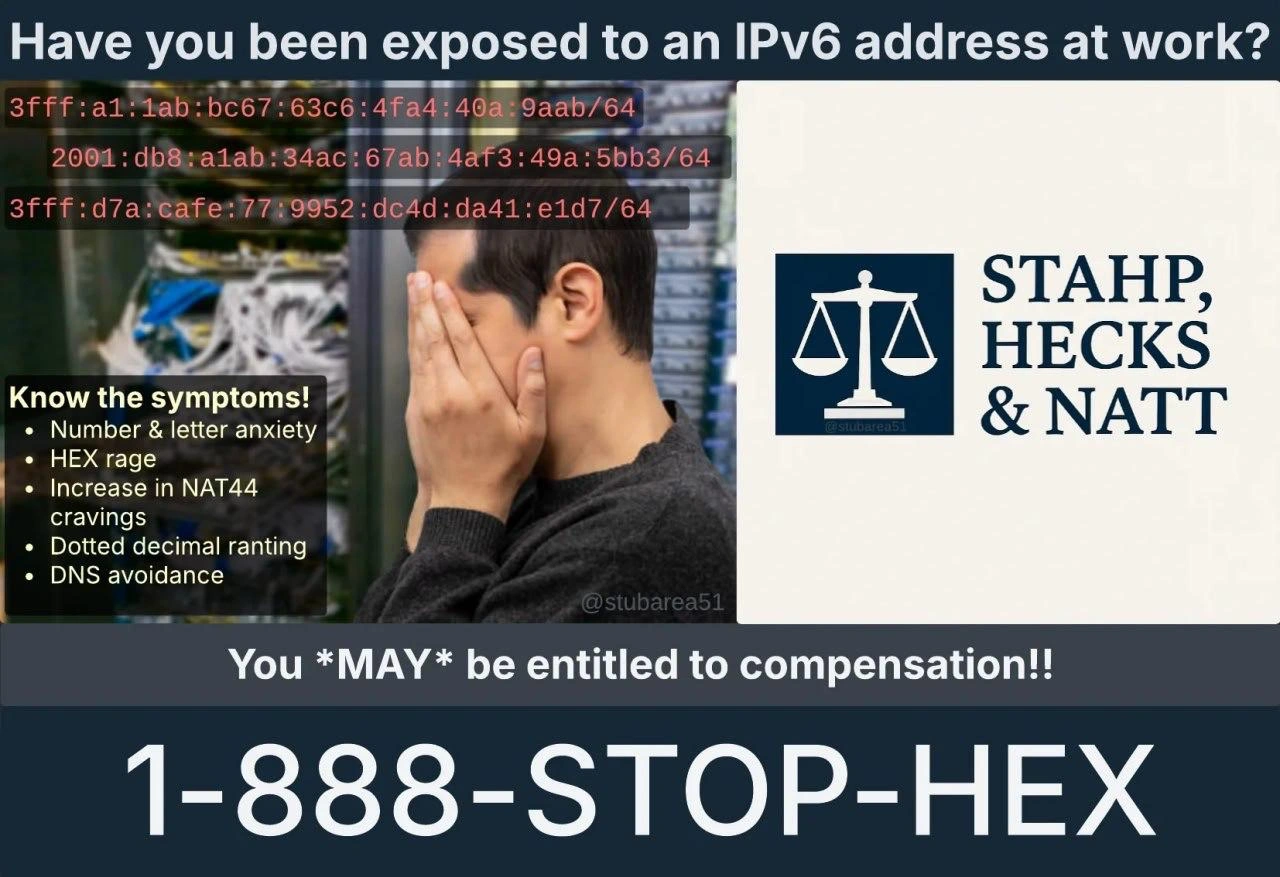
The image is styled to look like a late-night legal advertisement. You know those TV commercials that say, “If you or a loved one has been exposed to [Dangerous Thing] at work, you may be entitled to compensation?” Here, the “dangerous thing” is comically an IPv6 address. Of course, an IP address isn’t harmful – it’s just a numerical label – but the joke is that certain IT folks react to IPv6 as if it were something toxic or scary. The top banner literally asks: “Have you been exposed to an IPv6 address at work?” as if just encountering a long hex address on the job is a traumatic event. This exaggeration sets the stage for the humor: it implies that IPv6 is so daunting that it might require legal action or therapy if it invades your workplace.

In the middle, we see a stressed-out sysadmin covering his face in front of a tangle of server cables. This represents the stressed engineer who’s been forced to deal with IPv6. His identity is blurred (like in real commercials when a victim speaks anonymously), amplifying the parody that he’s part of a class-action lawsuit. The black box on the left lists humorous “symptoms” in bright green text under the heading “Know the symptoms!” Each bullet point translates a piece of tech reluctance into a mock medical condition:

  • “Number & letter anxiety” – Feeling uneasy because IP addresses now contain both numbers and letters (A-F in hex). For someone used to only numbers in addresses, this mix can be intimidating.
  • “HEX rage” – Getting irrationally angry at dealing with hexadecimal notation. Hex can be harder for humans to read quickly, so some people get frustrated or “rage” when forced to work with these long strings.
  • “Increase in NAT44 cravings” – Suddenly wishing for the old days of NAT with IPv4. NAT44 is a term for the common setup where many devices in a private network share one public IPv4 address using Network Address Translation. It’s been a lifesaver to stretch IPv4 addresses. If someone “craves NAT44,” it means they’d prefer sticking with that familiar setup rather than moving to IPv6 (which ideally makes NAT unnecessary by giving every device a unique address). It’s like saying “I miss the old way of doing things with IPv4 and NAT.”
  • “Dotted decimal ranting” – Complaining loudly that addresses were better when they were the old IPv4 format (four dotted numbers). Someone doing this rant might say things like “Why do we need these stupid long addresses? The old style was perfectly fine!” It’s poking fun at how people romanticize the older system just because they’re comfortable with it.
  • “DNS avoidance” – Avoiding or distrustful of DNS (Domain Name System) because of IPv6. DNS is what translates domain names (like example.com) to IP addresses. In an IPv6 world, DNS often returns IPv6 addresses (called AAAA records). A frustrated engineer might disable or ignore those, preferring not to deal with IPv6 at all. “DNS avoidance” in this context implies someone might go to absurd lengths to avoid seeing an IPv6 address – possibly by turning off name lookups that could yield one. It’s exaggeration, but it’s based on real scenarios where people have, for instance, turned off IPv6 on their operating systems to stick with IPv4-only networking.

The entire tone of the symptom list is a tongue-in-cheek way to say: “Are you freaking out about IPv6? Here are the signs!” It mirrors how real health/legal ads list symptoms of, say, asbestos exposure or a bad drug reaction. The humor comes from mapping technical gripes to “medical” issues. IPv6 phobia isn’t a real medical condition, but in tech circles, it’s a joking way to describe someone’s stubborn reluctance to learn or implement IPv6.

On the right side of the image is a fake law firm logo with scales of justice and the name “STAHP, HECKS & NATT.” This is not a real firm – it’s constructed purely for the meme with layered puns:

  • It looks like a credible law firm name at first glance (three names & an ampersand).
  • STAHP is internet slang for “stop” (spelled humorously), implying “stop” whatever is happening (here, stop forcing hex on me!).
  • HECKS hints at “hex” (hexadecimal), but spelled like a surname (also sounds like a euphemism for a mild curse, adding comic flavor).
  • NATT hints at NAT (Network Address Translation) with an extra “T” to resemble a last name (it reads like a Scandinavian last name too, which often end in double consonants, adding to the parody authenticity).

So when you say it out loud, “STAHP, HECKS & NATT” sounds like “Stop Hex and NAT.” It’s as if the law firm’s mission is to fight the scourge of hex addresses (and NAT issues) afflicting poor engineers. In reality, no one would sue over having to use IPv6 – but the joke is framing everyday tech frustration as if it were a legal injury.

Finally, the bottom of the image declares, “You MAY be entitled to compensation!!” and provides a big fake phone number 1-888-STOP-HEX. Real class-action lawsuit commercials often use these phrases to entice viewers. The word MAY is highlighted (in italics here) because real ads legally hedge the promise of compensation with a big “may.” It’s part of the trope that everyone recognizes. The phone number is a classic vanity number, where STOP-HEX corresponds to numbers on a telephone keypad. It’s memorable and directly references stopping hexadecimal addresses. Of course, calling that number in real life won’t connect you to a law firm – but it completes the illusion that this could be a real ad on late-night TV for beleaguered IT staff.

So what’s the context? Networking professionals have been dealing with the transition from IPv4 to IPv6 for years. IPv4 allowed around 4.3 billion addresses, and by the 2010s we essentially ran out of free IPv4 addresses globally (IPv4 exhaustion). IPv6 was created to solve this with a virtually unlimited address space, plus some improvements in how IP works (like simpler routing and no need for NAT). But adopting IPv6 isn’t just flipping a switch – it requires updating systems, learning new addressing, and sometimes running both IPv4 and IPv6 together (dual-stack networks) until IPv6-only is feasible. Many companies delayed this process because it’s complex and IPv4 with NAT was “good enough” for a long time. As a result, some engineers have gone most of their career using only IPv4, and they treat IPv6 as a strange, intimidating beast they avoid unless absolutely forced.

This meme is making fun of that resistance. It highlights the almost irrational side of it – like someone being so upset by change that they talk about it as if they were injured. The term “NAT44 cravings” shows the irony: NAT was never a “healthy” or elegant solution (it was a workaround to share one IP among many devices). But here, people miss NAT like a comfort food. Similarly, “dotted decimal ranting” shows how people can be nostalgic about something just because it’s familiar (there’s nothing inherently superior about dotted decimal, it’s just what they know).

For a junior developer or someone not deeply into networking, what you need to know is:

  • IPv6 addresses look long and include letters (A-F) because they’re in base-16. This is jarring if you’ve only seen IPv4 addresses (which are shorter and only have digits 0-9).
  • NAT (Network Address Translation) is a technique that became widespread with IPv4 to cope with not having enough addresses. A home router doing NAT lets your laptop, phone, and TV all share one public IP address. It’s like having many people behind one postal address and the router figures out whose traffic is whose. NAT44 is specifically NAT for IPv4 networks. In an ideal IPv6 world, NAT isn’t needed as much because every device can have its own unique address.
  • DNS (Domain Name System) is how we use human-friendly names for hosts. With IPv6, DNS entries (AAAA records) map names to those long addresses. If someone “avoids DNS” in this joke, it’s implying they might disable queries that return IPv6 results, sticking to what they know.

The meme is basically saying: “Some devs and network engineers act like moving to IPv6 gave them trauma, so here’s a fake lawyer ad to ‘help’ them.” It’s humorous because it exaggerates real sentiments. Many of us have heard a colleague jokingly say “IPv6 gives me nightmares” or “I’ll retire before I learn IPv6, haha.” This image takes that sentiment and blows it up to comedic extremes, complete with a hotline. For anyone who’s been in those meetings where IPv6 comes up and people groan, the joke hits home. It’s filed under NetworkHumor because you kind of have to be in the networking/software world to get why this is funny. But even at a surface level, the format (serious lawsuit ad vs trivial “injury”) is a classic comedy formula: overreaction to a mundane thing. In summary, the meme humorously parodies the reluctance and anxiety around IPv6 adoption by dressing it up as a literal injury case. It’s a lighthearted jab at our own technophobic tendencies – even as techies – when faced with change.

Level 3: NATstalgia & Hex Hysteria

In this meme’s class-action parody, seasoned network engineers see the new world of IPv6 through the lens of a late-night injury lawsuit commercial. The top banner asks, “Have you been exposed to an IPv6 address at work?” – treating the mere sight of a 128-bit hexadecimal IP as if it were asbestos or a toxic chemical. This absurd question lampoons the irrational dread some ops folks feel about leaving the familiar IPv4 world. Beneath the question, ominous red IPv6 addresses (in /64 CIDR notation) scroll by like a list of harmful substances. They look convoluted: 3fff:a1:1ab:bc67:63c6:4fa4:40a:9aab/64 and friends – an unsettling wall of hex for anyone clinging to comfy dotted-decimal IPv4. (One even starts with 2001:db8:..., an Easter egg using the IPv6 documentation prefix reserved for examples – a sly nod that these “scary” addresses aren’t even real, much like tongue-in-cheek fine print in a parody.)

At center stage, a blurred-out sysadmin covers his face in distress, as if reliving a war story. This image captures the shared trauma humor: many network engineers have a well of anxiety (or at least dark humor) about migrating to IPv6 after decades of IPv4 habitual use. The black symptom box listing “Know the symptoms!” in hacker-green bullet points is a direct spoof of those lawsuit ads (which often list medical symptoms). Here each “symptom” satirizes a real gripe or behavioral quirk in network teams struggling with IPv6 adoption:

  • Number & letter anxiety: Suddenly IP addresses contain letters (A through F) in addition to numbers. It’s like an old-school admin’s worst nightmare – they’ve spent a career with addresses like 192.168.0.25, and now they see fe80::40a:9aab. The unfamiliar mix of hex digits can induce anxious double-checking or outright rejection.
  • HEX rage: A playful term for the frustration or anger when dealing with hexadecimal notation. Ever tried reading or typing a long IPv6 address under pressure? It can provoke rage, as in “Why on earth do I have to deal with this indecipherable hex garbage?!” This echoes real-world rants where vets curse at how “ridiculous” IPv6 addresses look compared to the tidy 4-part IPv4.
  • Increase in NAT44 cravings: “NAT44” refers to the classic Network Address Translation scenario: IPv4-to-IPv4 NAT (one public IPv4 shared by many private IPv4 hosts). It’s a cornerstone of IPv4 life support. Craving NAT44 is a tongue-in-cheek way to say the engineer longs for the safety blanket of old IPv4 networks behind a NAT, rather than embracing IPv6’s public addressing. Under IPv6, every device can have a globally routable address – a concept that triggers withdrawal symptoms in those weaned on NAT. They suddenly reminisce about NAT like it’s a beloved old friend: “Remember when all we needed was a single IPv4 and some port overload? Those were the days…”. This nostalgia for NAT hints at how NAT became an addiction – it hid countless network sins and staved off IPv4 exhaustion, but also entrenched itself so deeply that giving it up feels scary.
  • Dotted decimal ranting: This is the archetypal old man yells at cloud behavior. It’s the engineer ranting that IP addresses were better when they looked like 203.0.113.5 (four neat decimal numbers separated by dots). They might go on about how you could remember and eyeball subnets easily. Now, confronted with 3fff:d7a:cafe:77:9952:dc4d:da41:e1d7, they lose it – perhaps delivering a tirade at team meetings: “Back in my day we had normal IPs, not these unreadable phone serial numbers!” The meme exaggerates this as a “symptom,” implying such folks can’t stop complaining about the good old days of IPv4.
  • DNS avoidance: In theory, with IPv6’s unwieldy addresses, we should rely on DNS (the domain name system) even more – you won’t manually memorize or input those beastly addresses. But the joke here is that traumatized engineers might start avoiding DNS entirely, possibly from paranoia that DNS will return an AAAA record (IPv6 address) and force them to confront the hex. It’s a playful jab at those who respond to IPv6 by disabling or ignoring newer systems (e.g. “Just turn off IPv6 and avoid anything that might give me a hex address”). Ironically, “DNS avoidance” might also allude to admins who turn off IPv6 resolution or hack hosts files to stick with IPv4 – a real if counterproductive coping mechanism.

All these bullet points resonate with inside jokes in Networking circles. The meme tags it as ipv6_phobia and hexadecimal_trauma, capturing the tongue-in-cheek idea that encountering an IPv6 address induces a phobic reaction. IPv6 adoption has been a running saga in IT: despite IPv4 address exhaustion looming for decades, many practitioners dragged their feet. By October 2025, one might expect full IPv6 rollout, yet plenty of enterprises (and weary network veterans) still treat IPv6 as exotic. This meme pokes fun at that reluctance, as if chronic IPv6 avoidance were a diagnosable condition worthy of a class-action lawsuit!

On the right, the faux law-firm logo “STAHP, HECKS & NATT” sells the joke further. It mimics the style of real injury-law firm names (often “Lastname, Lastname & Lastname”), but each “name” is a pun:

  • STAHP – a play on “stop”, echoing internet slang (“stahp it!”) and suggesting “Stop!” to IPv6 maybe.
  • HECKS – sounds like a surname but clearly hints at “hex” (hexadecimal). It’s as if one partner is literally named after the hex woes.
  • NATT – looks Scandinavian, but is a wink at NAT (with an extra “T” to seem like a last name). Possibly nodding to “Network Address Translation” being so integral it’s personified as an attorney here.

Together, “STAHP, HECKS & NATT” reads like “Stop hex & NAT” in memetic dialect. The firm’s very name satirically suggests halting the hex nightmare (and maybe NAT, though in reality the meme’s “clients” are more likely pro-NAT if they fear IPv6). It’s deliberately ridiculous: a law firm to help aggrieved devs who had to see an IPv6 address. The bottom text clinches the parody: You MAY be entitled to compensation!! – exactly the phrasing from real class-action ads (with may emphasized to be legally safe and oh-so-enticing). And then the big teal 1-888-STOP-HEX phone number urges viewers to call now, parodying those memorable vanity numbers (“Call 1-800-BAD-DRUG” style). STOP-HEX implies stopping the use of hex addresses or halting the trauma from them. It’s a hilarious overreaction in literal terms, which is the core of the meme’s humor.

On a deeper level, this meme is a commentary on tech culture lag. IPv6 was standardized in the late 1990s to solve the impending IPv4 address exhaustion. It offered 2^128 addresses – a practically inexhaustible supply – and eliminated the need for NAT tricks by making every device addressable. Yet, decades later, many engineers still drag their feet, citing everything from legacy support to sheer familiarity. The meme exaggerates this inertia as if it were a medical condition. The “compensation” joke implies a shared pain among devs and network engineers who have been forced (perhaps by management or new infrastructure) to confront IPv6 and found it traumatic. It’s darkly comical: instead of being excited about modernizing the network, these folks act like victims of some negligence.

In reality, of course, no one is literally getting a payout for IPv6 exposure – the only “suffering” is having to learn new notation and update some tools. But the humor lands because anyone who’s worked with entrenched systems or reluctant colleagues has seen similar melodrama (if not quite to lawsuit levels). There’s truth under the silliness: migrating a large network to IPv6 can be painful. There are oddball bugs, misconfigured devices, confusion over IPv6 subnets (like /64 being the norm, a far cry from familiar /24), and the eerie feeling of seeing addresses you can’t easily recognize. Many sysadmins joke about staying on IPv4 as long as humanly possible, using NAT, private ranges, and even CGNAT (carrier-grade NAT) to stretch IPv4 a bit further – analogous to clinging to an old habit or addiction.

The meme’s tone thrives on shared exasperation: “We know this change is ultimately good and necessary, but darn if it doesn’t feel overwhelming – so let’s laugh at our over-the-top resistance.” By framing that resistance as a class-action lawsuit, it satirizes the idea that one could seek justice or compensation for being forced into best practices. It’s engineer humor at its best: hyperbolic, self-deprecating, and full of insider references (like NAT44 and hex rage) that make experienced folks smirk knowingly. The categories and tags (like IPv6Adoption, IPv4Exhaustion, NetworkHumor) underscore that this is a network engineer meme, born from real industry growing pains. In short, the meme hilariously dramatizes the plight of the IPv4 old guard facing the seemingly scary new IPv6 world, by spoofing those “if you’ve been harmed, call now” ads – turning a technical transition into a mock legal cause. It’s both a roast and a reassurance: “Yes, IPv6 can freak people out – you’re not alone, we’ve all felt it – but let’s laugh and get over it (before 1-888-STOP-HEX really becomes a thing).”

Description

A parody lawyer advertisement styled as a class-action lawsuit ad for people 'exposed to IPv6 addresses at work.' The header reads 'Have you been exposed to an IPv6 address at work?' with three IPv6 addresses displayed: '3fff:a1:1ab:bc67:63c6:4fa4:40a:9aab/64', '2001:db8:a1ab:34ac:67ab:4af3:49a:5bb3/64', and '3fff:d7a:cafe:77:9952:dc4d:da41:e1d7/64'. A distressed man covers his face in front of server racks. The fake law firm 'STAHP, HECKS & NATT' (phonetic for 'Stop Hex and NAT') lists symptoms: 'Number & letter anxiety', 'HEX rage', 'Increase in NAT44 cravings', 'Dotted decimal ranting', 'DNS avoidance'. Bottom reads 'You *MAY* be entitled to compensation!! 1-888-STOP-HEX'. Credit to @stubarea51

Comments

15
Anonymous ★ Top Pick If you or a loved one has been forced to type fe80::1 from memory during a live outage, you may be entitled to financial compensation -- or at minimum, a lifetime supply of NAT64 gateways and a therapist who understands hex notation
  1. Anonymous ★ Top Pick

    If you or a loved one has been forced to type fe80::1 from memory during a live outage, you may be entitled to financial compensation -- or at minimum, a lifetime supply of NAT64 gateways and a therapist who understands hex notation

  2. Anonymous

    The only thing longer than an IPv6 address is the weekly meeting where we decide to postpone the IPv6 migration project yet again

  3. Anonymous

    "The real damages accrue when Legal asks for the ‘last 4 digits’ of the offending IPv6 address and your deposition hits the three-hour mark."

  4. Anonymous

    After 20 years of IPv6 evangelism, the real trauma isn't the address format - it's explaining to the C-suite why we're still running dual-stack in production because that one critical vendor's API still doesn't support it properly

  5. Anonymous

    After years of comfortable /24 subnets, engineers exposed to IPv6's 128-bit hexadecimal nightmares are finally getting the recognition they deserve - call 1-888-STOP-HEX if you've experienced NAT44 withdrawal symptoms

  6. Anonymous

    IPv6: where NAT44 hangovers meet hex-induced PTSD, finally billable hours for address therapy

  7. Anonymous

    I called 1-888-STOP-HEX after finding our auth used client_ip VARCHAR(15) and split‑horizon DNS - turns out the damages were self‑inflicted

  8. @deimossos 8mo

    boomers hating on new technology as always

    1. dev_meme 8mo

      "New" 😂

  9. @ygerlach 8mo

    man 3 inet As you can see, legacy ip (ipv4) can also be hex (even though some programs may not support it correctly)

    1. dev_meme 8mo

      Of course it can be, wtf This is meme to laugh 🌚

    2. @azizhakberdiev 8mo

      sorry for saying obvious, but ipv4 is neither decimal, nor hex. It's just 4 bytes, how we represent it doesn't matter

      1. @ygerlach 8mo

        Sure, my point is that hex is also an accepted representation. It is not unique to ipv6

      2. _ 8mo

        It depends for what purposes. For sending packets over the Internet, you're right. For reading, entering or telling each other addresses, it very much matter

  10. @Johnny_bit 8mo

    It hurts when IP

Use J and K for navigation