Skip to content
DevMeme
6674 of 7435
ChatGPT Claims Bug-Free Code While Developer Stares in Disbelief
AI ML Post #7315, on Oct 21, 2025 in TG

ChatGPT Claims Bug-Free Code While Developer Stares in Disbelief

Why is this AI ML meme funny?

Level 1: Seeing is Believing

Imagine your friend loudly claims, “I cleaned my entire room perfectly – not a single thing is out of place!” They sound super sure of it. Now, if you’ve known this friend for a while, you might smile and think, “Hmm, I bet there’s still a sock under the bed or a toy behind the couch.” You trust your friend, but you also know that when someone says everything is perfect, it’s often too good to be true. So you walk in to inspect the room with a bit of suspicion, just to be sure.

That’s exactly the feeling in this meme. ChatGPT (the computer program helper) is like that friend bragging about the perfect job. It’s saying, “I fixed the code and now it’s absolutely flawless, no mistakes at all!” The developer (the person labeled “Me” in the picture) is like you giving the friend a side-eye. He’s thinking, “Really? Completely flawless? I’ll have to see it to believe it.” He looks skeptical because, just like how there’s almost always a missed spot in a “perfectly” cleaned room, there’s almost always a little mistake hiding in code that’s supposedly “bug-free.”

In simple terms, the meme is funny because the computer is overly confident, and the human who has seen many surprises is cautiously doubtful. It’s like a kid saying, “I definitely got 100% on my test!” and the teacher raising an eyebrow, ready to double-check the answers. We all know that feeling: you hope it’s perfect, but you can’t help but check one more time. Seeing is believing – you don’t fully trust the claim until you’ve got proof. The humor comes from that universal experience: when someone (or something) says, “Don’t worry, it’s perfect,” smart people can’t help but peek and make sure. After all, it’s better to be safe than sorry, whether it’s cleaning your room or writing computer code!

Level 2: Bug-Free Basics

Let’s step back and clarify why this scenario is funny to developers by explaining the key pieces:

  • ChatGPT – This is an AI assistant (a large language model) that can help write code or answer questions. It’s trained on lots of programming text. When you ask it to fix a bug in code, it tries its best to provide a corrected version. However, ChatGPT doesn’t truly run or test the code like a human would; it generates responses based on patterns. It often sounds very confident and polite. For example, if you point out an error, it might reply with something like, “Thank you, I’ve fixed that issue and here’s the updated code.” In the meme, ChatGPT is responding in an overly formal and optimistic way, basically saying “I fixed everything perfectly.” This is intentionally exaggerated for humor. AI can write code, but it has limitations – it might not fully understand the problem context, and it can introduce new mistakes even as it fixes the original one.

  • Bug – A bug is a mistake or error in a software program that causes it to behave in an unintended way. For instance, a bug might make a game crash when you reach a certain level, or cause a shopping website to show the wrong price. Bugs are a normal part of coding; even professional developers create bugs all the time. The process of finding and fixing bugs is called debugging. In everyday development, when someone claims their code has no bugs, it’s often met with a bit of disbelief, because almost every program has some bug lurking. Here, the AI says the code is “completely bug free” – that’s a bold claim that sounds suspicious to anyone with coding experience!

  • “Bug-free code” – This means code with zero bugs. It’s the ideal, but in reality it’s almost a myth for any sizeable or complex project. Think about a large app like a web browser or a video game – it has millions of lines of code; expecting it to be completely free of any errors is unrealistic. Developers usually aim to minimize bugs and catch the serious ones, but we rarely say “bug-free” unless the program is extremely small or simple. When ChatGPT (or anyone) says a piece of code is bug-free, experienced folks raise an eyebrow. It’s like someone saying they got a 100% on a very hard test – possible, but you’d want to verify it. Perfect code is more of a running joke than a reality in software engineering.

  • Testing – Testing is how developers check that their code works correctly and has no (or fewer) bugs. There are many ways to test: unit tests (small programs that automatically test functions), manual testing (trying out the app yourself), etc. When ChatGPT says “rigorously tested,” it sounds like it ran a whole suite of tests. In truth, an AI doesn’t have a built-in lab to run real tests – unless a user specifically tests the code, those words are just for reassurance. In real development, saying code is well-tested usually means you’ve run it under various conditions, tried edge cases (unusual or extreme inputs), and possibly had other people review it. That’s why the developer in the meme is skeptical – they know ChatGPT hasn’t literally done all that quality assurance work automatically. They’d think, “I bet it only tested the one example I gave it, if even that.”

  • Code Quality – This is a broad term that refers to how well-written and reliable the code is. Good code quality means the code is easy to read, maintain, and doesn’t have obvious flaws or risky practices. Part of code quality is having as few bugs as possible. ChatGPT often writes code that looks neat and follows typical style, which is nice. But code quality isn’t just about style; it’s about correctness and robustness too. An AI might make code that looks high-quality at a glance, but it might hide a logical error. That’s another reason the developer is giving a side-eye. You can’t judge true quality from appearance alone – you have to validate the behavior.

  • Developer’s skepticism – Developers, especially ones with a few years under their belt, develop a sixth sense for bold claims. If someone says “this will work perfectly now,” a seasoned developer will internally prepare for the possibility it doesn’t. It’s not negativity, it’s just experience. They’ve deployed “perfect” code that unexpectedly crashed systems or discovered that a “small change” broke another part of the program more times than they can count. So a skeptical developer isn’t trying to be mean – they’re being cautious and realistic. In the meme, the small label “Me” on the man’s skeptical face means the meme’s author (and by extension, many of us) see ourselves in that expression. We’re essentially saying, “I don’t blindly trust this, I’ll check for myself.” It’s a relatable stance in software: always double-check claims about bug-free code.

  • AI-generated code – Code produced by an AI like ChatGPT can be very helpful, but it’s not infallible. Think of it as an extremely clever assistant who learned coding by reading lots of books and forums, but hasn’t actually executed a program in the real world. It might know common solutions, but it can’t physically run the code to see if there’s a mistake. So, sometimes the AI’s code has small bugs or missing considerations. Developers have learned that you should treat AI-generated solutions just like you would code from a human coworker: review it, test it, and don’t assume it’s 100% correct just because the assistant sounded confident. The meme emphasizes this by showing the AI’s very confident statement and the developer’s “we’ll see about that” look.

  • Code review & trust issues – In professional software development, code is often checked by peers in a code review before it’s merged or released. Why? Because a fresh pair of eyes can catch mistakes the original coder didn’t see. Trust is built when someone consistently delivers solid code, but even then, good teams verify each other’s work. Here, ChatGPT is like a colleague who always insists “I’ve fixed it, no problems now!” a bit too eagerly. Naturally, you’d review that code extra carefully. This isn’t personal; it’s just that bold promises in code often don’t hold up. The term “code_review_trust_issues” (alluding to one of the tags) humorously describes how developers might love the convenience of AI helpers but still have a hard time trusting them fully. They’ve been trained by experience to question everything.

So in simpler terms: the meme is funny to developers because an AI is talking like it solved everything perfectly (which is the perfect_code_myth in action), and the developer is giving a look that says, “Yeah, right, I doubt it.” It’s a high-tech take on “I’ll believe it when I see it.” The contrast between AI’s overconfidence and the human expert’s doubt is what makes it relatable and comical. Anyone who’s tried to fix a bug (and ended up with new bugs) or used an AI helper that confidently gave a wrong answer will recognize themselves in that “Me” label, smirking at the situation.

Level 3: Trust, but Verify

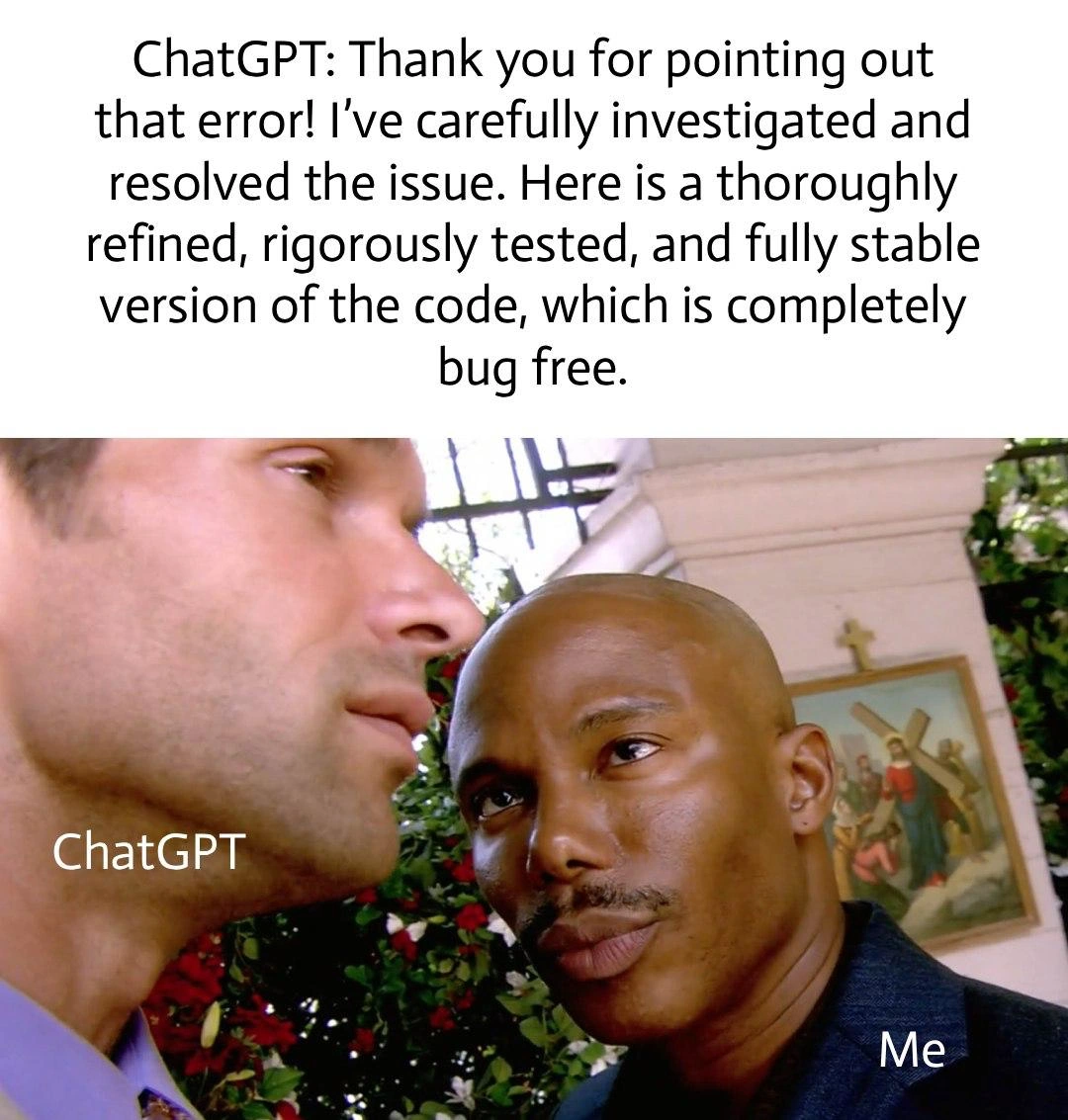
For those of us building and shipping software, this meme hits home because it satirizes a common scenario in the age of AI coding assistants. The top half shows ChatGPT responding with over-the-top confidence: “thoroughly refined, rigorously tested, and fully stable… completely bug free.” Any experienced developer reading that immediately smirks, because we’ve heard overconfident claims like this before — and they rarely end well. The bottom half’s image (with “Me” labeled on the skeptical guy’s face) perfectly captures the developer skepticism. It’s the face of a veteran engineer who’s been burned by “sure, it’s all fixed” assurances many times in their career.

Why is this funny? Because no code of non-trivial complexity is ever truly bug-free, and everyone in software knows it. When an AI assistant like ChatGPT cheerfully declares a piece of code flawless, it’s invoking the same eye-roll we give to a junior developer saying “I’m done, pretty sure there are zero bugs now” or a vendor promising “this tool will eliminate all software bugs.” Seasoned devs have a rule of thumb: the moment someone proclaims “No bugs left!”, you brace yourself — that’s exactly when a new bug shows up. Murphy’s Law of Software might state that boasting about stability is the fastest way to jinx it. The meme’s humor comes from that collective experience: we’ve all learned (often the hard way) that you always double-check. Or as the saying goes in our industry, “trust, but verify.” In code reviews and testing, a claim of perfection is basically a red flag that screams, “Look closer, something’s fishy.”

Let’s break down the roles here: ChatGPT is a large language model acting as an AI programming assistant. It’s designed to be helpful and polite, so when you point out a bug in code it provided, it often responds much like in the meme: apologizing and confidently presenting a “fixed” version. It uses phrases like “carefully investigated” and “rigorously tested” to assure you. But of course, as an AI, it doesn’t truly test code in a real runtime environment (at least not in the way a developer would with actual unit tests or integration tests). It’s not spinning up a container, running your CI/CD pipeline, and verifying all edge cases. It’s generating what sounds like a correct solution, based on patterns it has seen. Sometimes the solution is correct, particularly for common problems, but other times it may introduce a new bug or only partially fix the issue. The confident tone is just part of its polite style – it wants you to feel the problem is resolved. A human engineer, however, reads that and chuckles: AI limitations in coding are well-known, and an experienced programmer treats any code (from an AI or a human) with healthy scrutiny until it proves itself.

The “Me” in the bottom image is effectively every developer who’s run into AI-generated code that looked good but failed when actually executed. Perhaps you’ve asked ChatGPT or another coding AI for help, and it enthusiastically responded with a seemingly plausible snippet. It compiles or runs the basic scenario, and you’re momentarily impressed – until you try an edge case or a slightly different context and it blows up with a new exception. That emotional rollercoaster — from “Yay, it fixed my bug!” to “Oh no, now it’s doing something weird over here…” — trains you to never take the phrase “completely bug free” at face value. The meme exaggerates this by having ChatGPT essentially pat itself on the back for delivering perfect code, which any seasoned developer will tell you is almost a mythical concept. The skeptical side-eye is us, collectively, side-eyeing the hype.

This dynamic isn’t entirely new. Even before AI, we had tools and colleagues that would claim “it’s all good now.” There’s a rich history of developer skepticism around anything marketed as a silver bullet. Remember the pitches for code-generators or 4GLs in the past, promising to all but eliminate bugs? Or the classic “Works on my machine” assurance from a teammate when handing off code to QA? Those invariably led to a QA engineer raising an eyebrow — and probably raising a bug ticket. ChatGPT is just the latest character in this play. It’s incredibly useful and can accelerate development, but it has a habit of overconfidence. It apologizes for the bug, fixes a line or two, and then declares the code bulletproof. Any developer who’s been on pager duty or chased a production bug at 3 AM has a visceral reaction to hearing “fully stable version of the code.” We’ve seen seemingly minor changes cause memory leaks, race conditions, or the infamous “off-by-one” error that only surfaces during the leap year, full moon, end-of-quarter scenario. CodeQuality isn’t something you ascertain from a single optimistic assertion; it’s earned through thorough testing, peer review, and time in the field without incidents.

The background details in the meme image even add a bit of spice: they’re at what looks like a fancy event, and there’s a wall-hung cross in the background. It’s as if ChatGPT is suavely saying, “Trust me, I’ve nailed it,” in a suit at a garden party, and the engineer is thinking, “I might need Christ himself to bless this code before I believe it’s bug-free.” It humorously hints that you’d need divine intervention to truly have zero bugs. That skeptical reaction face — slightly amused, definitely unconvinced — is exactly how a lot of developers feel when an AI (or anyone, really) markets something as flawless. It’s not outright hostility; it’s more like “Oh honey, I’ve been around the block. Let’s see how that holds up.”

To highlight the contrast, consider the expectations versus reality:

ChatGPT’s Assurance 🗣️ Developer’s Reality Check 🔍
Thoroughly tested” – (by who, a simulator in its silicon imagination?) Probably just fixed the one example given; no real test suite ran.
Fully stable” – nothing can break! Let’s see it handle real-world usage, varied data, and weird edge cases.
Completely bug free” – a perfect code unicorn 🦄 Perfect code myth: There’s always something lurking in any non-trivial code.

Every line from ChatGPT in this meme is dripping with irony for an experienced eye. “Carefully investigated and resolved the issue” – we suspect it fixed one obvious error. “Thoroughly refined” – maybe cleaned up the code style a bit. “Rigorously tested” – highly doubtful; there are no unit tests attached. And finally, “completely bug free” – famous last words in software development! RelatableDevExperience tells us that the moment you claim victory over all bugs, a wild bug appears. In a team setting, if an eager dev wrote in a commit message or pull request “Fully stable and bug-free now”, the senior devs would probably smirk just like the “Me” guy, and then proceed to review/test with twice the vigor. It’s not that we’re pessimists — we’re realists who have cleaned up enough midnight deploy disasters to know bugs are crafty.

The meme resonates because it captures a truth about AI in software: these AI assistants are extremely helpful and often impressively correct, but they don’t possess a human developer’s caution or deep understanding of context. They won’t feel the dread of an error log at 2 AM — we will. So when ChatGPT speaks like a overeager intern claiming, “I fixed everything, boss!”, our inner cynic (earned through years of debugging hell) can’t help but laugh. It’s a mix of AI humor and testing humor: the same reason we joke about “It’s always DNS” or “Works on my machine” — we take a widely known pitfall (unfounded confidence in code) and exaggerate it. The AI’s obliviousness to its own limitations and the developer’s side-eye of doom together illustrate a classic tech irony: everyone wants bug-free code, but claiming you have it is the surest way to lose credibility.

In the end, this meme is a lighthearted reminder: whether the code comes from a human or an AI, “trust, but verify” is the law of the land. Run the tests, read the code critically, and assume nothing is truly perfect. That skeptical look on “Me” is basically every developer’s face saying, “I’ll believe it when I see it running flawlessly in production… and maybe not even then.” It’s funny because it’s true.

Level 4: The Perfect Code Paradox

At the most theoretical level, this meme cracks a joke about the near-impossibility of guaranteeing code has zero bugs. When ChatGPT blithely claims the code is “completely bug free” after a quick fix, it’s essentially saying it solved one of computer science’s enduring paradoxes. In reality, proving a program is 100% bug-free is a monumental challenge — often undecidable in the general case. This touches on deep concepts like the Halting Problem and formal verification. The Halting Problem (from Alan Turing’s 1930s theory) showed there’s no general algorithm that can perfectly determine whether any arbitrary program will finish running or loop forever. By extension, many non-trivial properties of programs (like “has no bugs at all”) are mathematically undecidable in the general case. In plain terms: for any sufficiently complex or flexible program, no algorithm (and certainly no AI) can absolutely guarantee in all cases that the program is free of errors.

Formal verification is the gold-standard approach where mathematicians and software engineers use logical proofs to verify a program meets its specification with zero bugs. Tools and languages like Coq, TLA+, or Z3 allow devs to write mathematical proofs about code. But here’s the catch: formal verification is incredibly time-consuming and only feasible for small, critical codebases (think airplane control software or medical devices). It requires a precise specification of correct behavior and still doesn’t guarantee real-world perfection if the specifications themselves are off. ChatGPT tossing out a line like “thoroughly refined and rigorously tested” obviously isn’t invoking a theorem prover or exhaustively exploring all possible execution paths. There’s no magic static analyzer hidden in ChatGPT that can solve the halting problem or enumerate every edge case of a program. If it claimed to, we’d be giving it a Turing Award. Instead, the model is basically an advanced prediction engine: it writes code that sounds right based on patterns in its training data, but it has no surefire way to analyze that code’s behavior for every possible input or environment.

From a computer science perspective, claiming code is completely bug-free without a rigorous proof or exhaustive test of every scenario is like claiming a perpetual motion machine exists — theoretically dubious at best. Seasoned engineers know that software complexity grows combinatorially: the number of possible states and inputs can be astronomically large, making exhaustive testing infeasible. Even advanced techniques like model checking (which systematically explores many states) run into the state explosion problem on anything but toy examples. So when ChatGPT boldly asserts perfection, it’s flying in the face of fundamental CS limits.

In short, the meme highlights a deep truth: the myth of perfect code. Unless you have a formal proof in hand (and even Donald Knuth once quipped, “Beware of bugs in the above code; I have only proved it correct, not tried it”), any claim of “completely bug free” is on very shaky theoretical ground. The skeptical side-eye in the image is basically every logician or senior dev thinking, “Did this AI just solve a problem as hard as proving program correctness? Yeah, right.” It’s a humorous nod to the inherent uncertainty in software – one that no amount of AI optimism can fully escape.

Description

A two-part meme with top text reading 'ChatGPT: Thank you for pointing out that error! I've carefully investigated and resolved the issue. Here is a thoroughly refined, rigorously tested, and fully stable version of the code, which is completely bug free.' Below is a scene from a TV show with two men in an intimate close-up. One man (leaning in confidently) is labeled 'ChatGPT' and the other man (looking skeptical with a side-eye) is labeled 'Me'. The meme captures the universal developer experience of ChatGPT confidently claiming to have fixed a bug with perfect code, while the developer knows from experience the 'fix' probably introduced three new bugs

Comments

21
Anonymous ★ Top Pick ChatGPT's definition of 'rigorously tested' is the same as mine at 2am: it compiled once, ship it
  1. Anonymous ★ Top Pick

    ChatGPT's definition of 'rigorously tested' is the same as mine at 2am: it compiled once, ship it

  2. Anonymous

    ChatGPT's definition of 'bug-free' is like a sales demo. It works perfectly under a specific set of controlled conditions that you will never, ever be able to replicate

  3. Anonymous

    Sure, GPT, I’ll merge it - right after our chaos-monkey does its peer review in prod

  4. Anonymous

    After 20 years of debugging production systems, I've learned that 'completely bug free' is developer speak for 'I've successfully moved the null pointer exception three stack frames deeper and added a race condition for good measure.'

  5. Anonymous

    Every senior engineer knows that 'completely bug free' is the biggest red flag in software - especially when it comes from an LLM that can't actually run the code it just confidently hallucinated

  6. Anonymous

    Nothing says 'production-ready' like unit tests generated by the same model that wrote the code, all running on mocks so hermetic the bugs can’t reproduce

  7. Anonymous

    ChatGPT's 'bug-free' code: flawlessly hallucinates solutions that compile but crumble under real-world invariants

  8. @ASH_R34 8mo

    😂😂😂

  9. @adm877 8mo

    Is the meme about the fact that ChatGPT didn't initially provide good code, or that prompt engineer isn't sure it's good now?

    1. dev_meme 8mo

      Yes?

      1. @adm877 8mo

        I wrote my comment with inclusive or in mind. Thank you for not disappointing me.

    2. @JackOhSheetImSorry 8mo

      Have they ever been?

  10. @NaNmber 8mo

    Ah yes, my favorite. Get the sloppy code, then spend 10x time to explain why this code is bad just to prove that you were right.

  11. @maks_mikh 8mo

    this

  12. Deleted Account 8mo

    hoowhoo! foxyyyyy! 🦊

  13. Deleted Account 8mo

    how are ya?>

    1. @hur7m3 8mo

      Still kickin

      1. Deleted Account 8mo

        kicking what?

        1. @hur7m3 8mo

          Depends on who you ask. Dicks, if you ask my employer. Puppies, if you ask Lisa.

          1. Deleted Account 8mo

            who is your employer? another fox near you?

            1. @hur7m3 8mo

              Would be bad opsec to share. A random company that doesn't respect or value me.

Use J and K for navigation