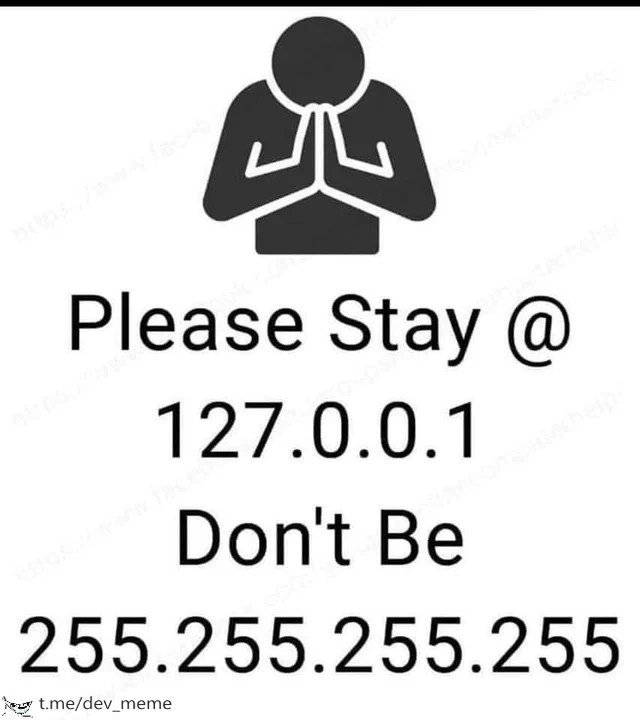
Dev meme: stay at localhost 127.0.0.1, don't broadcast 255.255.255.255 around
Why is this Networking meme funny?
Level 1: Stay Home, Don’t Roam
Imagine you have a special house that only you can live in, and it has a secret address only you know. Staying at 127.0.0.1 is like staying in that cozy little house – you’re safe and sound all by yourself. Now imagine the opposite: running through the whole neighborhood shouting through a megaphone so everyone can hear you. Being 255.255.255.255 is like doing that – it means you’re trying to talk to everybody at once. This meme is basically a playful way of saying, “Stay in your own home and don’t go shouting to large crowds.” It’s funny because it uses computer language to give a very simple life advice. Even if you don’t know computers, just picture localhost as your home and broadcast as a huge public announcement. The message? It’s best to chill at home and not spread things all over the place!
Level 2: Home Sweet Localhost
Let’s break down the technical references in this meme. It’s riffing on two special IP addresses that programmers and IT folks encounter:
127.0.0.1– “localhost.” This is a loopback address, which just means “this computer I’m on right now.” If you run a web server on your own PC and visithttp://127.0.0.1, you’re connecting to a website hosted on the very same machine. It’s your computer talking to itself. In fact,localhostis a nickname for127.0.0.1(you’ll even see it in yourhostsfile, mapping the name to the number). So when the meme says “Please stay @ 127.0.0.1,” it’s saying “please stay at your own place.” In plain terms: stay on your own device, don’t go anywhere. This clever usage takes advantage of every coder’s familiarity with localhost as a safe, local environment.255.255.255.255– “broadcast.” This one is a bit less commonly typed by new developers, but it’s fundamental in networking. It’s the broadcast address for IPv4, meaning a message sent to this address is delivered to all hosts on the local network. Think of it as a group announcement – instead of sending a message to one specific IP, you send to 255.255.255.255 and everyone listening on that LAN gets it. For example, when a device is first trying to join a network and doesn’t know any addresses yet, it might say “Hello, anybody out there?” by sending a broadcast packet to 255.255.255.255. Every nearby computer sees it and the appropriate one (say, the DHCP server) responds. So, “Don’t be 255.255.255.255” in the meme means “don’t go around reaching out to everybody at once.” It’s like the tech equivalent of “don’t attend a big gathering.” In other words, don’t broadcast yourself everywhere.
Now, why do these addresses work as a pun? The meme uses them as metaphors for personal behavior: localhost (127.0.0.1) is your home base (only you), while broadcast (255.255.255.255) is like mixing with the crowd (everyone). In normal English we’d say “stay home, don’t go out everywhere,” and in computer-speak that transforms into “stay at 127.0.0.1, don’t be 255.255.255.255.” It’s a one-to-one translation for those who speak fluent networking! This kind of tech humor lands because it requires knowing the context. If you’ve taken Networking 101 or just toyed with servers, you probably know localhost is your own computer. And if you’ve done any socket programming or IT work, you might recall that broadcasts send data to all nodes. So the meme is effectively a little quiz: do you get the reference? For those who do, it’s an instant delightful “aha!” moment.
It also taps into the culture of wordplay puns among developers. We love to remix everyday phrases with technical jargon. Here the phrase “stay at home, don’t broadcast around” is remixed into pure network terminology. The @ symbol in “Stay @ 127.0.0.1” even visually mimics writing an address. It’s a simple black-and-white design, almost like a straightforward public announcement poster – but with an inside joke twist. The praying-hands silhouette is basically begging everyone who understands this message to follow it. And during the time this was posted, that message was everywhere (literally on billboards and news): please stay home. Seeing it in “geek speak” made tech folks feel like, “Hey, this message is for us, by us.” It’s PSA: Programmer Service Announcement.
To put it simply: 127.0.0.1 = home (just you), 255.255.255.255 = everyone (all your neighbors). The meme is using basic networking concepts to convey a bit of real-world advice. If you’re new to these terms, just remember:
- Localhost is your own computer’s loopback address – there’s no safer or more isolated place on a network.
- Broadcast is sending to all machines around – useful for network setup, but you wouldn’t want to “broadcast” something private or harmful.
In a way, the meme also educates. A newcomer might see this and ask, “What’s 127.0.0.1? What’s 255.255.255.255?” and end up learning about IP addresses and network scope. So it's a fun little lesson hidden in a joke. By blending a DeveloperHumor punchline with actual networking facts, it speaks to both our love for tech and our shared pandemic-era reality. Keep it local, folks – in code and in life!
Level 3: Localhost Lockdown
This meme hits home for developers and network engineers because it fuses a public health message with pure networking lingo. In early 2020, "Please stay at home" became a global plea – and here that home is cheekily translated to 127.0.0.1 (your localhost). It's a classic piece of developer humor: taking something serious and reframing it as a nerdy in-joke that only those fluent in tech will truly appreciate. The phrase “Please Stay @ 127.0.0.1” is essentially saying “please stay on your own machine (don’t go out),” and “Don’t Be 255.255.255.255” warns “don’t broadcast yourself everywhere.” To a seasoned dev, this mapping is instantly clear and elicits a grin – it’s a tech pun playing on IP address roles.
Why is it funny? Because it’s exactly right. In computing terms, 127.0.0.1 is as local as it gets – you can’t catch a virus from another computer if you’re only talking to yourself, right? It’s your safe sandbox. Meanwhile, 255.255.255.255 is like running around the office spraying packets (or, in the real world, germs) at everyone. The meme exploits this perfect metaphor: localhost equals staying home, and a broadcast address equals mixing with everyone. For developers who have spent late nights configuring network interfaces or debugging connectivity, these addresses are iconic. Seeing them used in a worldly context feels both hilarious and gratifying – a kind of “secret handshake” of the programming world. It says we get it: we know what it means to bind a server to localhost or to cringe when someone accidentally broadcasts something on the network.
There's also a bit of ironic self-awareness here. Developers often joke that they prefer living at 127.0.0.1 – that is, staying in their comfort zone, working from home or in isolation with their gadgets. The stay_home_meme energy of this post taps into that stereotype: we coders have been social distancing since long before it was trending! Remote work and coding in solitude are second nature in tech culture, so “staying at localhost” feels amusingly apt. Plus, in March 2020 many of us were literally deploying our work-from-home setups, VPNing into office networks, and confining our interactions to Zoom calls. This meme took the edge off that stressful time by translating Stay at Home into our native tongue of IP addresses. It’s a bit of levity that says: hey, we’re all in this together – and by together, we mean each on our own localhost, connected only by the internet.
From a networking perspective, senior engineers also chuckle because “Don’t be 255.255.255.255” doubles as good technical advice. Broadcasting indiscriminately on a network is usually bad form except for very specific use cases. It can lead to network congestion or unintended consequences (anyone who’s accidentally triggered a broadcast storm in a corporate network knows that panic!). In that sense, the meme winks at a best practice: don’t spam your network neighbors, just like you wouldn’t want to spam people in person. There's an underlying notion of containment that resonates both in code and real life. Seasoned devs recall war stories like the newbie who wrote a script that inadvertently sent data to 255.255.255.255 and woke up every device on the subnet — oops! So telling someone "don't be 255.255.255.255" is tongue-in-cheek engineer-speak for "don't make that noisy, all-reaching mistake" – whether it's a network broadcast or ignoring a quarantine.
All these layers – the pandemic reference, the network fundamentals, the inside joke nature – combine to make this a primo example of TechHumor and wordplay. It satirizes how we filter the world through our tech lens. Even in a serious situation, a developer’s instinct is to inject a bit of Wordplay: turning a solemn plea into a clever IP address pun. In the end, it’s funny because it’s true: for both network hygiene and public health, the motto stands: keep it local, avoid broad exposure!
Level 4: OSI Layer 3 Distancing
At the network protocol level, this meme is a masterful play on reserved IPv4 addresses – specifically the loopback and broadcast addresses. In the world of networking (OSI Layer 3), every IP address has a special role, and these two are polar opposites in terms of reach:
127.0.0.1 – This is the famous loopback address, typically mapped to
localhost. It’s part of the reserved127.0.0.0/8block (over 16 million addresses!) that all loop back to your own machine. When a packet is sent to127.0.0.1, the IP stack short-circuits it internally: the data never leaves the host NIC. It's essentially a virtual wire that goes straight from the sender to receiver within the same device. Operating systems handle this by treating the 127.0.0.0/8 network as a special case — any outgoing packet with a destination in this range is immediately routed to the loopback interface (often namedlo), meaning you’re talking to yourself. This allows servers and processes to communicate as if over a network without any physical network traffic.255.255.255.255 – In binary this address is
11111111.11111111.11111111.11111111– all 1s. It's the IPv4 limited broadcast address, meaning "to all hosts on the local network segment." When a packet is sent to 255.255.255.255, every device on that LAN (within the sender’s broadcast domain) will receive it. Under the hood, the network interface typically transmits it with a special link-layer broadcast (e.g., EthernetFF:FF:FF:FF:FF:FFas the MAC destination) so that all listening nodes pick it up. Crucially, routers do not forward these limited broadcasts, confining the flood to the local network. This design prevents broadcast traffic from propagating indefinitely (imagine the chaos if a broadcast could echo across the entire internet!). Instead, broadcasts are meant for scenarios like service discovery or address assignment – for example, a new device uses 255.255.255.255 to ask “Hey, is there a DHCP server out there?” and all local servers can hear the request. In summary, sending to this address is like shouting in a closed room: everyone in the room hears you, but folks outside won’t.
In the TCP/IP specifications (see RFC 1122 and friends), these addresses are explicitly defined for their special behavior. The loopback function is fundamental for testing and inter-process communication; it guarantees a stable endpoint that is always up and only accessible by the host itself. The broadcast address is fundamentally about reach: one packet, delivered to all local recipients. It's a powerful tool, but if overused it can lead to broadcast storms that swamp a network (a classic networking headache).
Now, why is this OSI Layer 3 distancing? The meme humorously maps a real-world social directive onto networking concepts: 127.0.0.1 is isolation at the IP level (packets never leaving home), whereas 255.255.255.255 is maximal exposure (packets sent to every nearby host). In a network theory sense, it's a clever analogy – containment vs. propagation. It’s almost like treating a contagious packet: keep it on loopback to quarantine it, and definitely don’t broadcast it to everyone. The praying figure in the meme even gives a hint of pleading for proper protocol: essentially praying to the networking gods of IANA for people to respect these packet boundaries. The humor emerges from seeing a normally dry technical convention (reserved addresses) turned into guidance for human behavior. This deep cut works because any networking-savvy developer knows these fundamental addresses and their stark difference in scope. It’s IPv4 social distancing: a perfect analogy grounded in the basics of internet architecture.
Description
The image is a minimalist black-and-white meme. At the top, a solid black silhouette of a person with hands pressed together in a praying gesture is centered on a white background. Under the icon, large black text is arranged in four lines: "Please Stay @", "127.0.0.1", "Don't Be", and "255.255.255.255". A small watermark "t.me/dev_meme" appears in the lower left corner. Technically, it plays on IPv4 addressing: 127.0.0.1 is the loopback (localhost) interface suggesting "stay home," while 255.255.255.255 is the limited broadcast address suggesting "don't go everywhere," creating a networking pun that resonates with developers familiar with IP fundamentals
Comments
6Comment deleted
Senior dev mantra: keep your hot takes and one-liner scripts bound to 127.0.0.1 - once they hit 255.255.255.255 you’ve triggered a layer-8 broadcast storm with a TTL of office drama
When you've spent 20 years debugging distributed systems, you realize the real relationship goal is finding someone who handles packet loss as gracefully as TCP and doesn't panic when you need to open port 22 at 3 AM
Every senior engineer has had that 3 AM moment when they realize their 'quick local test' service bound to 0.0.0.0 has been cheerfully broadcasting to the entire corporate network for the past six hours. This meme perfectly captures the existential dread of network configuration - where the difference between 127.0.0.1 and 255.255.255.255 is the difference between 'works on my machine' and 'works on everyone's machine, including the CEO's laptop during the board meeting.' It's the networking equivalent of hoping your debug logs don't contain production credentials: a prayer we've all whispered while frantically checking our bind addresses at 2 AM
Senior rule: keep experiments on 127.0.0.1; once they hit 255.255.255.255, it’s not a status update - it’s an outage
Senior rule: keep comms loopback-scoped - DHCP discovery can hit 255.255.255.255, your status updates shouldn’t
Localhost: dev's panic room. Broadcast: the network's 'reply all' to every subnet