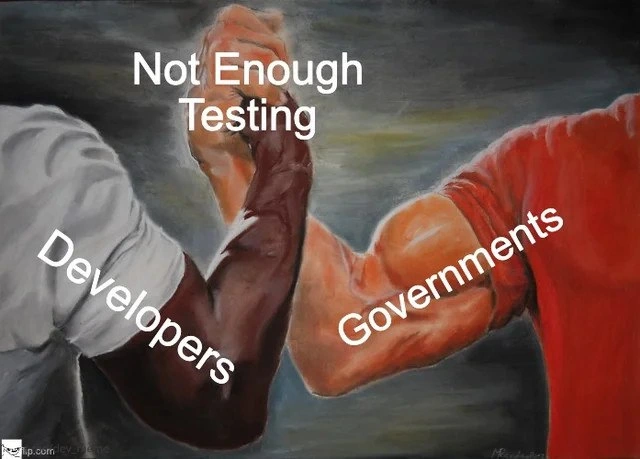
Developers and Governments Unite Over a Mutual Disrespect for Adequate Testing
Why is this Testing meme funny?
Level 1: Not Checking Your Work
Imagine two people giving each other a big high-five because they both decided not to double-check what they did. Sounds a bit silly, right? That’s basically the joke here. Think about when you do homework or a school project: if you don’t check your work or test it out beforehand, you might have mistakes you don’t catch until it’s too late. Maybe you wrote a math answer in pen without reviewing, and it turns out wrong during grading. Or you build a little wooden birdhouse but never test if the door fits, and on the day of the showcase it won’t open. Not testing things is usually a recipe for “Uh-oh!” moments.
In this meme, one strong arm stands for developers (people who make software) and the other stands for governments (people who run countries or big organizations). They’re clasping hands in agreement over “Not Enough Testing.” It’s as if both are proudly saying, “We didn’t try it out first to see if everything’s okay. High-five!” The humor comes from the obvious truth that not testing is a bad idea, and yet it happens everywhere. It’s like two students smiling at each other because neither studied for the test – you just know that’s not going to end well for either of them, and it’s a bit funny they’re celebrating it.
So, put simply: the meme is joking that both programmers and policymakers share a common flaw – they often skip the practice round and go straight to the real deal. And just like you’d expect in everyday life, when you don’t check your work, things tend to break or go wrong. The picture makes us laugh because it highlights this human tendency in a cheeky way. We can all relate to a time we should have tested or rehearsed something but didn’t – and then had a facepalm moment. Here, the developer’s software might crash with bugs, and the government’s plan might backfire with problems, all because neither did enough testing. It’s a light-hearted reminder: whether you’re coding a game or launching a big plan, it’s always wise to check your work before you put it out for real.
Level 2: But Did You Test It?
For those newer to development (or anyone just learning about software practices), let’s break down what this meme is saying. First, the image itself – it’s using the famous Predator handshake meme. That meme format comes from an old action movie where two strong characters clasp hands dramatically. Online, people label each arm as different groups and the joined hands as something they oddly agree on. In this picture, the left arm is labeled “Developers” (software developers, the people who write code) and the right arm is labeled “Governments” (the folks running countries or institutions). Their hands are clasped together over the phrase “Not Enough Testing.” So visually, it’s saying developers and governments are united because neither does enough testing. Pretty bold claim, right? It’s a humorous way to point out a common problem in both worlds.
Now, what do we mean by “not enough testing” in software? In programming, testing means checking that your code actually works the way you think it does. There are a few types of testing developers typically do:
- Unit testing: where you write small tests for individual chunks of code (called units, often single functions or modules) to ensure they return the expected results for given inputs. It’s like checking each Lego piece to make sure it’s not broken before building a big structure.
- Integration testing: once those pieces work in isolation, you test how they work together as a group. Continuing the Lego analogy, integration tests are like verifying that when you connect the pieces, the whole set functions as intended (no mismatched parts).
- Regression testing: after you’ve built something and later make changes or add new features, you run tests to ensure the old parts (the ones that used to work) still work the same way. It catches the oops-I-broke-something- bugs that sometimes happen when fixing or updating other things.
When we say “adequate testing” or enough testing, we mean doing a mix of these tests (and more, like performance tests or security tests) to cover the important scenarios. Test coverage is a term you’ll hear – it’s basically a measurement of how much of the code is executed by your test suite. For example, 80% coverage means your tests execute 80% of the code lines or paths; ideally, higher is better (though 100% doesn’t guarantee bug-free code, it’s a good sign of thorough testing). Adequate testing also means thinking of edge cases – odd or extreme situations your program might encounter – and testing those, not just the basic happy path.
However, in reality, developers often face pressures (tight deadlines, demanding feature requests, or just excitement to ship a product) that lead them to do minimal testing. Imagine a developer writing some new feature and thinking, “It works on my machine, so it must be fine! Time to deploy.” That tongue-in-cheek phrase, “Works on my machine,” is a classic in DeveloperHumor. It jokingly excuses the programmer from blame: “Hey, it ran okay on my computer, so if it crashes on the server or the user’s device, not my fault!” Of course, in truth, it is the developer’s job to test beyond just their own environment. The meme is poking fun at how developers sometimes skip writing enough tests or doing thorough checks, leading to more bugs in software when real users start using it. Those bugs could be anything from a simple app crash to a major security hole – all because something wasn’t tested properly before release.
Now, where do governments come into this? Think of governments launching new programs, policies, or even software systems for public use. “Testing” in that context might mean doing small pilot programs, gathering feedback, running simulations, or just carefully reviewing and analyzing a plan before making it official. Adequate testing for a government could be like a city testing a new traffic light system in one neighborhood before deploying it city-wide, or a country’s health department trying a new policy in a small region to see the effects before applying it everywhere. Just like software, this helps catch bugs – in this case, mistakes or unintended consequences – on a small scale first. But often, governments skip or shorten these trial runs. Maybe there’s political pressure to announce something quickly, or an emergency forces them to act fast. The result? They implement something that hasn’t been fully tested, and suddenly they hit serious problems. For instance, if a government rolls out an online service (like a new tax filing website) without properly testing it, it might crash or malfunction when everyone tries to use it at once. That’s essentially a load testing failure – similar to a website going down because the developers didn’t simulate a high number of users. Or consider policies: if they don’t test a new policy on a small scale, they might discover too late that it has loopholes or negative effects they didn’t foresee, kind of like discovering a bug in production. They then have to scramble to fix it by issuing clarifications or amendments (the equivalent of emergency hotfix patches in software).
Early-career developers often learn the hard way why testing matters. Maybe you wrote a school project or a small app and only tried the one scenario you expected to happen. It worked that one way, so you assumed everything was good. But then your professor or friend used it slightly differently and bam – it crashed or gave wrong results. That sinking feeling is how you get introduced to the world of bugs. 😅 The lesson: you need to think of those other scenarios and test for them. Write a few more unit tests for edge cases, try out your website on different browsers, throw unexpected input at your function to see what happens – basically, break your own stuff before it breaks on its own. Over time, developers adopt practices like Test-Driven Development (writing tests first), using continuous integration systems that run test suites automatically, and having QA teams who rigorously try to break the software in every way imaginable before real users get it. All of that is an effort to avoid the embarrassment and damage of a buggy release.
So this meme cleverly points out: it’s not just rookie coders or lazy teams that sometimes skimp on testing – even huge governments do it too! It’s a bit of a roast on both. Both developers and government agencies sometimes deploy big changes without doing their homework (testing) thoroughly. And when that happens, usually chaos ensues and people start scrambling to fix things. The unity in the handshake is comedic because you wouldn’t normally group these two together, but here they are, arm-in-arm, bonded by the same bad habit. For a junior dev or anyone new, it’s a reminder with a laugh: testing is important. If skipping tests can wreak havoc on a software codebase and on a country’s plans, maybe it’s something worth respecting! The meme is essentially a nod to CodeQuality folks and testers everywhere, saying “Yup, see, lack of testing causes trouble in any field.” It encourages you to recognize that writing tests and doing proper QA isn’t a ceremonial step – it’s what saves you from big headaches down the road, whether you’re running a website or a whole nation.
Level 3: Release and Pray
From a seasoned developer’s perspective, this meme lands painfully close to home. It highlights a shared anti-pattern in both software projects and public policy: skipping the homework of testing and charging straight to deployment. The left arm labeled “Developers” represents software engineers under the gun of tight deadlines, feature creep, and managerial pressure to “just ship it.” The right arm labeled “Governments” represents public institutions and officials who often roll out initiatives or technology with similarly rushed due diligence. Their clasped hands join over the phrase “Not Enough Testing,” implying a brotherhood born of cutting corners. It’s a tongue-in-cheek acknowledgement that two very different groups bond over the same dubious strategy: deploying first, dealing with bugs or fallout later.
Why is this so funny to those of us in the trenches? Because we’ve lived it. In software development, inadequate testing is a well-known recipe for bugs in software and 3 AM production incidents. Every experienced engineer has a war story of when lack of unit tests or integration tests turned an innocent code merge into a Sev-1 outage. Maybe your team pushed a new feature on Friday (without proper regression testing), only to spend the weekend scrambling as users discovered spectacular failures. It’s the classic “Deploy now, fix later” mentality – sometimes sarcastically expressed as, “We’ll test in production.” That phrase is basically the developer humor encapsulated by this meme. We laugh (perhaps a bit bitterly) because it’s a coping mechanism for the stress: if you don’t laugh about it, you might cry when yet another hotfix deployment blows up because someone said QA was “optional this sprint.”
The humor sharpens when you realize governments often do the exact same thing, just with higher stakes. Think about large government IT projects or policies that launch with a splash, only to immediately face bugs (glitches, errors, unintended consequences) because they weren’t adequately tried out beforehand. For example, a state launches a new online health portal without thorough load testing, and it crashes repeatedly on day one – essentially a production bug on a nationwide scale. Or consider when a new law or public policy is enacted without a small-scale pilot program or sufficient analysis: suddenly there are massive unintended side effects (loopholes, public confusion, maybe entire sectors thrown into chaos) that officials have to hastily “patch” with amendments or emergency measures. It’s the governmental equivalent of pushing untested code to prod and then scrambling to apply bug-fixes when things catch fire. The meme wryly observes that both developers and governments undervalue testing upfront and pay the price later.
There’s a rich vein of TestingHumor here around code quality (or the lack thereof). Developers are often caught between the ideal of high test coverage and the reality of “just get it done.” Writing tests doesn’t directly add a flashy new feature that managers can demo to stakeholders, so testing time often gets cut. It becomes a form of technical debt – you save time now by not testing, but you incur a big liability that might blow up later in the form of critical bugs. Governments face a similar dynamic: there’s political and financial pressure to deliver quick results, announce big programs, or respond swiftly to a crisis. Thorough testing – whether it’s simulating economic impacts, running a controlled trial, or simply beta-testing a new website with real users – takes time and money without producing an immediate public “win.” So the pressure is to launch now and deal with problems as they arise. It’s all too real that in both domains, the people at the top often don’t appreciate the quiet, behind-the-scenes work of testing. They might even dismiss it with a wave: “We don’t have time for that, just roll it out!”
The meme’s Predator handshake reference is the perfect visual metaphor. In that iconic film scene, two muscle-bound heroes clasp hands in a show of over-the-top macho unity. Here, the labels repurpose it to joke that developers and government officials – groups that rarely overlap in culture – are united like action heroes by their “disrespect for adequate testing.” It’s an unlikely alliance forged in the fires of poor planning. Seasoned engineers chuckle (or groan) at this because we’ve seen major software releases go out with barely any testing and we’ve watched public agencies bungle projects for lack of proper trials. The phrase “Not Enough Testing” on the handshake says it all: both sides are essentially agreeing, “Who needs careful testing? Not us!”
This is a bit of developer humor that resonates beyond just coding – it’s pointing out a wider human folly. Whether it’s a continuous integration pipeline or a large bureaucratic program, testing and quality assurance often get second-class treatment. And inevitably, reality catches up. The shared smirk comes from knowing that skipping testing is like skipping leg day at the gym: it seems fine until you face a real challenge, and then you collapse. In both software and governance, robust testing is usually the first thing on the chopping block and the last thing you wish you hadn’t cut. By clasping hands in the meme, devs and governments are essentially high-fiving over a bad habit that everyone down the chain (users or citizens, and the poor engineers or analysts on call) will suffer for. It’s tragic, it’s frustrating – and it’s funny because it’s true.
To sum up the senior perspective: this meme is a satirical mirror. It reflects how corners are cut in projects everywhere, and how bugs and failures don’t care whether you write code or policy – if you don’t test adequately, things will break. The humor has a bite to it because those in the know have fought the fires caused by this very handshake deal. We laugh, perhaps a bit cynically, acknowledging that “Yep, been there, done that, got the sev-1 t-shirt – and apparently so have government folks.”
Level 4: Path Explosion Paradox
At the deepest technical level, insufficient testing is more than just a lazy oversight – it’s a symptom of the theoretical impossibility of exhaustively verifying complex systems. In computer science, the number of possible execution paths through a non-trivial program can grow combinatorially explosive (think astronomically large). This is sometimes called the path explosion problem. Even with the best intentions, a developer can’t realistically test every single combination of inputs, states, and interactions in a modern application – there are just too many. Mathematically, trying to cover all cases in a large codebase starts to resemble an NP-hard search problem or even hints at the infamous halting problem (you can’t build an algorithm to catch every possible infinite loop or logic error, just like you can’t test every path).
So what do we do when adequate testing borders on the impossible? In critical fields (like aerospace or cryptography), engineers turn to formal methods – mathematical proofs of correctness. Instead of writing test cases for each scenario, they write specifications in logic and use theorem provers or model checkers (e.g. TLA+, Coq) to prove that the code meets its requirements for all possible cases. It’s like a formal mathematical guarantee that the software won’t stray off course. Formal verification can catch the kinds of edge cases no amount of unit tests would ever cover. For example, the seL4 microkernel was proven correct using formal methods, and NASA famously exhausts both testing and formal analysis to avoid spacecraft failures.
However, formal methods are extremely expensive and require specialized skills – they’re the rocket science of software. Most development teams (and certainly most governments) don’t have the time, budget, or expertise for this level of rigor. Instead, we rely on writing a reasonable subset of tests and hope it’s enough to catch the major issues. As the legendary computer scientist Edsger Dijkstra noted, “Testing shows the presence of bugs, not their absence.” In other words, no matter how much you test, you can never be absolutely sure you found all the bugs – you can only ever prove that some bugs are there by catching them. This fundamental limitation looms in both software and governance: you can’t anticipate every failure in a complex program or a complex policy. There will always be untested scenarios lurking in the dark.
So when we see the meme’s beefy handshake labeled “Not Enough Testing,” there’s an underlying truth: even if developers and governments wanted to test thoroughly, the combinatorial complexity of real-world systems means complete testing is practically unachievable. Of course, the dark humor here is that neither party is typically even aiming for exhaustive coverage – they often do far less testing than reasonably possible. The paradox is that while you can’t test everything, doing almost nothing (as this meme jokingly implies) is a recipe for disaster. The handshake of Developers and Governments over “Not Enough Testing” satirically unites two worlds that both tend to say, “Ah, that edge case probably won’t happen,” and then get bitten by precisely that edge case. In theory, rigorous testing or even formal proofs could prevent most disasters – but in practice, humans in both domains choose to race ahead, blissfully ignorant of the ticking time bombs in untested corners.
Description
The image is the classic 'Predator handshake' painting: two heavily muscled forearms, one in a white sleeve on the left and one in a red sleeve on the right, clasp hands in the center of the frame against a dark, brush-stroked background. White overlay text labels the left arm "Developers", the right arm "Governments", and the clasped hands "Not Enough Testing". The meme humorously highlights that both software teams and public institutions often ship or deploy solutions without sufficient test coverage. For seasoned engineers, it nods to the perennial struggle of convincing stakeholders to invest time in unit, integration, and regression testing before release, showing that this shortcut spans industries far beyond tech
Comments
6Comment deleted
Apparently 80% code coverage and 51% parliamentary approval mean the same thing: ship to prod now, hotfix on the constituents later
The only difference between our staging environment and healthcare.gov's production is that we actually have a staging environment
The only thing developers and government IT projects can agree on is that 'testing in production' is a perfectly valid QA strategy - after all, users are just unpaid beta testers with higher expectations and legal recourse
Devs and governments share the same QA plan: ship to prod as a “pilot,” let citizens run UAT, and call the regression fixes “amendments.”
Rare consensus in a CAP world: even governments agree lack of tests guarantees partition intolerance
Amazing how “test in prod” scales from microservices to public policy - only the blast radius differs