Skipping QA entirely: Vaccine trials meme mirrors editing code directly in production
Why is this Production meme funny?
Level 1: No Safety Net
Imagine you’re helping bake cupcakes for a big school fair. Normally, you might taste a little bit of the batter or test one cupcake first to make sure it’s sweet and delicious, right? Now picture skipping that step completely – you don’t taste anything, you don’t check the recipe twice, you just bake a huge batch and give them out to everyone. If you accidentally used salt instead of sugar, all the kids at school are going to find out by biting into a really yucky cupcake at the same time! 😬 It’s a disaster waiting to happen.
That’s what skipping tests and going straight to production is like. It’s funny (and a bit scary) because the person is basically saying, “I’m not going to double-check this at all, I’m just going to hope it turns out fine.” We laugh because it’s such a wild, risky thing to do – like doing a big circus trick without a safety net below. Everyone hopes it will be okay, but deep down we all know it’s smarter to be safe and practice (or in coding, to test things first). This meme makes us giggle and gasp for the same reason: someone skipped the safety steps and is just crossing their fingers that nothing disastrous happens.
Level 2: Straight to Production
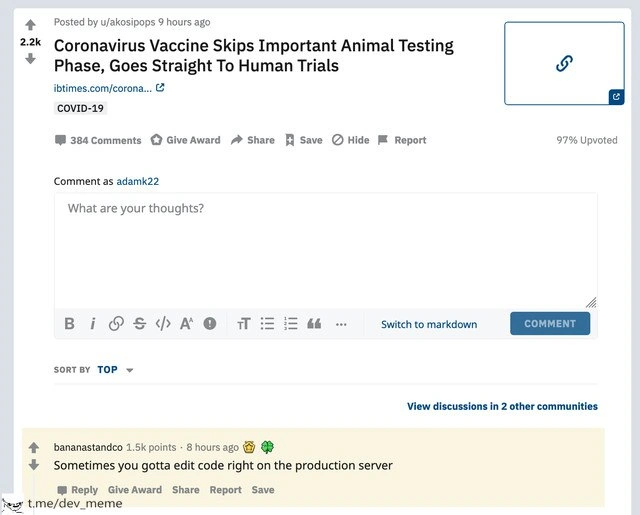
Let’s break down the meme in simpler terms. The image is a screenshot of a Reddit post. The title of the post is serious news: “Coronavirus Vaccine Skips Important Animal Testing Phase, Goes Straight To Human Trials.” Below that, a Reddit user bananasandco made a joke in the comments: “Sometimes you gotta edit code right on the production server” (with two 🍀 clover emojis for luck). This comment got a lot of upvotes (points), meaning many people found it funny and true-to-life for developers.
What’s the analogy here? It’s comparing the vaccine skipping its normal testing steps to a software developer skipping QA and pushing code directly to the live site.
First, know that in software development we usually have multiple environments:
- Development (Dev) environment: where developers write code on their own machines or a sandbox. You test things out here initially.
- Staging environment: a space that’s almost like the real thing (production) but not public. Think of it as a dress rehearsal. New code is deployed here to see if everything works in a production-like setting. Not every company has this, but it’s considered good practice as a safe intermediary step.
- Production (Prod) environment: the real deal – the website or app running for actual users. When you deploy to production, your code is live for customers. Any bug here can affect real people and data.
Now, Quality Assurance (QA) is the process of testing the code before it reaches production. It can involve automated tests (like unit tests, integration tests) and manual testing by QA engineers. The idea is to catch bugs in dev or staging so that production (where the stakes are highest) remains stable. Skipping QA means not doing these thorough tests at all.
So, editing code on the production server means making changes directly on the live system. Imagine you have a website that users are currently using, and you open up a text editor on that very server to change some code, then save it – poof, the site’s code is now different immediately. There’s no review, no safety net. If you made a mistake, users might start seeing errors right away. It’s like performing surgery on a patient without any rehearsal or backup plan, which is as scary as it sounds.
New developers are usually taught: never deploy untested code, and avoid changes on Fridays (since if something goes wrong late in the week, you might be fixing it over the weekend). There’s even a tongue-in-cheek phrase: “Works on my machine.” This is what a dev might say when something hasn’t been properly tested elsewhere – it ran fine on their computer, but who knows what happens on the prod server? It’s a joke because just because it works on your laptop doesn’t guarantee it will work in a different environment with real user traffic.
The clover emojis 🍀 in the comment signify luck. Essentially the commenter is saying, “Sometimes you have no choice but to make a change live and just hope for the best.” This acknowledges it’s a risky move. In development, relying on luck is obviously not a sound strategy, hence the dark humor.
Why would anyone ever do this for real? Sometimes, emergencies happen. For example:
- If the site is down or a critical bug is costing a lot of money every minute, a developer might do a quick hotfix. A hotfix is an urgent change to fix a bug, often applied directly to production because waiting to go through the whole pipeline would take too long. It’s like an emergency patch. Ideally, even hotfixes are tested a bit first, but in extreme cases people skip straight to fixing on prod to save time.
- If there’s no proper process or environment set up (like a company with no staging server or no automated tests), developers might end up treating the production environment as the test by default. This often happens in early-stage startups or hacky projects where speed is valued more than safety – at least until something goes wrong. It’s not good, but it does occur.
The Reddit meme draws a direct parallel between medicine and software:
- Vaccines normally go through multiple test phases (including animal testing) to ensure they are safe before giving them broadly to people. It’s a careful step-by-step rollout.
- Code is also supposed to go through multiple environments (dev, QA, staging) before reaching all users, to ensure it’s stable and bug-free.
In the COVID-19 situation, because it was an emergency, they accelerated the process and went straight to human trials for the vaccine. That’s very unusual and risky in medicine, so it made headlines. The commenter jokes that this is like a developer skipping the normal testing phase and deploying code straight to production. It’s funny to developers because it’s a relatable scenario – we’re taught it’s a big no-no, but under pressure, we recognize that “yeah, sometimes that happens.”
For a junior developer or someone new to deployments, the idea of editing a live server might sound crazy. Think of it this way: normally, you’d make changes in a controlled setting, run your code to see if it works, maybe ask someone to review it, and deploy carefully. If you bypass all that, you’re basically testing on real users. The meme highlights that this approach is as risky as it sounds – whether in software or in medical trials. It’s a bit of nervous laughter at the idea of being so overconfident (or desperate) that you just cross your fingers and deploy without testing.
In summary, skipping QA entirely means not testing code properly before release. The deployment goes straight to production without the usual safety checks. The meme uses the extraordinary case of a vaccine skipping a testing phase as an analogy for the risky practice of releasing untested code. It resonates with developers who have felt the butterflies-in-the-stomach feeling of deploying changes and the relief of having a proper testing pipeline. And it’s a reminder (wrapped in a joke) that while sometimes you can get away with “editing in prod,” it’s definitely not something to aim for!
Level 3: Production Guinea Pigs
"Sometimes you gotta edit code right on the production server" 🍀🍀
That single line is a battle-scarred developer’s proverb delivered with a resigned chuckle. It’s the kind of phrase you hear at 3 AM during an on-call war story, dripping with sarcasm and a hint of nostalgic trauma. In the meme, it’s a top Reddit comment equating the life-or-death rush of bypassing vaccine trials to the deployment nightmares of bypassing QA and editing code directly in production.
Why is this so funny (and scary) to experienced devs? Because it perfectly nails a dreaded anti-pattern: skipping tests and going straight to prod. It’s basically saying “Yeah, who needs a staging environment or QA? Let’s just wing it in production – hope those 🍀 lucky clovers will save the day!” This tongue-in-cheek attitude hides real DeploymentPainPoints and ProductionAnxiety that senior engineers know too well.
In normal software development, we have a deployment pipeline with stages to catch problems:
- You write and run unit tests and integration tests in a controlled environment.
- You might even have a dedicated QA team or automated CI/CD pipeline verifying everything.
- Only then do you push to a staging environment – a safe replica of prod – to double-check with production-like data.
- Finally, you deploy to the production server (where real users are), ideally through careful, monitored release strategies (blue-green deploys, canary releases, etc.).
Now compare that to the YOLO approach humorously referenced:
build: compile_and_package
test: [skip] # YOLO: skipping all tests for "speed"
deploy: production # Deploy straight to users, because what could go wrong?
Yes, that’s essentially edit_in_prod mode. A developer directly SSH-ing into a live server and changing code on the fly is like a scientist skipping animal trials and jabbing the first willing human. In both cases, it’s a high-stakes gamble likely to cause ProductionIssues.
The Production Guinea Pigs phrase is not just about cute rodents – it's a dark pun. If you bypass testing, you turn your end users into the test subjects (guinea pigs). Just as skipping animal trials means actual humans become the first to feel any side effects, skipping QA means real customers will be the ones to find your bugs (ouch). This is a classic TestingHumor inversion: “Who needs QA? Our users will do the testing for free!” It's funny because no sane team ever plans that... at least not out loud.
Why would anyone do this? Usually, they shouldn’t. It violates every “ProductionReadyCode” principle. But in practice, pressure makes people crazy:
- Urgent hotfix: Imagine a critical bug is crashing your site. The CEO is slacking you in all-caps. The proper CI pipeline is slow or broken. So what happens? A dev goes cowboy, opens up a live code editor on the server, and prays to the uptime gods while saving a quick fix. Hotfix directly in production, mode engaged.
- Missing staging environment: Not every team sets up a full staging area (lack of time, resources, or foresight). So they test on their machines (“works on my machine!” they swear) and then dump it into prod. If something breaks in the real environment (different data, more load), welp, time to scramble. This staging_environment_missing scenario is a common deployment pain point: you skip a safety net because you don’t have one.
- Overconfidence or ignorance: Juniors (or overconfident seniors) might think a one-line change is harmless. “It’s such a small fix, it can’t possibly break anything... right?” Next thing you know, that tiny untested change brings down half the site. (Ever heard someone say “It was a simple change” after a full outage? Yeah.)
In the meme’s context, the COVID-19 vaccine trial had to skip animal testing due to extreme urgency. The world needed a solution yesterday, so they went straight to human trials under the assumption that careful lab work would suffice and time was of the essence. Experienced developers see the parallel: sometimes business or crisis demands force us to cut corners. It’s “all hands on deck, fix it live now”. We hate it, we know it’s risky, but occasionally skipping_tests is the lesser evil compared to a certain disaster.
The humor also taps into the absurd visual of a developer as a mad scientist. Picture a coder in a lab coat, saying “We don’t have time to test on staging animals... deploy the code to the humans!” It’s ludicrous. Senior devs laugh because they’ve felt that pressure, and they cope with dark humor. We joke that some startups treat production like their testing ground. It's a ProductionIssues support group of sorts: "Haha remember that time we took down the database by patching a script live? Good times (never again)."
Importantly, while we laugh, we also shudder. The comment’s two 🍀 clover emojis aren’t random — they imply you’ll need luck if you try this. It’s basically the “roll the dice and hope nothing breaks” deployment strategy. And let's be real, luck isn’t a strategy. Any veteran will tell you how this story usually ends:
- Best case: The quick fix works, and you high-five (virtually) while your heart rate slowly returns to normal.
- Realistic case: The change kind of fixes one problem but causes another subtle bug. You just traded one support ticket for five new ones. Congrats, you’re now debugging live under even more stress.
- Worst case: Production meltdown. The site is down, data might be corrupted, and you’re frantically trying to undo changes or apply another patch while users (and managers) are screaming. In other words, major ProductionIssues abound. This is the DeploymentAnxiety nightmare that keeps folks up at night.
So this meme delivers a jolt of "I can’t believe they went straight to prod" camaraderie. It highlights an industry anti-pattern in a way both software devs and even outsiders (familiar with the news) can grasp. It’s essentially saying:
- Pharmaceutical teams normally never skip critical test phases, and when they do, it’s headline news.
- Likewise, competent dev teams never deploy untested code on purpose – and when they do, it’s the stuff of legend (or post-mortem reports).
The combination of a serious COVID news headline with a casual dev quip is gold. It underscores the shared element of risk. Whether it’s code or a vaccine, skipping the safety steps is a bold move that courts disaster. The meme resonates especially with those of us who have had to do a hotfix in prod or seen someone do it. We laugh because we’ve survived those “human trials” of software firsthand. And trust me, once you’ve been burned by an edit-in-prod gone wrong, you become the biggest advocate of "test, test, test (and test again)".
Description
Screenshot of a Reddit post with 2.2k upvotes titled “Coronavirus Vaccine Skips Important Animal Testing Phase, Goes Straight To Human Trials” from ibtimes.com, tagged COVID-19 and showing 97 % upvoted. Under the post, the top comment by user bananasandco (1.5k points) reads, “Sometimes you gotta edit code right on the production server” with two green clover emojis. The layout includes the standard Reddit vote arrows, share/save buttons, comment box that says “What are your thoughts?”, formatting toolbar, and a blue “COMMENT” button. Technically, the humor equates bypassing pre-clinical testing to developers pushing untested changes directly onto a live production server, highlighting deployment risk, missing staging environments, and the perils of skipping a proper testing pipeline
Comments
5Comment deleted
New best practice: skip the mice, deploy straight to 7.8 billion canaries and let Prometheus alert when respiration == 0
The only difference between this vaccine approach and my last production hotfix is that the vaccine has a rollback plan
Straight to human trials: pharma’s prod deploy - no staging, the canary is everyone, rollback is a regulator, and observability is the evening news
Skipping animal trials is the pharma equivalent of SSH’ing into prod - sure, it ships faster, but your rollback strategy becomes a postmortem
Skipping staging for prod? Bold - because nothing builds SRE character like live-fire vaccine trials on humans