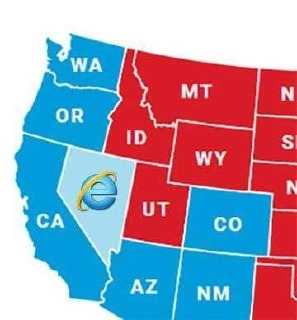
Nevada’s election map stuck loading because it runs on Internet Explorer
Why is this Frontend meme funny?
Level 1: Old Tools, Slow Work
Imagine you have two people trying to do the same job: one is using a really old, slow tool and the other has a new, fast tool. Who do you think will finish first? Probably the one with the fast tool. This meme jokes that the state of Nevada is using the oldest, slowest tool – an ancient web browser called Internet Explorer – to do an important task (counting election results). It’s like Nevada is driving a rusty old car while other states zoom by with sports cars. The picture shows Nevada looking like it’s “loading” (taking forever to finish) because of that old browser.
Why is this funny? Because everyone knows how frustrating it is to wait for something when the technology is outdated. It’s the same feeling as waiting for a slow computer or an old phone to respond – you see that little spinner or hourglass and it takes forever. We find it silly and laughable that something as important as an election count might be stuck using such an old program. Of course, Nevada isn’t literally using Internet Explorer to count votes, but joking about it helps us vent our impatience. It’s a simple joke: using old tech = very slow progress. Even if you’re not a computer expert, you know that if you open a really old web browser, modern websites might load super slowly or not at all. So picturing Nevada’s vote tally on that old browser is a funny way to explain why it’s taking so long. It’s humor built on the idea that outdated things work slowly, and we can all chuckle at how absurd it would be to rely on something like that in such an important moment.
Level 2: Legacy Lag
Let’s break this down in simpler terms. Internet Explorer (often abbreviated as IE) is an old web browser from Microsoft. It used to be extremely popular in the late 90s and 2000s, but over time it became outdated. Newer browsers like Chrome, Firefox, and Safari appeared and were much faster, more secure, and followed web standards (the rules for how websites should be built) much better than IE did. Microsoft eventually discontinued Internet Explorer – essentially telling everyone to stop using it – and replaced it with a new browser called Edge. In tech lingo, IE is now a legacy browser, meaning it’s old and no longer recommended, but some people or organizations still use it because their systems haven’t been updated.
Now, the meme shows a portion of a U.S. election map. Each state on the map is usually colored red or blue depending on which candidate is leading or has won. In the image, Nevada is colored a very light blue and instead of the letters “NV” (Nevada’s abbreviation), it has the Internet Explorer “e” logo. In an election-night context, light blue might indicate an unfinalized or slowly updating Democratic lead. The joke here is that Nevada’s results are taking a long time to “load” or finalize, and they humorously blame that on Nevada using Internet Explorer to run its election map or counting system.
Why is that funny to developers? Because Internet Explorer has a reputation for slowness and glitches. If a website or application runs on IE, it’s often noticeably slower or prone to showing a spinning “loading” icon compared to running on a modern browser. Web developers have a lot of experience struggling with IE’s browser quirks – these are weird behaviors or bugs that only IE would have. For example, a webpage might look perfect in Chrome and Firefox, but when you open it in IE, the layout could be messed up or some features won’t work at all. Developers might then have to write special code just for IE to fix those issues. This is called handling browser compatibility. It’s a tedious task: often involving polyfills (little code pieces that add missing functionality to an older browser) or conditional hacks (like the snippet above, which shows HTML that only IE would read).
Some classic IE quirks include: not supporting certain modern JavaScript functions, using a different interpretation of CSS styles, and running JavaScript much slower because the engine inside IE is less optimized. One common joke in programming circles was that developing for IE would take an extra chunk of time just to make sure “the darn thing works on Internet Explorer.” So if something is really slow or hanging, saying “maybe they are using IE” is a tongue-in-cheek way to explain it. It’s like an inside joke among tech folks: outdated tools = slow results.
In the context of the 2020 election, Nevada’s vote counting was indeed slower than other states, and people were anxiously refreshing map websites to see updates. By replacing “NV” with the IE logo, the meme implies that the state’s counting process or website is stuck using an outdated browser, hence the interminable wait. It’s funny because it’s obviously not the real reason, but it feels fitting: Nevada’s slow update is as frustrating as trying to load a modern website on Internet Explorer. The humor draws on our shared experience of watching a page painfully load or break in IE and thinking, “Ugh, of course it’s IE.” Every web developer, from juniors to seniors, has at least heard about IE problems if not lived through them. This meme gives a nod to that collective pain in a very relatable way (especially for those who had to support IE at some point). And for newer developers, it’s an introduction to the ongoing joke that IE is the ultimate slowpoke of browsers – so much so that even an entire state’s reporting could be imagined to choke on it.
Level 3: Quirks Mode Quagmire
At the highest level, this meme combines a real-world event with deep web development lore. Nevada’s slow vote count in the 2020 election is humorously blamed on Internet Explorer (IE) – a browser notorious among developers for legacy bloat and slowness. The map shows Nevada with the light-blue “loading” color and an IE logo, implying the state’s results are stuck rendering. Technically speaking, this pokes fun at how outdated software can bottleneck critical processes. Internet Explorer’s Trident rendering engine (the core of IE that interprets HTML/CSS) and its old JScript/Chakra JavaScript engine were infamously slow and non-compliant with modern web standards. In an interactive map or app, IE’s slower JavaScript execution and DOM rendering could dramatically delay updates – much like Nevada’s delayed reporting.
From a senior developer’s perspective, the humor lands because IE symbolizes legacy tech debt and browser quirks. IE (especially older versions like IE6-IE8) would operate in Quirks Mode if a page’s doctype was missing or outdated – essentially a backward-compatibility mode with broken CSS layout rules (the IE box model bug being one classic example). In a complex UI like an election results dashboard, running in IE’s quirks or older standards mode could wreak havoc: misaligned elements, endless spinner icons, or scripts throwing errors. Veterans remember painstakingly writing CSS hacks and JavaScript shims to placate IE’s peculiarities. For instance, IE needed special treatment for simple things like transparency in PNG images or AJAX calls (recall using an ActiveXObject("Microsoft.XMLHTTP") before XMLHttpRequest became standard). These extra hoops often slowed development and the app’s runtime performance.
This meme taps into that shared memory: “IE is so slow and finicky that if an entire state’s election process ran on it, of course results would lag.” It’s a tongue-in-cheek explanation for Nevada’s delay that software engineers find darkly amusing. There’s also a grain of truth under the joke: many government and enterprise systems remain stuck on outdated browsers or tech stacks. Corporate IT policies often lag behind, with some internal applications only working on IE due to old ActiveX controls or proprietary Silverlight dashboards. Senior devs have war stories of critical apps being shackled to IE long after it was obsolete, much like Nevada humorously appears to be. So the meme resonates as a commentary on how outdated software can hold back progress in the most absurd places.
And of course, there’s the long shadow of the Browser Wars and IE’s fall from grace here. Historically, IE dominated the web in the early 2000s (achieving over 90% usage at its peak after crushing Netscape). But Microsoft infamously let IE stagnate for years – IE6 through IE8 barely improved and ignored many web standards. Developers grew to despise IE’s limitations: no support for modern CSS3/HTML5 features, sluggish JavaScript performance (no efficient JIT compilation until much later), and numerous proprietary bugs. This neglect opened the door for Firefox and eventually Chrome to usurp IE by offering faster, more reliable browsers. By 2020, IE was a dinosaur – officially deprecated and replaced by Microsoft’s new Edge browser (which itself switched to Chrome’s engine). Thus, making IE the scapegoat for something being frustratingly slow is an inside joke that rings true. It’s the equivalent of saying “this process is stuck in the past.” Even Microsoft jokes about IE nowadays – the running gag is that the only thing IE is good for is downloading a better browser. In short, the meme is a perfect storm of developer humor: mixing a timely situation with the quintessential example of obsolete tech and performance issues. Anyone who’s wrestled with IE can laugh (and cringe) at the suggestion that Nevada’s count is literally held back by the blue e logo of doom.
<!-- Legacy IE conditional comment: Only Internet Explorer will render the enclosed HTML -->
<!--[if IE]>
<div class="ie-warning">
Nevada's results are still loading... (Internet Explorer detected)
</div>
<![endif]-->
<!-- Other browsers skip this, much like the rest of the country moved on while IE lingers -->
Description
The image is a cropped, stylized U.S. election-style map of western states. Each state is filled either red or blue and labeled with its postal abbreviation: WA, OR, CA, ID, MT, WY, UT, CO, AZ and NM. Nevada is shown in a very light blue and, instead of the “NV” label, its silhouette contains the classic Internet Explorer lowercase "e" logo with the yellow ring. The joke suggests Nevada is still "loading" results because it relies on the infamously slow, deprecated Internet Explorer, a tongue-in-cheek nod to legacy browser performance, rendering quirks and the pain of supporting outdated tech in web development. Developers recognize the humor in associating critical workflows with an obsolete browser notorious for compatibility issues and sluggish JavaScript execution
Comments
12Comment deleted
The rest of the country is streaming results over WebSockets; Nevada wired its vote counter through an IE6 ActiveX progress bar, so the election is bottlenecked on a synchronous XHR from 2004
Just like how Nevada is where people go to gamble away their life savings, Internet Explorer is where developers go to gamble away their sanity trying to support CSS grid layouts that were standardized a decade ago
Ah yes, Nevada - the state developers visit as often as they test in IE: never. Though to be fair, both have a reputation for unpredictable behavior, requiring special handling, and making you question your life choices. At least Nevada eventually adopted modern standards
Blue states innovate in React; their enterprises still render in IE Quirks Mode
We dropped IE nationwide; Nevada’s the exception - some casino compliance portal still hinges on an ActiveX control signed with SHA‑1 and a VB6 “SDK” nobody wants to open without gloves
Nevada must be rendering in IE11 - our Promise to get results never resolves because a synchronous XHR is blocking the event loop
i don't understand( Comment deleted
There are presidential elections at the united states of america, one of the states, nevada, is taking a lot of time to count the votes. There's the meme that internet explorer is so slow so that's the joke Comment deleted
😂 Thank You for explaining! Comment deleted
It's not true, Nevada is way faster than freaking Explorer Comment deleted
You're welcome Comment deleted
E Comment deleted