Cisco Licensing Changes Faster Than You Can Understand Them
Why is this Networking meme funny?
Level 1: Changing the Rules Mid-Game
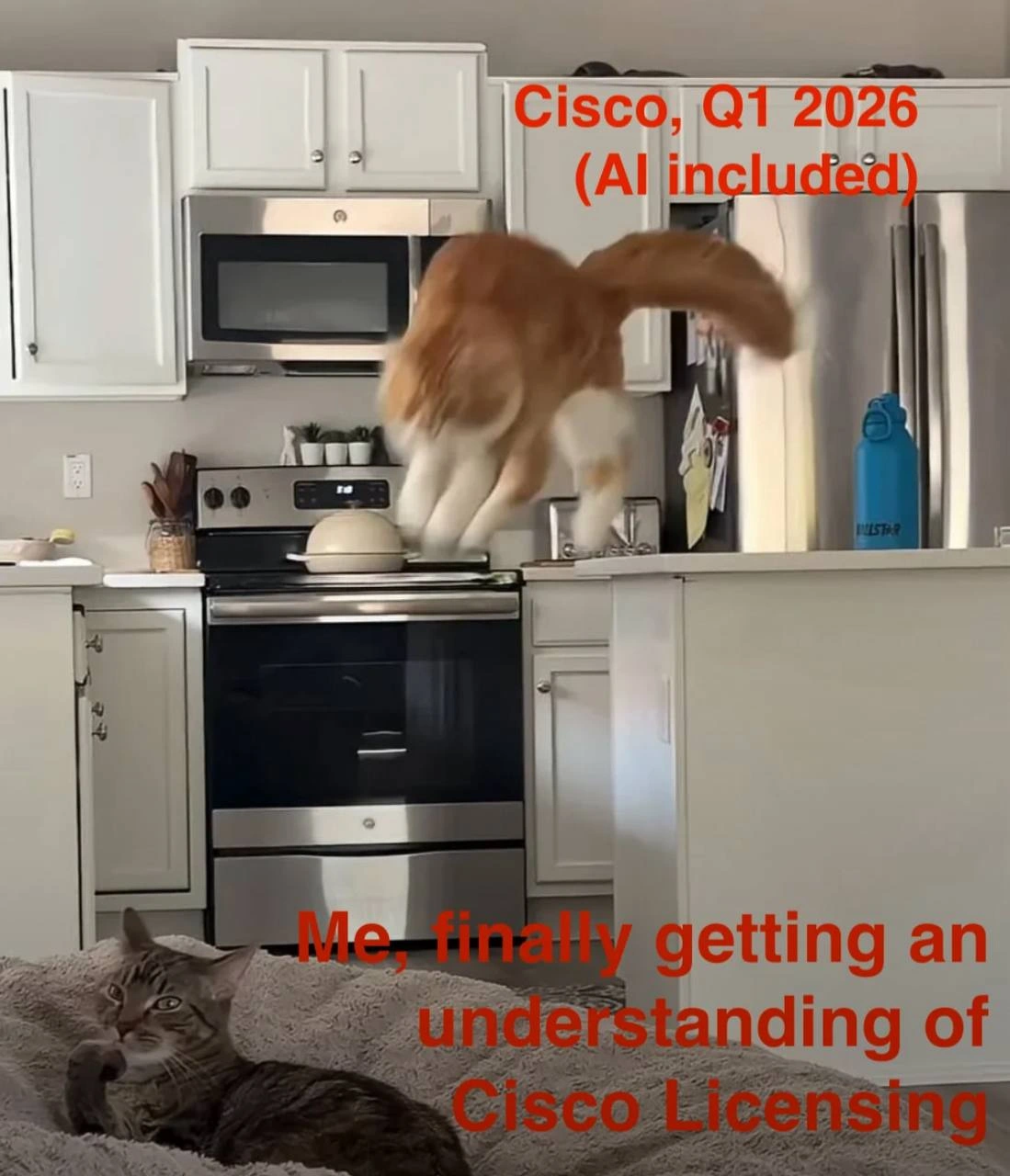
Imagine you just learned all the rules to a really complicated board game. You studied and practiced until finally it all makes sense. You feel proud and relieved – now you can actually enjoy playing! But then, right when you’re about to start a new game, the company that made it suddenly says, “Wait, here are new rules and an extra game piece you have to use now!” 😮 Everything you just learned? It’s not wrong exactly, but now there’s more to figure out and you’re back to feeling confused. It’s a little funny and a little frustrating: funny because it’s so absurd, frustrating because you worked so hard to understand it. In the meme, the calm cat is like you feeling “Finally, I get it,” and the jumping cat is the game maker (Cisco) changing things on you with a big surprising leap. The humor comes from that relatable uh-oh feeling – just when you think you’ve got it, they change it all over again. It’s like chasing after something that keeps moving away, and all you can do is sigh and laugh at how crazy it is.
Level 2: License Maze 101
Let’s break down what’s happening in simpler terms. Cisco is a huge company that makes the routers and switches running many networks. They also sell software features for those devices, and to use those features, companies must deal with Cisco’s licensing system. Imagine buying a car and then having to pay extra to unlock the radio or AC — that’s what tech licensing can be like. Over the years, Cisco’s licensing has become a bit of a maze with different packages and subscriptions.
- Cisco Licensing: This refers to the rules and purchase plans for turning on features in Cisco’s hardware or software. It’s frankly notorious among network engineers for being complex. There are different editions (like “basic” vs “advanced” features) and you often need to buy the right license for the features you want.
- SKU Matrix: SKU stands for Stock Keeping Unit, basically an ID for each product or license. Cisco has so many combinations of hardware and software features that their price list (the SKU matrix) feels like a giant spreadsheet of codes. Network folks joke about needing a decoding ring to figure out which SKU enables which capability. The meme’s mention of “understanding Cisco Licensing” means our engineer finally pieced together what each SKU or license does and how to legally get all needed features running. It’s like finally solving a puzzle.
- Smart Accounts: In the old days, you might get a license key (a code) in an email and install it on a device. Now Cisco often uses Smart Accounts – an online portal where a company’s licenses are centrally managed. It should make life easier by automating license activation and tracking, but at first it confused a lot of people. They had to learn new processes: how to set up the account, “reserve” licenses for devices, and so on. Think of it as moving from manually unlocking each device to having a cloud-based key manager – convenient when you get the hang of it, but frustrating until then.
- DNA Subscriptions: Cisco DNA (Digital Network Architecture) is a fancy name for Cisco’s newer software features (like security analytics, automation, monitoring) especially on campus switches and routers. Instead of a one-time purchase, DNA features are sold as a subscription (you pay annually or every few years). They have tiers, for example: DNA Essentials (basic monitoring) and DNA Advantage (more advanced tools). This was a big shift for customers used to buying hardware once and using it for a decade. Now they had to budget for ongoing costs and figure out which tier they needed. It caused a lot of head-scratching and budgeting discussions.
- “AI included” add-ons: Lately, everything in tech is about AI (Artificial Intelligence). Companies add AI to products to make them sound cutting-edge. For networking, this could mean AI that helps manage the network or find problems faster (Cisco has talked about AI for network analytics, basically smarter monitoring that spots issues or optimizes performance). In context, “AI included” suggests Cisco will bundle some AI-driven feature into a new license tier. But likely it won’t be free – it’s an upsell, meaning an additional thing they charge for. They might introduce an “AI-Assistant for Network Ops” that, say, predicts outages or automates fixes, available only if you buy the premium AI license. For a network engineer, that means yet another thing to learn and decide on: is it worth it, and how does it change the current licensing structure?
- Quarterly Revenue Targets: Big corporations like Cisco live by quarterly financial results. Every quarter (3-month period), they need to show growth to shareholders. This can drive companies to release new products or packages regularly. Q1 2026 in the meme likely means the first financial quarter of 2026, a time by which Cisco might be planning a new product launch (“AI included!”) to boost sales. The joke is that these timing and revenue pressures lead to frequent changes in offerings – keeping engineers in perpetual learning mode.
- Vendor Lock-In: This term means once you’re using a vendor’s products, it’s really hard to switch away. Cisco is a classic example: if your whole network is built on Cisco gear and you’ve trained your IT staff on Cisco, you can’t easily rip everything out and use another brand. The VendorLockIn tag in the meme hints that Cisco can keep changing things (like licensing terms) and customers kind of have to go along, because switching vendors is even more painful.
- Relatable Pain & Industry Irony: The meme is funny because it’s so relatable to anyone who’s dealt with enterprise tech. There’s an irony that tech companies often promise to simplify and innovate, yet they sometimes create new headaches in the process. Industry folks share this kind of meme to say “ugh, yes, this exactly!” and also to laugh it off. It pokes at the hype (IndustryTrends_Hype tag) too: everyone is slapping AI on their products in 2025, even if it’s not revolutionary, and customers know it’s partly about riding the hype wave (and charging more).
- Cat Meme Format: Using cats in memes is a tried-and-true formula on the internet. Here it’s not just random cats; the two cats play roles. The orange cat leaping in the kitchen represents the sudden, chaotic move by Cisco. The relaxed tabby cat with the “paw on chin” pose represents the meme’s creator (or any network engineer) who is thoughtfully resting after doing the hard work of learning. The positions are comical: one cat is literally airborne (mid-leap across the counter, a blur of motion) – that’s how abrupt and wild Cisco’s next move feels. The other cat is on a blanket, looking contemplative – that’s how satisfied and finally comfortable the engineer feels after understanding the current system. The contrast is what makes it funny: calm understanding vs. crazy surprise. If you’ve ever seen a cat suddenly jump out of nowhere, that’s the vibe – and it’s being compared to Cisco’s habit of surprising its users.
In summary, at this level we explain that the meme is about the frustration of constantly changing technology rules. Cisco’s licensing is the specific example: it’s complex, and just when you get it, they change it (by adding something big like “AI”). The cats are visual metaphors: Cisco = energetic jumping chaos; Me (engineer) = chill for one second before chaos strikes. The joke lands especially well for people in networking or IT because they know this story, but even a junior developer can appreciate it as “big tech company keeps changing stuff, making life hard for the techies.”
Level 3: Sisyphean SKU Shuffle
At the highest level of technical irony, this meme skewers Cisco’s notoriously convoluted licensing and their relentless drive to tack on the latest buzzword for profit. Picture an enterprise network architect (the tabby cat in contemplative repose) who has finally untangled the SKU matrix hell of Cisco’s current licensing – all the Smart Accounts, tiered feature sets, and elusive activation keys. This poor soul has achieved a hard-won “licensing epiphany,” mapping out which DNA subscription tier unlocks that crucial routing feature and how to align device entitlements across a global network. It’s the kind of knowledge earned by wading through countless PDF guides and Cisco Live slides, or maybe an internal wiki page titled “Understanding Cisco Licensing (No, Really).”
Enter the orange blur labeled “Cisco, Q1 2026 (AI included)” – that’s Cisco’s next quarter product strategy pouncing out of nowhere. AI included? Of course! It’s Q1 and quarterly_revenue_targets must be met. The meme implies Cisco is about to shake up the model yet again by introducing a new AI-tier upsell. The calm cat (you, the network pro) has barely put your feet up after mastering the current model, and suddenly Cisco leaps in with a brand-new licensing bundle featuring “AI”. It’s as if Cisco’s product team has a standing algorithm:
# Pseudocode for Cisco's quarterly licensing strategy
if customer_understands(current_licensing):
raise LicensingModelUpdate("New quarter, new model with AI!")
(Yes, that’s basically how it feels.)
The humor here hits hard for seasoned networking folks. We’ve seen this pattern: one quarter it’s Cisco ONE licensing, next it’s Smart Licensing, then DNA Center with required subscriptions, and now inevitably “AI-driven” features sold separately. Every time, the rules change. It’s a Sisyphean task (hello, sisyphus_learning_curve): you push the boulder of understanding uphill—labbing out feature activation keys, aligning budgets to new SKUs, negotiating with Cisco reps—only to have that knowledge boulder roll back down when a new model is announced. The meme’s cat meme format perfectly captures this dynamic. The flying orange cat is chaotic and unpredictable (just like Cisco’s licensing updates that come out of the blue), and the relaxed cat is bracing for impact (the engineer who expected a stable system, now struck by how ephemeral their “expertise” was).
From a corporate culture angle, the meme is a jab at IndustryTrends_Hype and the way big tech companies suddenly jam in whatever’s trending into their product lines. AI is the new cloud, and Cisco, like clockwork, will sprinkle some “AI-powered network insights™” into a premium package and slap on a new SKU. It’s both hilarious and painful: hilarious because of the sheer predictability (everyone in the industry can see this coming), and painful because if you’re that engineer, you know you’ll soon be reading yet another 50-page licensing guide and migrating your accounts… again. Vendor lock-in exacerbates this. Once your infrastructure is built on Cisco gear and licenses, you’re stuck on their treadmill: they raise prices or complexity, and you have little choice but to play along or risk losing support and features. The meme’s irony is that just when you’ve optimized your network’s license compliance (maybe even scripted it out), Cisco’s sales strategy yanks the rug.
In essence, Level 3 analysis shows the deep, shared technical pain: the RelatablePain of chasing Cisco’s ever-moving goalposts. It highlights industry irony: a company selling “Digital Transformation” and simplicity often creates labyrinthine rules that transform your patience into digital dust. The caption “(AI included)” dripping in red is a tongue-in-cheek reference to how every vendor in 2025 slaps “AI” on products to juice sales. Senior engineers reading this are smirking because they’ve lived it — they’ve sat in meetings with Cisco account managers hyping the new AI-licensing tier that “you just gotta have,” while internally they’re thinking “Great, here we go again…”. By combining all these elements, the meme offers a wry commentary on the networking world’s reality: technology evolves, but licensing complexity just mutates (often under the guise of “innovation”). The leaping cat of Q1 2026 is the avatar of our collective exasperation and dark humor about this never-ending cycle.
Description
A meme showing two cats in a kitchen: an orange cat mid-leap labeled 'Cisco, Q1 2026 (AI included)' and a gray tabby cat lying calmly on a cushion labeled 'Me, finally getting an understanding of Cisco Licensing.' The orange cat jumping chaotically represents Cisco releasing yet another licensing model change (now with AI bundled in), while the relaxed cat below represents the network engineer who just barely understood the previous licensing scheme
Comments
8Comment deleted
The only thing that changes faster than Cisco licensing models is the number of engineers who've given up trying to understand them
Cisco licensing tiers are like spanning-tree reconvergence - just when you think the topology’s stable, a new ‘AI Premium Advantage Plus’ VLAN floods the network
After 20 years in enterprise IT, I've mastered BGP, OSPF, and MPLS, but Cisco licensing remains the only protocol where the handshake never completes and every packet requires a different subscription tier
Cisco licensing is the only thing in tech where you need a PhD to understand whether you're compliant, a law degree to interpret the contracts, and apparently until Q1 2026, divine intervention to figure out what you actually own. The addition of 'AI included' is the cherry on top - because nothing says 'we've simplified our licensing model' quite like bundling machine learning into your already incomprehensible SKU matrix. At least now the AI can be just as confused about your entitlements as you are
Cisco Smart Licensing: 'Perpetual' features that expire faster than a BGP session timeout
In networking, the only truly perpetual license is the spreadsheet tracking every time Cisco rebrands Smart Licensing to “AI Advantage Premier” and rewrites the token math
Cisco licensing is the only system where, just as your spreadsheet reaches eventual consistency, a new ‘AI Advantage’ SKU forces a full re‑shard of the budget
I want the raw template Comment deleted