If Pete Davidson Can Do It, You Can Dereference a Pointer
Why is this CS Fundamentals meme funny?
Level 1: Anything’s Possible
Think of something that seems really, really hard or unlikely to you — like maybe learning to ride a bike felt before you actually learned, or solving a super tough puzzle. Now imagine a totally ordinary person doing something that everyone thought was impossible, like a kid from your school suddenly becoming best friends with the most famous pop star in the world. You’d probably say, “Wow, if that can happen, then maybe I shouldn’t give up on my hard thing!”
This meme is basically doing that. It’s using a funny real-life example: Pete Davidson is just a regular funny guy, and he ended up dating three super famous, glamorous women (Ariana Grande, Kim Kardashian, and Kate Beckinsale). A lot of people found that surprising, even absurd, like seeing an unlikely dream come true. The meme says if that wild, unlikely thing can happen, then you, the reader, can definitely tackle something that feels hard for you — in this case, remembering how C++ pointers work, which is just a fancy way to say “learning a tricky part of computer programming.”
You don’t actually need to know what a pointer or C++ is at this level. The heart of the joke is motivation: “Nothing is impossible, no matter how hard it seems.” It’s a playful way to encourage someone. We find it funny because it pairs a serious insecurity (“ugh, I’ll never understand this complicated thing”) with a goofy encouragement (“hey, if that guy can pull off a miracle in dating, you can do this!”). So even if you strip away the tech talk, it’s a lighthearted message: don’t underestimate yourself. Crazy, unexpected successes happen every day – so your hard task might not be so impossible after all. Keep going, you got this!
Level 2: Pointer Pointers (Advice on Pointers)
Let’s break down the tech side in simpler terms. The meme is talking about pointers in C++. So first: what is a pointer? In programming, a pointer is basically a variable that holds a memory address. Think of it like a signpost or an index card that tells you where to find a particular piece of data in the computer’s memory. C++ is a language that gives you a lot of control (and responsibility) over memory, which is why pointers are a big topic in C++ and other low-level languages like C. It’s a key part of CS_Fundamentals when learning how data is stored and accessed.
Here’s a straightforward example in C++ code:
int number = 42;
int *ptr = &number; // & gives the address of 'number', so ptr holds that address
std::cout << "ptr is " << ptr
<< ", *ptr is " << *ptr << std::endl;
In this snippet:
- We have an integer variable
numberstoring the value 42. - We declare
ptras a pointer to int (int *ptr) and set it to&number. The&operator takes the address ofnumber. So ifnumberlives at memory location, say,0x7ffe...810, thenptrwill hold that address value. - When we print
ptr, it shows an address (some hexadecimal number like0x7ffe...810). - When we print
*ptr, we use the*operator to dereference the pointer. Dereferencing means “follow the pointer to the address it holds, and retrieve the value there.” So*ptrgives us 42. The output would be something like:ptr is 0x7ffeefbca810, *ptr is 42
In short, ptr points to number. *ptr lets us access the thing ptr is pointing to. A common way beginners phrase it is: ptr is like a treasure map, and *ptr is the treasure you find at the location on the map. Or ptr is a hotel room number, and *ptr is the person staying in that room.
Pointer arithmetic is another aspect mentioned in the tags (like PointerArithmetic). This means you can do math with pointers to navigate through memory. Suppose you have an array in C++:
int arr[3] = {10, 20, 30};
int *p = arr; // arrays can decay to a pointer to the first element
Here, p initially points to the start of the array (the element 10). If you do p++, it will now point to the next element (20). This happens because when you increment an int*, it jumps ahead by the size of an int (usually 4 bytes). So p + 1 moves one integer forward in memory. After p++, *p would give you 20. If you did p++ again, *p would give you 30. This is really handy for iterating through arrays, but you have to be careful: if you increment one time too many, p would point past the end of the array — that’s an out-of-bounds pointer now. If you try to dereference it (*p at that point), you’ll get garbage or a crash. The rule is: you should only use pointer arithmetic within the bounds of the memory you know you’ve allocated. Going outside is like stepping off a marked trail into danger. 🐍 (Cue the danger noodle, which in programming is the snake of undefined behavior!)
Now, why does the meme specifically say “you can remember how pointers work”? Because keeping track of all these pointer rules can be tricky! Many new programmers (and even not-so-new programmers) find pointers confusing at first. Here are some reasons:
- Syntax and semantics: In C++, the symbols
*and&do different things depending on context.int *p;declares a pointer.*pin an expression uses the pointer.&vargives the address ofvar. Forgetting one of these or mixing them up (like accidentally writing*p = &xwhen you meantp = &x) leads to errors. It’s a common learning hurdle. - Manual memory management: If you use
newto allocate memory for a pointer, you must later usedeleteon that pointer to free the memory. If you forget, you get a memory leak (memory that your program no longer uses but isn’t given back to the system). If you delete something too early and then use the pointer, that pointer becomes a dangling pointer (it points to memory that’s gone or reused), and using it can crash the program or corrupt data. Basically, C++ doesn’t have a garbage collector to clean up automatically (unlike languages such as Python, Java, or C#). The programmer has to remember to handle it. That’s a lot of responsibility, akin to remembering to turn the stove off after cooking — easy to forget with consequences if you slip up. - Debugging: When something does go wrong with pointers, the errors can be cryptic. A program might just crash with no obvious clue, or worse, not crash but produce weird results because you wrote to the wrong memory (imagine accidentally writing to some other variable’s space!). Debugging pointer issues (like hunting for why a variable has a crazy value) can be tough. Tools and experience help, but initially it’s daunting.
So pointers are often seen as a “hard” part of C++ (and C) that you just have to practice and get used to. In college computer science classes, there’s usually that week when everyone is pulling their hair out over a segmentation fault caused by a pointer bug. It’s almost a cliché: “It’s always the pointers.” Over time, you do remember and internalize how they work, but the meme is joking that this feat is on par with achieving something wildly unlikely in life.
Now, enter Pete Davidson and his dating roster. For those who might not know the pop culture side: Pete Davidson is an American comedian (from Saturday Night Live) who’s gained notoriety for dating a series of very famous, glamorous women. Ariana Grande (a pop superstar singer), Kim Kardashian (reality TV star/business mogul), and Kate Beckinsale (British actress) are three of his most high-profile exes. People joke about this because Pete is kind of an everyman – he’s goofy, covered in random tattoos, not conventionally handsome in a Hollywood sense – yet he’s dating women many consider “out of his league.” It’s become a running pop-culture joke/inspiration: if Pete can date these women, anything is possible! There’s even a bit of wholesome encouragement people take from it, like “hey, don’t sell yourself short.”
This meme applies that exact analogy to coding: mastering C++ pointers is the “out-of-your-league” challenge for many programmers. It’s the thing that seems too hard, almost unattainable at first. By saying “If Pete can snag [those names], you can remember how pointers work,” the meme is encouraging you in a very comedic way. It’s a motivational_meme wrapped in irony. The underlying message is: Don’t worry, you got this! Yeah, pointers are tricky, but so was Pete landing those dates — and look how that turned out. In other words, believe in the improbable.
Also, it's worth noting the snake on Pete's shirt in the image, just because it's a fun detail for us nerds: a snake could remind us of Python 🐍 (a programming language that, mercifully, doesn’t make you deal with pointers directly at all). In Python, you never have to write int *p or worry about freeing memory; it’s handled behind the scenes. Many programmers first learn in such high-level environments, and then when they meet C++ pointers, it’s like, “Whoa, I have to do all this manually?” So the snake is like the opposite end of the spectrum from C++ — maybe an unintended symbol of simpler times! And the arrow on the shirt looks like the ↑ arrow, which isn’t exactly a C++ symbol, but humorously we could link it to the -> operator (used to access members via a pointer to an object, e.g. ptr->member). It’s probably a coincidence, but given the meme’s text, it almost feels like even Pete’s fashion is telling us, “hang on, there’s a hint of programming here.” 😄 (That’s us reading way too much into it, but hey, that’s what we do in deep dives!)
In summary, for a newer developer or student: the meme is saying pointers in C++ are tough to wrap your head around, but don’t lose hope. It uses a goofy real-world comparison to make you smile and boost your confidence. After all, learning how * and & and memory addresses work is certainly possible — thousands of programmers have done it — it just feels as daunting as, say, asking out a celebrity. The truth is, like any skill, it becomes clear with practice. This meme’s just a funny reminder not to be intimidated by those tricky pointers. If an unlikely scenario like Pete’s dating life can happen, then you can definitely conquer pointer arithmetic and remember_pointers quirks. Consider it a nerdy form of “Anything is possible!” encouragement.
Level 3: Out-of-Bounds & Out-of-League
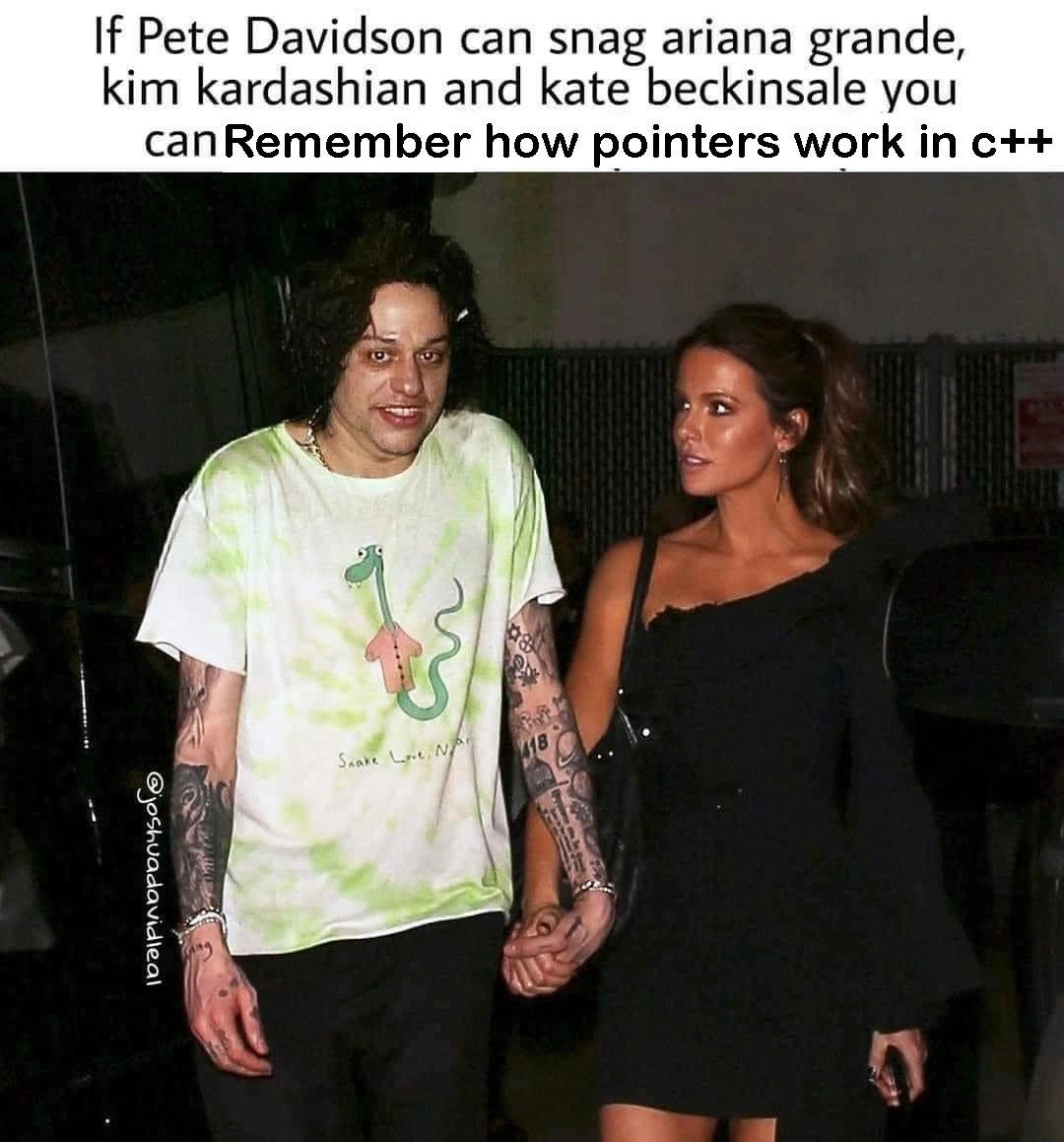
The meme shows a paparazzi-style photo of comedian Pete Davidson, tattooed and in a tie-dye shirt, holding hands with actress Kate Beckinsale during a night out. The overlaid caption boldly declares:
“If Pete Davidson can snag Ariana Grande, Kim Kardashian and Kate Beckinsale, you can remember how pointers work in C++.”
This one hits home for a lot of developers. It humorously compares two things that seem unbelievably difficult: Pete Davidson’s track record of dating A-list celebrities (truly out-of-his-league by typical standards) and the struggle of keeping C++ pointer rules straight in your head. It’s saying, in effect, “Look, that guy pulled off something crazy — so surely you, dear coder, can tackle the crazy-hard thing on your plate.” The juxtaposition is ridiculous in just the right way.
Any senior developer reading this will likely chuckle because remembering how pointers work is a very relatable pain point. Pointers are notorious in the programming world. We’ve all had moments where a simple * or & misplaced caused hours of debugging. The meme’s encouragement acknowledges that shared struggle. It taps into a bit of collective PTSD from LowLevelProgramming days: things like chasing down a mysterious crash only to realize you had a dangling pointer, or painstakingly debugging why your program prints gibberish — oops, you went out-of-bounds in an array by miscalculating a pointer offset. These experiences are almost a rite of passage. Senior devs have accumulated war stories such as:
- Accidental
NULLdereference: Forgetting to check if a pointer isnullptrbefore using it, resulting in an instant crash. It’s like trying to open a door that isn’t there. - Dangling pointer bugs: Using memory after freeing it. For example, delete an object but keep a pointer to it and later do
*ptr– now you’re referencing garbage. The program might seem to work… until it spectacularly doesn’t. - Off-by-one errors in pointer arithmetic: Iterating one element too far past the end of an array. Suddenly you’re reading memory that isn’t part of your array – who knows what it might contain! This often leads to weird behavior or a segmentation fault.
- Confusing syntax: C++ pointer syntax can be unintuitive. Is it
*ptr++or(*ptr)++or*(ptr++)you meant? Each does something different! And let’s not forget the classic brain-teaser of pointers to pointers (int** ptr2ptr) which newcomers find mind-bending. - Memory leaks and manual free: If you allocate memory with
newand neverdeleteit, you leak memory. A long-running program can gobble up more and more RAM. On the flip side, free something too soon or twice, and you’re in undefined behavior land. Managing this without mistakes is challenging, which is why modern C++ introduced smart pointers (std::unique_ptr,std::shared_ptr) to help out.
All of the above are why even seasoned programmers sometimes joke that working with pointers is like juggling knives. Powerful, but you better not lose focus. So when the meme says “you can remember how pointers work,” it’s a tongue-in-cheek nod to how non-trivial that can be. It’s arguably easier to learn a high-level framework or a new programming language than to truly master C++ pointer semantics. Many of us have switched to languages like Python or JavaScript for daily work, only to feel rusty when we return to C++ and have to recall, “Wait, does * go here or not? Do I use -> or . with this pointer?” It’s comforting and comical to be told that this feat of memory (pun intended) is in reach, using Pete Davidson’s absurdly lucky love life as evidence that unlikely things do happen!
Visually, the meme heightens the absurd contrast. Pete is in a casual green tie-dye tee featuring a cartoon snake with an upward arrow (yes, that’s actually on his shirt!) next to the very glamorous Kate Beckinsale in a chic black dress. The faces are blurred, but Pete’s distinctive look (tall, lanky, heavily tattooed, goofy grin) is recognizable. For context, Pete Davidson isn’t exactly the person you’d imagine dating a pop superstar like Ariana Grande, a reality TV mogul like Kim Kardashian, or an elegant actress like Kate Beckinsale. Yet he did, and those headlines baffled and amused the world. The meme leans into that bafflement. It basically screams: “If this seemingly impossible dating streak happened, then come on, remembering pointers must be doable!”
There’s even an extra layer of geeky delight in the image: Pete’s snake-and-arrow shirt feels like an inside joke for programmers. The snake could nod to Python (a programming language whose iconography often involves a snake, and notably a language where you don’t deal with pointers explicitly thanks to automatic memory management). And the upward arrow design is uncannily reminiscent of C++’s -> operator (which is used to dereference pointers to objects/structs). It’s likely a coincidence in fashion, but for a bunch of us nerds, it’s the kind of detail that makes us go “ha, I see what you did there!” even if the meme creator didn’t intend it. This mix of pop culture and programming easter eggs is what makes developer memes fun — they operate on multiple levels of reference.
In summary, from a seasoned developer perspective, this meme is developer humor gold. It blends a quirky celebrity reference with a core programming challenge. It’s relatable: many devs indeed find pointers tricky and have to pep-talk themselves through debugging memory issues. And it’s slightly absurd, which is the point — it takes an outrageous real-world situation to make our technical struggle feel a bit more normal and surmountable. We laugh, we nod, and maybe we feel a tiny bit more motivated that yeah, if Pete can somehow manage that, we can handle a little *ptr vs **ptr brain workout. It’s an encouraging meme that says “hang in there, you got this” in one of the nerdiest ways possible.
Level 4: Indirection All The Way Down
At the most granular level, a pointer in C++ is literally a variable containing a memory address — a number that tells you where in the computer’s RAM some data lives. This ties into core CS_Fundamentals and the very architecture of computers: memory is one big array of bytes, and a pointer is an index into that array. When you work with pointers, you're doing Low-LevelProgramming because you're manually dealing with how data is laid out in memory. There’s a famous saying in computer science: “All problems can be solved by another level of indirection.” In programming, pointers are that indirection. They let you refer to data by address, pass references around, and build complex data structures like linked lists or trees by connecting memory locations. A pointer to a pointer (C++’s ** syntax) is a second level of indirection (like a note that points to another note that points to the treasure). You can even have multiple layers, hence the joke among advanced developers that it’s “indirection all the way down.” Each layer adds flexibility but also mental overhead, much like having to follow a chain of clues.
With this power comes serious complexity. C++ pointer semantics demand that you remember exactly how to use them, or you risk invoking the dreaded undefined behavior. For example, pointer arithmetic follows strict rules: adding 1 to a pointer doesn’t just add 1 to the numeric address; it advances the pointer by one unit of the pointer’s data type. So if p is an int* at memory address 0x1000, p + 1 would be 0x1004 (assuming a 4-byte int size) – it now points to the next integer in memory. This arithmetic makes sense only because of how arrays are stored contiguously in memory. But if you miscalculate and go out-of-bounds (past the allocated array), you might read or write into random memory. That’s a serious error: the program could start corrupting data or crash immediately. Modern operating systems guard against these illegal memory accesses by throwing a segmentation fault (a crash with a message like "Segmentation Fault (core dumped)"), essentially saying “Whoa there, you’re not allowed to touch that memory address!” This is low-level ManualMemoryManagement in action — the programmer is expected to keep track of what is a valid address and what isn’t.
Another fundamental aspect is the distinction between a pointer and what it points to. In C++ code, the * operator is used to dereference a pointer, i.e., to follow the address to the actual value. If ptr is an int* that holds the address of an integer, *ptr gives you the integer at that address. Conversely, the & operator gives you the address of a variable. Seasoned C++ developers internalize that int *p = &x; means “point p to the address of x,” and then *p lets you access x’s value via indirection. Forgetting a single & or * in the right place can completely change meaning or crash things – a nuance that trips up even experienced programmers when they haven’t touched C++ in a while.
Perhaps the biggest peril with pointers is dangling pointers – pointers that used to point to valid memory, but that memory has since been freed or gone out of scope. Dereferencing a dangling pointer is like calling a phone number that’s been disconnected; if you’re lucky you get an immediate error, if not, you might end up talking to someone else entirely (i.e. corrupting some other data)! This is classic undefined behavior: the C++ standard says anything can happen if you use memory incorrectly – your program might crash now, or later, or subtly do the wrong thing. It’s a key reason why manual memory bugs are responsible for countless security vulnerabilities (buffer overruns, wild writes) and why entire toolsets (like Valgrind for runtime checks or compiler sanitizers) and newer languages (like Rust with its strict borrow checker) exist – to avoid these pitfalls. ManualMemoryManagement with raw pointers is powerful but unforgiving. One must rigorously keep track of allocations (new/malloc) and deallocations (delete/free) to avoid memory leaks or double frees. This complexity forms the backdrop of the meme’s joke: the idea that remembering all these pointer rules and edge cases is a non-trivial achievement, almost an epic quest in a programmer’s journey.
To tie it back to the meme’s spirit: pointers are a fundamental but challenging concept in programming languages like C++. Mastering them is a bit like mastering a high-stakes skill – it feels improbable at first. The humor is that Pete Davidson’s wildly improbable dating history is being used as the benchmark of “impossible things that actually happened,” implying that understanding C++ pointers is also possible despite feeling nearly impossible. It’s an absurd encouragement, rooted in the truth that pointers require careful thought (and perhaps a bit of faith in yourself) to get right. In essence, this is LowLevelProgramming bravado: if you can conquer pointers, you’ve joined the club of developers who manage complexity at the machine level... and hey, if Pete can conquer the celebrity dating scene against all odds, you can conquer pointer semantics! 🎉
Description
The meme displays a paparazzi-style photograph of comedian Pete Davidson and actress Kate Beckinsale holding hands at night. An overlaid text caption reads: 'If Pete Davidson can snag ariana grande, kim kardashian and kate beckinsale you can Remember how pointers work in c++'. The humor is generated by creating a motivational parallel between two vastly different and seemingly impossible feats: Pete Davidson's famously successful dating life with prominent celebrities, and a programmer's struggle to master pointers in C++. For developers, especially those working with C++ or C, pointers are a notoriously difficult concept due to their direct memory manipulation, complex syntax, and the high risk of critical errors like segmentation faults. The meme serves as a funny piece of encouragement, suggesting that if something as unlikely as the referenced celebrity pairings can happen, then surely a determined developer can conquer one of the most challenging topics in computer science

Comments
13Comment deleted
C++ pointers are a lot like celebrity dating: one wrong move and you get a segmentation fault in front of millions
Pete keeps dereferencing relationship objects without a single segmentation fault - meanwhile our char ** still core-dumps on the first date
Just like Pete Davidson's dating history, C++ pointers seem to defy all logic until you realize they're just following a simple pattern: point to what you want, dereference when you need the value, and pray you don't cause a segmentation fault that crashes the whole relationship... I mean program
Both feats hinge on the same skill: holding a reference to something way out of your league without it dangling
The meme brilliantly captures the C++ developer's existential crisis: if someone can navigate the complex social dynamics of Hollywood relationships, surely you can navigate the labyrinth of pointer dereferencing, memory allocation, and the eternal dance between stack and heap. Yet somehow, `char* ptr = nullptr;` followed by `*ptr = 'a';` still feels more unpredictable than any celebrity romance. At least segfaults give you a stack trace - relationships just give you emotional baggage and no valgrind output
If dating had C++ semantics, tabloids would call it a shared_ptr cycle - nobody truly owns anything and the leak is permanent
Pete's chaining supermodels like a flawless linked list; your pointers? Eternal dangling disasters
In C++ relationships, raw pointers ghost you, unique_ptrs mean exclusivity, shared_ptrs trigger custody battles, and weak_ptr is “it’s complicated” - manage lifetimes or the breakup ends in a segfault
I've just researched internet on this fenоmena. It seems his pointer is quite big 😁😂😂😂😂 Comment deleted
Some say that 16-byte pointers are, well, pointless. Typical 8-byte pointers are more practical. And even those modest 4-byte pointers have their niche use when applied properly. (byte ≈ inch) Comment deleted
try to reread this messgae assuming 1 byte is equal to 1 bit... Comment deleted
From the scientific point of view, 16 bits are just enough for production. (assuming 8-bit byte) Comment deleted
bold words Comment deleted