The Unsung Hero and Potential Villain of Every PC Build
Why is this Hardware meme funny?
Level 1: The Weak Block
Imagine you build a tall tower out of toy blocks and put all your coolest, sparkly pieces on the very top. Everyone is looking at the top of the tower, saying “Wow, look at those awesome decorations!” But at the very bottom of the tower, there’s just one small, wobbly block holding everything up. It’s a plain, boring block, and nobody really notices it. If that one little block breaks or slips out, the entire tower will crash down in an instant, and all those cool decorations will fall and smash. That’s exactly what’s happening with the computer in this meme. All the exciting parts of the PC (the things that make it fast and fun) are like the shiny decorations on the tower, and the power supply is like that one plain block at the bottom. It’s not exciting to look at, so people ignore it, but it’s actually supporting everything. If the power supply fails, all the other parts will suddenly stop working – just like the tower collapsing. The meme is funny because all the fancy parts at the “party” don’t realize their quiet friend (the PSU) is so important. It’s a simple reminder that sometimes the most ordinary-looking part is the one keeping everything together; and if it breaks, the fun is over for everybody.
Level 2: The Weakest Link
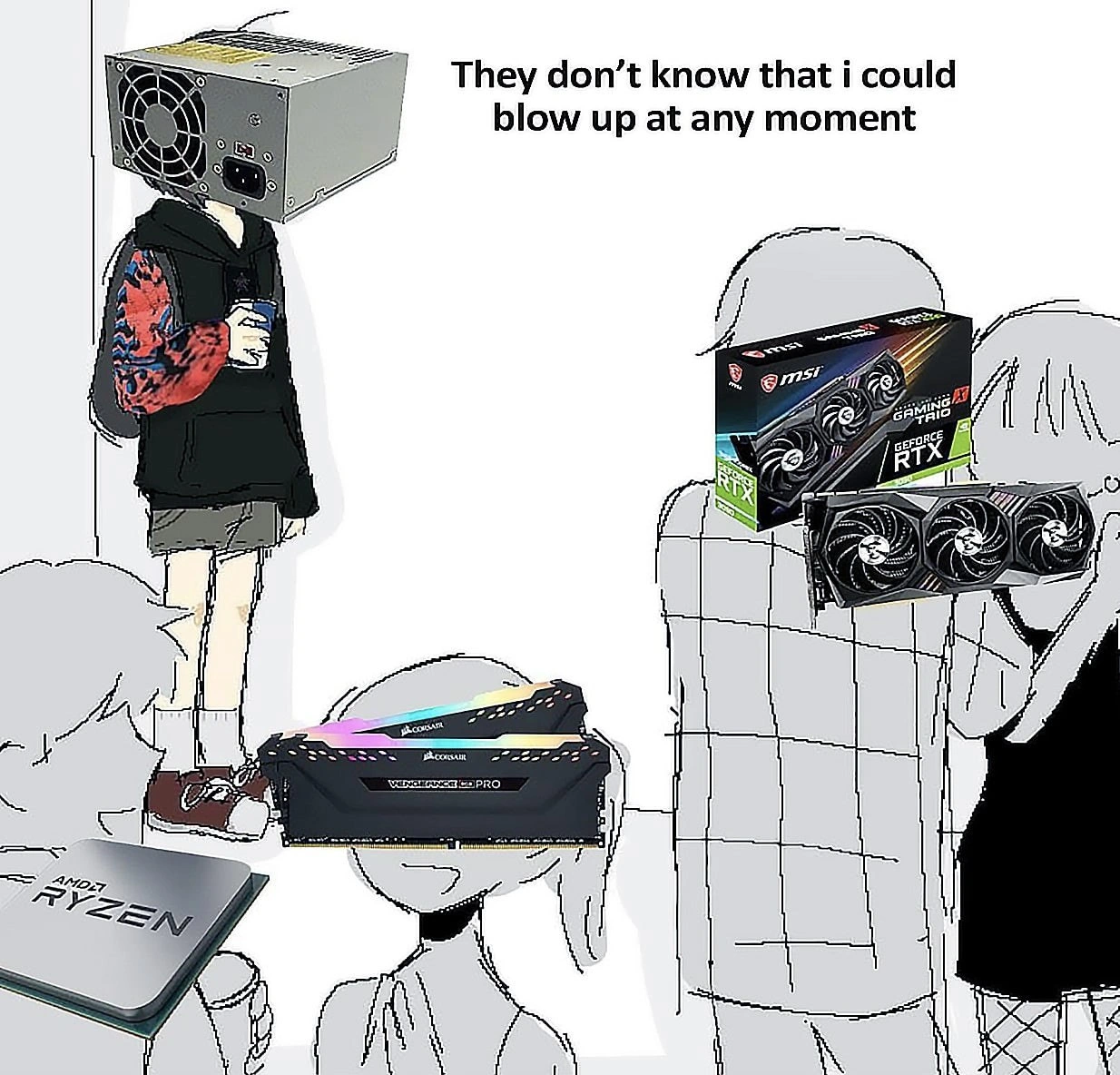
Think of this meme as a little lesson in how a computer is put together. It’s showing a bunch of PC parts as people at a party, with each part playing a role. Here's a quick rundown of the characters in this PC party and what they do:
PSU (Power Supply Unit): This is the box (usually at the bottom of a PC case) that you plug into the wall. Its job is to take the electricity from your wall outlet and convert it into the right form and voltage that the computer's parts need. Every component – the motherboard, GPU, CPU, drives, fans, you name it – gets its power through cables from the PSU. If the PSU fails (especially if it's a cheap, low-quality one), the whole PC loses power instantly. In dramatic cases, a PSU can even make a loud pop or a spark (that’s the “blow up” the meme references) and potentially damage other parts when it dies.
CPU (Central Processing Unit): Represented by the AMD Ryzen chip in the meme, the CPU is the "brain" of the computer. It carries out general-purpose computations and runs your programs. People often talk about how fast their CPU is (in gigahertz) and how many cores it has, because that determines how much it can do at once. It’s a critical component for overall system performance.
GPU (Graphics Processing Unit): Shown as the MSI GeForce RTX graphics card box, the GPU is like a specialized, super-powerful processor just for graphics (and other parallel tasks). Gamers care a lot about the GPU because it’s key for high frame rates and fancy visual effects in games. Modern GPUs – especially those RTX cards – draw a lot of power (often more than the CPU) and run hot, so they have big fans or coolers. The GPU is usually the most expensive part of a gaming rig and often the star of the show for bragging rights.
RAM (Random Access Memory): Depicted as the Corsair Vengeance RGB Pro sticks (the ones with the colorful light strip). RAM is the short-term memory that your PC uses to store data that’s actively being used or processed. Having more RAM or faster RAM means your computer can handle more tasks at once without slowing down. The RAM in the meme has RGB lighting – little LEDs that can glow in all sorts of colors. The lights make the RAM look cool through a clear case window, but they don’t actually make the computer run any faster (they’re just for style).
Now, all these parts (CPU, GPU, RAM, etc.) connect together to make a powerful gaming computer. But they all depend on the PSU for power. The meme is pointing out that the PSU is a single point of failure in this setup – meaning if that one part fails, the entire system shuts down because nothing else has power. It’s like a chain where if one link snaps, the whole chain breaks. The PSU is that one link holding everything together in terms of power supply. So the joke is that the PSU could "blow up" (fail) and instantly end the "party" for all the other parts.
For a newcomer building their first PC, it’s easy to get excited about the flashy, fun parts – the super-fast GPU, the high-end CPU, the glowing RAM – and not pay much attention to the PSU, which is just a plain metal box with cables. Many novices might even buy a cheap PSU to save money, thinking it’s not a big deal. This meme is a humorous reminder that if you neglect the power supply, you do so at your peril. One common real-world lesson is discovering that a budget PSU can cause pc_build_anxiety with random crashes or shut-offs when under heavy load. For example, you might spend hours wondering “Why does my PC reboot whenever I play this game on ultra settings?” only to find out the power_supply_failure (or simply an inadequate PSU) was the culprit. It’s a relatable experience: everything else in your build can be top-notch, but that one overlooked component can bring it all down.
In short, the meme’s message is: all the cool and expensive parts of a computer mean nothing if the unexciting PSU (the power source) isn’t reliable. The PSU is the weakest link if it’s low quality or pushed beyond its limits. So while the other components are enjoying the spotlight, the quiet PSU in the corner knows that without it, the party (the PC) is over in a flash. This is why experienced builders often say don’t skimp on your PSU! It may not be flashy, but it's the backbone that keeps the whole system alive.
Level 3: Single Point of Boom
“They don’t know that i could blow up at any moment”
That ominous caption floats above the head of an anthropomorphic Power Supply Unit (PSU) in this meme’s sketch-style party scene. The PSU is depicted as a quiet figure in a hoodie, holding a soda off to the side. Meanwhile, the other partygoers have heads representing flashy high-end PC components: one is an MSI GeForce RTX GPU (a top-tier graphics card), another is a pair of Corsair RGB DDR4 RAM sticks (memory modules with rainbow LED glow), and another is an AMD Ryzen CPU (a powerful processor chip). These glamorous parts are mingling and basking in attention, as if at a LAN party where everyone brags about their rig. The poor PSU, on the other hand, stands apart with that internal monologue: it’s painfully aware it’s the one part that could take down the whole party in an instant.
The humor (tinged with anxiety) comes from the PSU being a single point of failure that nobody appreciates until it's too late. All those expensive, high-performance parts rely completely on the PSU to feed them stable power. If the PSU fails – especially if it fails spectacularly (hence “blow up at any moment”) – the entire system will go dark no matter how fancy the GPU, CPU, or RAM are. It’s a comedic way to highlight a classic hardware truth: a PC is only as strong as its weakest component. The PSU is often the most overlooked part of a gaming_rig_architecture, yet it carries the literal power to destroy everything if it goes bad. The meme text, “They don’t know that i could blow up at any moment,” is funny because it’s exactly what an underappreciated PSU might think at a party where GPUs and RGB RAM are getting all the compliments.
Seasoned engineers and PC builders find this painfully relatable. It echoes the idea of a Single Point of Failure (SPOF) in any system: that one component whose failure can bring everything else down. In production environments, it's like having a cloud service with 99 microservices but all of them depend on one small, neglected database or a single power circuit – the moment that one thing dies, the whole service crashes. Here, the PSU is that one critical link. You could splurge on a $1500 graphics card and a 16-core CPU, but if you skimped on the PSU, all that investment can turn to smoke (quite literally) if the PSU decides to give up. The hardware_dependency_chain in a PC has the PSU at its root: power flows from it to every other part. So if that chain breaks at the source, nothing else can function.
The meme’s underlying message also carries a whiff of cynical truth learned from hard experience. Many of us who have been on-call for ProductionIssues or who have built our own PCs have a story about a power_supply_failure at the worst possible time. Maybe it was a cheap PSU that went pop in the middle of a gaming marathon, or a single under-provisioned power feed in a data center rack that tripped and took down a cluster of servers. The PSU in the meme is drawn with a kind of knowing slouch, as if it's seen this scenario play out before. It's basically saying, "Everyone is partying now, but I'm the ticking time bomb you all forgot about." That dark, self-aware humor is what makes engineers smirk at this image – it’s funny because it’s true. The fancy RTX GPU box bragging about frame rates and the RGB RAM shining in pride won’t mean much if the quiet PSU decides tonight’s the night to die. In other words, the whole system’s stability is balancing on that one unsung component, and only the PSU itself seems to realize the danger.
In summary, at this deepest level we see the meme mocking the tendency to ignore unglamorous Hardware fundamentals (like a reliable power supply) while obsessing over performance and bling. It’s a slice of EngineeringHumor that draws on real SystemFailures: despite all our careful engineering, sometimes a single $5 part (or a single overlooked risk) can take down an entire $5000 setup. The PSU at the party isn't just being paranoid – experienced folks know it's speaking the truth. And that blend of ominous honesty with an absurd party cartoon is exactly why this meme resonates among techies.
Description
This image uses the 'They Don't Know' meme format to personify personal computer components at a party. A lone figure with a Power Supply Unit (PSU) for a head stands in the corner, thinking, 'They don't know that I could blow up at any moment.' In the foreground, other figures socialize, their heads replaced with more glamorous components: an AMD Ryzen CPU, Corsair Vengeance RGB Pro RAM sticks, and an MSI GeForce RTX graphics card. The visual joke contrasts the flashy, high-performance parts with the utilitarian but critical PSU. The technical humor lies in the well-known wisdom among experienced PC builders that a cheap, low-quality PSU is a catastrophic single point of failure. While the CPU, GPU, and RAM get all the attention, a faulty power supply can indeed 'blow up' (or fail spectacularly), potentially destroying every other expensive component in the system. It speaks to the anxiety of overlooking the foundational elements of a system in favor of more exciting ones

Comments
12Comment deleted
A cheap PSU is the ultimate form of technical debt: you save a few bucks on the initial commit, only to liquidate all your other assets during the first major incident
Datacenter veterans know the feeling: you can design five-nine redundancy everywhere, but let one marginal PSU through procurement and congratulations - you’ve just re-created a campus-wide outage in 2U
The no-name PSU at the party watching everyone else discuss their redundant power supplies and N+1 configurations while knowing it's the single point of failure in three production clusters because "it's just temporary until Q4 budget."
Everyone budgets $1600 for the GPU and $30 for the PSU, then acts surprised when the single point of failure they cheaped out on executes a literal cascading failure
When your PSU is running on 10-year-old capacitors but powering a 450W TDP GPU, you're not doing load balancing - you're playing Russian roulette with your entire build. The real technical debt isn't in your codebase; it's the literal electrical debt your aging power rails are about to default on, taking your NVMe drives and their uncommitted git changes with them
The architecture diagram lists GPU, CPU and RAM, but the $49 80+ Bronze PSU is the unacknowledged SPOF quietly running Chaos Monkey via the 12V rail
That one Kubernetes pod everyone ignores: happily serving traffic until it OOMs the node and takes the whole cluster down in a fireball
We bikeshed microservices while a $39 PSU without OCP acts as our real control plane - one transient spike and it performs a zero‑downtime rollout of magic smoke to every component
Points for honesty tho Comment deleted
Samsung galaxy s7 be like Comment deleted
yea, if it was made from the shit Comment deleted
Every detail's cost +100$, power supply - 10$. Comment deleted