Skip to content
DevMeme
963 of 7435
The Programmer's Golden Rule
LegacySystems Post #1086, on Mar 2, 2020 in TG

The Programmer's Golden Rule

Why is this LegacySystems meme funny?

Level 1: If It Ain't Broke...

Imagine you have a favorite old toy that still works. Let’s say it’s a music box that plays a lullaby, or a remote-controlled car that drives around, even if it makes a funny noise. You ask your dad, “Why does it do that? Should we try to fix it or change it?” And your dad basically says, “Well, it’s working fine, so let’s not mess with it.” In other words, he’s saying we shouldn’t try to change something that’s working, because we might end up breaking it. That’s exactly what’s happening in the meme: the little lion cub (the son) is curious why the sun always rises in the same place, and the dad (who thinks like a programmer) jokes that since it works well, there’s no need to change anything. It’s funny because normally a parent would explain the real reason (like the Earth spinning), but instead this dad treats the sun like a gadget that might stop working if you fiddle with it. It’s a silly way to show that sometimes people are afraid to change things that are going just fine — basically, “if it isn’t broken, don’t try to fix it.”

Level 2: Hardcoded Sunrise

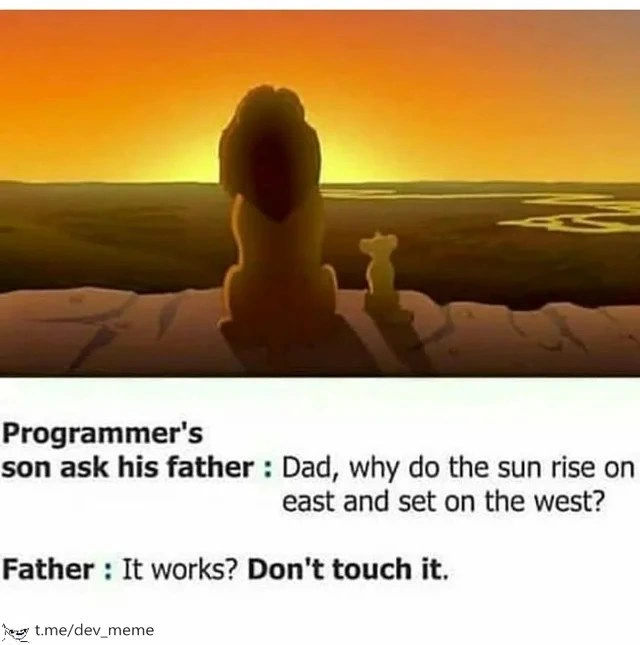
Let’s break down the humor and reference behind this meme in simpler terms. The image shows a father and son lion (evoking the famous scene from The Lion King where Mufasa shows Simba the kingdom at sunrise). In the caption, the son asks: “Dad, why does the sun rise in the east and set in the west?” That’s a normal curious question a child might ask about how the world works. But the dad – who is a programmer – replies, “It works? Don’t touch it.” This answer is unexpected in context; instead of a scientific explanation, he gives a very programmer response.

"If it works, don't touch it" (similar to the saying "If it ain't broke, don't fix it") is a well-known motto in software development. It means that if something is functioning adequately, it’s often best not to change it or tamper with it. In everyday terms: don’t mess with success. This mindset comes from real experience: sometimes, trying to improve or figure out a perfectly working thing can accidentally break it. In software, especially on large projects, a small change in one place can have surprising side effects elsewhere. So developers learn to be cautious. If a program or system (especially a complex, legacy system) is running fine today, tweaking it without a very good reason might cause new bugs, also known as regressions (a regression is when a feature that used to work suddenly stops working after a change).

The meme plays on this by treating the sunrise itself like a piece of software in production. In programming, production (or “prod”) is what we call the live environment where real users are affected – basically the real world usage of a system. A programmer saying “don’t touch it” about the sun implies he sees the world’s sunrise/sunset cycle as a critical production system that nobody should dare modify because it’s already running smoothly. It’s a funny exaggeration, because of course no one can change how the sun rises! But the dad’s mindset is “pretend we could change it – we still shouldn’t, because everything is working fine as is.” This mirrors how developers feel about old, reliable code: just leave it alone!

Why would a programmer be so wary of changing something that works? One big reason is technical debt. Imagine a software project as a house: if you build it in a hurry, you might leave some parts messy or make quick fixes that aren’t ideal in the long term. Those unresolved problems are like taking on “debt” – eventually, someone has to clean them up (pay it off). Technical debt refers to these shortcuts or old code that really should be improved someday. But as that debt grows, the code becomes harder to change without causing issues. Legacy code (old code from earlier versions of the software) often has a lot of these quirky fixes and outdated structures. It might not follow modern best practices, but it mostly works. When a system accumulates years of such changes, developers get nervous about touching it because everything is so fragile. There might not be proper tests (automated checks) to ensure a change is safe. There’s often poor documentation (written explanations of how things work). In short, nobody fully understands all the moving parts anymore.

Because of this, teams adopt a very cautious approach: no refactoring unless absolutely necessary. Refactoring means improving and restructuring the code without changing what it does – like cleaning up messy wiring in a house without altering the functionality. In a clean, ideal world, developers refactor regularly to keep code quality high. But in reality, when you have a critical system that users rely on, the motto "if it works, don’t touch it" often wins out. People fear that a change meant to tidy things up could unintentionally break something important (this is the fear of regression – basically fear of backfiring changes). Maintaining uptime (keeping the system running) takes priority over making the code elegant.

This is a very relatable developer experience. For example, imagine you’re a new programmer joining a project and you see a weird, clunky function handling user logins. It’s written in an old style and doesn’t follow what you learned in school. You ask, “Why don’t we rewrite this? It’s hard to understand.” You might get an answer like, “Well, it’s worked fine for years, and we’re afraid to mess with it. Last time someone tried, logins broke for a day.” 😬 Essentially, the risk of changing it outweighs the pain of leaving it as-is. That old login code is the software equivalent of the sun rising in the east — a longstanding behavior that everyone just accepts. No one wants to be the person who breaks something that everyone else has come to depend on.

The meme’s humor also lies in the father-son dynamic. Normally, a father might encourage his child’s curiosity or give a scientific answer about Earth’s rotation. But here the dad’s answer is comically pragmatic and a bit lazy: “It works, don’t touch it.” It’s as if he’s treating the sun like some legacy program he inherited at work, rather than a natural phenomenon. This reflects a kind of weary, cautious attitude common among veteran developers who have been on the receiving end of outages or bug-fixes gone wrong. They learn (sometimes the hard way) that sometimes it’s smarter to leave well enough alone.

In summary, the dad’s reply packs a lot of developer culture into one line:

  • If it works – meaning the system is currently doing its job (the sun is rising and setting correctly each day),
  • Don’t touch it – meaning avoid unnecessary changes (don’t go poking at that code or trying to alter something fundamental, because you might introduce a serious problem).

This motto is often said half-jokingly in engineering teams dealing with legacy software or shaky systems. It’s a way to cope with the anxiety that any change could bring everything crashing down. The meme exaggerates it by applying it to the sun, which makes us laugh because of the absurdity. Yet, for those in the programming world, it’s a familiar absurdity – we’ve all seen situations where people act like this about a piece of code. It’s funny and a little bit true.

Level 3: The Circle of Tech Debt

This meme recasts the iconic Lion King sunrise scene into a software engineering joke. The father lion (a seasoned senior developer archetype) is essentially delivering battle-hardened programmer wisdom. Instead of explaining why the sun rises in the east and sets in the west, he responds with the ultimate legacy-system mantra: "It works? Don't touch it." To experienced devs, this is both hilarious and painfully relatable. It’s the kind of dark humor you develop after years of wrestling with LegacySystems held together by duct tape and hope. The daily sunrise is treated like a stable production job that's been running flawlessly for ages – a piece of cosmic legacy code. The father's mindset is clear: if a system has been working fine for the last 4.5 billion years, why risk changing it now? This is the voice of accumulated TechnicalDebt speaking, the voice that has been burned by one too many 3 A.M. outages caused by a "simple fix." Here, the sun’s east-to-west journey is a metaphor for any tried-and-true, fragile process in a codebase: it might be weird or unexplained, but it runs, so we leave it alone. The fear of unintended consequences (a dreaded regression bug) looms behind every proposed tweak to such a system. Better to accept the quirky behavior than become the engineer who broke the universe by poking at it.

In coding terms, the father imagines the world has a config file with a line like "sunrise_direction: east". It's a setting that's been working since the beginning of time (the Big Bang commit 😜) and no one has the nerve to change it. A paranoid senior dev would treat it something like this:

# Legacy cosmic configuration
sunrise_direction = "east"
sunset_direction = "west"

# Long-standing workaround: no one remembers why it must be east->west,
# but nobody dares to change these values.
if sunrise_direction == "east" and sunset_direction == "west":
    print("Sun routine stable. Proceed normally.")
else:
    print("Warning: Unexpected sun behavior. Revert changes!")

This tongue-in-cheek code snippet captures the vibe: everything is hardcoded to the known-good values. If anything deviates, alarms go off and we roll back ASAP. The humor here is that treating the sunrise like a software routine isn't far-fetched to a grizzled engineer – we've all seen systems so old and mysterious that we treat their normal operation as almost magical and untouchable. The father’s one-liner is basically saying, “We have a working LegacySoftware system; messing with it could bring the whole thing down, so let’s not.”

Experienced developers nod knowingly at this because we've encountered that exact mentality on projects. Common hallmarks of the "it works, don't touch it" philosophy include:

  • Stale Dependencies: Running on an ancient library or OS version (hello, Python 2 or Java 6) because upgrading is riskier than staying outdated. The app works, so who cares if it's 10 years behind on patches?
  • "Here Be Dragons" Comments: Ominous warnings in code like // DO NOT TOUCH - it finally works or // Here be dragons. These comments essentially scream that this part of the system is held together by prayers. Everyone is afraid to refactor it because it might collapse like Jenga.
  • No Test Coverage: The legacy code has zero automated tests. Changing a single line feels like defusing a bomb blindfolded. Without tests, you won’t know you introduced a bug until it’s live in production (and by then it’s too late). This lack of safety net makes folks extra superstitious about "successful" code – they treat it like a black box shrine.
  • Tribal Knowledge: The system’s quirks are known only through oral tradition. Senior team members might say, “Oh, the job fails if it runs past 2 AM, so we scheduled a restart at 1:59 AM. Don’t ask why.” There’s no official documentation explaining why the sun rises in the east (so to speak); it’s just accepted as an axiom handed down by the elders.
  • Outage Scars: War stories of past attempts to "improve" things that went horribly wrong. e.g. "Remember when Bob tried to tweak the scheduler and the entire service went down for a day?" Those tales become cautionary lore. The last person who altered that one piece of code got burned, so now even the CTO says, "If it ain’t broke, don’t fix it." 🔥

All of this underpins the father’s sardonic advice. It’s a reflection of TechnicalDebt and fear: over years, shortcuts and fragile fixes pile up, until the code is so brittle that even its own creators treat it like a delicate artifact. The safest course is often doing nothing at all. Sure, leaving things as-is might violate every CodeQuality guideline and scream for a cleanup (RefactoringNeeded!), but when you’re the on-call engineer at 3 AM, you prefer a weird system that works over a "clean" system that might crash.

The meme is funny because it exaggerates this professional caution to an absurd level: a dad applying workplace logic to the laws of nature. The child asks a why question born of curiosity, and the dad replies with a weary, pragmatic “It works, don’t touch it.” It’s like Mufasa imparting not the Circle of Life, but the Circle of Tech Debt. 😂 Seasoned developers chuckle because they’ve essentially given or received that exact answer in code reviews or planning meetings. It’s a coping mechanism as much as it is wisdom – a way of saying “I know it’s not ideal, but touching it might open Pandora’s box.” The real punchline is that in software culture, maintaining stability often outweighs understanding the underlying mechanics, which is the opposite of what you’d expect a father to teach his son about the world. In the Kingdom of Legacy Code, stability is king, and curiosity is a dangerous luxury. So the sun continues to rise in the east each day, un-debugged and un-refactored – and everyone is just fine with that. 👍

Description

The meme uses a screengrab from Disney's 'The Lion King,' showing Mufasa and Simba looking over the Pride Lands at sunrise. Below the image is a text-based joke. It starts with 'Programmer's son ask his father: Dad, why do the sun rise on east and set on the west?'. The father's reply is 'Father: It works? Don't touch it.'. This perfectly captures a core tenet of software development, especially when dealing with legacy systems: if a critical piece of functionality is working, you don't question it or try to refactor it for fear of breaking it in unpredictable ways. The joke highlights the pragmatic, risk-averse mindset developers adopt when faced with complex, poorly understood, or fragile code that is somehow, miraculously, still functioning in production
Comments

7
Anonymous ★ Top Pick That's the same logic that keeps a 20-year-old Perl script running in production. No one knows how it works, but everyone knows the company goes bankrupt if it stops
  1. Anonymous ★ Top Pick

    That's the same logic that keeps a 20-year-old Perl script running in production. No one knows how it works, but everyone knows the company goes bankrupt if it stops

  2. Anonymous

    Yes, the sun rising in the east predates version control, but unless your migration plan covers orbital mechanics, tide scheduling, and seven-billion circadian dependencies, it’s staying in prod

  3. Anonymous

    That's the same philosophy that kept our COBOL system running since 1987 - until someone tried to add timezone support and accidentally made the sun rise in Nebraska at 2 PM

  4. Anonymous

    This perfectly captures the existential dread of inheriting a 15-year-old monolithic codebase where the original architects have long since departed, documentation is a myth, and the system processes $10M in transactions daily. Sure, you could refactor that nested ternary operator spaghetti into clean, testable code - but when the last person who touched it triggered a three-day outage, 'it works, don't touch it' becomes less a guideline and more a survival instinct. Sometimes the most senior engineering decision is recognizing that understanding *why* something works is a luxury you can't afford when the alternative is explaining to the CEO why the entire platform is down

  5. Anonymous

    Sunrise is a 13.8B‑year production contract - file an RFC with a multi‑planet canary and rollback plan, otherwise the SRE default is freeze

  6. Anonymous

    Solar system's in prod 4.5B years with zero downtime - refactor at your peril

  7. Anonymous

    Sunrise in the east is the universe’s oldest backwards-compatible API - refactor it and you’ll break tides, calendars, and a billion cron jobs

Use J and K for navigation