A Developer's Pickup Line
Why is this WebDev meme funny?
Level 1: Secure Love Analogy
Imagine you have a secret diary that you want to keep safe. Writing in plain pencil might let anyone read it if they get a hold of the pages. But if you write it in a special secret code, only someone with the key to that code can understand it. In this meme, being “HTTPS” is like being that special secret-coding ability (the thing that keeps information safe). And being just “://” by itself is like having a diary with no lock or code at all – completely unprotected and kind of pointless because anyone could peek.
Now think of a cute way to tell a friend “I need you to be complete.” The meme does this by saying: “Are you HTTPS? Because without you I’m just ://.” That’s a silly way of saying “You’re the important part that makes me whole and safe!” It’s like saying to someone: “Are you the lock for my door? Because without you, I’m wide open.” In other words, the person (or the “S”) is what makes everything secure and meaningful.
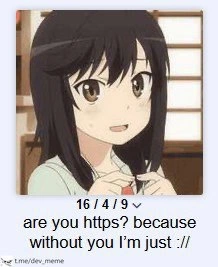
The joke mixes a lovey-dovey feeling with a computer idea. The girl in the picture looks a little shy and happy, as if she’s giving a sweet compliment. People who make computer jokes often use funny cartoon or anime characters to make the joke feel extra playful. You don’t have to know the anime — it just looks cute, which makes the nerdy joke more fun.
So why is it funny? Because it’s taking a very technical thing (the difference between “http://” and “https://” in a web link) and turning it into a charming one-liner. It’s basically saying “With you, I’m secure; without you, I’m incomplete.” Even if you don’t get all the computer details, you can smile at the idea that a single letter “S” (or a special someone) makes a world of difference. It’s a geeky way of saying “you complete me”, using the language of the internet.
Level 2: Web Protocol 101
Let’s break down the technical terms and joke for a newer developer (or anyone curious). First up: HTTP stands for HyperText Transfer Protocol. It’s the basic way web browsers and web servers communicate. For example, when you type a website address and hit enter, your browser uses HTTP to ask the server for the page content. However, HTTP by itself is not encrypted – meaning the information goes over the internet in plain form, which others could read if they intercept it. That’s where HTTPS comes in. HTTPS is just HTTP with a layer of encryption (via something called TLS, Transport Layer Security). The easy way to remember it: HTTPS = HTTP + S(ecurity). With HTTPS, the data is encrypted, so if someone snoops on your connection, all they see is gibberish instead of actual passwords or messages. Modern browsers show a little padlock icon for HTTPS sites to indicate they’re secure.
Now, what’s with the weird :// in the meme text? In any web address like https://devmeme.com, the part before the :// (http or https) is known as the scheme or protocol. The :// is just a fixed separator that comes after the scheme. It’s literally pronounced “colon slash slash”. On its own, :// isn’t valid; it needs something in front (like http or ftp or another protocol name). So if someone writes just ://, it’s like an unfinished thought — the computer doesn’t know what to do because the protocol is missing. It would be as if you wrote an email address @gmail.com without a name before the @. That’s incomplete.
The meme’s text says: “Are you https? because without you I’m just ://”. This is formatted like a pick-up line, a fun, cheesy way to compliment someone. You might have heard other joke pick-up lines like “Are you Google? Because you have everything I’m searching for.” Here, they replaced the usual romantic subject with a tech twist: asking “Are you HTTPS?”. The reason it’s funny: if “you” are HTTPS, then with you, I (the speaker) become https://. Without you, I’m just ://. In other words, you make me complete. It’s a nerdy way to say "I need you." Also, note the double meaning: without HTTPS, a website is insecure – so “without you I’m just ://” can imply “without you I’m insecure.”
Let’s identify the parts:
- “HTTPS” – the secure version of the web protocol (adds encryption).
- “://” – part of a URL that’s normally preceded by the protocol name. By itself, it’s nothing useful. It’s like having a path separator with no path defined.
- So, “HTTPS” is essentially the missing piece that should go before
://. When it’s there, you get a full URL likehttps://.... When it’s not, you’re left hanging with an incomplete://.
The image uses an anime-style girl who is blushing and clasping her hands. In meme culture, especially among programmers, it’s become common to use anime characters to convey exaggerated emotions or just for quirky contrast. Here the girl’s expression is shy/adoring, fitting the flirty nature of the line. It’s like she’s playfully saying this pun to someone she likes. The combination of anime reference and a programming joke makes it especially appealing to folks in developer communities who enjoy both. The watermark t.me/dev_meme suggests this image came from a developer meme channel, where mixing coding and cartoons is all fair game.
For a junior dev, the takeaways are:
- HTTP vs HTTPS: Know that HTTPS is the secure version and always preferred. It’s what locks the connection.
- Why “://”: It’s just part of URL syntax. If you only see
://by itself, something’s missing (the protocol name). - The joke format: It’s a pun and a compliment rolled into one. It shows how tech lingo can be used humorously, even in something as non-technical as a pick-up line.
In simpler terms, the meme is saying: “You’re the special ‘S’ that makes my world (or website) safe and whole.” And it does so with a dash of cute anime flair, because why not? That’s the charm of tech humor – it finds connections between our work (like web protocols) and everyday life (like flirting), resulting in a good-natured, only-developers-will-get-this kind of joke.
Level 3: You Complete Me
At a more practical level, this meme plays on a scenario every seasoned web developer knows: the crucial importance of that “S” in HTTPS. In day-to-day WebDev, we treat HTTPS as non-negotiable — without it, a website is insecure. The joke is formatted as a cheesy pick-up line: “Are you HTTPS? Because without you I’m just ://”. It’s saying “You make me whole and secure” in geek-speak. The humor lands because developers instantly get the double meaning: without you (the “S”), HTTP is not just incomplete textually, it’s also not secure. The letter “S” literally upgrades HTTP to HTTPS, transforming a barebones connection into a safe, encrypted one. In romance terms, you complete me; in tech terms, you encrypt me.
Think about the :// for a moment. We see it in every URL, but it has no life of its own. It needs a prefix (like http or https) to mean anything. The meme cleverly personifies that idea: the poor :// feels lonely and purposeless without “HTTPS” in front of it. It’s like a wink to developers: remember that feeling when you forgot to add https:// in a link and it just showed up as plain text? We’ve all been there, maybe writing Markdown or HTML and realizing the link doesn’t work because we left out the scheme. Relatable? Absolutely. This is RelatableHumor for anyone who’s configured a website or dealt with the hassle of obtaining SSL/TLS certificates. Perhaps you can even recall a time before Let’s Encrypt, when setting up HTTPS meant paying for a certificate and wrestling with web server settings. Seeing an anime character deliver this line also pokes fun at developer culture — many devs enjoy anime, and it’s a running gag to use a wholesome-looking anime girl saying something extremely geeky. That contrast between cute and technical amplifies the silliness.
Security-wise, experienced devs chuckle because they know the web moved from “optional HTTPS” to “HTTP? Are you crazy?” pretty fast. Around the time this meme was posted, browsers like Chrome had started outright labeling HTTP pages as “Not Secure” with scary red warnings. It was the final nudge for everyone to adopt HTTPS everywhere. So the meme also taps into that recent industry push: without HTTPS, you’re not just incomplete, you’re flagged as dangerous. In a way, the line “without you I’m just ://” hints: without security, an address is naked punctuation — not something you’d trust.
From a DeveloperHumor perspective, this one-liner is gold because it mixes a TechHumor reference (URL schemes and TLS) with a classic WordplayPun format. It’s the same formula as saying, “Are you a framework? Because I can’t function without you,” but here it’s tailored to a very specific tech concept. The anime meme format (blushing girl + text caption) is commonly used in online dev communities to package these jokes. It’s partly tongue-in-cheek: combining something as dry as a URI scheme with the over-the-top earnest emotion shown in anime style. The rating line "16 / 4 / 9 ⌄" at the top looks like part of the meme template or an inside joke (perhaps mimicking a user rating or an anime reference rating like age/genre scores). It isn’t essential to the pun, but it adds to the parody — as if this pick-up line is being “rated”.
In short, the senior dev perspective sees this and nods knowingly. It’s highlighting an essential truth (HTTPS is vital) in a playful way. We laugh because we’ve lived through the “HTTP vs HTTPS” transition pains, and we also enjoy a good mix of pop culture with our programming. The meme is saying that in the web world, just like in relationships, adding the right secure connection can turn something flimsy into something reliable. And of course, it’s a much cuter way to remind us of TLS than reading an RFC or a security bulletin!
Level 4: Cryptographic Courtship
At the deepest technical level, this meme flirts with the fundamentals of web encryption. When the character asks "Are you HTTPS?", she’s really alluding to Transport Layer Security (TLS) — the cryptographic protocol that gives HTTPS its secure powers. Under the hood of that little “s”, there’s a flurry of asymmetric cryptography and handshakes happening. Here’s how it works: when your browser connects via HTTPS, it performs a TLS handshake with the server. This involves exchanging public keys, verifying digital certificates (issued by trusted Certificate Authorities), and agreeing on a session key. All this complexity happens in milliseconds to ensure that any data you send (like passwords or personal info) is encrypted and safe from eavesdroppers.
Without TLS, plain HTTP is like a public conversation – anyone lurking on the network can hear every word. With HTTPS, that conversation is spoken in a secret code (thanks to encryption), so only the intended recipient can understand it. In technical terms, HTTP operates over TCP port 80 in plain text, whereas HTTPS typically operates over TCP port 443, wrapping the HTTP messages in a TLS layer. The difference is night-and-day for security: one is cleartext, the other is an encrypted tunnel.
To appreciate the joke’s depth, remember that :// is part of a URL’s scheme (or protocol indicator). It’s a divider that says “the following is the address using this protocol.” The origin of this :// goes back to the earliest design of URLs by Tim Berners-Lee. (Fun fact: he admitted the double slash was “unnecessary” but we’re stuck with it now!) In a URL like https://devmeme.com, https: is the scheme and // announces the upcoming web address. But :// by itself is like an open bracket with nothing before it – a dangling symbol awaiting a protocol. In the context of the meme, being “just ://” humorously implies being a URL with no scheme, essentially nothing useful or secure.
So on this advanced level, the meme is a tongue-in-cheek homage to how crucial that little “s” is. It’s the difference between HTTP (which offers no protection) and HTTPS (which provides confidentiality, integrity, and authenticity via TLS). The pickup line’s subtext is that the security layer (the “s”) is what makes the whole link meaningful. It’s like saying without strong cryptography, our connection means nothing! This is nerdy WebSecurity humor at its finest — blending the romance of protocols with the rigors of encryption. We’re essentially witnessing a cryptographic courtship, where the presence of a secure protocol turns a hollow, insecure link into a trustworthy connection.
// Using HTTP (insecure): Anyone watching the network can read this request
GET /private/messages HTTP/1.1
Host: insecure.example.com
// Using HTTPS (secure): Eavesdroppers see only encrypted gibberish
�������>�x�&�(���a�H���
Description
An image of a female anime character with black hair looking slightly concerned or inquisitive. Below the image, there is a text-based pickup line that reads: 'are you https? because without you I'm just ://'. The numbers '16 / 4 / 9' are also visible above the text. The humor is a classic tech pun that plays on the structure of a URL. The 's' in 'https' stands for 'secure,' but here it's used to represent a significant other. The remaining part of a URL prefix, '://', is cleverly repurposed to look like a sad or empty emoticon face, implying that the speaker is incomplete or insecure without the person they are addressing. It's a nerdy but endearing joke common in developer communities
Comments
7Comment deleted
Is your name Wi-Fi? Because I'm feeling a connection, and I'd like to attempt a three-way handshake
Asking “are you HTTPS?” is cute until she replies, “Sure - just deprecate TLS 1.0, enable HSTS, and pin my cert,” and suddenly you’re negotiating a relationship upgrade in production
After 20 years in tech, I've seen developers treat SSL certificates like relationships - they only care when they expire, cost too much to renew, and everyone panics when the chain of trust breaks down at 3 AM on a Saturday
This meme perfectly captures the existential dread of being downgraded to plaintext - because in production, being 'just HTTP' means you're broadcasting your secrets to every coffee shop router between here and the origin server, and no amount of anime protagonist determination can save you from that MITM attack
Our secure-by-default plan lasted until certbot skipped renewal on the ingress - then the whole mesh remembered it’s just ://
My love life uses HSTS and cert pinning - once we go HTTPS, any attempt to drop back to :// is a hard fail and triggers an incident
HTTPS pickup lines: the rare upgrade where latency spikes but you avoid getting your heart MITM'd