Skip to content
DevMeme
1222 of 7435
A Little Chaos Engineering for Your Competitors
WebDev Post #1361, on Apr 22, 2020 in TG

A Little Chaos Engineering for Your Competitors

Why is this WebDev meme funny?

Level 1: Ghostly Browser Prank

Imagine you have a very old toy that everyone is afraid of because it’s always breaking. Let’s say it’s a really old, clunky robot that barely works. All the kids have the new robots now, and nobody plays with the old one anymore. But one day, for a prank, you wind up that old broken robot and send it sneaking into your friend’s room. When your friend sees signs of that old robot — maybe hears its creaky sound — they get scared and start checking all their new toys to make sure they still work with old robot rules. In reality, nobody uses that old robot to play anymore, but just thinking it’s back makes your friend worried.

In this meme’s case, the old robot is an ancient web browser (IE6) that almost no one uses now. The prank is like sending a fake ghost visit to a rival’s website using that old browser. It won’t really hurt anything, but it will spook them into double-checking their site, kind of like making them think the monster under the bed is real again, just to keep them alert. It’s funny because it’s a harmless trick that plays on a big fear developers have — having to deal with that super old, problematic browser one more time.

Level 2: Compatibility Jitters

Let’s break down the key concepts for those newer to the web dev scene. First off, Internet Explorer 6 (often just called IE6) was a web browser released by Microsoft in 2001. It’s practically ancient history in tech years. Modern developers know Chrome, Firefox, maybe IE11 or Edge — so imagine a browser so old it doesn’t understand many modern web features. Supporting IE6 was the bane of every front-end developer’s life in the 2000s and early 2010s. It had tons of browser quirks: different interpretation of CSS rules, a completely broken understanding of the CSS box model, no support for fancy newer HTML/CSS, and even trouble with transparent PNG images. Because of these quirks, developers often had to write special code just for IE6, ensuring websites didn’t look broken on it. This is what we mean by legacy_browser support: making sure even very old browsers can still display your site correctly. Not fun!

Now, what does it mean to ping a website using an IE6 VM? Here “ping” isn’t literally the ping network command, but more like “send a visit to their site.” A VM (Virtual Machine) is a program that simulates a whole computer. Developers often use VMs to run old operating systems. For example, one could set up a VM with Windows XP and launch the real Internet Explorer 6 inside it. Why? For testing how a website looks and behaves on that old setup — or in this mischievous case, to visit someone’s site from IE6 on purpose. When you do that, the target site’s analytics and logs will record a visit from IE6. Specifically, web servers record something called a user-agent string for each request, which is basically the browser’s ID card. IE6’s user-agent string is a dead giveaway of its identity (something like "Mozilla/4.0 (compatible; MSIE 6.0; Windows NT 5.1)"). Developers on the receiving end, seeing that string pop up in their logs, might gasp: “Whoa, someone out there is using IE6 on our site!” That’s extremely rare now, so it stands out like a red flag.

Why would that cause panic? Because of browser compatibility. Web developers strive to ensure their sites work on all common browsers, but IE6 is so old and different that many modern sites just break or display incorrectly on it. Officially, hardly anyone supports IE6 anymore — it’s been long considered deprecated. But if even one real user (especially a big potential customer) was on IE6 and your site failed for them, it could be an issue. Some companies historically had policies like “if any user reports an issue, we fix it,” or they might worry it’s a sign that some clients (like old corporate networks) still rely on IE6. So a single IE6 visit can trigger meetings or at least a dev tasked with checking, “Are we unintentionally locking out someone on an old browser?” It’s like seeing a canary in a coal mine.

This meme is classic FrontendHumor: it takes a real concern (browser support) and suggests a sneaky way to exploit it. The categories WebDev and Frontend are spot on: it’s addressing web developers, especially those who deal with client-side stuff like HTML, CSS, and JavaScript. They know the term BrowserCompatibility means making the site work across Chrome, Firefox, Safari, Edge…and in nightmares, IE6. The tags like legacy_browser and browser_compat_testing refer to that tedious task of testing on old browsers. In fact, large teams often had a ritual: whenever you changed CSS/JS, you had to test the page in IE6 (often using a special old computer or VM) to ensure you didn’t break anything for the fraction of users stuck on it. By 2020, that ritual was mostly gone, and everyone was relieved.

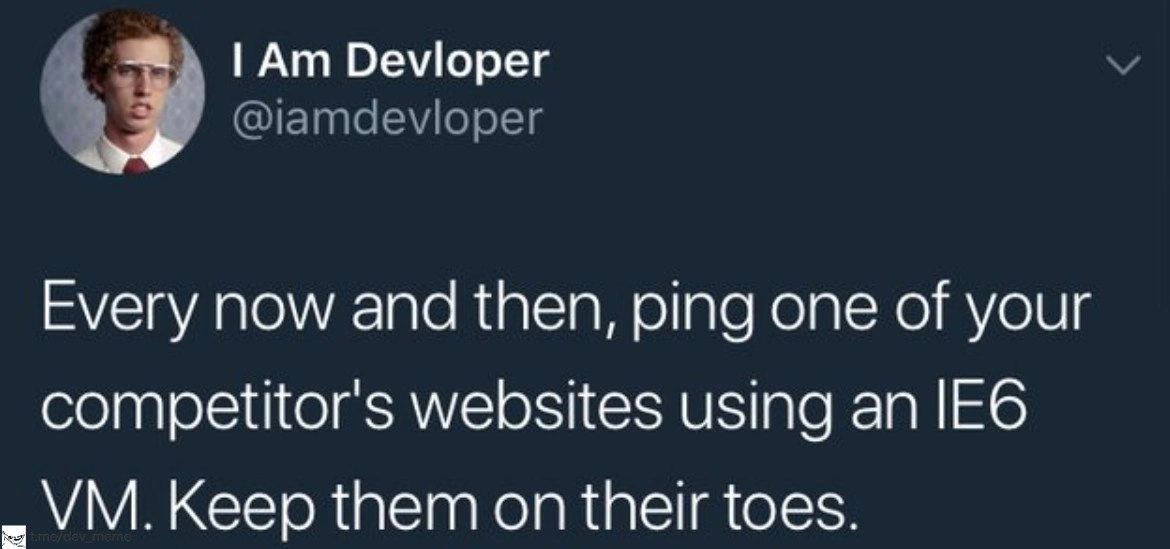
So, when someone says “Every now and then, ping one of your competitor's websites using an IE6 VM,” they’re basically saying: “Pretend to be a user with this crusty old browser and visit their site.” It’s implied as a joke: doing so will spook your competitors. They’ll be forced to wonder if they need to dust off their old compatibility code. Maybe they had dropped support for IE6 thinking nobody uses it — and now they might question that decision. It’s a harmless prank (you’re not hacking anything, just visiting a public website) but it causes a little chaos on the other side.

This relies on a bit of user_agent_spoofing or usage, because IE6’s user agent string is the crucial part. Fun fact: you wouldn’t even need a full VM; some geeks could just use a tool like curl or a browser extension to send a fake IE6 user-agent. But using a real IE6 VM is a flex — it’s committing to the bit. It also ensures the site actually loads as IE6 would load it, possibly generating real error logs on their side if something fails. That’s even scarier for them: error tracking systems might suddenly report “JavaScript undefined on IE6” exceptions, and imagine the developers seeing that and going, “Wait, what? We haven’t thought about those in years!”

In summary, this meme capitalizes on the fear of legacy support that still lurks in many dev teams. If you’re a junior dev who’s never had to worry about anything older than, say, IE11 or maybe just evergreen browsers, you should know that back in the day, supporting IE6 was such a headache that it’s become an inside joke. The mere idea of having to re-support it sends shivers down seasoned devs’ spines. So the tweet suggests giving your rivals a little scare by making them believe the IE6 ghost is visiting them. It’s tongue-in-cheek, and it’s funny because we all know how overboard we might react if an IE6 user showed up out of nowhere.

Level 3: The IE6 Ghost Ping

At the highest level, this meme pokes fun at browser compatibility paranoia among seasoned web developers. It's referencing a crafty tactic: using an Internet Explorer 6 (IE6) environment to ping a competitor's website, thereby leaving behind an ancient browser signature in their analytics or server logs. Why is that diabolical? Because IE6 is the boogeyman of web development — an outdated browser so infamous for its quirks and nonstandard behavior that just a whiff of its presence can send any front-end team into a cold sweat. By deliberately hitting a competitor’s site with an IE6 user-agent string, you trigger their alarm bells for legacy browser support.

Think about the layers of humor here: the trollish brilliance lies in exploiting how modern web infrastructure still logs the User-Agent (a little identifier that browsers send, telling websites “Hey, I’m Chrome” or “I’m Firefox” — or in this case “I’m IE6, surprise!”). Most teams run tools that aggregate visitor browsers. Spotting an unexpected blip from IE6 (a browser released in 2001!) is like seeing a ghost in the machine. It’s the phantom of an era when document.all and tags roamed the earth. In companies where managers nervously track every browser compatibility metric, even a single hit from IE6 might kick off frantic meetings: “Did we accidentally break something for old browsers? Are we losing users on ancient systems?”

The underlying technical joke is that devs have long moved on from supporting IE6 — or so they hope. By 2020, IE6 usage was practically zero, banished to the same dustbin as dial-up modems. Yet the trauma lingers. Many of us veteran developers still remember the dark times of writing special CSS hacks and conditional comments to please IE6’s quirky rendering engine (Trident). We carry scars from debugging why a page looked like abstract art on IE6 at 3 AM. Here’s a taste of those days, in code form:

<!-- Only loaded for Internet Explorer 6, to fix its broken box model, etc. -->
<!--[if IE 6]>
<link rel="stylesheet" href="ie6-fixes.css" type="text/css" />
<![endif]-->

The meme’s suggested prank exploits that collective PTSD. It’s essentially front-end psychological warfare. The competitor’s devs, seeing an IE6 appear out of nowhere, might dig out an old VM (Virtual Machine) with Windows XP to test their site, or at least spend a few unhappy hours combing through code to ensure display: flex hasn’t quietly exploded on IE6. It satirizes the lengths engineers go to maintain backward compatibility: supporting legacy browsers is a notorious pain point in web development, often mandated by some enterprise clients or government agencies long after the rest of the world modernized. This tweet gleefully twists that knife. After all, nothing says “I’ve been through the browser wars” like knowing exactly how to weaponize IE6 in 2020. It’s a cynical in-joke about the anxiety that even a single obscure analytics event can inflict on a team. The brilliance is how low-tech the sabotage is: you’re not hacking anything, you’re just knocking on their door dressed as a zombie browser, then watching from afar as they scramble for the holy water of polyfills and fallback code.

Description

A screenshot of a tweet from the popular developer humor account 'I Am Devloper' (@iamdevloper), which uses a profile picture of the character Napoleon Dynamite. The tweet is displayed in white text on a dark blue background. The text reads: 'Every now and then, ping one of your competitor's websites using an IE6 VM. Keep them on their toes.' A small, faint watermark for 't.me/dev_meme' is visible in the bottom-left corner. The joke targets the shared trauma among experienced web developers who had to support Internet Explorer 6, a notoriously buggy and non-standards-compliant browser from 2001. Accessing a modern website with IE6 would almost certainly trigger numerous JavaScript errors and rendering failures. This would pollute the competitor's monitoring and logging systems with phantom issues, potentially causing their on-call engineers to waste time investigating problems that no real user is experiencing. It's a form of mischievous, passive-aggressive sabotage that only a developer would appreciate
Comments

7
Anonymous ★ Top Pick Sending IE6 traffic to a competitor is the SRE equivalent of a denial-of-service attack on their alert fatigue
  1. Anonymous ★ Top Pick

    Sending IE6 traffic to a competitor is the SRE equivalent of a denial-of-service attack on their alert fatigue

  2. Anonymous

    Nothing nukes a React-18 roadmap like a lone “MSIE 6.0” hit in the logs - next sprint everyone’s Googling hasLayout quirks and hunting for an XP ISO

  3. Anonymous

    The real competitive advantage isn't your tech stack - it's knowing your competitor still has that one developer who insists "it works fine in IE6 on my machine" keeping their entire CI/CD pipeline hostage

  4. Anonymous

    The beauty of this strategy is that it weaponizes technical debt: every IE6 request triggers their monitoring alerts, forces their support team to investigate 'why users are still on IE6,' and potentially exposes CSS layout bugs they thought were long buried. It's the digital equivalent of sending a fax to a startup - technically valid traffic, but guaranteed to cause existential dread in their engineering standup

  5. Anonymous

    One IE6 hit in their analytics and suddenly they’ve got a tiger team, a blown error budget, and a Q3 roadmap called “polyfills and prayers.”

  6. Anonymous

    IE6 is the original frontend Chaos Monkey - one UA string and it’s Quirks Mode, hasLayout, and a 3am sev‑1 about why CSP ‘broke’ for 0.01% of traffic

  7. Anonymous

    L6 VM ping: The $0.50 trick that makes their SREs question every anomaly in Prometheus

Use J and K for navigation