Adversarial T-Shirt vs. License Plate Recognition System
Why is this AI ML meme funny?
Level 1: Tricking the Camera
Imagine you have a robot friend who’s really good at one job: reading car license plates and remembering them. This robot watches a parking garage and whenever a car goes by, it reads the license number, like “ABC 123”. Now, picture a playful prank: you wear a shirt covered in random license plate numbers. When you walk in front of the robot, it gets totally confused. It starts reading the numbers on your shirt and thinks there are lots of cars around, even though it’s just you standing there. It’s as if the robot is seeing things that aren’t real because you tricked its eyes.
This is funny because it’s a bit like playing hide-and-seek with a very literal-minded machine. The camera is supposed to find cars, but you fooled it by giving it too many fake signals. It’s the same feeling as if a security guard was told to write down every car’s plate number, and you walked past him wearing a big sign that has a bunch of fake plate numbers – he’d start writing them down and totally miss what’s actually happening. In simple terms, the computer fell for a prank. A normally serious high-tech camera got outsmarted by something as simple as a T-shirt. The joke highlights that even smart computers can make silly mistakes because they don’t really understand; they just react to patterns. So the guy in the picture found a clever way to hide from the robot eye – not by disappearing, but by confusing the camera with a bunch of nonsense. It’s a bit of tech mischief that makes us smile, because it shows that sometimes a little creativity can outsmart a big fancy machine.
Level 2: Computer Vision Confusion
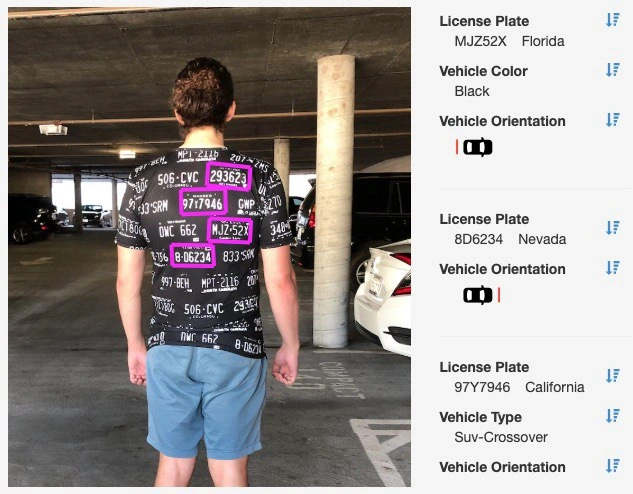
So what’s actually happening in this picture? We have a camera system that’s supposed to read car license plates automatically. These systems, often called ALPR (Automatic License Plate Recognition), are basically specialized cameras with software that spots a license plate on a car and then reads the numbers and letters on it. They use machine learning and pattern-matching to do this — kind of like how your phone’s camera might recognize faces or text. Now, the funny part is the guy’s black T-shirt. It’s covered in white text strings that look like license plates (random combos of numbers and letters, some with formats like “ABC-123”). The computer vision algorithm doesn’t actually understand what a car or a person is; it just sees patterns of pixels. So when it scans the scene, it finds those license-like patterns on the shirt and goes “Aha! I found a plate!” not just once, but multiple times. It’s a classic false positive bonanza — the system is detecting things that aren’t real targets.
Think of the ALPR’s software as an extremely diligent but slightly clueless robot security guard. It was trained on tons of car images and learned “when you see a white rectangular cluster of characters, that’s a license plate.” Here, our prankster’s shirt is basically impersonating multiple license plates. The poor system gets confused. On the right side of the image, you can see the software’s output panel confidently listing plates and even details like state (Florida, Nevada, California) and vehicle info for each “plate” it thinks it sees. Of course, there are actually real cars in the background, but the algorithm latched onto the shirt’s high-contrast text instead, likely because it was closer to the camera and clearer to read. This is an AI humor moment because the computer is behaving in a silly way from a human perspective – it’s essentially reading the guy’s shirt as if he were three different cars!
Let’s break down a few terms here. Adversarial attack in AI means someone intentionally messing with the input to fool the model. In this case the input is the camera image, and the attack is the T-shirt designed to inject confusing data (fake plate numbers). Image processing algorithms are the programs that analyze images – here one algorithm finds regions that might be plates, and another reads the characters. An edge case (or ai_edge_case) is a situation that’s unusual or outside what the system normally handles. A man wearing a bunch of license numbers is definitely an edge case for a license plate detector! Machine learning limitations are on display because the system isn’t doing any common-sense reasoning; it was never taught “If you find five license plates all clumped together on a person-shaped thing, maybe something’s off.” Regular software with explicit rules might have had a rule like “license plates are usually attached to cars, not people,” but machine learning models often just learn from examples and don’t have explicit rules, so they can be brittle (easily broken by weird inputs).
This ties into security and privacy concerns too. Why would someone do this? Possibly to avoid being tracked. If a surveillance camera is trying to follow cars by their plates, a person walking around with a shirt like this could throw a wrench in the system. The camera database might fill up with nonsense plate reads, making it harder to know which reads are real. It’s a form of peaceful protest or privacy hack: no illegal activity, just confusing the automated eye that’s watching. It’s like shining a bunch of flashlights at a security camera – not damaging it, but making its job harder. In tech terms, this is automation gone wrong: the automation (the ALPR) is doing something it wasn’t meant to do, because it was fooled by a simple trick. For a junior developer or someone new to AI, it’s a neat illustration that “smart” systems can have dumb blind spots. It also emphasizes why testing with unusual scenarios is important. After all, if your program is used in the real world, someone will inevitably try weird stuff either on purpose or by accident. This meme is a lighthearted example of that lesson: even a fancy AI can be tripped up by a creative input it didn’t expect.
Level 3: T-Shirt Zero-Day
Seasoned engineers can practically hear the facepalms at ALPR HQ. This meme highlights the classic cat-and-mouse dynamic between clever users and over-trusted automation. In practice, an ALPR system is expected to monitor parking lots or roads, automatically logging license plates. But here comes a guy in a parking garage wearing an “exploit” on his back — an adversarial T-shirt — and suddenly the system is hallucinating ghost cars. It’s issuing plate reads for Florida, Nevada, and California all from one dude’s outfit. This is a physical-world hack that feels like a security zero-day: the system’s designers never anticipated a wardrobe-based attack vector, so there was no defense. It’s both hilarious and eye-opening to see a high-tech surveillance tool get punked by streetwear.
Why is it funny to those of us in the trenches of AI and security? Because we’ve seen automation gone wrong in the most ridiculous ways whenever an edge case wasn’t accounted for. The ALPR likely performs great on normal data (real cars, real plates), boasting high accuracy. But it has a context blindness: it will cheerfully read license numbers off anything that looks plate-ish. As senior devs, we chuckle because we know that feeling: the program is doing exactly what it was told, and that’s the problem. The machine learning model was told “find text that resembles a plate” and never told “by the way, make sure it’s on a car”. So of course it dutifully reports a false positive detection – or three – when confronted with this novel situation. The meme underscores how AI limitations can bite you in production. We’ve learned (sometimes the hard way) that real-world users or protesters will find those one-in-a-million corner cases your QA team didn’t cover. It’s a modern twist on “SQL injection”, but instead of malicious SQL in a text field, it’s malicious visual data in the camera’s view. Think of it as optical injection: the shirt injects junk data (fake license numbers) into the surveillance system’s input stream, and the poor AI falls for it completely.
This scenario also resonates as a privacy hack. In an age of ubiquitous surveillance, a savvy individual can fight back with fashion. Seasoned security folks might recall similar tricks: reflectors or IR LEDs on hats to blind traffic cameras, or license plates that read “NULL” causing database confusion. Here, the T-shirt floods the system with garbage plates, potentially burying the wearer’s own license or identity in noise. It’s a peaceful protest tool—no need to break anything or hack the code, just exploit the system’s pattern-matching obsession against itself. The sheer low-tech elegance of it is beautiful. As engineers, we’re half amused, half cringing: amused because it’s a clever reminder that machine learning isn’t magic—it can be gullible; cringing because if this were our system in production, we’d be scrambling for a patch or hotfix. Cue the Jira ticket: “Model misidentifies apparel as license plates – severity: Major.”
The perennial tension here is one every senior dev knows: users vs. system, edge-case vs. assumption. It’s a guarantee that if you boast “our detection is 99% accurate!”, someone will find the 1% scenario (like a license-print shirt) that flips your assumptions upside down. We know fixing it isn’t trivial either. You might tighten the detection algorithm to ignore plates not at typical car locations or sizes, but then what about motorcycles or people carrying plates? Every fix can introduce new false negatives. One can almost imagine the scramble: “Alright team, how do we teach the AI to differentiate a shirt from a sedan?” Possibly add a secondary check: is the “plate” attached to an actual vehicle-shaped object? Incorporate a person-detector to downweight plates seen on humanoid figures? These are non-trivial updates, and until then, this T-shirt is essentially a zero-day exploit in the wild.
From an industry standpoint, this meme pokes fun at our current AI robustness gap. It’s a reminder of how brittle some deep learning systems can be: they excel in the lab or typical scenarios but stumble in the face of ai_edge_case inputs. Seasoned devs will also note the irony: fancy AI-powered surveillance being foiled by a DIY fashion statement. It’s the classic story of high-tech measures and low-tech countermeasures. We’ve seen it with spam filters and spammers, DRM and pirates, now computer vision and adversarial clothing. The arms race continues. And let’s be honest, part of us is rooting for the human in the hoodie over Big Brother’s all-seeing eye. As the meme’s post message quips, this shirt is a “stylish tool for peaceful protest against state human tracking.” In other words, the engineers built an AI to watch everyone, and someone found a way to make the AI watch his shirt instead. That’s poetic tech justice and prime meme material.
Level 4: Camouflaged in Plain Sight
In the realm of adversarial machine learning, this T-shirt is essentially a piece of neural camouflage. It exploits how an ALPR (Automatic License Plate Recognition) system's computer vision pipeline works at a fundamental level. Typically, an ALPR system uses a combination of object detection and OCR (Optical Character Recognition) to spot and read license plates in an image. The model has been trained on thousands of images of real license plates affixed to cars, learning the visual patterns (like rectangular shapes with high-contrast alphanumeric text) that signal “this is a license plate.” But those learned feature representations can be weaponized against the model. By wearing a shirt plastered with patterns resembling license plate numbers, the man in the photo introduces a form of adversarial input: a carefully crafted physical pattern that the AI mistakenly interprets as multiple legitimate plates.
Deep neural networks operate in a high-dimensional pixel space where they latch onto statistical cues; here, the convolutional filters in the ALPR’s vision model are firing off on the shirt’s text patches. To the model’s convolutional layers, a cluster of white characters on a dark background looks like a license plate region because it hits all the right triggers in the network’s learned weights. The system doesn’t truly “understand” context — it can’t reason that license plates usually attach to cars, or that a person’s shirt probably isn’t an SUV’s bumper. Instead, it’s doing pattern matching: white alphanumeric sequences of a certain aspect ratio within the frame are strongly correlated with the “license plate” label in its training data. The T-shirt is basically saturating the feature space with false targets. It’s akin to throwing out chaff (metal strips) to confuse radar – a computer vision countermeasure. The AI’s object detector dutifully reports multiple hits, and the OCR subsystem reads off “MJZ52X”, “8D6234”, “97Y7946” and so on, merrily assigning each a state and even guessing a vehicle type for one. It’s an absurd misfire, highlighting a gap between how humans perceive meaning and how models do.
From a theoretical perspective, this is a vivid demonstration of an adversarial example in the physical world. We often think of adversarial attacks as those psychedelic pixel perturbations that fool a classifier into seeing a toaster as a dog. Here it’s less subtle but quite effective: the shirt’s license-like patterns represent a kind of universal perturbation that the model was never trained to ignore. In academic terms, the model lacks robustness and fails under a distribution shift — it never saw “random person wearing lots of random plate numbers” in training. There’s also a hint of the open-world recognition problem: the system wasn’t built to ask “could this be a trick?” because that possibility wasn’t in its explicit requirements or training data. As a result, the AI is over-confident in its false positives, as evidenced by the UI listing plates with full details (state, orientation, vehicle color/type) with no hint of uncertainty. This over-confidence is a known failure mode in deep learning systems — they can assign high probability to incorrect predictions on out-of-distribution inputs. It’s a reminder that even advanced image processing algorithms can be brittle. Researchers have been actively exploring defenses like adversarial training (exposing the model to such outlier examples during training) or adding context-checking logic (e.g., verifying that a detected plate is physically attached to a vehicle-sized object). But fundamentally, this meme captures the tension between pattern-recognition intelligence and true visual understanding. The model sees characters; we see a human intentionally messing with a machine. The humor (and concern) arises because a multi-billion transistor AI vision system can still be duped by a $20 DIY adversarial shirt, exposing the perceptual blind spots in our otherwise sophisticated machines.
Description
A two-part image demonstrating an adversarial attack on a computer vision system. On the left, a person is shown from behind in a parking garage, wearing a t-shirt covered with various license plate designs. An automated system has drawn pink bounding boxes around several of the plates on the shirt, incorrectly identifying them as real. On the right, a screenshot of the surveillance system's output logs these false detections, listing license plate numbers like 'MJZ52X' from Florida and '97Y7946' from California. The image and its caption, 'T-shirt to inject junk data into surveillance systems,' illustrate a clever, real-world example of an adversarial attack. The shirt is designed to pollute the data collected by Automatic License Plate Recognition (ALPR) systems, a form of technical protest against mass surveillance. This resonates with experienced engineers by highlighting the vulnerabilities of AI/ML models to creatively crafted, real-world inputs

Comments
7Comment deleted
My production model is robust; it passed all the unit tests.' The model in question: *misclassifies a t-shirt as a multi-state car theft ring.*
Wear this into the garage and you’re basically running a live data-poisoning job on the ALPR pipeline - finally, a Chaos Monkey you can throw in the wash
Finally, a SQL injection attack that actually requires you to walk through the parking garage
When your ALPR system has 99.9% accuracy in the lab but encounters its first adversarial t-shirt in production - suddenly that parking garage has more 'vehicles' than a Tesla factory. This is what happens when your training dataset didn't include 'fashion-forward humans wearing novelty license plate shirts' as a negative class. The model's probably writing tickets to this guy's wardrobe as we speak, and somewhere a product manager is frantically updating the acceptance criteria to include 'must distinguish between actual vehicles and ironic clothing choices.'
CNNs in the wild: classifying a single t-shirt as a multi-state vehicle fleet - proof no dataset survives production fashion
ALPR confidently logged three cars and a Florida plate - from a pedestrian’s T‑shirt - because we shipped OCR before the “is this a vehicle?” gate; 99% accuracy, 0% context
ALPR without temporal gating or human/vehicle segmentation = ticketing-by-t-shirt: adversarial patch 1, vendor mAP 0