Skip to content
DevMeme
483 of 7435
The Duality of Developer Confusion: C++ vs. JavaScript
Languages Post #554, on Aug 14, 2019 in TG

The Duality of Developer Confusion: C++ vs. JavaScript

Why is this Languages meme funny?

Level 1: Code Confusion Ping-Pong

Imagine you have two very different toys to play with. One toy is like a super complicated robot kit with tons of pieces – it can do amazing things if you build it right, but if you put a piece in the wrong place, the whole thing might start acting really weird or even break. This is like the C++ language: very powerful but a bit fragile if you’re not careful, sometimes leading to crazy surprises.

The other toy is like a magical clay that can change shape. One moment it’s a dog, then you push it a certain way and suddenly it’s a dragon! It’s fun and flexible, but it doesn’t always change in ways that make sense – you expected a puppy but got a dragon, what?!. This is like the JavaScript language: very flexible and easy to mold into different things, but sometimes it morphs your data into surprising shapes, also leading to “huh, that’s odd!” moments.

Now, picture yourself (the developer) playing with these two toys one after the other, like a game of ping-pong. First, you tinker with the robot kit (C++), and uh-oh, something strange happened – maybe the robot’s left arm spins wildly because you inserted a gear wrong. You say “What the...?” in surprise. It’s a bit frustrating, so you put that toy down for a moment. To take a break, you pick up the magical clay (JavaScript). You shape it into what looks like a ball and ask it to add “1 + 1” for you (metaphorically). Poof! The clay gives you a result, but instead of the expected 2, it gives you 11 (imagine it formed the shapes of “11”). “Huh?! Why eleven?” you exclaim. That’s another weird surprise – the clay toy tried to be clever and just stuck the “1” and “1” together side by side. Now you’re equally puzzled by this toy!

So, you glance back at the robot kit on the table and think, “Maybe I should fix that spinning arm instead.” You go back to the robot and try again, only to find another odd issue – say now the robot won’t turn on at all because one tiny connection deep inside wasn’t set (like a variable not initialized). There’s our pendulum swing: you’re back with the robot and once again going “WTF?!” (or in kid-friendly terms, “What in the world is happening now?!”). Feeling a bit exasperated, you switch again to the clay toy. And guess what? The magical clay has yet another trick for you – perhaps you mix red and blue thinking you’ll get purple, but it turns green instead (another nonsensical outcome). You’re flabbergasted: “Not again! This thing is full of surprises!”

You see the pattern? You keep swapping between the two toys, and each time, the toy you pick up delivers a fresh, unexpected surprise that makes you scratch your head. It’s almost predictable in its unpredictability – you know whenever you play with either toy, something weird might happen. It becomes kind of funny, in a cartoonish way, like watching a character go back and forth getting tricked every time: first by the robot, then by the magic clay, then back to the robot, over and over.

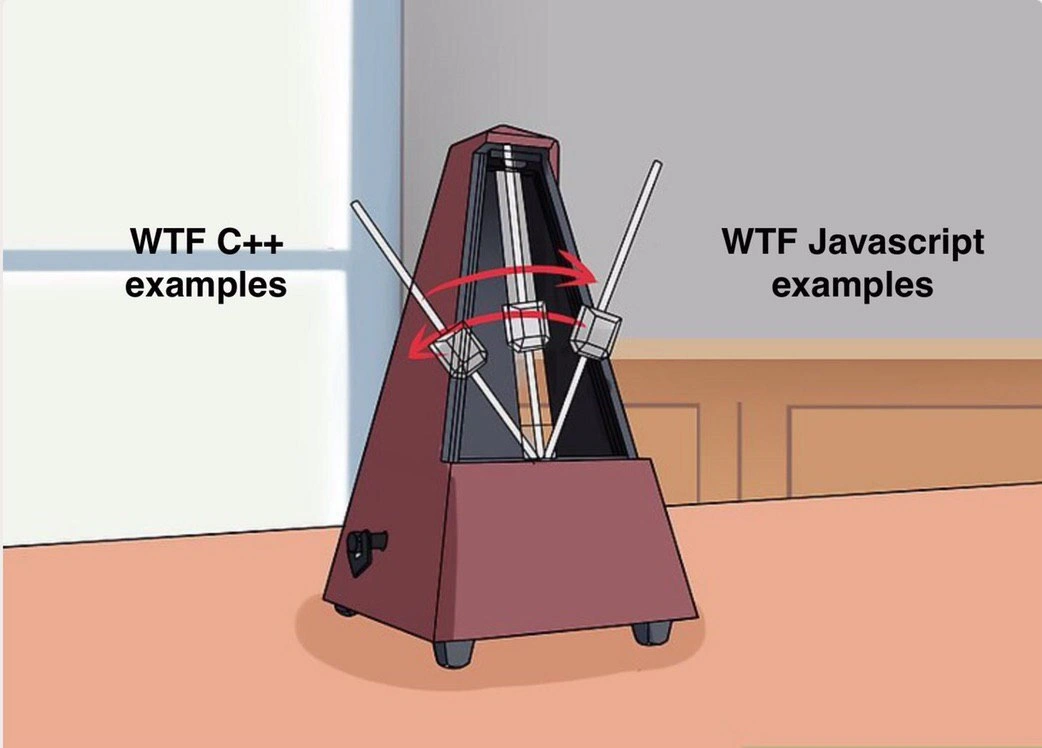
That’s exactly what this meme is joking about. In real life, the “toys” are programming languages C++ and JavaScript. Each has their own strange behaviors (their quirks), and a developer often deals with both, feeling a bit like they’re on a seesaw or swinging pendulum of confusion. The meme shows a metronome, which ticks left and right steadily, to symbolize how a developer’s confusion alternates between “Whoa, C++ did something crazy!” and “Whoa, JavaScript did something crazy!” again and again. It’s funny because it’s true – it captures the feeling of, “No matter where I turn, something ridiculous is waiting to surprise me!” in a playful, exaggerated way. Essentially, the meme is saying: Being a programmer means constantly bouncing between different kinds of head-scratching problems, like a never-ending game of ping-pong with bizarre results – and we’ve just got to laugh at it!

Level 2: Debugging Whiplash

Let’s break down what this meme is showing, in more straightforward terms, and why developers find it so funny. We have a picture of a metronome – that ticking device musicians use to keep time, swinging a pendulum arm left and right at a steady pace. On one side of the swing it says “WTF C++ examples,” and on the other it says “WTF JavaScript examples.” In plain terms, it’s saying a developer’s attention (or frustration) is constantly swinging back and forth between C++ and JavaScript weird examples, almost rhythmically. If you’re a programmer who has dealt with both languages, you likely have experienced this back-and-forth confusion. One day you’re debugging some C++ code and encounter a “WTF” moment (What-the-Fish? 🤨), and the next day you’re writing or debugging JavaScript and hit an equally puzzling “WTF” scenario. The cycle repeats so regularly it feels like the steady tick-tock of a metronome. The meme cleverly equates that repetitive surprise to a pendulum swing: left = “C++ has done something crazy,” right = “Now JavaScript has done something crazy,” and over and over.

Now, what kind of crazy examples are we talking about? Let’s define a few terms and typical scenarios for each language:

  • C++ (C plus plus) is a programming language known for being super powerful and fast. It’s used in situations where performance really matters (like game engines, operating systems, high-frequency trading systems, etc.), and it lets programmers work with low-level concepts like direct memory access. However, with great power comes great responsibility: C++ gives you enough rope to hang yourself 🤠. You have to manage your own memory and follow strict rules, and if you mess up those rules, the consequences can be wildly unpredictable. A common term here is undefined behavior. This means if you do something the C++ language doesn’t allow or expect, the resulting program behavior is not defined by the language. In practical terms, that’s the source of many “WTF C++” examples. For instance, using a variable that was never initialized (never given a value) is undefined behavior. The program might print some random garbage value that happened to be in memory, or it might behave differently on another machine or crash outright. Check out this tiny C++ snippet:

    #include <iostream>
    using namespace std;
    int main() {
        int x;              // x is uninitialized here
        cout << x;          // WTF: x is used before being set, undefined behavior!
        return 0;
    }
    

    In C++, if we try to print x without ever assigning a value, there’s no telling what you’ll get. It might output 0 one run, 42 on another, or just some nonsense. That’s because x contains whatever junk was in that memory location. The language doesn’t require any specific outcome – it literally allows anything to happen (we saw earlier how this liberty is often jokingly referred to as conjuring “nasal demons”). Most modern tools will at least warn you, but the code will compile and run. Now imagine encountering a bug caused by something like this in a large codebase: you’d be scratching your head thinking “WTF is going on?” until you realize some variable wasn’t initialized 3000 lines away, causing the weird behavior. Other classic C++ WTF scenarios include things like reading past the end of an array (which might accidentally read some unrelated data or trigger a crash), or super complex template code that produces error messages you could wallpaper a room with. Templates in C++ let you write code that works with many types (generic programming), but they can be pushed to do insanely complex computations at compile time (yes, C++ can execute certain code when it’s compiling, not running, through templates). Developers have hilariously abused this feature to, say, calculate prime numbers or Fibonacci sequences during compilation – genius, but also kind of WTF when you first see it, because it’s like using a Swiss Army knife’s toothpick to do brain surgery. In summary, C++ quirkiness often comes from its combination of low-level operations (like manual memory handling) and high-power features (like templates and macros). If you violate its expectations (like the rules about order of operations or memory safety), you get bizarre bugs that can take ages to debug. That’s why C++ devs sometimes find themselves muttering “What the...??” at 3 AM while troubleshooting a crash.

  • JavaScript is a very different beast. It’s the language of the web – it runs in your browser, making websites interactive, and also on servers (with Node.js). JavaScript is dynamically typed and very forgiving. “Dynamic” means you don’t have to declare types for your variables (a variable can hold a number, then later you can put a string in the same variable, and JavaScript won’t complain ahead of time). “Forgiving” means if you try to do something that doesn’t quite make sense, JavaScript will often try to guess or make it work rather than error out. This forgiving nature is the source of many WTF JS moments. A key concept here is type coercion – that’s when the language automatically converts a value from one type to another because it thinks that’s what you need. Sometimes that’s convenient, but other times it leads to bizarre results. For example:

    console.log("5" + 1);    // "51"
    console.log("5" - 1);    // 4
    console.log([] + []);    // "" (an empty string)
    console.log(true + true);  // 2
    console.log([] + {});    // "[object Object]"
    console.log({} + []);    // 0
    

    What on earth is happening there? Let’s decode a couple of these:

    • "5" + 1: In JavaScript, the + operator is a bit tricky. If you use + with a string and something else, it will concatenate (join) them as strings. Here we have the string "5" and the number 1. JavaScript sees one operand is a string, so it converts the number 1 to "1" (as a string) and then concatenates. That gives "5" + "1" which results in "51" (a string that looks like 51). Many newbies expect 5 + 1 = 6, so this is a classic WTF moment.
    • "5" - 1: Now for subtraction, JavaScript doesn’t do string concatenation (there’s no meaning to "hello" minus something in natural terms), so it tries to be helpful in another way: it converts both operands to numbers. The string "5" becomes the number 5, and then 5 - 1 = 4. So "5" - 1 gives 4. At least that one ends up as a number. Weirdly, using + and - on similar-looking values gave totally different types of results (one a string, one a number). That inconsistency is what makes you go "WTF?" as a developer – you have to know these hidden rules.
    • [] + []: As mentioned, when adding two arrays, JavaScript will convert each array to a primitive (either a number or string) first. An empty array [] when coerced to a primitive becomes "" (an empty string) – this is a bit of a long story, but essentially arrays try to convert to strings by joining their elements, and here there are no elements, so it becomes an empty string. So [] + [] becomes "" + "" which is "" (still an empty string). Instead of some error like “cannot add arrays” (which you might expect in a stricter language), JS just gives you an empty string result, leaving you scratching your head.
    • The { } + [] versus [] + { } showing 0 and "[object Object]" respectively is even wilder: it has to do with the fact that {} at the start of a statement is interpreted as an empty block (not an object) by the JavaScript parser. So { } + [] is actually just + [] in disguise, which converts [] to 0 (because + in front of a non-number tries to turn it into a number, and empty array becomes 0 in that context!). Meanwhile, [] + {} is treated as array plus object: the array becomes "" again, the object {} becomes "[object Object]" (that’s what happens when you convert a generic object to a string in JS), and then "" + "[object Object]" gives "[object Object]". Phew! Yes, this is really the kind of stuff that exists in JavaScript’s world.
    • true + true: Each true becomes 1 (since in a numeric context true is considered 1 and false is 0), so this is 1 + 1 = 2. It’s kind of neat but also unexpected if you didn’t know booleans act like 1/0 when added.

    As a junior developer, when you first encounter these odd behaviors, it’s genuinely confusing. You might think “Who would design it this way?!” The answer is usually history and convenience. JavaScript was designed to be easy for beginners typing little scripts in web pages, so it tries hard to not throw errors and instead produce some result. Over time, for better or worse, those behaviors got locked in because millions of web pages relied on them. In modern JavaScript development, we actually have best practices to avoid these pitfalls: for example, always use triple equals === (strict equality) instead of == for comparisons, because === does no type coercion. So "" === 0 would be false (which is what you’d intuitively expect – an empty string is not the same as zero) whereas "" == 0 is true (weird!). Understanding these little rules becomes part of your learning journey with JS. Debugging a JavaScript problem often involves asking “Hmm, did something automatically turn into a different type here?” It’s almost comical how many odd bugs boil down to “JavaScript helpfully misinterpreted my data.”

So why do developers joke about going back and forth between WTF moments in C++ and JS? It’s because these two languages, while very popular, each come with a reputation:

  • C++ reputation: Powerful but easy to shoot yourself in the foot. You get speed and control, but if you aren’t extremely careful, you get bizarre bugs. Debugging C++ often feels like detective work, finding that one tiny mistake that caused memory chaos.
  • JavaScript reputation: Easy to start with but full of weird gotchas. You don’t get compile-time errors for type issues, things will try to work even when they shouldn’t, and that can lead to wacky situations you never anticipated. Debugging JS often involves console-logging values to see “why on earth is it giving me that?” due to some silent type conversion or scoping issue.

If you’re a developer familiar with both, you’ve likely experienced the whiplash of context-switching: one day chasing a segmentation fault in C++ (maybe a program that crashes with no helpful message, often due to memory mismanagement), and the next day chasing a logic bug in JavaScript (where nothing crashes, but the output is just nonsensical because a value became NaN or undefined unexpectedly). The meme exaggerates this into an endless loop — implying that as soon as you solve one WTF in C++, you’ll swing over to find a WTF in JavaScript, and it keeps repeating. It resonates because it’s a cycle many devs know too well.

Languages and Debugging: The categories given (Languages, Debugging_Troubleshooting) really sum it up. This is about language-specific quirks and the troubleshooting headaches they cause. When debugging, knowing the language’s odd little rules is crucial. For example, a junior might spend all day wondering why their C++ program prints gibberish, not realizing they never initialized a variable. A senior will immediately suspect “Ah, probably an uninitialized variable or memory stomp — classic C++ bug.” Similarly, a newcomer to JS might be baffled why their login check if(passwordInput == 1234) always succeeds even when the input is empty or letters — a seasoned JS dev would ask “Are you using == instead of ===? Because that could be doing type coercion.” Bit by bit, developers build a mental catalog of these language quirks. This meme playfully acknowledges that even at an advanced stage, you’ll never run out of new quirks to add to that catalog — in either language.

And let’s not forget the LanguageComparison angle (as hinted by the tags). People often like to compare languages: Which is better? Which is worse? Here, the comparison is done through humor: C++ and JavaScript are very different, but both can leave you muttering “WTF?!” The phrase “LanguageWars” is even tagged, which is a nod to those endless debates on forums about C++ vs something or JS vs something. The meme isn’t picking a winner; instead, it’s saying “Look, whether you’re dealing with low-level or high-level, you’re gonna face absurdity. Pick your poison.” For a junior developer, it’s a gentle warning and an in-joke: every language has its quirks — those little peculiar behaviors you only learn by encountering them. It encourages you not to feel too smug thinking “my language of choice is perfectly logical.” C++ might surprise you with how illogical things can become if you invoke undefined behavior, and JavaScript might surprise you with how too logical it is in following wacky conversion rules.

In summary, this meme is highlighting a shared developer experience. It’s saying: “Whether you’re deep in C++ or jamming in JavaScript, you’re never far from a head-scratching moment. In fact, experienced devs often hop between these two kinds of head-scratchers so frequently it feels like a metronome ticking away – WTF, WTF, WTF… on and on.” It’s funny to us because it’s true and it bonds us over the absurd parts of our work that outsiders might never believe.

Level 3: Pendulum of Perplexity

For a seasoned developer, this meme hits right in the shared experience. It paints a hilariously accurate picture of how, over the years, one can end up oscillating between two nightmare-fuel languages during debugging sessions. The metronome analogy isn’t random – it reflects that rhythmic regularity with which a senior dev encounters crazy surprises first in one language, then the other, back and forth, endlessly. In practice, many of us work with multiple languages day-to-day (perhaps a C++ backend server and a JavaScript-based frontend, or switching between a high-performance module in C++ and a scripting task in Node.js). We’ve learned that no language is a safe haven; each has its own arsenal of “WTF moments” ready to launch when you least expect it. The humor here comes from recognition: we’ve all been that developer, one moment cursing an absurd C++ template error, the next moment throwing our hands up at a JavaScript bug that makes zero logical sense at first glance. It’s a pendulum we ride not because we want to, but because it’s part of the job.

On the left swing: C++ WTF examples. These are the kind of code snippets or bugs that make you go “How on earth is this even compiling/running?!” Perhaps you’ve seen an innocuous-looking piece of C++ code corrupt an entire object in memory due to a single misplaced & (address-of) or a misused reinterpret_cast. A classic senior-dev war story: the case of the mysteriously morphing variable, where some unrelated part of the code was writing past an array’s end (a buffer overflow) and accidentally overwrote that variable’s memory. In a debugging session, you’d watch in disbelief as an innocent integer’s value changes without any direct assignment – pure ghost behavior caused by an out-of-bounds write. C++ is infamous for such hijinks because it trusts the programmer with raw pointers and manual memory management. It’s powerful, but like handling live wires; if you slip up, you might get zapped with hours of troubleshooting weird crashes or data corruption. And then there’s the templaté black magic: error messages hundreds of lines long because some template instantiation went wild, or metaprogramming tricks that generate code in ways your brain has to do backflips to follow. (Ever see the expression std::is_same_v<std::decay_t<T&&>, T> in a template error? It’s like reading hieroglyphics until you have enough experience.) The community loves sharing these WTF C++ gems, partly as cautionary tales and partly as tech folklore. There’s even a tongue-in-cheek “WTF++” category in many forums highlighting the wildest things you can do in C++ (like creating compile-time brainf**k interpreters or exploiting the preprocessor to output poems). For experienced devs, encountering such an example is almost comforting in a twisted way – ah yes, C++ did it again.

Now on the right swing: WTF JavaScript examples. These are a staple of developer humor on Twitter and blog posts (you might recall the “WAT” lightning talk that famously showed JS oddities). The reason they’re so funny (or painful) is because JavaScript often tries to be helpful in a very odd way. For instance, you write a simple equality check like if (userInput == 0) to catch empty input, and suddenly it’s true when userInput is "" (empty string) because JavaScript helpfully converts the empty string to 0 in a loose comparison. Surprise! That bug had you scratching your head because you never considered that "" == 0 is true (yep, that’s a real JS quirk). Or consider when you’re debugging why an array plus an object isn’t giving an error – instead, it produces some goofy string "[object Object]". JavaScript’s type coercion and default toString behaviors are often behind these WTFs. The senior perspective here is smirking familiarity: we’ve been burned by forgetting to use === (strict equality) instead of == and thereby inviting those “helpful” conversions. We’ve seen how adding a number to a string doesn’t throw an error but just concatenates (leading to bugs like a calculator app that outputs “511” when you meant 5+6 = 11, because one of the 5 or 6 was held as a string). There’s also weird scoping issues from the old days (var hoisting causing variables to behave unexpectedly) and the infamous this context madness in JavaScript that gave many of us gray hairs. The WTF JS examples circulating around often include things like typeof NaN returning "number" (even though NaN means “Not a Number”), or the fact that you can call [].__proto__ === Array.prototype // true and then do wild stuff by modifying Array.prototype that affects all arrays. Senior devs have learned these lessons the hard way and often joke about them: “JavaScript will implicitly convert your mistakes into features.”

The meme brilliantly captures that as a veteran developer, you can’t escape these scenarios – you just learn to ride the pendulum of perplexity. One week you might be deep in C++ land, puzzling over a crash that ultimately boils down to an undefined behavior (maybe some code used memcpy incorrectly and broke object alignment – cue facepalm). The next week, you’re in a Node.js project, perplexed why your function is receiving [object Object] as a string instead of an object – oops, someone did string concatenation with an object by mistake, triggering that toString conversion. The back-and-forth nature of these experiences becomes almost rhythmic in a long developer career. Especially for those of us who straddle both worlds (systems programming and web development), we develop a kind of dark humor about it. We joke that we keep a “WTF counter” on our desk that ticks every time one of these languages surprises us, and it pings back and forth like… well, a metronome.

From an industry perspective, this meme also pokes fun at the eternal language wars. C++ vs JavaScript is not a common direct rivalry (they occupy different domains), but developers love to poke at languages’ weaknesses. Here, instead of saying one is better, it implies both can be ridiculous in their own ways. The result is a sort of camaraderie in pain: whether you’re a hardened systems programmer or a JavaScript guru, you’ve been baffled and exasperated by your tool of choice more times than you’d like to admit. It’s almost comforting to realize no one’s stack is free from absurd bugs. Your senior developer survival kit ends up including both Valgrind (to catch C++ memory mischief) and a copy of “You Don’t Know JS” (to remember all the JavaScript gotchas). We invest in better debugging and troubleshooting techniques precisely because of these recurring WTFs. We run address sanitizers on C++ code to sniff out that nasal-demon-summoning undefined behavior before it hits production. We use linters and type checkers (like TypeScript or Flow) for JavaScript to prevent coercion surprises. Yet, no matter how much we prepare, some new snippet of code will find a creative way to confuse us. And when it does, we’ll sigh, maybe laugh, share the story with colleagues, and move on – until the pendulum swings again. The meme is a humorous nod to this never-ending cycle: you fix one bizarre bug and say “Whew, that was crazy,” only to turn around and exclaim “Wait… what?!” at something bizarre on the other side. It’s practically clockwork.

Level 4: Nasal Demons vs Type Gremlins

At the most esoteric layer of this meme’s humor, we delve into the language specifications and formal quirks that spawn these endless "WTF" moments. C++ and JavaScript embody nearly polar-opposite design philosophies, yet each harbors complex corner cases that can baffle even language experts. The metronome swinging between "WTF C++ examples" and "WTF JavaScript examples" hints at an oscillation of perplexity driven by deep technical contrasts: one side by undefined behavior in a low-level, compiled language, the other by quirky type coercions in a high-level, interpreted one. It’s like a pendulum between two different species of chaos – each governed by its own arcane rules of the universe.

On the C++ side, the term “nasal demons” is a tongue-in-cheek reference to the fact that certain C++ operations (particularly invoking undefined behavior) can literally do anything – literally anything, including the joke of “making demons fly out of your nose.” This stems from the C++ language standard: if you wander outside the bounds of well-defined behavior (say, by reading uninitialized memory, dereferencing a wild pointer, or overflowing an integer), the standard imposes no requirements on what happens. The program’s behavior becomes indeterminate. Your code might seemingly work, might crash spectacularly, or might exhibit utterly bizarre output. Each compiler might handle it differently, and optimizations can make matters even more surreal. For instance, the expression i = i++ + ++i in C++ is undefined – the language spec doesn’t dictate an order in which i++ and ++i occur, so the result can’t be trusted. The object code could legitimately do something totally counterintuitive or optimize the entire statement away assuming it never happens. This is not a bug but a conscious design trade-off: by leaving such behavior undefined, C++ allows compilers to optimize aggressively without needing to account for “impossible” scenarios. Seasoned C++ devs have seen how a slight misuse of features can invoke these nasal demons, resulting in hours of debugging ghosts in the machine. The WTF C++ examples online are often extreme demonstrations of this – maybe a template metaprogram that generates a compile-time Mandelbrot set or exploits function pointer aliasing to twist the program logic. These examples showcase how Turing-complete the C++ template system is and how the combination of low-level memory access and an uber-powerful compile-time meta-language can produce truly mind-bending outcomes.

Meanwhile, on the JavaScript side, our “type gremlins” come out to play. Unlike C++, JavaScript doesn’t have an undefined behavior concept in the same chaotic sense – the ECMAScript specification meticulously defines what should happen in every scenario. But defined doesn’t mean intuitive. The infamous WTF JavaScript moments usually arise from the language’s type coercion rules and quirky legacy design decisions. JavaScript is dynamically typed and was originally designed in a hurry (about 10 days in 1995!) to make web pages interactive. This rushed origin and desire for newbie-friendly behavior led to some astonishingly convoluted internal algorithms for seemingly simple operations. When you use the + operator on mixed types, JavaScript invokes its abstract ToPrimitive and ToString/ToNumber conversions behind the scenes. For example, adding an array [] to another array [] triggers a chain of conversions: each empty array becomes an empty string, and "" + "" results in "" (an empty string). Thus [] + [] yields "" – a result that can make a developer spit out their coffee. This is specified behavior (ECMAScript defines it step by step), but it’s so counter-intuitive that it feels like the work of mischievous gremlins. Similarly, true + true in JavaScript becomes 2 (because true coerces to 1 in numeric contexts), while true + "true" results in "truetrue" (string concatenation prevails if one operand is a string). The classic WTF JS collections include gems like [] + {} vs { } + [] yielding different results due to the way the JS parser interprets the {} either as an object literal or a code block depending on context. And then there’s the notorious NaN (Not-a-Number) which bizarrely is a number type but compares unequal to itself (NaN === NaN is false by design!). All of this is by design: the JavaScript spec writers decided on these rules both for performance and backward compatibility. There’s a twisted consistency to it once you study the spec, but to mere mortals reading code, it’s a breeding ground for “What the heck?!” reactions.

In a theoretical sense, each language sits at opposite ends of a spectrum: C++ emphasizes performance and programmer control, even if that means the formal semantics will occasionally shrug its shoulders (“If you do X, all bets are off”). JavaScript, on the other hand, emphasizes flexibility and forgiving syntax, meaning the spec will bend over backwards to do something even when types don’t match – leading to bizarre but deterministic results. One could say C++ exhibits a kind of quantum uncertainty (the outcome is not determined in certain edge cases – until you observe it on a particular run, at which point anything might happen), whereas JavaScript exhibits a kind of surreal determinism (the outcome is predetermined by complex rules, but those rules often defy common sense). Both approaches produce a never-ending supply of “WTF” examples that senior devs trade like campfire horror stories. The meme’s developer metronome metaphor perfectly captures this oscillating equilibrium of absurdity: as soon as you grapple with an eye-opening quirk on one side (say, a mind-bending C++ template instantiation), you’ll soon find an equally head-scratching jQuery or Node.js snippet on the other. The swing never stops because at a fundamental level, the complexity and creativity built into these languages ensures that there will always be new edge cases to discover. It’s an endless dance dictated by the laws of two very different, yet equally quirky universes – one governed by the C++ ISO standard and its intentional gaps, and the other by the ever-evolving ECMAScript spec with its quirky historical warts. The result? A perpetual motion machine of WTF that keeps experienced engineers simultaneously amused, humbled, and ever so slightly traumatized.

Description

A meme depicting a classic wooden metronome swinging back and forth. The left side of the swing is labeled 'WTF C++ examples', and the right side is labeled 'WTF Javascript examples'. The image humorously illustrates the constant mental shift a developer makes between different types of programming-induced confusion. It contrasts the complexities of a systems language like C++ (often related to memory management, pointers, and verbose syntax) with the notorious quirks of JavaScript (such as type coercion, the 'this' keyword, and asynchronous behavior). The metronome symbolizes the relentless, rhythmic oscillation between two very different but equally baffling programming paradigms, a relatable experience for full-stack or multi-language developers

Comments

7
Anonymous ★ Top Pick My daily routine is a metronome swinging between wondering why C++ gave me a segfault and wondering why JavaScript thinks `[] + {}` is '[object Object]' but `{} + []` is 0. The only consistent tempo is my confusion
  1. Anonymous ★ Top Pick

    My daily routine is a metronome swinging between wondering why C++ gave me a segfault and wondering why JavaScript thinks `[] + {}` is '[object Object]' but `{} + []` is 0. The only consistent tempo is my confusion

  2. Anonymous

    Tick: untangle a 200-line SFINAE error cascade; Tock: explain why [] + {} === "[object Object]". Agile claims we’re in sync - this metronome just says we’re in denial

  3. Anonymous

    After 20 years, I've realized C++ and JavaScript aren't competing for worst language design - they're collaborating on a distributed system where confusion is the only consistent API

  4. Anonymous

    When you're a senior polyglot engineer and realize you need four arms just to defend against the simultaneous onslaught of JavaScript's `[] + [] === ''` and C++'s `std::vector<bool>` not actually being a container - because apparently both languages decided that sanity was optional and 'surprising behavior' was a feature, not a bug

  5. Anonymous

    Metronome for code review: tick C++ undefined behavior, tock JavaScript implicit coercion - if it ever stops, someone enabled UBSan and "use strict" and the whole app refuses to boot

  6. Anonymous

    C++ hands you the rope, JS ties it into a prototype knot - metronome ticks your unraveling sanity

  7. Anonymous

    In C++ it’s UB; in JavaScript it’s coercion - the invariant is your pager at 3 a.m

Use J and K for navigation