Human Code and AI Slop Trade Labels
Why is this AI ML meme funny?
Level 1: Yesterday’s Mess
Imagine a child telling a robot, “Your room is messy,” and the robot pointing at the family’s crowded attic. The child suddenly has no comeback. That is the joke here: the human calls the robot’s work “slop,” but the robot reminds him that humans keep piles of old work called “legacy.” A mess made today and a mess inherited from yesterday are still things somebody has to clean up.
Level 2: From Prompt to Burden
AI-generated code is code proposed by a language model from a prompt and surrounding context. “Slop” is the insulting name for output accepted in bulk without enough care. Common warning signs include functions that duplicate existing behavior, invented APIs, shallow error handling, unnecessary abstractions, and tests that confirm the implementation rather than the requirement.
Legacy code is existing software a team must continue supporting, often with limited documentation or tests. It can be risky to change because other systems rely on behavior that is not obvious from the source. Technical debt is the extra future work caused by shortcuts or design choices that no longer fit. Like financial debt, it is not always irrational: shipping quickly can be valuable. The problem is taking on debt without understanding who will pay it.
The meme connects these terms through a lifecycle:
- A human or model produces code quickly.
- Review misses unclear assumptions or needless complexity.
- The code enters production and other features depend on it.
- Months later, nobody can safely replace it.
- Yesterday’s “slop” is introduced at a meeting as “the legacy platform.”
For a newer developer, the practical defense is source-neutral review. Ask whether you understand every changed line, whether the tests cover failures as well as success, and whether the patch uses real project conventions. Never merge a model’s output merely because it looks polished; never preserve a human’s output merely because it looks historic.
Level 3: Provenance Is Not Quality
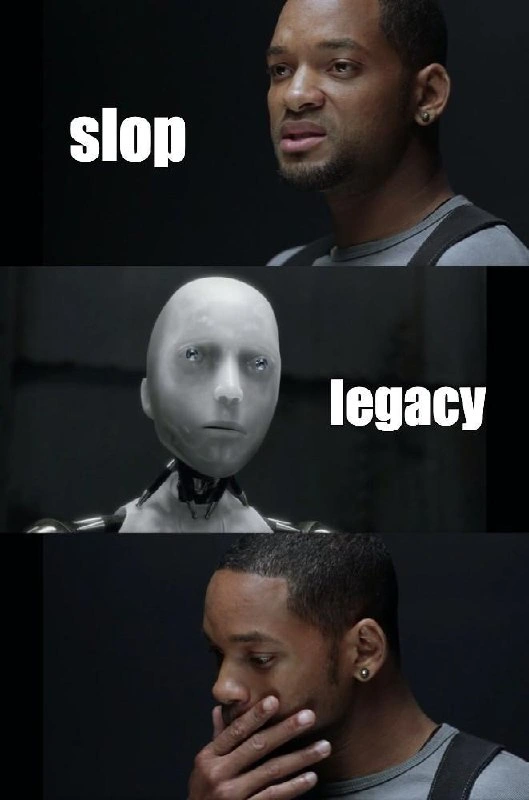
The three-panel exchange needs only two labels:
slop
legacy
Detective Spooner directs “slop” at Sonny, the humanoid robot; Sonny answers “legacy,” and Spooner covers his mouth as if the counterattack has landed somewhere painfully billable. The I, Robot imagery makes the human-versus-machine argument literal. In current developer language, “AI slop” means output produced quickly, abundantly, and with too little judgment. The robot’s reply points out that human-written repositories have their own unflattering category: old code that nobody fully understands but everybody is afraid to remove.
The comeback works because authorship is not a quality model. Human code can be duplicated, poorly tested, misleadingly named, or built on an assumption that expired three reorganizations ago. Generated code can be clear and correct when it is tightly specified, tested, and reviewed. Either source can also produce an incident with excellent indentation. What matters after generation is evidence: behavior, readability, tests, security properties, operational fitness, and whether a maintainer can change it without consulting office folklore.
“Legacy” is sharper than a simple synonym for “bad.” Legacy code is software inherited from an earlier context that still matters now. It may be old, coupled to obsolete dependencies, or missing tests, but it can also embody years of hard-won business rules and production fixes. Its defining feature is consequence: something depends on it. That is why replacement is difficult. The visible robot is not merely saying humans write ugly code; it is reminding the human that yesterday’s questionable output became today’s indispensable system.
This is also the likely future of unreviewed generated code. Once “slop” is merged, deployed, connected to data, and used by customers, it acquires state, integrations, and organizational ownership. At that moment it stops being disposable text and starts becoming technical debt—a set of future costs created by today’s speed. An AI can produce a hundred lines in seconds; the organization may maintain those lines for years. Generation compresses the writing phase, not the software lifecycle. Congratulations: the slop has achieved tenure.
The systemic temptation is obvious. Teams are rewarded for visible delivery, while maintainability costs arrive later and often land on different people. AI tools widen that incentive gap by making patches cheaper to create than to understand. Guardrails therefore belong at the boundary where output becomes shared code: small diffs, clear requirements, automated checks, human review, dependency scrutiny, and ownership after merge. Labeling everything AI-made as slop avoids evaluation; labeling everything human-made as trustworthy avoids it just as effectively.
The final panel is the whole debate in miniature. Spooner has no clever third label because “legacy” attacks the comforting assumption behind his insult: that the human side already solved software quality. It did not. It merely accumulated several decades of unusually durable counterexamples.
Description
A vertically stacked three-panel scene from the film I, Robot shows Will Smith's Detective Spooner facing the pale humanoid robot Sonny in a dark interrogation room. In the top panel, bold white text beside Spooner says "slop"; in the middle, matching text beside Sonny answers "legacy"; the final panel shows Spooner looking down with his hand over his mouth, visibly silenced by the comeback. The exchange condenses the human-versus-AI coding argument into two insults: developers dismiss generated code as low-quality slop, while the machine reframes established human code as aging legacy software. Its punchline is that provenance alone does not guarantee quality, and today's disposable output can become tomorrow's business-critical maintenance burden.
Comments
1Comment deleted
Slop is code you hate today; legacy is code you’re afraid to delete tomorrow.