A Veteran of the Editor Wars Sees Cursor
Why is this IDEs Editors meme funny?
Level 1: A New Kind of Tool
Imagine an old craftsperson who spent years learning whether the finest hammer or the cleverest screwdriver was better. Then an apprentice arrives with a machine and says, “Please build me a chair.” The old expert cries because the famous tool argument suddenly seems tiny. It is funny, but the expert still knows something important: when the machine stops, somebody must check whether the chair is safe to sit on.
Level 2: Modes Meet Prompts
A text editor is the program used to read and change source files. Vim uses modes and compact keyboard commands. Emacs is highly programmable and can be expanded with packages into a full development workspace. Developers historically argued about them because an editor is used all day, and years of learned shortcuts make switching feel like relearning how to type.
An AI code editor adds language-model assistance. In Cursor, that can range from predicting the next edit to giving an agent a task that requires searching files, changing code, and running terminal commands. Vibe coding informally means steering software through prompts and feedback rather than manually planning and typing every line. The phrase is often affectionate and critical at the same time.
For a junior developer, the new workflow might look like this:
- Describe a small, testable change.
- Give the agent the relevant files and constraints.
- Review every proposed addition and deletion.
- Run tests and reproduce the behavior personally.
- Ask why unfamiliar code works before accepting it.
The fifth step is what separates accelerated learning from outsourced understanding. Cursor can reduce repetitive typing, but it cannot take responsibility for a patch. Vim and Emacs veterans learned their tools by controlling each transformation; agent users need an equally deliberate habit of controlling intent and verification.
Level 3: The Last Keybinding War
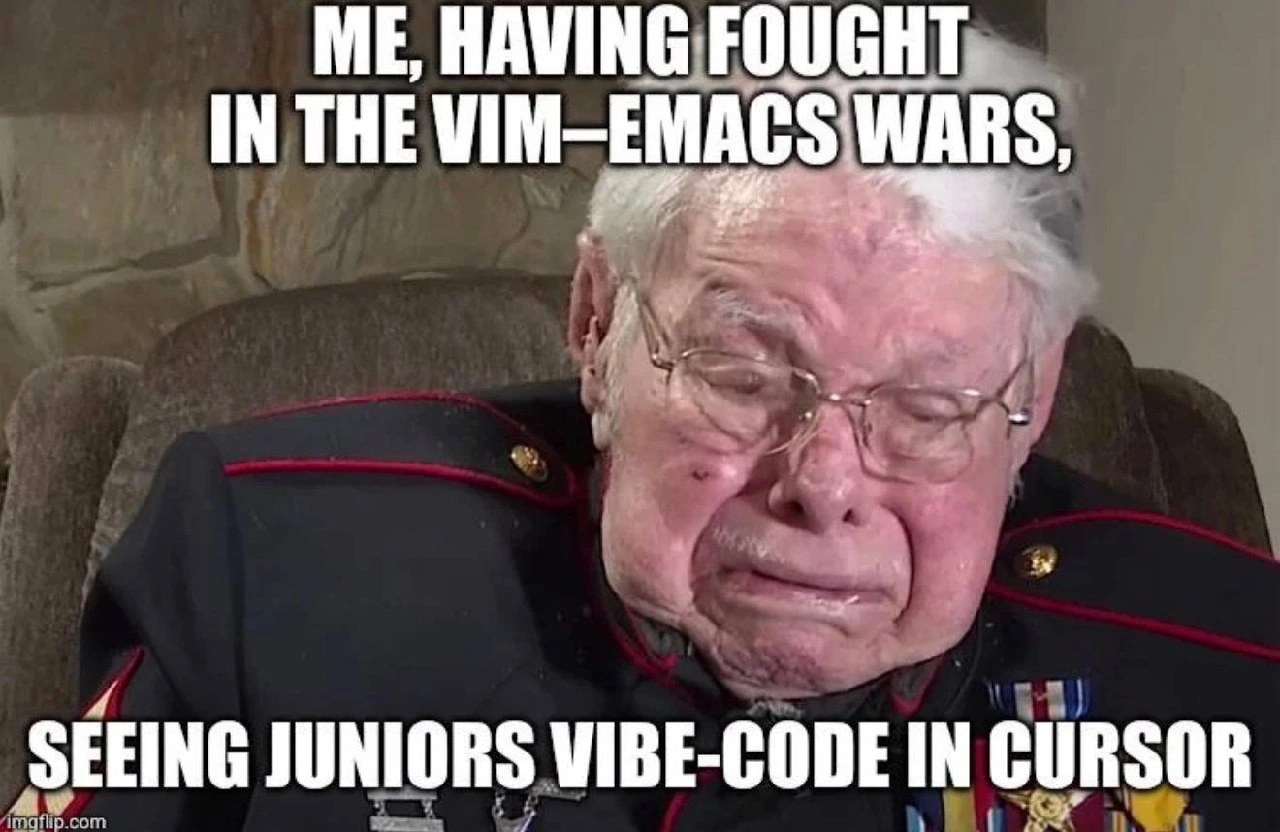
ME, HAVING FOUGHT
IN THE VIM–EMACS WARS,
SEEING JUNIORS VIBE-CODE IN CURSOR
The crying, decorated veteran turns editor preference into military history. His medals stand in for years spent memorizing commands, defending configuration files, and explaining why the other editor is not merely inconvenient but morally unsound. Then a younger generation arrives in Cursor and describes what it wants in natural language, letting an AI agent search, edit multiple files, run commands, and repair errors. The veteran prepared for the decisive battle over keystrokes; history changed the unit of work from editing text to directing a software-making process.
The old rivalry represented two serious philosophies. Vim is centered on modal editing: keys mean different things in normal, insert, visual, and command modes. Operators and motions compose into a compact language, so an experienced user can transform text with very few keystrokes. Emacs is an extensible environment whose editor behavior can be reshaped through Emacs Lisp, packages, and deeply personal configuration. One side prizes a grammar of efficient text manipulation; the other can turn the editor into a programmable habitat. Both reward long investment until commands become muscle memory.
Cursor does not make those ideas irrelevant—it changes where leverage appears. Its AI features can predict edits, accept natural-language instructions, inspect a codebase, propose multi-file changes, and operate through an agent. The developer’s valuable skill shifts toward specifying intent, selecting context, constraining the task, reviewing diffs, and testing outcomes. A perfect command for deleting a function is less impressive when the hard question is whether the function should exist and what depends on it.
That is why “vibe-code” is doing so much satirical work. The term suggests building by conversational momentum: ask for a feature, inspect what appears, report the next error, and keep prompting until the application feels right. At its best, this is rapid prototyping with unusually powerful automation. At its worst, it separates the person approving code from the understanding needed to maintain it. The meme’s juniors are caricatures, not evidence that younger developers lack rigor; they represent the veteran’s horror that hard-earned mechanical expertise may no longer be the main admission ticket.
Every tooling generation produces this anxiety. High-level languages reduced the need to write assembly; IDEs automated navigation and refactoring; language servers supplied completion and diagnostics. Each layer removed some manual work while creating new failure modes and new expertise. AI agents continue that history, but with a larger jump: they generate plausible decisions, not just deterministic transformations. That makes review, architecture, debugging, and domain knowledge more important precisely because the typing looks effortless.
The organizational joke is crueler. Companies once tolerated hours spent perfecting editor setups because the payoff appeared across years of manual coding. Now they may encourage AI throughput while leaving little time to understand the generated patch. The veteran is not only mourning keybindings; he could be watching the industry preserve the speed target while deleting the apprenticeship that taught people how code behaves. Somewhere, a .vimrc with twenty years of campaign ribbons quietly loads in 14 milliseconds.
The wisest response is synthesis rather than surrender. Modal editing and programmable environments remain useful for precise navigation, debugging, and controlled changes. Agentic tools are useful for broad exploration and routine implementation. A strong developer can prompt at high altitude, descend into the diff, and use exact editing skills when the model’s confident approximation meets an unforgiving codebase. The editor war did have a winner: whoever can verify what happened after pressing Tab.
Description
A crying elderly military veteran sits in an armchair wearing a dark dress uniform and rows of medals, turning a classic remembrance image into a programmer-generation meme. Large white Impact-style text reads, "ME, HAVING FOUGHT IN THE VIM–EMACS WARS," across the top and "SEEING JUNIORS VIBE-CODE IN CURSOR" across the bottom; a small "imgflip.com" watermark appears at lower left. The visual casts old-school developers' fiercely tribal choice between Vim and Emacs as a historic war, then confronts its survivors with juniors using Cursor's AI assistance to generate software from intent rather than hand-edit every line. The humor comes from technological whiplash: hard-won editor muscle memory and decades of keybinding debate suddenly look quaint beside agentic, autocomplete-heavy development.
Comments
1Comment deleted
After decades of modal warfare, the winner was the Tab key.