HTTP Status Codes Illustrated with Toilet Humor
Why is this WebDev meme funny?
Level 1: Toilet Surprises
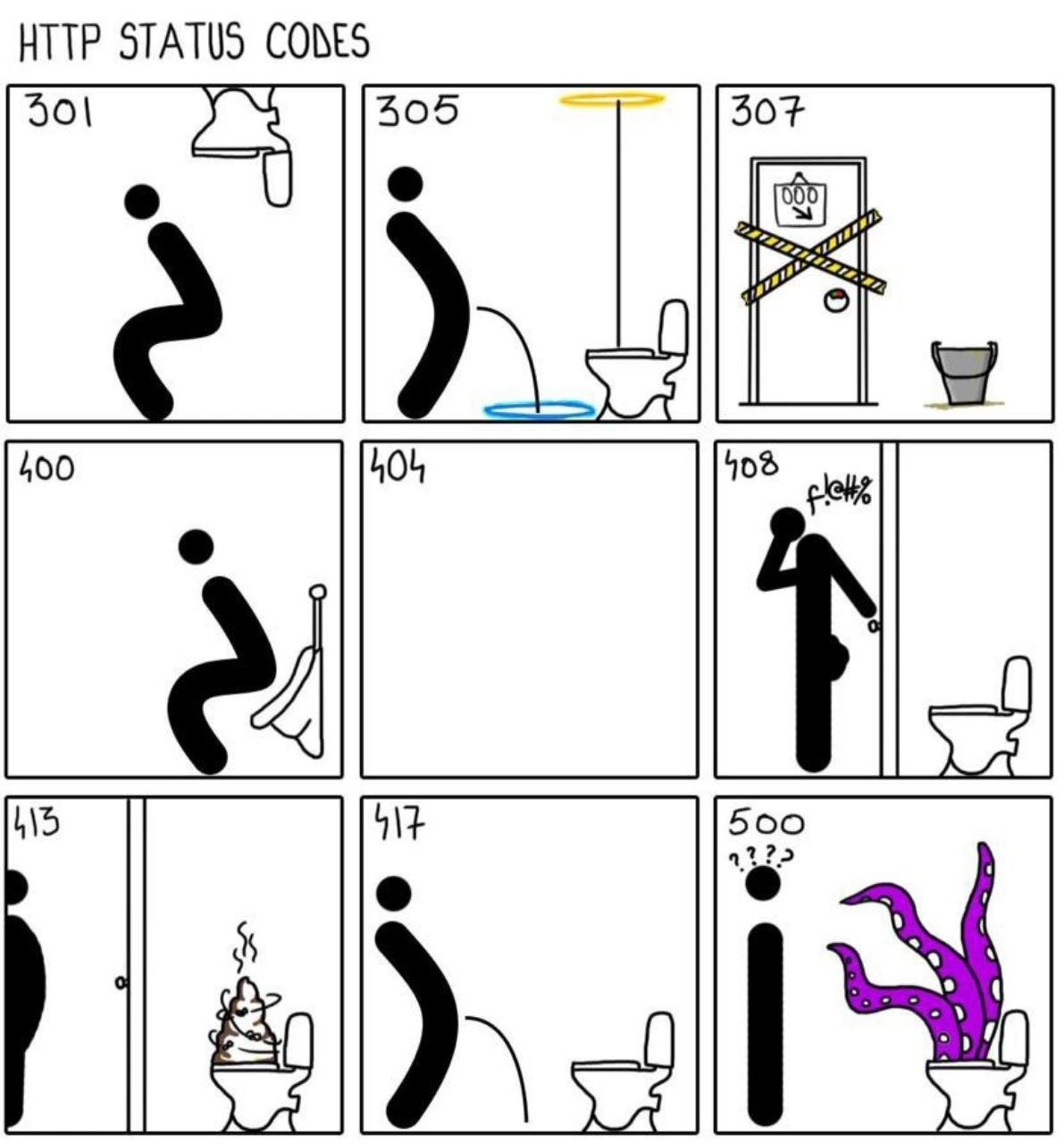
Imagine you really need to use the bathroom, but nothing goes as expected. First, a sign on the door says “Go to the shower instead” – huh?! Then, you find one toilet stall is blocked off with tape and there’s only a bucket to use – eww, that’s just temporary, right? Another time, you open a door and… there’s nothing there at all, like an empty space where a toilet should be. Or you’re waiting for the only stall and the person inside is taking forever, so long that you start pounding on the door in frustration. You might even walk into a bathroom where someone made such a huge mess that the toilet is overflowing (gross!). And sometimes, things go so wrong that a monster seems to come out of the toilet! Each of these little bathroom surprises is totally ridiculous, and that’s why it’s funny. We don’t expect any of this to happen during a normal potty break, so seeing a stick figure deal with all these wacky problems is like watching a comedy sketch. It’s taking a serious idea (rules and errors, like signs telling you what you can or can’t do) and showing it in the silliest place – the restroom. Even if you don’t know anything about computers or codes, you can giggle at the poor guy who just can’t catch a break on his bathroom trip. It’s humor anyone who’s ever rushed to a toilet can understand: sometimes things just don’t go according to plan, and all you can do is shake your head and laugh (after you wash your hands, of course!).
Level 2: Decoding the Bathroom Signs
Let’s break down what each of those numbered codes means in plain English, and how the comic turns them into goofy restroom situations. HTTP (HyperText Transfer Protocol) is the foundation of the web – when you visit a page or call an API, your browser sends a request and the server answers with a status code plus the content. Those codes (like 404 or 500) are the server’s way of saying what happened. Here’s a guide to the ones in the comic, which every web developer encounters sooner or later:
301 Moved Permanently – This means the thing you’re looking for isn’t here anymore; it’s moved to a new address for good. In the comic, the poor stick figure is diverted to a completely different fixture (a shower) instead of the toilet. That’s a permanent change of venue! Imagine a bathroom sign that says “We’ve moved to Room 301”; you’re expected to always go to the new place from now on. In web terms, your browser will note the new URL as the correct one.
305 Use Proxy – This one’s a bit of a rare beast. It tells the client, “I can’t give this to you directly; please go through this proxy server.” A proxy is like a middleman or relay. The cartoon shows a crazy solution: the stick guy uses a portal (a glowing hole on the floor leading to one above the toilet) to do his business. The portal is acting like a proxy, an intermediate path to reach the real target. While modern web apps don’t really use 305 anymore, it’s depicted here for completeness – and it definitely makes for a funny visual metaphor!
307 Temporary Redirect – This code says “The resource you want is at a different address for now, but it’s not a permanent move.” In real life, think of a sign on a bathroom door that says “Closed for cleaning, please use the porta-potty outside.” You’ll use the alternative (bucket, in the comic) this time, but you know the normal toilet will be back later. The comic’s door is taped off with caution, and a bucket is provided nearby – a temporary detour, just like websites sometimes send you to a backup page or mirror site until the main one is back.
400 Bad Request – The server didn’t understand your request because you (the client) did something wrong. Maybe you typed a URL that makes no sense or your browser sent a garbled message. The stick figure sitting on a wall-mounted urinal is exactly that kind of mistake. It’s the wrong way to use the facility, just like a bad HTTP request is the wrong way to ask the server. A newbie example: sending malformed JSON to an API will get you a 400 error – essentially the server saying “I can’t even process this.”
404 Not Found – This is the famous one everyone knows. It means the server can’t find what you asked for. It’s like walking into a restroom stall that turns out to be completely empty… or opening a door and there’s just nothing there! The comic literally left the 404 panel blank, which is a perfect representation. As a new developer, the first time you deploy a site you inevitably hit some 404s – maybe an image file path is wrong and the image is just missing. The server isn’t mad at you (it’s not a 400 or 500 level issue), it’s just politely shrugging: “404 – I looked, but there’s nothing here by that name.” Often you’ll create a custom 404 page to apologize to users or redirect them, but under the hood it’s still this same code.
408 Request Timeout – This one means the server timed out waiting for you, the client, to do something. Picture you have a limited time to send your request, and if you’re too slow, the server closes the connection. In the comic, our stick figure is banging on the stall door yelling because he’s waited too long. In a web scenario, imagine you start loading a page but your internet is super slow – after a while the server might give up and say “408: Took too long, I’m leaving.” As a developer, you might see this when a client’s request is incomplete or network delays happen. It’s basically the server tapping its foot and eventually saying “timeout, I’m done waiting.” The comic makes it a bit more human: someone waiting for a toilet who runs out of patience!
413 Payload Too Large – The request was too big for the server to handle, so it’s refusing it. “Payload” is a fancy word for the data you’re sending. Maybe you tried to upload a 10GB video where only 100MB is allowed, for example. The cartoon visualizes this as an overflowing toilet with way too much “payload” (eww!). If you’ve ever seen an upload form say “File too large” – that’s essentially a 413 error behind the scenes. As a junior dev, you learn to set limits on what users can send. If someone goes over, the server responds with a payload-too-large message, much like a toilet that just can’t take any more input without spilling everywhere. Lesson learned: don’t overwhelm the poor system!
417 Expectation Failed – This one is a bit uncommon, but it’s saying “I couldn’t meet the expectation defined in your request.” In HTTP, it’s usually about the
Expect: 100-continueheader – basically the client asking “hey server, are you okay with what I’m about to send?” and the server saying “Nope” (417) if it’s not okay. The comic turns this into a simple physical joke: the guy expected to hit the toilet bowl, but failed – he missed, big time. So the expectation_failed, quite literally. As a newcomer, you probably won’t run into a 417 often unless you’re dealing with some specific low-level HTTP stuff. But if you do, now you have this funny mental image to remember what it means!500 Internal Server Error – A generic and dreaded error indicating “Something went wrong on the server’s side.” The server itself crashed or hiccuped while trying to fulfill your request. This is often due to a bug in code, an unhandled exception, or some resource exhaustion. The comic portrays it as a monstrous surprise: tentacles bursting out of the toilet. That’s the artist’s way of saying “the problem is inside (internal) and it’s big and scary.” For a beginner, encountering a 500 might be intimidating – it’s not your fault as the client, but you know the server is in trouble. When you write server-side code, a mistake like dividing by zero or a missing pointer can cause a 500 for anyone trying to use your site. Debugging a 500 is like figuring out why there’s a creature in the pipes – you have to investigate the server’s internal logs (its guts, so to speak) to find what went wrong. It’s a staple of WebDev life to fix 500 errors; the comic just dramatizes it with a bit of horror-comedy flair.
In summary, this cartoon is basically a cheat-sheet of HTTP status codes disguised as bathroom humor. For someone new to API development or web, it’s surprisingly educational: after you laugh, you also remember. You learn that 3xx codes redirect you (even through weird routes like a proxy), 4xx errors mean you goofed up your request (or it just can’t be fulfilled as asked), and 5xx means the server had a meltdown. Every junior developer eventually has that “Aha!” moment when these codes click – perhaps the first time you deploy a website and see a 404 for a missing file, or you call an API incorrectly and get a 400, or you crash your app and see a 500 in the browser. It’s all part of learning the ropes of WebDevelopment. This meme just makes the learning fun (and a bit gross!) by linking each abstract code to a memorable visual. Trust us, once you’ve seen a 413 represented as an overflowing toilet, you won’t forget what “Payload Too Large” means! It’s the kind of nerdy humor that actually helps cement technical concepts while giving you a laugh.
Level 3: The RESTroom API
For seasoned developers, this comic hits right in the gut (or should we say, the bowels?) of daily WebDevelopment life. We deal with HTTP status codes so often that they become second nature – a terse language between frontends and backends. Here, that abstract language is translated into slapstick bathroom skits, and it’s hilarious because it’s spot-on. Each panel is essentially an inside joke for web devs, turning mundane codes into memorable calamities.
Think about it: every backend engineer knows the mini-drama behind these codes. We’ve all set up a permanent_redirect at some point – perhaps moving an old API endpoint to a new URL – and we know clients are supposed to seamlessly follow along. Seeing a 301 depicted as literally being shunted to a different plumbing fixture is funny and relatable: “Yep, we moved the resource and now everything goes down the drain over there.” And who hasn’t encountered a 404 Not Found in the wild? Broken links are as common as empty toilet paper rolls. The comic’s blank 404 panel is exactly how a missing page feels on a website: a whole lot of nothing. It’s the same indifferent void that greets a user who mistyped a URL. That joke practically winks at us: “404? Nothing to see here – literally.”
Then there’s the 500 Internal Server Error – the bane of every API developer’s on-call rotation. When a production server starts throwing 500s, it absolutely feels like tentacles might as well be exploding from the app’s innards. The panel with the purple monster is a comedic exaggeration of that dreaded Slack message: “Site’s down, getting 500 errors.” Seasoned devs chuckle because we cope with that horror by joking, “the gremlins in the server are out again.” This meme just personifies those gremlins as a toilet kraken. It’s cathartic humor; it takes a stressful scenario (a sever crashing spectacularly) and makes it absurd in a cartoonish way. You laugh, but nervously, because you’ve been that stick figure, eyes wide, saying “What the…?!” at a production incident.
What really sells this to the experienced crowd is the attention to detail with lesser-known codes like 305 and 417. Let’s be honest, not everyone remembers 305 Use Proxy off the top of their head – it’s a bit of an HTTP trivia question since it’s so rarely used. Including it here (with that genius Portal reference) signals that the creator is one of us, someone deep into MemeCulture and web quirks. It’s the kind of joke you forward to your team saying, “Lol, they even did a 305!” Similarly, 417 Expectation Failed is obscure enough that junior devs might not have seen it, but seniors smirk at the expectation vs reality gag. We’ve set Expect: 100-continue in some API call or read about it in an HTTP spec at some point, so we get the joke when the cartoon character’s expectation (hitting the target) fails miserably. It’s an extra layer of “get it?” that makes the meme feel tailor-made for BackendHumor connoisseurs.
This comic also underscores how error handling in web apps is often a messy affair – and here we see “messy” in a very literal sense. A 400 Bad Request usually means some client-side input was off, which in real life is akin to using a device completely the wrong way. Every dev has seen users do things in an application that make us go, “That’s not what you’re supposed to do!” The panel of a stick figure SITTING ON a urinal captures that feeling exactly. It’s cringe-inducing and funny: as developers we empathize with the server going, “Um, what am I supposed to do with this?!” Similarly, the 408 Request Timeout panel – who hasn’t been an impatient user jiggling the doorknob (or mashing F5 on a browser) when things take too long? We know that irritation intimately. The meme turns the abstract wait-for-response into a tangible scenario: waiting outside a locked stall. You can almost hear the sighs of all the times we watched a spinning loader until the app said “Timed out. Try again.”
Beyond the individual codes, there’s a broader relatable developer experience: maintaining web services sometimes feels like maintaining public bathrooms. 😅 Things break in strange ways, people (clients) make odd requests, and you, the developer, are effectively the janitor cleaning up the aftermath. This comic pokes fun at that reality. It’s saying, “Look, our daily HTTP codes and errors might as well be bathroom misadventures – equally chaotic and human.” And because every dev has been there, debugging or implementing these exact conditions, the humor really lands. It transforms the dull, numbered codes from our logs into vivid memories: 301 – oh yeah, that time we redirected all users to the new site; 413 – haha, remember when someone tried to upload a 5GB file and broke our app?; 500 – yikes, that Friday deploy that unleashed a monstrosity. In meetings or chat, we often use these codes as shorthand (“That endpoint’s returning 404s” or “We’re getting 500s, time to roll back!”). This meme just takes that shorthand and illustrates it literally.
Ultimately, “HTTP status codes as bathroom misadventures” belongs in the canon of great DeveloperHumor because it operates on multiple levels. It’s crude and universal (everyone gets bathroom jokes), yet also smart and specific (devs appreciate the exact mapping to HTTP). It reminds us that even in serious tech work, there’s room for a good laugh. In the culture of software teams, sharing a meme like this can break the tension after a long day of debugging. It’s a way of saying, “Our jobs are weird – we speak in numbers like 404 and 500 all day – so let’s laugh at how absurd it really is when you think about it.” The next time you have to explain a weird HTTP status to a junior dev, you might just reference this comic: “Imagine you’re at a toilet and…”. Congratulations, you’ve officially onboarded someone into the quirky, analogy-filled world of developer inside jokes. 🎉
Level 4: From RFC to Restroom
At the highest level, this meme brilliantly bridges the formal world of HTTP status codes (as defined in dry IETF RFCs) with a visceral bathroom_metaphor. In web architecture, status codes are organized by their first digit: 3xx for redirection, 4xx for client errors, and 5xx for server errors. This comic exploits that structure, translating each code’s semantic definition into a literal restroom scenario: it’s like reading the HTTP spec but in toilet hieroglyphs!
Consider the 3xx (Redirection) class depicted in the first row. A 301 Moved Permanently is a code telling the client that the resource has a new permanent URL. The cartoon shows our stick-figure “request” redirected away from the intended target (toilet) to a completely different fixture: a shower head. It’s a permanent detour for his output – once you’re rerouted to the shower, there’s no going back. In contrast, 307 Temporary Redirect (an HTTP/1.1 code) means “go to this other place just for now.” The comic’s toilet stall is taped off with caution signs, forcing a temporary pee-in-a-bucket solution. It’s a spot-on visualization of a temporary_redirect: the original resource (the stall) is unavailable for the moment, but not gone forever, so you’re given a makeshift option. Notably, 307 preserves the request method on redirect (unlike its 302 predecessor) – a subtle nuance seasoned devs appreciate. Even in the drawing, the bucket isn’t a real replacement, just a temporary stand-in until the door opens again. And then there’s 305 Use Proxy, an almost-forgotten status code from early HTTP/1.1. A 305 instructs the client to route the request through a proxy server. It’s so rare and considered insecure that many modern frameworks have deprecated it. The comic renders this with a cheeky nod to Valve’s Portal game: the stick figure urinates into a blue portal puddle on the floor, which teleports the stream to a yellow halo above the toilet. In other words, he’s forced to go through an intermediary (the portal) to reach the target – exactly what a proxy does! This level of accuracy (and nerdy reference) in the metaphor shows a deep understanding of HTTP’s permanent_redirect vs proxy mechanics.
Now the 4xx (Client Error) scenes span the next panels, illustrating what happens when the client’s request is flawed. 400 Bad Request means the server couldn’t even parse the request – it’s nonsense. Sitting backward on a wall-mounted urinal is about as nonsensical a bathroom request as it gets. The poor stick figure is “using it wrong,” just as a bad HTTP request might be missing required syntax or have malformed data. The server (toilet) responds with a figurative “Huh? I can’t process this,” much like we assume the urinal’s perspective here. Next, 404 Not Found is the iconic code for an absent resource. The comic geniusly leaves that panel utterly blank – an empty frame to represent nothing there. This not_found_blank_panel gag is meta and minimalistic: the absence of an image is the image, echoing how a 404 error yields no result (except perhaps a “Not Found” text). It’s an elegant visual 404. Move on to 408 Request Timeout, which in HTTP means the server timed out waiting for the client’s request. In human terms: you took too long. The drawing shows our stick man pounding on a locked stall door, angrily swearing (“f..!@%” scrawled to show frustration). The toilet (server) was ready, but the client is delayed and now upset – a classic timeout scenario. It’s a clever inversion: usually the request_timeout angers the client, not the server, and here we see exactly that – the guy outside is livid that there’s no response from the occupied stall.
The third row dives into a mix of esoteric client errors and one server error. 413 Payload Too Large (formerly “Request Entity Too Large”) signals that the client sent too much data for the server to handle. In the web world, you’d get this if you try to upload a ginormous file or bloated request body that the server refuses. The cartoon portrays it as a grotesque overflow: the toilet bowl is heaping with a steaming mountain of… let’s say “data,” well beyond capacity. It’s an exaggerated gross-out visual for an overwhelmed server: the payload_too_large to flush. Any sysadmin who’s seen logs of 50MB uploads hitting a 2MB limit can relate (perhaps not with actual slime, but the sentiment!). Then we have 417 Expectation Failed – a niche code tied to the Expect: 100-continue header in HTTP/1.1. This status is sent when the server cannot meet an expectation that the client requested. Think of it like: the client says “I expect you to say OK to continue,” and the server replies “417: nope, I can’t satisfy that expectation.” The comic’s take: the stick figure’s aim expected to hit the target, but utterly failed, splattering outside the bowl. It’s a literal expectation_failed moment. While everyday web devs don’t encounter 417 often, its inclusion here is a wink to HTTP aficionados – the humor lands because the metaphor (missing the toilet) perfectly matches the code’s meaning of failed expectations.
Finally, the lone 5xx (Server Error) in the set: 500 Internal Server Error. In developer terms, a 500 means the server encountered an unforeseen problem – anything from a null pointer exception to a segfault – and it can’t fulfill the request. It’s the web’s way of saying “Oops, that’s on me.” The cartoon dials this up to eleven by unleashing a Lovecraftian horror from the toilet bowl: giant purple tentacles thrashing out, confronting the aghast stick figure. This is internal_server_error embodied – something deep inside the server went horribly wrong and now all the client sees is a big “???”. It’s funny because it’s true: a 500 error often feels like a monster from the deep, especially at 2 AM in production. You don’t know what’s wrong inside until you dive in to troubleshoot. The contrast between the stick figure’s polite “I just need to go” intent and the outrageous server meltdown is exactly how it feels when a simple webpage triggers a giant stack trace. The purple tentacles also hint at the running gag in tech that some bugs are so mysterious and dreadful, they might as well be mythical creatures.
In essence, this meme is an error_handling_visualization masterclass. It faithfully maps the dry technical definitions of HTTP codes to vivid real-world predicaments. The humor operates on multiple levels of knowledge: a junior web developer can laugh at the obvious “404 is blank” joke or the absurdity of a toilet monster, while a senior WebDev or API designer chuckles at the precise allusions (like using a proxy portal for 305 or preserving method semantics in the 307 bucket detour). It’s a celebration of web protocol trivia wrapped in potty humor. By rooting each panel in HTTP’s actual semantics, the comic gives a nod to how well-engineered those codes are — each one really is the perfect subtitle for a particular kind of failure or redirect. Who knew the HTTP spec could be so… flush with comedy? 🚽🕸️
Description
A nine-panel comic strip titled 'HTTP STATUS CODES' that creatively visualizes various HTTP status codes using a stick figure and a toilet. Each panel corresponds to a code: '301' shows a figure being physically moved from the toilet; '305' depicts urination through a 'Portal'-style proxy; '307' shows a temporarily blocked door with a bucket as an alternative; '400' has a figure using a plunger incorrectly; '404' is an empty panel for 'Not Found'; '408' shows an impatient figure waiting; '413' presents an overflowing toilet representing 'Payload Too Large'; '417' shows the figure missing the toilet, for 'Expectation Failed'; and '500' has purple tentacles emerging from the toilet, signifying a chaotic 'Internal Server Error'. The humor stems from mapping abstract technical networking concepts to universally understood, crude bathroom scenarios, making the codes memorable and relatable for developers
Comments
7Comment deleted
The 500 error is perfect. It's not just broken, it's 'Lovecraftian horror emerging from the plumbing' broken, which is how most production failures feel at 3 AM
If your 500s start spawning tentacles, it’s no longer a Sev-1 - it’s an exorcism ticket
After 20 years of explaining HTTP status codes to stakeholders, I finally found the perfect documentation - though I'm concerned this might give product managers ideas about what '503 Service Unavailable' really means during critical deployments
This perfectly captures the developer experience: 301 is when you're redirected to a different bathroom, 404 is when the bathroom doesn't exist at all, and 500 is when you open the door to find Cthulhu has taken up residence in your production database - I mean toilet. The empty 404 panel is chef's kiss perfect, and that 413 'Payload Too Large' really hits different after a team lunch at that sketchy taco truck
You know it’s senior-engineer humor when the taped-off stall is a 307 - preserve the method, redirect to a bucket - until the 500 tentacles stop thrashing
417 Expectation Failed: the HTTP code for PMs demanding infinite scalability from a finite toilet buffer
Use 307 when the stall is taped off; use 301 after you’ve moved the plumbing - otherwise your API becomes the 500 with tentacles