Why 1+1=2 is Only Part of the Story
Why is this CS Fundamentals meme funny?
Level 1: When 1+1 Isn’t 2
Imagine you have a special way of counting that’s different from normal. In this make-believe system, after the number 1 you don’t say “2”, you say “10” instead. So you’d count like: 0, 1, 10, 11, 100... It sounds crazy, but it’s just a different method. Now, if you ask a friend who uses that system what 1+1 is, they’ll answer “10”. You hearing “ten” would probably think, “That’s wrong, it should be two!” You’d be super confused until you realize in their language “10” really just means two.
Now imagine another friend who has a rule that when you combine one thing with one thing, it merges into one. Like, say you put one lump of clay together with another lump of clay – they become one bigger lump, not two lumps. So in that friend’s rulebook, 1+1 = 1 (because the result is one combined lump). If you didn’t know about this rule, hearing “1+1=1” would sound like nonsense, right?
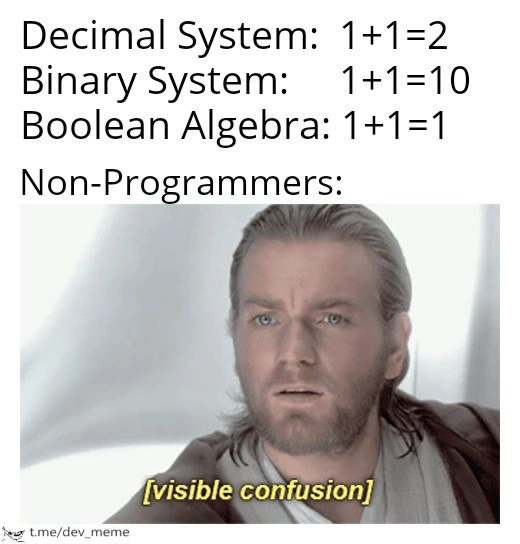
In the meme, that confused face (from a Star Wars character) is showing exactly that feeling. It’s like someone just told him these wild answers and he’s thinking, “Wait... what?!” The joke is that to a normal person, saying 1+1 gives anything but 2 feels like a magic trick or a bad joke. But to a programmer, it makes sense because they know we switched into different “modes” of thinking (just like switching languages or game rules).
So the funny part is really about expectations getting turned upside-down. We expect 1+1 to always be 2 (that’s what we all learn first in math). When suddenly it’s “10” or “1” instead, anyone would make a bewildered face. The meme is basically pointing and laughing gently at that confusion. It’s showing how the same simple question can have completely different answers when you play by different rules – and if you don’t know the rules, you’ll definitely be confused (and probably say, “Come on, 1+1 is 2, what are you talking about?!”).
In everyday terms: it’s like having a secret code or three different languages for the same math problem. Only those who know the code understand why the answer changed. Everyone else? They’re left scratching their heads, just like the guy in the picture with “visible confusion.” And that’s why it’s funny – we’re in on the little secret, and we can sympathize with anyone who isn’t, because it is pretty confusing at first glance!
Level 2: Base-ic Confusion
Let’s break down what’s going on in simpler terms. The meme lists three ways to interpret 1+1, and each way gives a different answer. Here are the three “systems” being referenced:
Decimal System (Base-10):
This is the normal way we all learn to count and do math. We have ten digits (0,1,2,3,4,5,6,7,8,9). So1 + 1 = 2is just basic addition. If you have one apple and then you get another apple, you have two apples. Nothing weird here – it’s the arithmetic every grade-schooler knows. The notation “base-10” simply means each digit in a number represents powers of 10 (for example, the number 247 means $2\times10^2 + 4\times10^1 + 7\times10^0$). But all you really need to remember is in everyday math, 1 + 1 will always equal 2. Decimal is our default number system.Binary System (Base-2):
Computers use this number system internally. Binary has only two digits: 0 and 1. That’s it – no 2,3,4,…9 in this world. When counting in binary, after1you roll over to10. It looks like “ten,” but in binary10actually means two. Here’s a quick binary counting sequence to illustrate:- 0 (zero)
- 1 (one)
- 10 (this is binary for two)
- 11 (binary for three)
- 100 (binary for four)
See the pattern? Each time you run out of digits, you add another place value (just like after 9 in decimal we go to 10, adding a new digit). Now,1 + 1in binary: if you add 1 and 1 using binary rules, you start in the ones place: 1 plus 1 is 2 in decimal, but 2 in binary is written as10. So you write down 0 and carry a 1 to the next place. The result is10(binary), which we read aloud as “one-zero” (to avoid confusion with ten). Importantly,10in binary equals 2 in decimal. So the meme’s second line1+1=10is saying: in the binary system, one plus one is written as one-zero. It’s a true statement within that system, but it’s definitely a head-turner if you’re not used to binary notation! Think of it like a different language for numbers. In Spanish, “1 + 1 = dos”; in Binary, “1 + 1 = 10”. Different language, same quantity.
Boolean Algebra (Logic):
Boolean algebra isn’t about regular numbers at all – it’s about True/False values (often represented as 1 and 0). In this context,1means True and0means False. The operations are based on logic. In Boolean algebra, the plus sign+typically means OR (logical disjunction). So when we see1 + 1 = 1here, it’s using that convention: True OR True = True. Another way to say it: if one condition is true or another condition is true (or both), the result is true. There’s no counting up beyond 1; 1 is the highest truth value (true is as true as it gets!). So “1 OR 1” stays 1. It’s like saying “Is at least one of these statements true? If yes, the answer is True.” Both inputs are true here, so the answer is True. If we were to write this with words instead of numbers: “True + True = True” in Boolean logic. This is a fundamental part of how computers make decisions: they use 1 and 0 for yes/no, on/off, etc., and use operations like OR and AND. So,1+1=1isn’t doing arithmetic addition at all – it’s doing logical combination. In everyday terms, imagine you have two light switches that control one lamp, and you wired them in parallel (OR logic). Switch A is on (1) OR Switch B is on (1) will result in the lamp being on (1). Even though both switches are on, the lamp is just “on,” it doesn’t get twice as on. There’s either light (1) or no light (0). That’s how Boolean logic works.
Now, the meme sets up these three factual statements and then shows the reaction of “Non-Programmers:” which is the picture of a very confused man. The image is actually actor Ewan McGregor in his role as Obi-Wan Kenobi from Star Wars, with a subtitle that says “[visible confusion]”. This frame comes from a popular internet meme format – people use Obi-Wan’s mildly befuddled expression to humorously portray confusion in text form. So the meme is basically saying: when non-programmers see these 1+1 examples (in decimal, binary, and boolean) and get three different answers (2, 10, and 1), they look completely baffled, just like this picture.
And you can’t blame them! If you haven’t been exposed to these different systems, seeing 1+1 apparently equal to 10 or equal to 1 is really bizarre. Most people are taught that 1+1 is 2, period, end of story. They might not even realize that “10” can mean something other than ten. So a non-developer or someone without a computer science background will look at those first three lines and think, “What kind of nonsense math is this? Are you trying to troll me?” The meme captures that feeling with the visible confusion reaction image – you can almost hear him saying, “Wait... how is 1 plus 1 anything but 2?!”
For a programmer or computer science student, each of those lines makes sense in its own context:
- They recognize decimal vs binary notation and know about base-2 carrying.
- They understand Boolean logic where 1 is true and using OR yields 1.
But a person who’s never encountered binary or Boolean algebra wouldn’t automatically understand those context switches. To them, it looks like someone just broke the fundamental rule of math three times in a row. The result? Utter confusion – exactly what the meme shows.
So, to put it simply: the meme is juxtaposing a few ComputerScienceFundamentals (binary numbers and Boolean logic are staples of CS 101) with the expected reaction of a layperson. It’s a fun, nerdy way of saying “Look how crazy this sounds if you don’t know the context!” And because we have the Star Wars visible confusion image labeled as “Non-Programmers,” it emphasizes that this bewilderment is what a typical person might feel when confronted with these less obvious interpretations of 1+1.
To recap the “joke” in plain terms:
- In normal math (decimal), one plus one is two.
- In binary (the language of computers), one plus one is written as “10” (which looks weird unless you know binary means base-2).
- In Boolean logic (true/false values), one OR one is one (since “true or true” is true).
Combine them all together and you have three wildly different-looking results for what seems like the same equation — enough to make anyone say “Huh?!” The meme is pointing out that what 1+1 equals really depends on which system you’re using, and non-programmers typically only know the first system (decimal), so they’ll be totally lost with the other two. It’s a playful gotcha that tickles programmers and mystifies others.
Level 3: That’s No 10, It’s a Two
For seasoned developers, this meme triggers a knowing grin. It encapsulates that classic experience of showing something totally legit from a coding or math perspective and watching a non-dev (or a newbie) panic as if you just broke arithmetic. Why is it funny? Because we’ve all been in that explanatory loop: “No, no, I swear I’m not insane – in binary, 10 really equals 2. Let me show you…” 😅
The humor comes from the clash of worlds: the comfortable everyday world where 1+1 is always 2, against the wonky programmer world where context flips the script. Imagine you’re in a meeting with business stakeholders or demoing something to a newbie developer. You casually mention a result in binary (“the value flips from 1 to 10”) or you present a truth table where 1 OR 1 yields 1, and suddenly everyone’s eyebrows shoot up. You can practically see the “Does not compute!” thought bubble above their heads. This meme captures that exact moment with Obi-Wan’s perplexed face labeled “[visible confusion]”. It’s the face of someone who just heard what sounds like mathematical heresy.
Developers chuckle because it’s relatable. We’ve all had to clarify basic number systems at some point, turning into impromptu math teachers. The first three lines of the meme are essentially a mini lesson in disguise – Decimal vs Binary vs Boolean logic. When a non-programmer sees “1+1=10,” they think you’re pulling their leg: “Surely 1+1 can’t equal ten!?” And that’s our cue to either grin and say “It’s true, from a certain point of view…” or actually explain that in base-2 notation, “10” means 2. The third line, “1+1=1” (Boolean), is even more mind-bending to the uninitiated. It’s like telling someone “I have one cookie and you have one cookie, together we still have one cookie” – an absurd statement unless you know we’ve switched from arithmetic to logical combination (where the cookie is some condition that is either present or not).
This meme brilliantly exaggerates a teachable moment. It’s common in developer humor to play with these fundamental truths because it highlights the gap between how computers think and how humans intuitively think. Positional notation (like binary) and logical operators are second nature to engineers, but to others it’s almost like magic or a Jedi trick. In fact, using Obi-Wan Kenobi’s confused look is apropos – to non-devs, developers might as well be mystical Jedi saying, “These are not the sums you’re looking for.” The meme could just as well be captioned: “Programmer math: when even Obi-Wan is baffled.”
In everyday dev life, we encounter this when, say, a QA tester or a manager sees a weird output and we have to explain it’s in hex or binary. Or when a junior dev first learns that computers use binary under the hood and goes “Wait, hold on – how can 10 mean two?!” You might recall the first time you discovered that and had your own visible confusion moment. And later on, you find yourself on the other side, patiently walking someone through it: “Alright, let’s recap: in binary, after 1 comes 10…”. The meme is essentially a snapshot of that conversation, distilled to a few equations and a reaction image.
There’s also a layer of DeveloperHumor here about how we sometimes enjoy these little gotchas. It’s like a nerdy party trick: ask “What’s 1+1?” and then say “10, obviously – in binary!”, reveling in the puzzled looks. Or the time you quipped, “In our database, 1 plus 1 equals 1, because we’re doing a boolean OR operation,” and everyone thought there was a bug. We find it funny because it’s a harmless way to highlight the cleverness of computer science fundamentals — and maybe to feel a bit smug that we understand the “secret code.”
But it’s also humbling humor. It reminds us that what’s obvious to a developer isn’t obvious at all to a layperson. There’s a fundamental disconnect between how programmers view a symbol like “1” (we immediately ask: is that an int? a char? a bool? what base? what context?) and how the general public sees “1” (it’s one, end of story). The meme’s punchline is basically: mixing those contexts without warning is a recipe for confusion. And that confusion is hilariously captured by a bewildered Jedi Master.
In a way, it’s also poking fun at how computer science fundamentals can turn simple things into confusing puzzles. This single image references at least three core concepts you encounter early in CS:
- Different number systems (decimal vs binary).
- Carry in addition (why binary 1+1 produces a new digit).
- Boolean logic (using 1/0 for True/False and OR’ing values).
Seasoned devs see all those at a glance and appreciate how neatly the meme stacks them. It’s like a compact inside joke about the weirdness of computer science: one second we’re counting normally, the next second we’re in a world where writing “10” doesn’t mean ten anymore, and then suddenly we’re doing logic where adding things can yield the same thing back. We find it funny because each of those shifts in perspective is a moment we had to learn and likely struggled with or explained before. The punch is imagining trying to explain all of that in one go to someone who’s never encountered it — of course they’d be visibly confused!
And let’s give a nod to the meme format itself: the “Non-Programmers: [visible confusion]” caption over Obi-Wan’s face is memetic language. It’s describing the reaction in a literal way, which adds to the humor. You read those lines of funky math and then see “Non-Programmers:” followed by a perfectly dumbfounded expression. It’s exactly the face a dev might get from a friend or stakeholder after dropping an out-of-context technical fact. In Star Wars, Obi-Wan’s usually the wise teacher, but here he’s stand-in for the student totally lost in the lesson. That role-reversal itself is chuckle-worthy to a crowd of geeks.
In summary, at the senior/dev-insider level, this meme lands because it’s relatable and layered. It’s pointing out a fundamental truth: context is king in computing, and if you ignore context, you’re in for some head-scratching moments. The laugh comes with a bit of pride — “heh, I get why that’s true” — and a bit of empathy — “yep, been there trying to explain it.” It’s a small celebration of our esoteric knowledge and a light-hearted jab at how that knowledge can befuddle others. In the end, it’s not just about the math; it’s about that classic developer experience of bridging the gap between computer science fundamentals and everyday intuition, often with entertaining results.
Level 4: Algebraic Overload
This meme cleverly illustrates context-dependent math by playing with different algebraic systems. The expression 1+1 means very different things depending on which rules you apply:
In the decimal system (our usual base-10 arithmetic),
1 + 1 = 2. This is plain old integer addition in base-10, where we have digits 0 through 9. Ten is the radix, so when we count we go "…8, 9, 10". The result 2 here is an abstraction of adding two single units.In the binary system (base-2),
1 + 1 = 10. Now,10is not "ten"—it's the binary representation of the decimal number 2. In base-2, we only have digits 0 and 1. When you add 1 (binary1) to 1 (binary1), you get a sum of 2 in decimal. But base-2 has no single digit for “2,” so we carry 1 into the next column, yielding the binary number10(which means $1 \cdot 2^1 + 0 \cdot 2^0 = 2_{10}$). The arithmetic operation is the same addition, but the notation is different because of the radix. This carrying mechanism is fundamental to binary arithmetic (and any positional numeral system): whenever a sum in one column reaches the base, it rolls over to 0 and carries 1 to the next column. So in binary, $1 + 1$ triggers a carry, resulting in10. It’s a valid equation within base-2 mathematics, even though it looks like we magically turned two into "ten."In Boolean algebra,
1 + 1 = 1is actually a logical statement. Here we aren’t dealing with ordinary numbers at all, but with truth values. Boolean algebra (developed by George Boole in the 19th century) formalizes logic using 1 for True and 0 for False. In this system, the plus sign (+) denotes the logical OR operation (while multiplication denotes AND). The equation1 + 1 = 1translates to True OR True = True. There is no concept of “2” because Boolean values saturate at 1: that is, you can’t have a truth value more true than True. This demonstrates an idempotent law of Boolean logic: $1 \lor 1 = 1$ (or in algebraic terms $A + A = A$ for any proposition $A$). Combining a truth value with itself doesn’t increase it – once true, it stays true. In a way, Boolean “addition” resembles a union operation or an OR gate in electronics: if you send an electrical signal (1) into an OR gate from two inputs, the output is still just a signal (1). Two ON states OR’ed together yield ON, not a higher level of ON. It’s a completely different algebraic structure (a bounded distributive lattice, to be precise) than normal arithmetic.
What’s fascinating is that the exact same symbolic expression 1+1 is interpreted under three different rule sets here: standard integer addition (in familiar base-10 notation), integer addition in binary notation, and logical OR in Boolean algebra. Each obedience to its own set of axioms yields a correct result within that system.
From a theoretical standpoint, this is a peek into how mathematical context matters. In abstract algebra terms, we’re looking at operations in different algebraic structures: the ring of integers (with different numeral systems for representation) versus a Boolean algebra. The meme exploits the overloading of the symbol “+” across contexts:
- In the integer world (whether written in base-10 or base-2), “+” means arithmetic addition.
- In the Boolean world, “+” means logical OR.
Because the symbol 1 appears in all three contexts (as a digit or truth-value) and + is used in two very different senses, the results look hilariously inconsistent side by side. But they’re each internally consistent. It’s a bit like linguistic ambiguity in mathematics—the language of math changes its meaning based on the dialect (system) you’re speaking.
Historically, the decimal system became dominant because humans have ten fingers (the word digit even means finger), giving us 0–9 as our counting symbols. The binary system was studied by Gottfried Leibniz in 1703, who noticed its elegance and even linked it to ancient Chinese I Ching symbols; binary later became the backbone of computing because it maps perfectly onto physical on/off states in electronic circuits. We represent everything in computers with 0s and 1s (bits) at the lowest level, so understanding that 10 can mean two is crucial in computer science. Boolean algebra was formalized by George Boole in 1854 and later applied by Claude Shannon in 1937 to design switching circuits using relays, showing that Boolean logic could model electrical circuits. Today, Boolean logic is fundamental in programming (think conditional statements and bitwise operations) and hardware design. So in one meme, we’re implicitly touching the work of Leibniz (binary numbers) and Boole (logical algebra) – quite a lot of historical depth for a joke about 1+1!
From a computer science fundamentals perspective, this meme is a quick nod to positional numeral systems and logic algebra. It’s the same reason why the classic geek t-shirt reads, “There are 10 types of people in the world: those who understand binary and those who don’t.” In that joke, “10” is binary for 2, and people who don’t know binary get a meta lesson in exactly the confusion our meme depicts.
In practical terms, developers constantly swap between these contexts. One moment you’re thinking in decimal (when discussing user-facing numbers), the next you’re debugging at the bit level in binary or writing a truth condition in code. Each context has its own consistent rules, but if you’re not explicitly told which system is in use, a statement like 1+1=10 feels like nonsense or a bad joke. The meme compresses that Aha! (or WTF?) moment into a simple visual. It leverages the [visible confusion] reaction image (featuring a bewildered Obi-Wan Kenobi) to represent how a non-technical person’s brain might short-circuit upon seeing these “magical” results that violate their grade-school math understanding.
So, at the deepest level, this meme is poking fun at how mathematical truths can seem paradoxical until you specify your framework. It’s a light-hearted reminder that in computer science, context is everything. What “1” and “+” mean isn’t absolute – it depends on which universe of discourse you’re operating in. And if you jump between universes without warning… you’re going to get some confused looks!
Description
A meme that contrasts different mathematical systems to highlight a common point of confusion for non-programmers. The top section lists three equations: 'Decimal System: 1+1=2', 'Binary System: 1+1=10', and 'Boolean Algebra: 1+1=1'. Below this text, under the label 'Non-Programmers:', is an image of the character Obi-Wan Kenobi from the Star Wars prequels, looking bewildered. A yellow subtitle at the bottom reads '[visible confusion]'. A watermark for 't.me/dev_meme' is present in the bottom-left corner. The humor arises from the fact that all three statements are correct within their respective contexts. For developers, switching between decimal, binary (where '10' represents the number two), and Boolean logic (where '1' is 'true' and the OR operation '1+1' equals '1') is fundamental. For those outside the field, it seems like a nonsensical contradiction, perfectly captured by the 'visible confusion' meme format
Comments
7Comment deleted
This is a perfect filter for project stakeholders. If they see this and don't get visibly confused, they're probably a former engineer who still has Opinions™ on your architecture
Amazing how engineers accept a carry bit and an idempotent OR without blinking, yet PMs still claim two one-day tasks equal exactly two days - now *that’s* visible confusion in production
After 20 years in tech, I still can't explain to my CEO why our database shows 1+1=1 in the deduplication logic, but somehow needs triple the budget to scale
When your product manager asks why the sprint velocity calculation doesn't add up linearly and you have to explain that in our codebase, 1+1 sometimes equals 10, occasionally equals 1, and on Fridays after 4pm, throws a NullPointerException
Any spec that says 'just add two flags' needs a section defining the algebra - otherwise billing returns 2, logs print 10, and the feature flag system confidently answers 1
Binary says 1+1=10 (carry bit). Boolean says 1+1=1 (idempotent OR). Enterprise says 1+1=11 because someone copy-pasted the feature flag twice
Boolean OR: idempotent genius that turns exec '1+1=3 features' demands into a merciful 1