The String Theory of the World Wide Web
Why is this WebDev meme funny?
Level 1: A Web of Strings
Imagine a spider’s web made out of long strands of silk – basically threads or strings. Now think about the “Web” we use every day, meaning the internet and websites. In computer talk, a “string” is just a bit of text (like a word or a sentence). So this joke says the World Wide Web is made of strings, implying it’s built out of words and text! It’s funny because it mixes two ideas: a real spider web made of silky strings, and the digital Web which is full of text strings. In simpler terms, it’s like saying the internet is one huge net of words. We usually don’t think of the internet as physical threads, but the joke plays on the word “web” to make us smile. It’s a silly pun that makes sense if you remember that computers often send messages in plain text. So, the “web of computers” is imagined as being woven from lots and lots of text strings – just like a spider web is woven from lots of silky strings.
Level 2: HTTP in Plain English
Let’s break down the joke in simpler terms. HTTP (HyperText Transfer Protocol) is the standard way web browsers and servers communicate. When we say HTTP is “text-based,” we mean that the messages sent back and forth are ordinary text that humans can read. A protocol is just a set of rules for how to communicate. So HTTP’s rules say, for example, that if a browser wants a webpage, it should send a line like GET /page.html HTTP/1.1 (which is basically a polite request in plain words). The server then answers with a line like HTTP/1.1 200 OK (meaning “Sure, here it is!”) followed by the page content. Notice those messages are written in plain letters and numbers – that’s what we call ASCII text. It’s like the computers are talking English to each other, not some secret code.
Now, in programming, a string means a bunch of text characters (like a word or a sentence). For example, "Hello, World!" is a string. This meme jokes that the “Web” – short for the World Wide Web – is literally made of text strings. Of course, the Web isn’t something you can touch; it’s a giant network of sites and pages. But a lot of what flows through this network (especially in the early days of WebDevelopment) is text: web pages are written in text-based languages like HTML, and the HTTP protocol itself sends requests and responses as text. Even configuration and data formats (URLs, headers, JSON) are often text that you can read. That’s why someone can quip that the Web is “made of strings.”
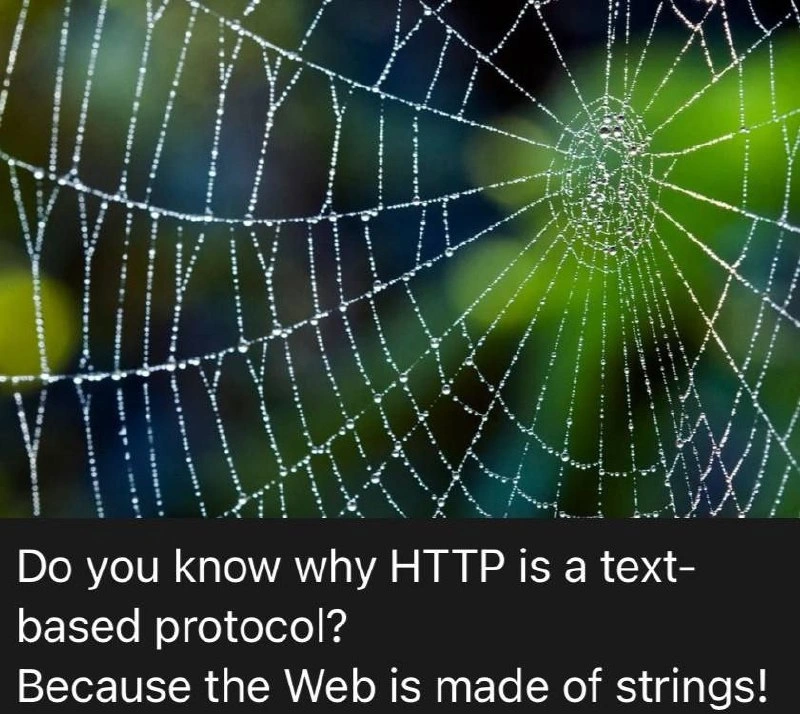
The punchline also riffs on the word “web.” We usually mean a spider web when talking about silk strings woven together – like the beautiful dewy web in the image. But here “Web” means the internet. It’s a play on words: a spider’s web is literally made of silky strands (strings), and the internet’s “web” is metaphorically made of text strings. It’s a nerdy joke combining Networking lingo with a visual pun. The humor comes from knowing that in tech, “string” = text, so saying the Web is made of strings is like saying the whole internet is built out of text messages. For a newcomer, just remember: a string is text data, and much of the Web’s data started out as human-readable text. That’s why this joke lands – it’s mixing a bit of computer science with a bit of dad-joke logic.
Oh, and about binary vs text: “binary” is the opposite of text in this context. Binary data is compact and meant for machines (think of it as raw bytes that look like gibberish to us, e.g., an image file or an encrypted message). Text is verbose but easy for humans to read (like a sentence). Early web protocols favored text so that developers could easily read and debug the messages. There’s an ongoing lighthearted debate in programming: Should we use text (for clarity) or binary (for efficiency) for data exchange? This meme winks at that debate in a fun way by personifying the Web as if it loves text so much that it’s “made of strings.”
Level 3: ASCII All The Things
The meme’s caption is a classic tech pun: HTTP – the HyperText Transfer Protocol – is famously a text-based protocol, and the joke claims “the Web is made of strings.” The image of a dewy spider web reinforces the gag by linking the World Wide Web to a literal spider’s web of silk strings. Technically speaking, early web protocols really did use plain text strings for communication. When your browser requests a page, it sends a human-readable command like GET /index.html HTTP/1.1 and receives responses starting with status lines like HTTP/1.1 200 OK. All of that is just ASCII text flying over the network (hence the tag ascii_over_the_wire). In other words, the web’s networking protocols were literally built on text.
This dual meaning of “web” and “strings” tickles developers who know the history. On one hand, a spider web is physically woven from silk threads (strings in everyday terms). On the other hand, the Web (as in WebDev) is woven from textual data – sequences of characters in protocols and pages. It’s a perfect string_protocol_pun. Seasoned engineers can’t help but smirk because the entire Web is kind of held together by text: HTML, CSS, JavaScript, and originally HTTP headers, are all just big blobs of text. We joke that the internet has strings attached – literally text strings everywhere!
Beyond the wordplay, there’s a nod to a real binary_vs_text_debate in networking. Old-school protocols like HTTP, SMTP (email), and FTP were designed to be human-readable. Why? In the early days, developers often debugged by typing commands manually (say via Telnet) and reading responses. Text-based protocols are forgiving – you can literally see what’s going on. Consider an HTTP request and response:
GET /index.html HTTP/1.1
Host: example.com
Accept: text/html
HTTP/1.1 200 OK
Content-Type: text/html
<!DOCTYPE html>
<html>
<body>Hello, Web!</body>
</html>
Everything above is plain text that any programmer can read or write. This text_based_protocols design made it easy to prototype and debug the Web in its infancy. However, text comes with overhead – it’s verbose, and parsing strings is slower for computers than parsing binary. As the Web grew, engineers debated “text vs binary” for performance. (Why send "200 OK" as letters when you could send a compact binary code?). In fact, modern HTTP/2 and HTTP/3 switched to binary under the hood for efficiency. But we developers still conceptualize web messages in text form – we write JSON APIs (text!), we inspect HTTP headers as plain text. The web_made_of_strings_gag lands because, despite all our advances, the Web’s soul remains textual.
Ultimately, this meme is funny to insiders because it’s literally true in a punny way. It connects a pains-of-development topic (text protocols vs binary protocols) with a play on words. The phrase “the Web is made of strings” sounds absurd until you realize: yes, our beloved Web mostly runs on strings (in the programming sense), just as a spider web is spun from silky strings. For veteran developers, it’s a groaner that also prompts a nostalgic nod – remembering that even our high-tech web began as simple lines of text. It’s string theory for the internet age, confirmed with a wink.
Description
The image is a two-part visual pun. The top half is a macro photograph of an intricate spider's web, with delicate strands covered in glistening dewdrops, set against a blurred green background of foliage. The bottom half is a solid black banner with white text that poses a question and provides a joke answer. The text reads: 'Do you know why HTTP is a text-based protocol? Because the Web is made of strings!'. The humor is a play on words, connecting the physical 'strings' of a spider's 'web' to the data type 'strings' that constitute the text-based communication of the World Wide 'Web' via HTTP. For developers, this is a classic, simple 'dad joke' that links a fundamental concept of internet architecture with a common programming data type through a visual metaphor

Comments
19Comment deleted
This joke was peer-reviewed and approved by the IETF in RFC 1996. It was later deprecated by HTTP/2, which proved the web is actually made of binary frames and broken promises of performance gains
Sure, binary framing saves bytes, but good luck grepping protobufs during a 3 a.m. incident - sometimes plain-text strings are the only life-line in the (spider) web
This is why senior engineers debug production issues at 3am - we're just following the spider's example of maintaining web infrastructure while everyone else is asleep, except our silk threads are actually just increasingly desperate curl commands and prayer-based deployment strategies
This perfectly captures why debugging HTTP feels like untangling a spider web at 3 AM - except the spider is a junior dev who thought nested JSON strings were a good idea, and the dew drops are your tears realizing the entire payload is double-encoded. At least when Tim Berners-Lee chose text-based protocols, he didn't have to deal with UTF-8 encoding issues in header values... or did he?
HTTP/2 went binary precisely to escape the regex nightmares of those sticky string webs
HTTP/1.1 stayed text so we could curl and grep outages - then HTTP/2/3 binary-framed it and we base64/JSON it back into strings, because in production it’s strings all the way down
Nice theory, but after HPACK and QUIC, that web of strings is just binary frames only curl -v and Wireshark truly understand
everyone gangsta until const char* isn't utf8 decodable Comment deleted
Do you know why Protobuf is a byte-based protocol? Because the Web creators bite its victims🥺 Comment deleted
TLDR:waste of time by bs Comment deleted
Wait until you see HTTP/2 and later Comment deleted
Actually, about half of the traffic now is binary http/2 and http/3 Comment deleted
thats what i meant as well Comment deleted
At first I thought this was some sort of a headline of an article Comment deleted
Ofc i fell for it Amk Comment deleted
Let me guess. Rick Astley photo? Comment deleted
Yep Comment deleted
Only few photos would work so well I think. What is Love with that meme clip from SNL comes to mind. Comment deleted
Its looks like captcha: select all squares with rick rofl Comment deleted