Crypto Gamification: Tapping a Pizza for Imaginary Coins
Why is this Blockchain meme funny?
Level 1: Shiny Coins Over Chores
Imagine you have some important homework to do, but on your phone there’s a silly game that gives you a gold coin every time you click a picture of a pizza. 🍕 It doesn’t give you real money or anything useful — just a bigger and bigger number of pretend coins. Still, it feels really fun to see that number go up! So instead of doing your homework, you keep tapping the pizza to collect more shiny coins. You even start feeling proud that you’ve got millions of these make-believe coins, more than some of your friends. Meanwhile, your homework (like cleaning your room or studying for a test, which are your real goals) is sitting unfinished. This meme is joking about that exact feeling for a software developer. The developer’s “homework” is their work goals (called OKRs, kind of like big tasks from their boss), but they got hooked on a pointless phone game about collecting Notcoins. It’s funny because we all understand it’s goofily relatable – sometimes doing a fun, easy thing (collecting pretend points) can feel more satisfying than doing the hard, important thing we’re supposed to do. In simple terms: chasing an imaginary reward can trick our brain into feeling happy, even if deep down we know it’s just for laughs. That contrast – between what we should do and what we want to do because it’s fun – is what makes the scenario so amusing.
Level 2: Tap-to-Earn 101
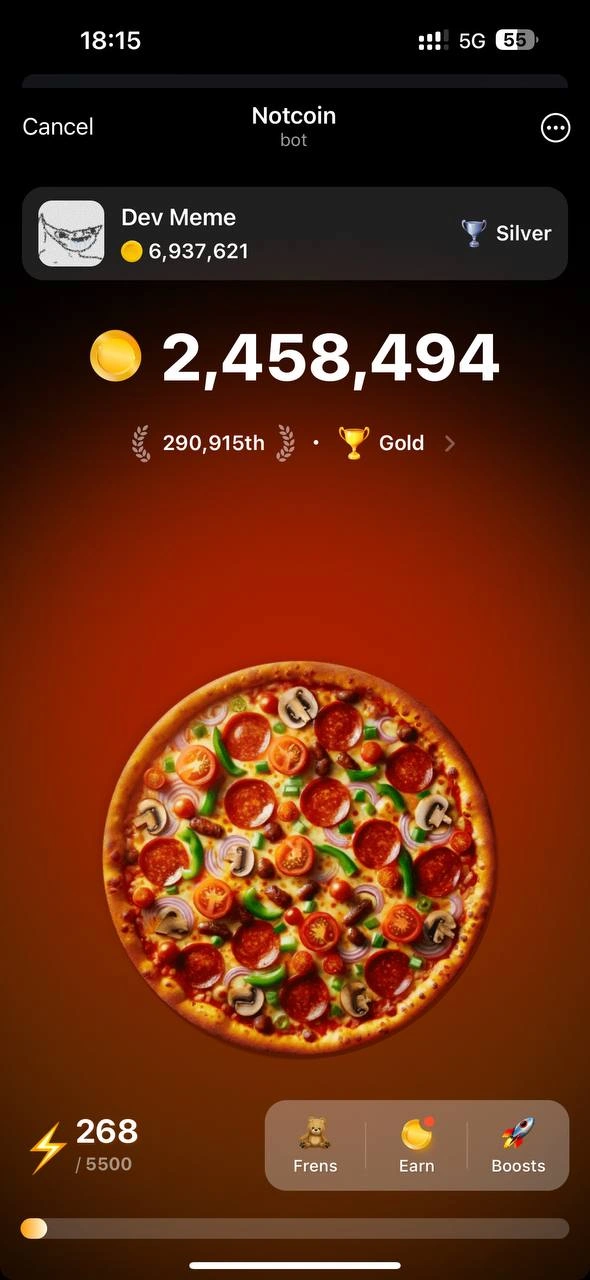
Let’s break down what’s happening for a newer developer or someone not deeply into crypto or mobile games. The meme shows a Telegram bot called “Notcoin” that turns collecting virtual coins into a game. Telegram is a popular messaging app (especially among tech folks and crypto enthusiasts) that lets you interact with bots — automated programs — as if they were chat friends. Here, the Notcoin bot has a whole mini-game UI: you tap a pizza image to “earn” coins. This concept is riffing on idle clicker games, where the main goal is to tap or perform a simple action repeatedly to accumulate points or currency. Those games are famously addictive because each tap gives you a small reward, starting a feedback loop: you tap, you get coins, a little dopamine (a happy brain chemical) is released because yay number go up, which makes you want to tap again.
Now, “Notcoin” is a punny name. In crypto slang, a “coin” usually means a cryptocurrency or token. By calling it Notcoin, they’re saying “this isn’t a real coin.” It implies the whole thing is a joke — none of these coins have any actual monetary value or blockchain behind them. It’s purely for fun. (It might also poke fun at the explosion of altcoins; there are so many weird named coins that “Notcoin” could fit right in!). The meme’s title “Grinding 2.4M Notcoins” uses gamer lingo: grinding means doing repetitive tasks in a game to gain levels or loot. So the dev in question has ground out 2.4 million of these fake coins. That’s a huge number, but in context, it’s only enough for rank 290,915th! Clearly, a lot of people or at least the game’s design allows enormous totals — which is part of the joke about cryptocurrency trends: often you’ll see coins with billions of supply, so holding millions might still be trivial.
Let’s talk about OKRs. This stands for Objectives and Key Results. It’s a goal-setting framework used in companies (pioneered at Intel, popularized by Google) where you have an objective (like “Improve app performance”) and key results (measurable outcomes like “reduce page load time by 20%”). OKRs are basically what a developer’s real work is measured by each quarter. The meme suggests developers should be focusing on those, but instead they’re getting their sense of accomplishment from this coin-clicking game. In plainer terms: imagine your boss set a goal for you to fix 10 bugs this week (that’s like an OKR). But instead you’re proud that you clicked a pizza 1,000 times and got a high score. It’s humorously highlighting misplaced priorities, something many of us can relate to when we procrastinate with something fun instead of doing work or study.
The image has some Mobile Development design cues to sell the parody:
- The big coin number “2,458,494” in bold white with a coin icon 🟡 next to it looks like a classic scoreboard or currency counter in an app. It’s center stage to constantly motivate the player (“look how rich in Notcoins you’re getting!”).
- Underneath it says “290,915th • 🏆 Gold.” That shows the player’s rank (290,915th place globally) and a trophy indicating their tier (Gold tier). Many games use tiers like Bronze, Silver, Gold, Platinum rankings. Here Gold sounds prestigious until you see that huge rank number – then it’s just funny. It’s referencing a dev meme leaderboard that’s totally for bragging rights. No real prize except maybe a shout-out or personal satisfaction.
- The pizza graphic is actually very significant: it’s the target you tap to earn coins. Why pizza? In crypto lore, the first real-world transaction using Bitcoin was someone buying two pizzas for 10,000 BTC back in 2010. That became a famous story (celebrated as “Bitcoin Pizza Day”). So pizza is kind of an inside joke symbol in crypto culture for spending coins. Here they twist it: you aren’t spending coins to get pizza, you’re tapping a pizza to get coins! It’s also just a funny, friendly image – much more amusing than, say, a gold coin graphic – and it emphasizes this isn’t serious. It’s a virtual pizza token generator. And who doesn’t like pizza?
- The bottom status “⚡ 268 / 5500” is an energy bar. In many mobile games, you can’t just play infinitely; you have an energy that depletes with actions and refills over time (or you pay to refill in some monetized games). Here the player has 268 energy left out of 5500 total – meaning they used up 5232 energy presumably tapping away. This detail shows how long they’ve been at it. It’s both a realistic game mechanic and part of the joke: the dev has burned through thousands of actions on this. The lightning bolt is just a common symbol for energy (and possibly a pun on crypto’s Lightning network, but that’s a bit advanced).
- The buttons Frens, Earn, Boosts: These likely correspond to parts of the game:
- Frens (with a teddy bear icon 🧸) probably shows your friends or invite list. “Frens” is intentionally spelled cutely; in many online communities (especially like Dogecoin or meme groups) people say “frens” to mean buddies, to give a wholesome, non-serious tone. The teddy bear reinforces the friendly, playful vibe. Maybe clicking that shows which friends are playing, or gives you a referral code you can share (referrals are huge in spreading crypto games and airdrops – invite X friends, get more coins!).
- Earn (with a crescent moon 🌙 icon): likely the main screen (which we’re seeing). The moon symbol is another little joke: in crypto slang “to the moon!” means we hope the price will go super high. Here, tapping is how you “earn”, and the moon icon winks at the idea that you’re hoping your Notcoin count goes to the moon (even if it’s value-less).
- Boosts (with a rocket 🚀): rockets also symbolize going to the moon or speeding up. In games, boosts might mean temporary power-ups or bonuses. For example, a boost might double your coin gain for 60 seconds, or refill your energy. It could also be something you get by spending a premium currency or perhaps just another in-game mechanic to keep players engaged. Given the rocket, it’s definitely about accelerating your progress. In a parody sense, maybe these are fake microtransactions (“spend 100 Notcoins to get a Jetpack and earn faster!”). It mocks how free games often have these enticing offers to progress quicker.
On the blockchain/crypto side of things, the meme is filed under CryptocurrencyTrends. Indeed, there was (and is) a trend of crypto gamification – things like airdrops and “play to earn” games. An airdrop is when a crypto project gives out free tokens, often in exchange for small tasks (like join a Telegram group, retweet something, or just as a random giveaway to holders). People would clamor to do these trivial tasks to get tokens that might one day be valuable. This meme plays on that idea. By providing a Telegram link, it’s mimicking an airdrop invite: “hey join us and you too can get some tokens (that are actually worthless)”. The line “pointless and meaningless, but if you want to join 125 of us – welcome 😂” reads exactly like a friendly developer saying “We know this is silly, but it’s a fun little club.” It’s that mix of ironic and earnest. 125 people isn’t a lot by internet standards, but the fact they mention it implies this is a small community joke that’s gaining traction – which itself is funny because it’s like a mini hype circle for nothing.
For someone newer to development or these concepts:
- Dopamine loop: Every time you accomplish something small (like see a number increment or get a trophy badge), your brain gives you a tiny reward in the form of dopamine, a neurotransmitter associated with pleasure and motivation. Games are designed to trigger this frequently so you stay hooked. Here, every tap giving a coin is that kind of loop. It’s psychologically rewarding, even if logically you know it’s meaningless. Developers often use the term “dopamine loop” to describe why certain apps (social media, games) are so addictive — they’ve turned user actions into a series of mini-rewards.
- Gamification: This is the practice of taking game-like elements (points, levels, leaderboards, challenges) and putting them into non-game contexts. Companies gamify tasks to motivate employees or users. For example, a learning app might give you XP for completing lessons, or a project management tool might have achievement badges for closing issues. Here, though, the gamification is in a place it arguably shouldn’t be – in a developer’s workflow/day, distracting them from real tasks. The meme implies the devs essentially gamified their own procrastination.
- MobileDevelopment angle: If you’re curious, building something like the Notcoin bot UI might involve using Telegram’s Bot API combined with a web interface. Telegram bots can send interactive messages, or even launch mini-games (Telegram has a Gaming Platform where you can create HTML5 games that run inside the app). The screenshot looks very app-like, so it might be an actual mini-game launched via the bot. That means someone did some front-end work (HTML/CSS/Canvas for that pizza and layout) and back-end work (the bot logic in Python, Node.js or whichever language, to handle taps, energy, leaderboards). It’s a fun mini-project that touches on both mobile UX and server logic. It’s not on an actual blockchain – more like a simulation for laughs – but the development of it bridges a few tech domains (messaging app development, simple game design, database for tracking scores, etc.).
- Blockchain vs Notcoin: A real blockchain coin (like Bitcoin or Ethereum) would require a decentralized network, miners or validators, etc. Notcoin by contrast is likely just a number in a database that the bot increments when you tap. No decentralization, no cryptography beyond maybe your Telegram ID linking to your score. The choice to call it Notcoin is to exaggerate how every silly coin idea does not need a real blockchain – it can be faked easily. It’s commentary on how sometimes the hype is more about the idea of a coin than the technology.
To summarize this level: the meme is pointing out in a playful way that developers, who deal with serious tech and complex projects, are not immune to the simple psychological tricks that make mobile games and crypto-fads so engaging. It teaches a kind of lesson: even if something is “pointless and meaningless” in objective terms, it can still feel rewarding and become a shared fun activity (especially if you throw in some techno-buzzwords and social competition). For a junior dev, it’s a peek into both office culture (OKRs and procrastination) and the intersection of tech trends (gaming and crypto). Plus, it’s a gentle reminder: don’t always chase the shiny metrics – whether they’re Notcoin points or meaningless GitHub stars – unless you’re okay with the fact it’s just for kicks.
Level 3: Proof-of-Pizza Work
At the highest level, this meme satirizes the blockchain hype and the way human psychology can be hijacked by gamification. In the screenshot, a developer is grinding “Notcoin” tokens on a Telegram bot – essentially a tap-to-earn game where you repeatedly tap a floating pizza to earn virtual coins. It's a parody of crypto “play-to-earn” mechanics: instead of mining with complex algorithms, the dev is mining by literally tapping pizza slices on a mobile screen. This is a tongue-in-cheek Proof-of-Work scheme – but here the proof is just proof of pizza clicking. The big 🟡 2,458,494 Notcoins count and the rank 290,915th (Gold trophy) exaggerate how absurdly inflated these rewards are. Millions of points yet only a mid-tier rank implies everyone is chasing meaningless high scores. This lampoons real cryptocurrency trends where people boast huge token amounts that ultimately mean nothing in practical terms.
From a senior developer’s perspective, the humor comes from contrast: companies push developers to meet OKRs (Objectives and Key Results) – formal, data-driven goals – but here the dev is deeply invested in a dopamine loop of a trivial mobile game. The phrase “dev dopamine loops beat OKRs every time” resonates because even experienced engineers (who know better) can get addicted to these gaming culture feedback loops. It’s an open secret that a quick hit of reward (a coin count going up, a trophy icon) can feel more immediately satisfying than slogging through a long-term project milestone. In other words, instant gratification from a game can quietly overpower corporate productivity metrics. Many veteran devs will chuckle (perhaps a bit bitterly) recalling times when a silly side-quest – whether an online game, a nerdy competition, or even obsessively optimizing trivial code – felt more compelling than the actual work objectives.
The meme’s visual design nails the parody:
- The orange gradient background and the photorealistic pizza resemble a mobile game UI (evoking that fiery “hot pizza” excitement and some nostalgia for the famous Bitcoin Pizza story – when 10,000 BTC bought two pizzas, the first real crypto purchase). Here, pizza is literally the token icon, a cheeky nod to “virtual pizza token” economics.
- The header shows “Notcoin bot” in Telegram with “Dev Meme 🟡 6,937,621 🏆 Silver.” This looks like a leaderboard or user status – apparently the user
Dev Memehas 6.9 million coins and a silver trophy, meaning even more grinding has happened. Leaderboards are classic in gaming and now even in dev communities (think GitHub contribution charts or Stack Overflow reputation). They trigger competition. Being 290,915th place with a Gold Trophy suggests there are hundreds of thousands of participants – hyperbole to underscore how common yet pointless this grind is. It mirrors crypto token leaderboards and Reddit karma — huge numbers that largely serve ego. - The lightning bolt “268 / 5500” energy bar at the bottom is a direct reference to mobile game mechanics. In free-to-play mobile development, you often have an energy limit (like 5500 max energy) and each action (each pizza tap) uses some energy. The player has 268 left, meaning they've burned through a ton of “energy” already clicking away. That lightning bolt might also slyly nod to the Bitcoin Lightning Network (a scaling solution), but here it’s just a sign of how much “juice” you have to keep playing. This is comedic to senior devs who know that real blockchain mining burns actual electricity, whereas here the dev is burning finger energy and time for a fake coin – a sarcastic take on crypto mining’s wastefulness.
- The three buttons “Frens,” “Earn,” “Boosts” with cute icons (teddy bear, moon coin, rocket) encapsulate the gamified social hooks and monetization tricks. “Frens” (intentionally spelled in meme-slang) likely lets you invite friends or view a buddy list, mirroring how crypto projects often grow via referrals (“gm frens!” is common lingo in crypto communities). “Earn” presumably is the main gameplay – tapping that pizza for coins (notice the moon icon, as in “to the moon” – another crypto meme implying skyrocketing value). “Boosts” (with a rocket) implies power-ups or ways to accelerate earning – maybe by spending something or achieving milestones. This button trio shows the full cycle: social virality, core action loop, and progression boost – exactly how addictive mobile apps keep users hooked. Senior devs recognize these patterns from countless apps and maybe sigh because they work so well at stealing attention.
The meme text invites others: “Pointless and meaningless, but if you still would like to join 125 of us – welcome 😂”. This self-aware humor is gold for experienced devs. It mocks the very thing it’s doing: acknowledging the Notcoin grind has no meaningful purpose (no real money, no career benefit, nothing tangible), yet admitting it hooked 125 developers anyway – a mix of FOMO and camaraderie. It’s reminiscent of those times in tech where everyone jumps on a silly bandwagon (like a viral Twitter coding challenge or an office Fantasy Football league) purely for the dopamine and community. The laugh emoji 😂 underscores that they know it’s ridiculous. This kind of herd behavior – engineers collectively partaking in something ostensibly “beneath them” intellectually – is ironically common. It points to a deeper insight: no matter how advanced our field gets, we’re all humans who can be enticed by gameified rewards and social inclusion. In fact, startups and tech companies frequently try to harness this: think of internal leaderboards for code commits, hackathon prizes, or “employee of the month” gimmicks – they’re trying to channel that same competitive dopamine energy toward OKRs. But as this meme jokes, a silly Telegram crypto-clicker might do it more effectively than official corporate incentives.
On a technical tangent, a savvy developer might also notice how centralized this all is despite the crypto gloss. Blockchain ethos is about decentralization, but here Notcoin likely isn’t on any blockchain at all – it’s just a Telegram bot with a database. Essentially, pressing “Earn” probably sends a /tap command to the bot, and the bot’s server responds with your new coin balance. No smart contracts, no real crypto – just the aesthetics (coins, trophies, “mining” by tapping). This highlights a truth in many so-called cryptocurrency trends: sometimes it’s all theater. Plenty of “crypto” games or airdrops are basically centralized apps using crypto terminology. A seasoned engineer finds that contrast hilarious. The meme creator doubling down with an actual Telegram invite link (in the post message) is the meta-joke: it’s both a meme and a real mini-game you can join, blurring the line between joke and reality (a very dev-humor thing to do). It’s almost like an XKCD comic come to life as a group activity.
In sum, Level 3 appreciation of this meme comes from recognizing the multiple layers:
- It’s poking fun at developers’ susceptibility to distraction (the “dev dopamine loop”).
- It skewers the shallow allure of crypto gamification (huge numbers, meaningless tokens, silly names).
- It acknowledges the disparity between what devs should care about (OKRs, real productivity) and what they actually gravitate to when bored or stressed (quick wins, fun competition).
- And it does all this by cleverly combining a Blockchain parody with a MobileDev game interface, topped with a delicious inside joke (a literal pizza reference baked into a crypto meme).
A battle-scarred senior engineer would likely chuckle and then share this around, possibly remarking, “This is why my sprint tasks are late – I’ve been busy mining 🍕 notcoins.” And they’d only be half joking!
Description
This is a screenshot of the user interface for 'Notcoin,' a viral tap-to-earn game that runs as a bot within the Telegram messenger app. The screen has a dark theme with a fiery orange-red gradient background. At the top, the player profile 'Dev Meme' is shown with a score of 6,937,621 and a 'Silver' league trophy. The main balance displays a large number, 2,458,494, next to a gold coin icon. Below this, a rank of '290,915th' and a 'Gold' league trophy are visible. The central interactive element is a large, detailed, and appetizing image of a pizza with various toppings, which the user taps to 'mine' Notcoins. At the bottom, an energy meter shows '268 / 5500', indicating the remaining taps available. Three buttons, 'Frens', 'Earn', and 'Boosts', offer social, earning, and upgrade options. The original post's caption, 'Pointless and meaningless,' highlights the self-aware irony of engaging in such a simple, repetitive task. For senior developers, this meme is a commentary on procrastination, the allure of simple gamified loops as a distraction from complex problem-solving, and the hype cycles common in the crypto and Web3 space
Comments
12Comment deleted
I'm just stress-testing the database with high-frequency writes. Each pizza tap is a transaction, and my carpal tunnel is the proof-of-work
Proof-of-Stake? Nah - Proof-of-Swipe: five minutes of thumb-tapping just netted me more Notcoin than our last quarter’s technical debt budget
After 20 years of optimizing database queries and implementing sophisticated caching strategies, here I am at 18:15 tapping a virtual pizza to earn imaginary coins, wondering if this is what we meant by 'distributed systems' and 'proof of work'
Ah yes, the inevitable evolution of cryptocurrency: from 'decentralized financial revolution' to 'tap a pizza 5,500 times for tokens.' Nothing says 'disrupting traditional finance' quite like implementing the same dopamine-driven engagement loops that mobile game developers perfected a decade ago - complete with energy systems, leaderboards, and referral mechanics. At least when we mine Bitcoin, we can pretend the electricity waste serves a cryptographic purpose; here we're just rate-limiting pizza taps. The real innovation? Convincing 6.9 million developers that manually clicking for fractions of a cent is somehow more dignified than writing a bot to do it - which, let's be honest, half of them probably already did
This proof‑of‑tap UX turns rate limiting into engagement; PMs celebrate Gold tier while SREs call it backpressure
Web3 innovation in 2025: a proof‑of‑tap consensus where TPS is capped by my thumb’s QPS and a 5,500‑unit energy quota - basically API rate limiting wrapped in pizza‑themed tokenomics
6M taps in Dev Meme bot before merging that PR - true blockchain incentives
How to waste your time Comment deleted
AI pizza,,,, Comment deleted
throwable ordnance Comment deleted
Click game from CERN ftw. https://particle-clicker.web.cern.ch/# Comment deleted
cookie clicker Comment deleted