A Four-Hour Debugging Session Caused by One Extra '9'
Why is this Dependencies meme funny?
Level 1: One Extra Digit
Imagine you and your friend are each given what you think is the same secret code to open a treasure box. The code is a long string of numbers, and it looks identical on both your papers at a quick glance. You both try to open the box with your codes, but weirdly, your friend’s box pops open and yours doesn’t. You two spend a long time scratching your heads. You compare everything about your boxes, check the locks, even swap boxes, and nothing makes sense – why would one open and not the other if the codes are the same?
After hours of frustration, you sit down and carefully compare the two code papers digit by digit. Finally, you spot it: on your paper, the number has one extra digit “9” at the very end that your friend’s code doesn’t have. It was so tiny and the rest of the numbers were all 9’s too, so it practically blended in. That one little difference meant your key code wasn’t the exact same as your friend’s code, so your lock stayed shut. Boom! – suddenly everything makes sense. You’re relieved to figure it out, but also a bit annoyed that such a tiny detail cost you so much time.
In this story, the treasure box is like a computer program build, and the secret code is like the version number of a library the program uses. The moral is simple: even a one-digit difference in a long sequence can completely change the outcome. It’s like having almost the right key, but not quite – so close, yet so far! The reason it’s funny (after the fact) is because the problem was so minuscule and sneaky. It teaches us that sometimes big problems can come from the smallest hidden mistakes.
Level 2: Spot the Difference
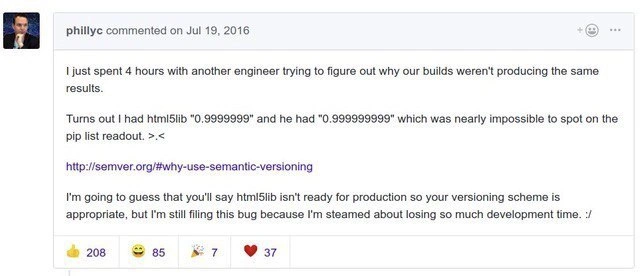
Let’s break down what happened in simpler terms. Two developers expected their software builds to be identical, but the results were different. Why? Because one of their dependencies (an external library their project uses) was a different version on each of their machines. Specifically, they were using a Python HTML parsing library called html5lib. Developer A had html5lib version 0.9999999, while Developer B had version 0.999999999. At first glance, those look practically the same. In fact, if you list your Python packages with the pip list command, the output for html5lib might look almost identical for both developers except for that one extra digit. It’s like a digital game of “spot the difference” — and initially they didn’t catch it.
In programming, version numbers usually follow a pattern to convey meaning. A common standard is Semantic Versioning (SemVer), where a version is three numbers like 1.2.3 (Major.Minor.Patch). For example, 1.2.3 -> 1.2.4 means a small bug fix, 1.2.3 -> 1.3.0 means a new feature added (but backward-compatible), and 1.2.3 -> 2.0.0 means a breaking change. This scheme helps developers quickly see how big an update is. However, in this case the library’s versions were 0.9999999 and 0.999999999 – which don’t fit the usual X.Y.Z format at all. They’re effectively just long decimal-like strings. Such a versioning scheme is highly unusual and not very informative. The maintainers probably kept the library at 0.x because they felt it wasn’t “1.0” ready (in SemVer, a 0.y.z version often implies “still in development, things can change”). But instead of using a clear progression (like 0.1, 0.2, … 0.10), they kept stretching the number with more 9’s. It’s technically a new version, but it’s nearly impossible to tell apart from the previous version by name alone.
So the two developers had slightly different Python dependency versions without realizing it. This led to non-deterministic builds, meaning the same project gave different results on their two systems. When they say “our builds weren’t producing the same results,” it implies that something in html5lib’s behavior or output was different between the two versions. Perhaps one version had a bug fix or a change that the other did not. Such differences can cause tests to fail on one machine and not on another, or data to be processed differently. It’s a frustrating situation because everything else in their code and setup was presumably the same — the only culprit was this almost invisible discrepancy in a third-party library.
For a relatively new developer, this scenario is a lesson in package management and the importance of consistency. If you don’t pin your dependencies (meaning, specify an exact version to use for each library), two installations of what you think is “the same” environment might actually pull slightly different library versions. In Python, one common practice is to use a requirements.txt file or Pipenv/Poetry lockfile to lock dependency versions so everyone is using the exact same ones. Here, it sounds like that wasn’t done, or the specification was loose enough to allow html5lib to update to a version with one more 9 for one developer. The result? A confusing bug that wasn’t in the app’s own code at all, but in the environment.
The meme’s author was so upset about losing 4 hours that they even filed an issue (a bug report) with html5lib’s maintainers. They linked to the official Semantic Versioning guidelines in that issue to make a point: please use sensible version numbers! The maintainers might argue that “html5lib isn’t 1.0 yet, so SemVer doesn’t apply strictly,” but from a user’s perspective, this was a Debugging and Troubleshooting nightmare. It’s a perfect illustration of Dependency Management gone wrong: when version numbers are not clear or when environment setups drift apart, you can end up chasing a phantom problem for hours. Many developers reacted with 👍 and 😆 on that issue because they’ve been through similar debugging frustration – it’s the kind of ordeal you only laugh about after you finally find the cause.
Key takeaways for a junior dev: Always be mindful of your dependency versions. If something works on one computer but not another, check that both are using the same versions of all libraries. An extra digit in a version string can hide like a needle in a haystack, but it can completely change program behavior. Tools like pip freeze (which lists exact installed package versions) and adhering to semantic versioning conventions exist exactly to prevent these “nearly identical version” mix-ups. This story is a gentle nudge to always double-check the basics during troubleshooting — sometimes the bug isn’t in your code at all, but in the subtle differences of your setup.
Level 3: Off by One Nine
The pain in this meme hits any seasoned developer right in the chest. Two engineers spent half a day chasing ghosts in their build outputs, only to discover a microscopic difference: one had html5lib version 0.9999999 and the other had 0.999999999. Yes, an extra single '9' in the version string – practically invisible – was the culprit. It’s a classic DependencyHell story: a near-invisible version diff that silently undermines the assumption of a deterministic build. This is the kind of debugging saga where you double-check everything from code to config, tearing your hair out, before finally squinting at the pip list and catching that one character discrepancy. Of course it turned out to be a trivial version mismatch – after hours of DebuggingFrustration.
Developer A: "Why are my results different? We’re using the same code!"
Developer B: "I don’t get it either... everything looks identical."
(Four hours later)
Both: "Oh, you've GOT to be kidding me – it's the version number." >.<
The humor (and horror) here comes from how absurdly insignificant the difference appears at first glance. Both versions are "0.something" with a parade of 9s – one is 0.9999999, the other 0.999999999. It’s like the version numbering equivalent of Where’s Waldo, and Waldo is a single digit long lost in a sea of 9’s. In theory, those two version strings suggest different releases of the html5lib library, but the naming scheme is so nonsensical that it’s nearly impossible to tell them apart without careful character-by-character inspection. For a senior dev, this scenario triggers war flashbacks of "works on my machine" bugs and endless diff comparisons. A tiny version discrepancy can lead to build non-determinism, meaning two machines produce different outputs despite running "the same" build process. Reproducible builds? Not today.
The comment in the meme even links to the Semantic Versioning spec with a bit of tongue-in-cheek annoyance. Why? Because 0.9999999 vs 0.999999999 flagrantly violates semantic versioning principles and is basically a versioning anti-pattern. Proper Semantic Versioning (SemVer) exists to prevent exactly this kind of confusion. Under SemVer, an update that changes behavior or results should bump a clear version segment (like going from 0.9 to 0.10, or incrementing a patch number), not sneak in as an extra hidden digit in a long decimal. By using a nearly indistinguishable version scheme, the maintainers of html5lib put users in a tough spot: the library might not be “ready for production” (hence still on 0.x versions), but the lack of a sane versioning scheme snubbed any hope of quickly spotting mismatches. As the frustrated engineer guessed, the maintainers likely rationalize that pre-1.0 versioning can be wild (0.x means “no guarantees”), but in practice this numbering approach is a nightmare for dependency management.
This scenario is painfully relatable: you lock yourself in a debugging_tunnel checking everything from your code logic to your environment variables. You wouldn’t immediately suspect that two versions labeled 0.999999x could behave differently. A seasoned dev might eventually recall past burns from such package management mishaps and run pip freeze or compare installed packages line by line. And bingo – there it is, a one-digit version difference hiding in plain sight, responsible for hours of lost productivity. The reactions (👍 208, 😆 85, etc.) on that GitHub comment confirm how absurdly common this feels — dozens of engineers have felt this exact pain and can only laugh (or cry) in solidarity. It’s a mix of “I can’t believe this happened” and “Oh, I absolutely believe this happened”. In the end, the meme’s punchline isn’t a traditional joke setup, but a cathartic battle scar from the field: one rogue digit in a dependency version can steal half your day, and you’ll never get those hours back. This is why experienced devs preach “pin your dependencies” and use lockfiles — nobody wants to be Sherlock Holmes peering at pip list output for stray 9’s ever again.
Description
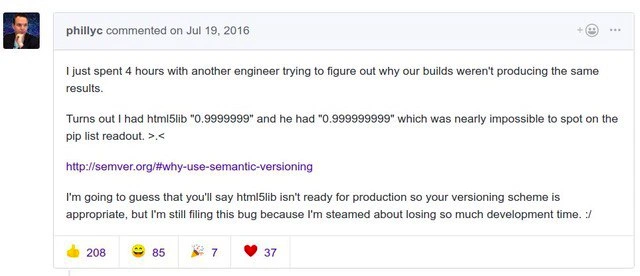
A screenshot of a GitHub comment from user 'phillyc' dated July 19, 2016. The user recounts spending four hours with another engineer trying to resolve inconsistent build results. The text of the comment reads: 'I just spent 4 hours with another engineer trying to figure out why our builds weren't producing the same results. Turns out I had html5lib "0.9999999" and he had "0.99999999" which was nearly impossible to spot on the pip list readout. >.<'. The comment includes a link to semver.org and ends with a frustrated note about losing development time. This image captures a quintessential developer nightmare: the 'works on my machine' problem caused by minuscule, hard-to-spot differences in dependency versions. It's a powerful and painful illustration of why semantic versioning (SemVer) and locked, reproducible builds are not just best practices but essential for sanity in collaborative software development. The absurdity of the version number itself makes the situation both tragic and hilarious
Comments
8Comment deleted
This is why we need `requirements.lock` files. Relying on a human to spot the difference between seven and eight nines is like asking them to find a missing semicolon in a minimized JavaScript file
In numerical analysis, 0.9999999 ≈ 1; in dependency hell, it ≈ four billable hours and a post-mortem on why we still don’t have a lockfile
The only thing worse than debugging a race condition is debugging a version number that's asymptotically approaching 1.0 but never quite getting there
Versioning with nines like it's availability: 0.9999999 is seven nines of confidence and zero nines of semver
Four hours debugging identical builds, only to discover the difference was a single '9' in a version string that looked like someone's attempt at floating-point precision cosplay. This is why senior engineers develop trust issues with dependency management and an unhealthy obsession with lock files - because somewhere, right now, a 0.9999999 and a 0.99999999 are plotting to ruin someone's Friday deployment
When your versions look like floats, CI behaves like IEEE‑754: one ULP off, four hours gone
Build drift ate our day; culprit: html5lib 0.9999999 vs 0.999999999 - when your version number looks like a float, you’re doing IEEE‑754 release management, not semver
SemVer: where one extra 9 turns reproducible builds into a 4-hour optical illusion team-building exercise