Skip to content
DevMeme
311 of 7435
The Elixir to Vue Bait-and-Switch Fueled by Programming Socks
DevCommunities Post #369, on May 14, 2019 in TG

The Elixir to Vue Bait-and-Switch Fueled by Programming Socks

Why is this DevCommunities meme funny?

Level 1: Magic Socks Surprise

Imagine you ask for something magical to help you do one thing, but it ends up making you really good at something else. Think of a kid who wishes for special shoes to become a great soccer player. But when they put on the magic shoes, surprise! they turn into an amazing basketball player instead. It’s not what they planned, but now they’re super skilled in a different game. It’s funny and happy because they still got a cool ability — just not the exact one they asked for. In the same way, this meme is joking that someone wanted help to code in one language, but the “magic” made them a superstar in another coding field. It’s a silly twist, but everyone’s smiling in the end because they’re awesome at what they do, even if it wasn’t the original plan.

Level 2: Socks, Elixir, and Vue 101

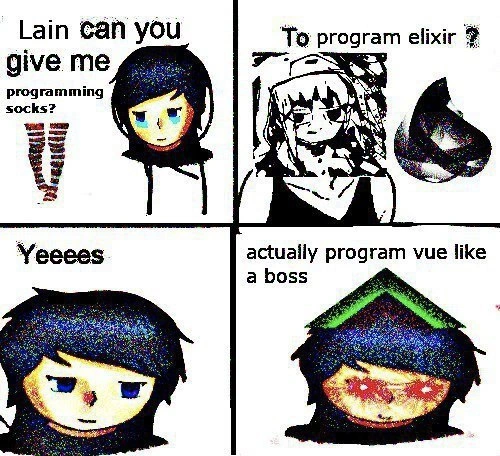
Let’s break down what’s going on for someone new to these terms. Elixir is a programming language used mainly for back-end development (the part of an application that runs on servers, behind the scenes). Elixir is known for being functional (which means it treats computations like solving math problems: you call functions, get outputs, and avoid changing things in place). It runs on the Erlang VM, making it great at handling lots of tasks at the same time (concurrency). People learn Elixir to build things like web servers that can handle many users or real-time chat systems. Its logo is a purple droplet shape – you can see that in the meme’s second panel next to the anime girl.

Vue.js (often just called Vue) is something entirely different: it’s a front-end JavaScript framework. Front-end means the code for the parts of an app or website that you actually see and interact with in your browser (buttons, text, forms, etc.). Frameworks like Vue help developers build those interactive user interfaces more easily. Vue lets you break a webpage into components (think reusable building blocks) and use a reactive approach – if your data changes, the page updates automatically in those spots. Vue’s logo is an upside-down green and dark-blue triangle (sort of like a letter V); in the meme’s last panel, Lain has this Vue logo on her head like a hat, signaling “now I’m all about Vue!”.

Now, the person in the meme originally says they want programming socks “to program Elixir.” The joke here is that Elixir and Vue are from two different worlds of coding. Back-end vs front-end is a big theme: back-end (Elixir’s side) is about the behind-the-scenes logic on servers, while front-end (Vue’s side) is about the visuals and interactions in a user’s web browser. The meme’s humor comes from expecting one and getting the other. It’s like a newbie developer saying, “I’m going to learn this cool server language!” but then they end up spending their time building pretty web pages with a JavaScript framework instead. That mismatch is the punchline. Still, in the final panel, it says “actually program Vue like a boss,” which suggests that even though they didn’t plan to, they became really good at using Vue.js. (“Like a boss” is slang for doing something confidently and extremely well.) So basically, they asked for one kind of coding power-up but got another, and it turned out awesome anyway.

Let’s talk about programming socks. If you haven’t heard this term, it might sound bizarre! It’s an inside joke in developer communities. “Programming socks” usually refers to fun, often striped knee-high socks that some coders jokingly wear or talk about as if it boosts their programming skills. Of course, socks don’t actually make you a better coder, but it’s a playful superstition or meme. Think of it like a quirky good-luck charm. In online coding humor, you might see someone say, “Time to put on my programming socks and crush this bug,” accompanied by a picture of funky socks. It’s all in good fun. In the meme, the person asks Lain for these mythical socks to help them code in Elixir. This sets the stage in a silly way: they’re basically saying, “Give me a magical boost for my programming.”

And who is Lain? Lain is the girl you see in every panel. She’s the main character from an old cyberpunk anime called Serial Experiments Lain (from the late 90s). The show is all about computers, the internet (called “the Wired” in the story), and blurring reality, so Lain has become an icon in techie and anime circles. People love to use her image in anime-in-tech memes because she kind of represents the mysterious power of the digital world. There’s a meme template that goes “Lain can you give me X?” where Lain usually grants the wish with some twist. In our meme, the request is the socks to code Elixir, and Lain’s “Yeeees” with a sly face implies she’s up to something. By the last panel, Lain essentially says, “Sure, here you go – now you’re amazing at Vue.js!” It’s a goofy gotcha. The glitchy art style of the panels (distorted pixels, high contrast) is also a nod to Lain’s aesthetic and the whole vaporwave/techno vibe in these kinds of memes.

So to recap in simple terms: The meme shows a programmer asking for a special boost (programming socks) to learn one thing (Elixir, a back-end coding language). The twist is that the “boost” ended up making them master something else entirely (Vue.js, a front-end framework). It’s funny to developers because we often have grand plans to learn some hot new language or technology, but then we get pulled into working with another technology instead. In this case, the result wasn’t bad at all — they became a Vue pro, “like a boss.” The meme humorously celebrates that unexpected outcome.

Level 3: Functional Dreams, Front-End Reality

This meme is a multi-layered joke mixing programmer meme culture with tech-stack irony. In the first panels, a developer asks the digital goddess Lain for programming socks so they can code in Elixir – a modern functional programming language known for its elegant concurrency (thanks to the Erlang VM). Lain smugly says "Yeeees," and by the final panel we get the twist: instead of empowering Elixir coding, the wish resulted in overpowered Vue.js skills like a boss. Lain is shown wearing the green/navy Vue logo as a hat, eyes blazing red lasers (the meme sign for “unstoppable mode”). The humor comes from this bait-and-switch between a developer’s lofty intention and the actual outcome. It’s a classic expectation vs. reality gag, amplified by the absurdity of anime MemeCulture and magical thinking in programming.

Experienced devs chuckle because they recognize a truth here: our career plans often collide with reality. You get hyped to master a cool language like Elixir (lured by its scalable actor model, immutable data, and that sweet syntax sugar) – but then the job market or your team’s needs yank you in another direction, say towards a JavaScript framework like Vue.js. One moment you’re reading about OTP supervision trees and thinking in recursion; the next you’re spinning up reactive UIs, writing v-if conditions and managing state in a browser. The meme exaggerates it as a genie wish gone wrong: you wished for functional programming prowess, and the genie (Lain) granted you mastery in an entirely different tech stack! It’s as if someone asked for a fancy Elixir potion but got a powerful front-end smoothie instead.

The contrast between Elixir and Vue makes this too real. Elixir lives on the back-end, powering servers with elegant pattern-matched functions and lightweight concurrency. Vue, on the other hand, rules the front-end, managing interactive components and the DOM. Switching from Elixir to Vue is switching contexts: from server logic to user interface concerns. It’s like planning to be a systems architect and waking up an interface guru. Many of us have been there: you set out to craft scalable back-end services, but suddenly you’re the go-to person for that slick front-end feature. This meme zeroes in on that stack swap. Instead of battling in the functional programming arena, our protagonist ends up in the middle of the Frontend framework wars (Vue vs React vs Angular), and ironically, absolutely owning it. The phrase “program Vue like a boss” with those laser eyes is meme-speak for achieving god-tier skill. In other words, the dev didn’t just dabble in Vue – they mastered it, unexpectedly.

Now, about those programming socks – that’s an inside joke emblematic of developer humor (DeveloperHumor at its finest). In some coder communities, people jokingly claim that wearing quirky knee-high striped socks somehow boosts your coding abilities. It’s tongue-in-cheek, of course – a way to poke fun at our own superstitions and the eccentric image of programmers. Asking Lain for “programming socks” is like asking for a +10 buff to your coding stats. It sets a silly, almost magical tone: as if donning these meme-worthy socks will help you write beautiful Elixir code. It’s an absurd premise, which makes the punchline even funnier.

The use of Serial Experiments Lain imagery ties into the tech-anime crossover in anime_in_tech_memes. Lain is a cult anime character associated with computers, networks, and digital identity. By 2019, a glitchy four-panel Lain meme template (“Lain can you give me…”) was trending in niche online circles. Here Lain plays the role of a mischievous code genie. She grants the wish – but with a twist worthy of a Monkey’s Paw tale. The final panel’s text, “actually program Vue like a boss,” is the comical gotcha. It’s written in a matter-of-fact way, which only heightens the humor: no exclamation point needed when you have laser eyes and a Vue logo hat to prove you’re OP. The meme art style – glitchy, pixelated – adds to the hacker aesthetic, making it feel like an artifact from some edgy corner of the internet where anime and coding jokes collide.

For seasoned developers, this meme triggers a knowing grin because it captures that unpredictable journey in tech. Maybe you dreamed of building distributed systems in Haskell but got swept into writing mobile apps with Swift. Or you set out to be an AI researcher and ended up an expert in database optimization. In this case, the dream was Elixir (a sleek, respected back-end language with a bit of hipster allure), but the reality turned out to be Vue.js (a practical, marketable front-end tool) – and the meme says, “hey, that’s okay, you crushed it anyway.” It gently satirizes the LanguageWars and framework fandoms: we chase the new hotness in programming languages, but often wind up deep in a popular framework because that’s where the work (and fun) is. The fact that the character becomes an absolute Vue ace is a light-hearted nod to how these detours can be rewarding. The developer in the meme didn’t get their Elixir-fueled dream, but they gained mad skills in Vue, and that’s portrayed as an almost supernatural level-up. The core of the joke is warm and self-aware: in tech, you might not always get what you ask for… but you just might kick butt at what you get.

Description

A heavily distorted, four-panel 'deep-fried' meme that references niche developer subcultures. In the first panel, an anime-style character asks another character named Lain, 'Lain can you give me programming socks?'. The second panel shows a high-contrast, black-and-white character asking, 'To program elixir?'. In the third panel, the first character smirks and replies, 'Yeeees'. The final panel is the punchline, showing the character with glowing red eyes and the Vue.js logo on their head like a hat, with the caption, 'actually program vue like a boss'. The meme's humor is multi-layered: it uses a classic bait-and-switch format, references the 'programming socks' trope from certain online developer communities, and contrasts Elixir (a functional backend language) with Vue.js (a popular frontend framework), treating the latter as a mischievous, powerful choice
Comments

8
Anonymous ★ Top Pick I've seen some weird performance optimizations, but attributing your Vue component's reactivity to the power of enchanted thigh-highs is a new one. Must be a hell of a memory leak when you take them off
  1. Anonymous ★ Top Pick

    I've seen some weird performance optimizations, but attributing your Vue component's reactivity to the power of enchanted thigh-highs is a new one. Must be a hell of a memory leak when you take them off

  2. Anonymous

    I bought the socks to master Elixir’s BEAM, but six quarters later the only thing scaling is the number of Vue single-file components named “Final2.vue.”

  3. Anonymous

    When you convince management you need Elixir for "fault tolerance and scalability" but really you just want to escape the JavaScript ecosystem for five minutes before inevitably adding a Vue frontend anyway

  4. Anonymous

    Asked for socks to write pure functional Elixir, ended up mutating reactive state in Vue - the socks grant productivity, not architectural integrity

  5. Anonymous

    The real horror isn't choosing Vue over Elixir - it's realizing that 'programming like a boss' means spending your afternoon debugging reactivity edge cases in a component that worked perfectly yesterday, while your Elixir colleagues are sipping coffee and letting OTP supervisors handle their crashes. At least the socks are comfortable during those 3 AM 'why is this computed property not updating' debugging sessions

  6. Anonymous

    Showed up to build Phoenix with supervision trees; shipped Vue components instead - apparently the only supervision tree the business recognizes is the one in Figma

  7. Anonymous

    Every architecture review says “Phoenix/BEAM for real-time,” but the quarter ends with another Vue SPA - the strongest typing we shipped was the socks

  8. Anonymous

    Asked for socks to endure Elixir's GenServers, got the elixir to boss Vue's reactivity without a single hydration warning

Use J and K for navigation