Skip to content
DevMeme
2730 of 7435
The Programming Language Food Chain
Languages Post #3015, on Apr 25, 2021 in TG

The Programming Language Food Chain

Why is this Languages meme funny?

Level 1: Hold My Juice Box

Imagine three friends working on a project together. The first friend, let’s call him Python, is super friendly and easy-going – he’s not the strongest kid, but he’s really good at coming up with ideas and putting things together quickly. Now, Python wants to build a treehouse but he isn’t very strong, so he usually asks a tougher friend for help with the heavy lifting. Enter the second friend, C++. C++ is like the strong, older kid who has all the power tools. He can definitely get the heavy work done fast, but you have to be very careful when you’re around him because those power tools can be dangerous if used wrong. One day, Python decides he wants to do something really ambitious for the treehouse – something even beyond what he’s done before. So he says to the crowd, “Hold my juice box!” (that’s the kid version of “hold my beer,” meaning he’s about to try something wild). He’s basically saying, “Watch this, I’m gonna use C++’s superpower to make my project awesome.” Python grabs C++’s big power drill to speed up the work. Now C++ (and his tools) are a bit nervous – and suddenly we hear the drill making a horrible screeching noise! It’s like the tool is screaming. In our story, that’s because Python maybe didn’t handle the tool quite right, and things are starting to break or get out of control. It’s a chaotic scene: the treehouse project was going fine, then BOOM – the big power drill is tearing through things it shouldn’t, sawdust everywhere, and C++ is yelling “Stop, stop, you’re gonna break it!”

Now in comes the third friend, Rust, from the side. Rust is a newer kid in the neighborhood who’s also pretty strong and has brand-new, super safe tools. Rust has been watching this little drama. Seeing the trouble, Rust says, “You know, if you had used my tools, it would have been much simpler and nobody would be hurt.” Rust is that kid who’s always talking about his awesome new gadgets that have safety guards and whatnot, so you supposedly can’t get hurt. He means well – he’s suggesting that instead of using C++’s old, risky power drill, Python could have used Rust’s fancy safe drill and avoided the whole mess. The other kids didn’t ask for Rust’s opinion, but Rust couldn’t resist saying it. Now, this scenario is funny because it’s like a cartoon version of a real situation in programming. Python (the easy-going friend) often teams up with C++ (the powerful friend) to get big tasks done. But sometimes things go wrong and it’s a bit of a disaster – that’s the drill “screaming.” And just when that happens, Rust (the new well-meaning friend) pops up to say, “I have a better way!” even if the others weren’t looking for advice at that moment. It’s like when you’re trying to fix your bike with an old tool and it snaps, and your neighbor kid hops over the fence to say, “I have this brand new tool set, you should’ve used that!” You kind of appreciate it, but it’s also funny timing. In the end, all three friends represent different approaches: Python is about being simple and quick, C++ is about being strong but a bit unsafe, and Rust is about trying to be both strong and safe (and maybe showing off a little). The humor comes from seeing these personalities clash in a playful way – and if you’ve ever worked with different tools or had friends like this, you know exactly why that makes us grin. The treehouse gets built, one way or another, and everyone learns a little lesson (and maybe next time, Python might actually consider using Rust’s tool — or at least read the safety manual on C++’s drill!).

Level 2: Beneath Python’s Hood

Let’s break down what’s going on in this meme in plain terms. It’s referencing three programming languages – Python, C++, and Rust – and how their communities or typical uses interact. Python is a very popular high-level programming language known for being easy to write and read. It’s the one you pick when you want to get something working quickly. However, Python can be slow for heavy tasks (like complex calculations or graphics) because it’s an interpreted language and does a lot of work for you (like managing memory automatically). To deal with that slowness, Python often uses libraries written in C or C++ to do the “heavy lifting.” C and C++ are lower-level, compiled languages known for being fast and powerful. Many Python libraries (especially for things like scientific computing, machine learning, or system interfacing) are actually wrappers around C/C++ code. A wrapper or binding is just a thin layer that lets Python talk to those C/C++ libraries. So when the meme says “Python programmers: Hold my beer,” it’s an internet way of saying Python devs are about to attempt something bold – in this case, probably calling into a C/C++ library to speed up their Python program.

Now, why would the C/C++ libraries “scream”? This is a humorous personification. Think of the C/C++ part as the bit of code that’s usually hidden “beneath Python’s hood.” Python itself is very friendly and won’t usually crash your program outright – if something goes wrong in pure Python, you get a nice exception with a traceback. But C and C++ don’t play by those cushy rules. If there’s a serious problem in a C/C++ library (like a memory error), it can make the whole program come crashing down with a cryptic error or no message at all. When the meme says the C/C++ libs scream, it’s imagining those libraries reacting in horror or pain to Python’s “hold my beer” stunt. In real life, this could mean a segmentation fault (that’s when a program tries to access memory incorrectly – often just shown as “Segmentation fault (core dumped)” in the console) or other scary low-level errors. It’s basically the computer equivalent of a blood-curdling scream. If you’ve ever seen your Python program just suddenly quit or freeze because of a C extension, that’s the scream. Another practical angle: setting up these C/C++ libraries can be rough. Ever tried to install a Python package and it asks for a C++ compiler or throws some intimidating error about missing dependencies? That’s the kind of pain we’re talking about – the meme jokes that those libraries are “screaming” during such an ordeal. This is often called dependency hell: when a project has a lot of dependencies (in this case, Python depending on C/C++ code) and they’re hard to get working together. It’s relatable humor for developers because many have struggled with these issues, like trying to make sure all the right versions of libraries and compilers are in place.

Now, what about Rust? Rust is a newer programming language that has been gaining a lot of attention in systems programming. It’s kind of like a modern cousin to C++ – it’s compiled, super fast, but importantly, it was built with memory safety in mind. Memory safety means the language helps prevent those nasty errors like the ones that cause segmentation faults. Rust does this through a strict set of rules (for example, each piece of data is owned by one part of the code at a time, and you can’t use data after it’s been freed). The learning curve is a bit steep, but once you get it, Rust lets you write systems-level code (like C/C++) with much lower chances of certain bugs. Rust has a very enthusiastic community (people who love the language and often recommend it – sometimes a bit too eagerly). The meme references a common joke about Rust’s fans: “No one: Absolutely no one: Rust programmers: ‘you know this would be much simpler in Rust…’”. This format of “No one: … Absolutely no one: … X: …” is a way to poke fun at someone who gives advice that nobody asked for. So the meme is gently teasing Rust developers for having a habit of popping up to say “rewrite it in Rust” whenever someone struggles with C++ or performance issues or pretty much anything. This is known in programming circles as the “rewrite it in Rust” meme. It’s a prime example of language evangelism – where fans of a technology earnestly (or sometimes annoyingly) push others to adopt it.

To a newer developer (or someone outside these communities), here’s what all this means: Python people are known for quickly writing something that works, even if under the hood it calls something else. C/C++ people are dealing with the tough, low-level stuff that can be really powerful but also error-prone (and those errors are loud and brutal). Rust people are the new kids on the block who think they have a better way to do that low-level stuff without the errors, and they can be pretty vocal about it. The meme puts these three in a comedic scenario. It’s a developer humor snapshot of a common situation: Python calls C++, something goes awry (cue the screams), and a Rust fan nearby can’t resist suggesting Rust as the savior. It’s funny because it’s exaggerating real dynamics in a dev community. Each of those lines in the tweet is basically representing a stereotype:

  • “Python programmers: Hold my beer” – implying Python devs might recklessly attempt to solve their performance issues by offloading to C/C++ (like saying “I know this is risky, but I got this”). The phrase “hold my beer” is a popular internet trope indicating someone is about to do something bold or foolish (imagine someone handing their drink to a friend, saying “hold this, watch what I’m gonna do!”).
  • “C/C++ libs: scream – indicating that the C/C++ code (which Python is using) is having a fit, likely because something’s not right. This dramatizes the idea that integrating C/C++ with Python can lead to scary problems (the libs don’t literally scream, of course; it’s humor).
  • “Rust programmers: you know this would be much simpler in Rust…” – showing the Rust folks jumping in unsolicited to recommend their favorite solution. It’s like an ongoing joke: no matter the context, a Rust enthusiast will suggest Rust with a confident smile.

All together, the meme is a lighthearted take on language comparison and the realities of bridging languages. It highlights a concept called ffi_cross_language_calls (Foreign Function Interface calls) which is just what we described – calling code in one language from another. Python’s ease of use often comes from relying on such cross-language calls, especially python_bindings_to_c (using C/C++ code via Python bindings). While that gives Python a lot of power, it can also lead to headaches when those lower-level parts act up. Meanwhile, Rust’s emergence has introduced an alternative: instead of C/C++ underneath, you could use Rust underneath. Indeed, some projects are doing just that – replacing C components with Rust for safety. The meme jokes about how Rust programmers are almost waiting in the wings to pounce on such opportunities to advocate Rust. If you’re new to this, don’t worry: the main takeaway is that each language has its own niche and community, and they good-naturedly tease each other about their quirks. Python is loved for being simple, C++ for being fast (but scary when things go wrong), and Rust for being the promising hero (with a bit of smugness). This Twitter screenshot-style joke is instantly relatable humor to developers who have seen these conversations play out in forums, chat rooms, or Twitter threads.

Level 3: Cross-Language Crossfire

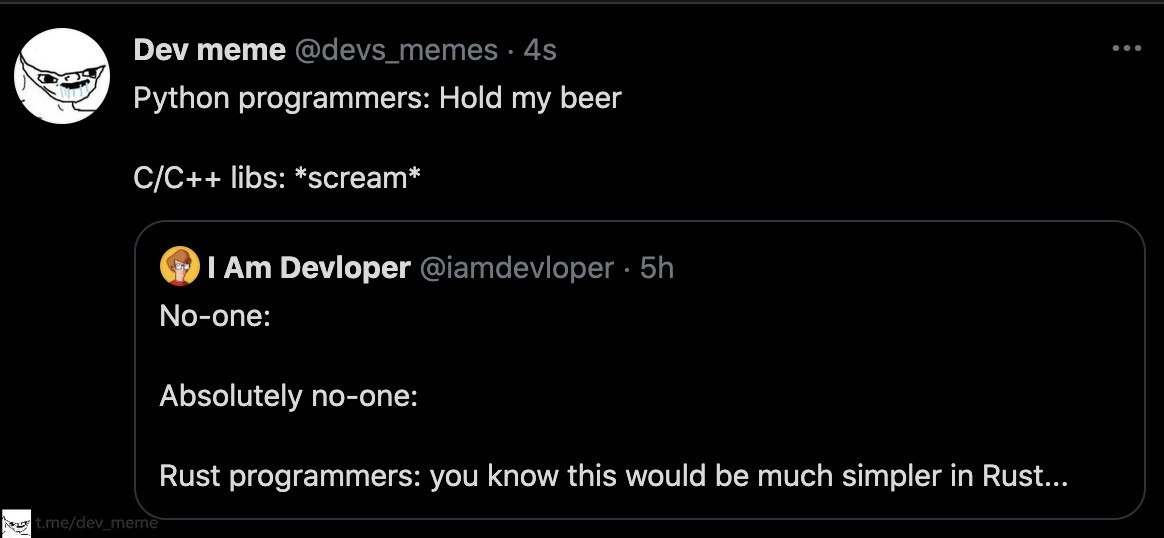
For seasoned engineers, this meme hits a painfully familiar note. It’s poking fun at a scenario we’ve seen time and again in programming language wars: the dynamic high-level language folks (here the Pythonistas) leaning on low-level powers (C/C++), and the new systems language evangelists (the Rustaceans) chiming in with “I told you so.” The tweet format itself is a classic:

Python programmers: “Hold my beer.”
C/C++ libs: [scream]

Translation: Python devs confidently attempt something wild — likely reaching into C/C++ to speed up their code or use a powerful library — and the C/C++ parts respond in agony. If you’ve ever mixed Python with C/C++ libraries, you can probably hear those screams in the form of compiler errors, segmentation faults, or dependency nightmares. It’s that feeling when you pip install a Python package and suddenly your screen fills with a sorrowful wall of C++ compilation errors because you’re missing some libstdc++ or the right version of Visual Studio Build Tools. The meme nails the dependency hell and integration pain: Python is easy until it isn’t, specifically when a needed library is just a thin Python wrapper over a complex C/C++ codebase. All it takes is one mismatch in compiler settings or a subtle memory bug in the native code, and your friendly Python script turns into a howling banshee of errors. The “hold my beer” attitude from Python devs is a tongue-in-cheek reference to how we sometimes bravely (or recklessly) say “I can make this faster, watch!” — which usually means dipping into a C/C++ extension or some Python binding to C for performance-critical sections. And often, that’s when things get interesting. The C/C++ libs screaming could symbolize the fragile C API complaining (think of a rogue Segmentation fault (core dumped) message that appears without mercy or explanation). It’s the kind of scream that doesn’t get caught by Python exceptions – a blood-curdling crash that kills your program dead. Seasoned devs have been there: maybe you tried to speed up number crunching with a bit of Cython or a C extension module and ended up spending your weekend debugging a memory corruption that shouldn’t happen in pure Python. That scream is real, and it usually echoes at 2 AM in the depths of your error logs.

Enter the bottom half of the meme:

No-one: (absolute silence)
Rust programmers: “You know this would be much simpler in Rust…”

This is an ironical jab at the Rust developer community’s well-known enthusiasm for their language – often referred to (playfully) as the “rewrite it in Rust” trope. In countless online discussions, as soon as someone mentions a C/C++ pain point or a Python performance problem, a wild Rustacean appears with a gleam in their eye, ready to extol how Rust could solve the issue with memory safety and speed. It’s a form of language evangelism that has become a meme itself. The format “No one: … Rust programmers: …” implies nobody asked for this advice, yet Rust fans offer it unsolicited. And it’s funny because it’s kinda true – Rust aficionados are passionate. They genuinely believe (often with good reason) that many problems plaguing C/C++ (like dangling pointers, buffer overflows, data races) simply wouldn’t occur in Rust, thanks to its strict compiler checks. From a senior dev perspective, we chuckle because we’ve seen this pattern before. Today it’s “rewrite it in Rust”; yesterday it was “rewrite it in Go,” “why not use Java,” or even earlier “have you tried it in Ada?” Every generation of programmers has that one language they swear will fix all the issues of its predecessors. The Rust evangelism is particularly strong because Rust directly tackles the exact nightmares that cause those C/C++ libraries to scream – namely memory and concurrency errors – without sacrificing performance. In theory, a pure Rust implementation could give Python a fast extension that doesn’t randomly crash at runtime. In practice, of course, a total rewrite is a huge undertaking. But Rust developers have a bit of a hero complex here: they see a burning building (C++ on fire inside Python) and can’t resist shouting that they have a fireproof solution, if only we’d let them rebuild the house from scratch.

This meme resonates in dev communities because it encapsulates a cycle we know well. Python developers value simplicity and speed of development, so they happily grab a battle-tested C/C++ library to do the heavy lifting (why reinvent the wheel, right?). But this creates an awkward marriage: Python and C++ have very different ecosystems and expectations. Just setting up those C/C++ libs can be a voyage through dependency purgatory – incompatible compilers, missing headers, ABI mismatches, you name it. And once it’s running, if something goes wrong deep in that C++ code (say, a memory leak or a null pointer dereference), the Python side is left holding the broken pieces with a bewildered look. It’s a trade-off seasoned devs accept but also joke about: “Sure, it’s Python on the surface, but beneath the hood it’s a rickety jalopy of C++ code held together by prayers and duct tape.” No wonder those libs are screaming! We’ve all seen that scary stack trace that winds its way out of Python, through some cpython_extension.so module, ending in a cryptic C++ error — at which point you realize your nice safe Python app just died in a very unsafe way.

And then there’s our smug friend Rust lurking in the corner. The meme brilliantly captures how Rust advocates tend to pop up like a deus ex machina: “Actually, this would be much simpler, safer, and probably even faster in Rust.” It’s equal parts helpful suggestion and smugness. Seasoned engineers might smirk here because we know that while Rust can indeed prevent a lot of bugs, convincing an entire team to adopt a new language or rewriting a crucial C++ library in Rust is easier said than done. There’s organizational inertia, the mountain of existing code, and the learning curve of Rust’s famously strict rules. The meme’s humor lies in the contrast: the Python dev is bravely hacking with C++, the C++ code is metaphorically screaming in pain, and the Rust dev is so confident he has the obvious answer – all while no one specifically invited that opinion. It’s a light-hearted jab at the Rust community’s reputation (yes, Rustaceans, we love you, but sometimes you do barge into every conversation 😜).

In essence, this meme is comedic developer relatability gold. It hyperbolizes a real scenario: Python’s ease-of-use hitting the wall of C/C++ complexity, and a typical Rust-flavored response from the sidelines. Each role in the meme is a caricature of its language’s community: Python programmers being bold and perhaps a bit naive about what lies beneath, the C/C++ libraries expressing the trauma of decades of manual memory management and integration woes, and Rust programmers proudly (or annoyingly) advocating the new way that could save us all. It’s funny to experienced devs because we’ve lived some version of this. We’ve been in the meetings where someone says, “We could speed this up with a C++ extension,” and an hour (or a week) later we’re dealing with compiler errors or mysterious crashes. We’ve also been (or heard) the person who quips, “Maybe we should rewrite that module in Rust and be done with these issues,” usually met with eye-rolls or maybe a hopeful nod. This meme takes those war stories and compresses them into one Twitter screenshot, perfectly capturing the absurd heroism of the Python dev, the agony of the C++ code, and the unsolicited optimism of the Rustacean. It’s a classic showdown indeed – a little humorous snapshot of the ongoing language comparison battles and the dependency angst that any engineer who has stitched together different technologies can relate to.

Level 4: The Unsafe Bridge

At the deepest level, this meme hints at the fundamental friction in software engineering when mixing languages of different abstraction levels. Calling C or C++ code from Python involves a Foreign Function Interface (FFI) – essentially a bridge between two worlds with very different rules. Python lives in a managed, high-level environment with automatic memory management (reference counting and garbage collection), while C/C++ live in the wild west of manual memory management. When a Python program says “Hold my beer” and dives into C/C++ territory, it’s stepping outside the safety rails. The screams of the C/C++ libraries are the echoes of unsafe operations and memory mismanagement lurking beneath Python’s smooth surface. There’s serious computer science here: Python’s runtime must hand control (and trust) over to compiled C/C++ code via a shared Application Binary Interface (ABI). If that C++ code misbehaves – say, by writing out of bounds or double-freeing memory – Python can’t do much about it. You’ve breached the interpreter’s safety net, and undefined behavior is now in charge.

From a theoretical standpoint, this underscores the difficulty of achieving both high-level ease and low-level performance in one system. It relates to what academics sometimes call the two-language problem: you prototype in a slow safe language and then rewrite hot parts in a faster unsafe language. The bridge (FFI) is opaque; the Python interpreter can only pray that the C/C++ code it’s calling is doing the right thing. Formal verification of such cross-language interactions is extremely hard – you’re interfacing a dynamically-typed language with a system that’s oblivious to Python’s runtime invariants. If we invoke some computing theory, we can see ties to type theory and memory safety: Rust enters the chat here as a potential savior using an advanced type system to guarantee memory safety. Rust’s compiler uses the borrow checker (grounded in concepts from linear logic and ownership types) to ensure objects live long enough and no invalid memory access happens – all at compile time, a form of lightweight formal verification. In an ideal world, rewriting those screaming C/C++ parts in Rust could eliminate entire classes of bugs (buffer overflows, use-after-free, data races) by making them impossible to compile. However, even Rust must cross the FFI boundary to talk to Python – and that requires using unsafe blocks in Rust, essentially saying “Trust me, I know what I’m doing”. In other words, the fundamental truth remains: when bridging between languages, the system’s reliability is only as strong as the weakest link. The meme’s absurd scenario is technically inevitable given these constraints – you either accept Python’s slower safe execution, or you grab C/C++ for speed and inherit the possibility of low-level failures. Rust’s promise is to offer speed with safety, but integrating it is a new kind of complexity. In short, the meme jokes about something quite real: the computing stack’s lower layers (native code) have inherent dangers that no high-level sugar can fully conceal, except maybe by a ground-up rewrite in a language designed to avoid those pitfalls in the first place.

Description

A screenshot of a Twitter thread that layers two programming memes on top of each other. The bottom tweet, by 'I Am Devloper' (@iamdevloper), uses the 'No one:' format to mock Rust evangelism: 'No-one: Absolutely no-one: Rust programmers: you know this would be much simpler in Rust...'. The top tweet, a reply from 'Dev meme' (@devs_memes), escalates the joke. It says, 'Python programmers: Hold my beer', followed by 'C/C++ libs: *scream*'. This implies that Python, known for its simplicity and vast ecosystem of libraries often written in C/C++, is the ultimate layer of abstraction, using powerful but complex low-level libraries under the hood. The humor comes from the layered conversation: while Rust programmers are busy advocating for their language, Python programmers are casually using the very C/C++ libraries that Rust aims to replace, often without needing to worry about the underlying complexity


Comments

40
Anonymous ★ Top Pick Python's relationship with C++ is the ultimate senior dev move: take a notoriously complex and powerful tool, wrap it in a five-line script, and then act like it was easy the whole time
  1. Anonymous ★ Top Pick

    Python's relationship with C++ is the ultimate senior dev move: take a notoriously complex and powerful tool, wrap it in a five-line script, and then act like it was easy the whole time

  2. Anonymous

    Python: “It’s just a quick pip install.” C/C++: *undefined symbol: panicScream()* Rust dev (from the corner): “Or - and hear me out - we stop FFI‐speed-running the SEV list and write it once in safe code.”

  3. Anonymous

    After 20 years of debugging segfaults and memory leaks, you realize the real undefined behavior was the Rust evangelists we met along the way - they'll find you even in discussions about Python's GIL

  4. Anonymous

    This perfectly captures the Rust community's well-earned reputation: while Python devs are busy wrapping C libraries with ctypes and dealing with segfaults in their native extensions, Rust evangelists appear like clockwork to remind everyone about memory safety and fearless concurrency - as if rewriting NumPy's 20-year-old battle-tested BLAS bindings in Rust is just a weekend project. The irony? Both communities are actually right: Python *does* scream at C/C++ libs when they misbehave, and it *would* be simpler in Rust... if you ignore the six-month learning curve, the compile times, and the fact that your stakeholders wanted this feature shipped last quarter

  5. Anonymous

    Nothing says “simpler” like replacing a flaky C extension with Rust, then shipping 18 platform‑specific wheels, a build.rs that summons LLVM, and one unsafe block that still calls the same screaming C API

  6. Anonymous

    Rust: Where 'much simpler' means trading C++ segfaults for borrow checker therapy sessions

  7. Anonymous

    Python dev: “it’s just a binding.” C++ lib: “it’s just UB.” Rust dev: “it’s just a rewrite.” PM: “it’s just not happening this quarter.”

  8. Deleted Account 5y

    Rust lol.

  9. @Tenoooo 5y

    Did not get it (

    1. @karumsenjoyer 5y

      - Python programmer

      1. @xgoader 5y

        what's bad about being a python programmer?

        1. Deleted Account 5y

          bc you have to know more than just one lang

          1. @xgoader 5y

            that's ok, but I suppose you would be using only one, perhaps two, languages mostly

            1. Deleted Account 5y

              more like 5

              1. Deleted Account 5y

                or more

        2. @Rodney_GoMK 5y

          Because you did not get it

  10. @xgoader 5y

    why would you need to use so many languages in work?

    1. Deleted Account 5y

      well, bash is necessary, python you need for cranking out a fast concept, and then a couple of langs you actually use for the project

      1. Deleted Account 5y

        example for those will be c++, glsl and lua if you do gamedev

        1. dev_meme 5y

          you'll need glsl anyway, and I can only recommend lua if you're implementing mod support. Otherwise, omg, don't. And I've written games in pure python before which run …okay. Search for RTris or Dodge to Drums. The first is ancient and the second unfinished.

          1. Deleted Account 5y

            no lua is nice

            1. @saniel42 5y

              It's not mandatory

              1. Deleted Account 5y

                well, none of them are, you han use hlsl, you can even use java (like minecraft, but suffer from low perf)

                1. @saniel42 5y

                  And why would you use lua in a small team, for example

                  1. Deleted Account 5y

                    you can give it to the game designers to make scripts for entities with it

                2. dev_meme 5y

                  if you're considering to use java, you might as well be using python

                  1. Deleted Account 5y

                    nah, it's still alot faster than py, but it still doesn't make sense for a game

                    1. dev_meme 5y

                      I can't play minecraft on my laptop. I could if it were made with python, I betcha.

            2. dev_meme 5y

              bro. no. - return must be the last statement in a function - there's no += or ++ - 0, 0.0 and "0" are all evaluated as true - not-equal operator is ~= - a={};a.field works, but {}.field doesn't - values are usually converted, but not in equality checks (which makes kinda sense, but still, implicit conversion bad) - surely other shit, but I gotta get to class now

              1. Deleted Account 5y

                3rd one is nice, basically a tradeoff between the best ternary and not using == in ifs

                1. Deleted Account 5y

                  but overall all of the above can be forgiven for how tiny this thing is

  11. @Rodney_GoMK 5y

    Bc you: I will do it in lang A, it will be fast and simple Pm: i think you don't understand how we work

  12. @xgoader 5y

    ok then ;)

  13. @anatoli26 5y

    Just use rust

    1. dev_meme 5y

      wait lemme guess… it has zero-cost abstractions? Incredible.

      1. @anatoli26 5y

        Yepp, and much more

  14. @anatoli26 5y

    Much much more

  15. @anatoli26 5y

    A perfect language system (lang, compiler, libs)

    1. Deleted Account 5y

      >no typelevel metaprogramming

  16. @OakGary 5y

    javascript :)

Use J and K for navigation