Hollywood vs. Reality: The Great Hacker-Gamer Rig Swap
Why is this Security meme funny?
Level 1: Real Life vs Movie Magic
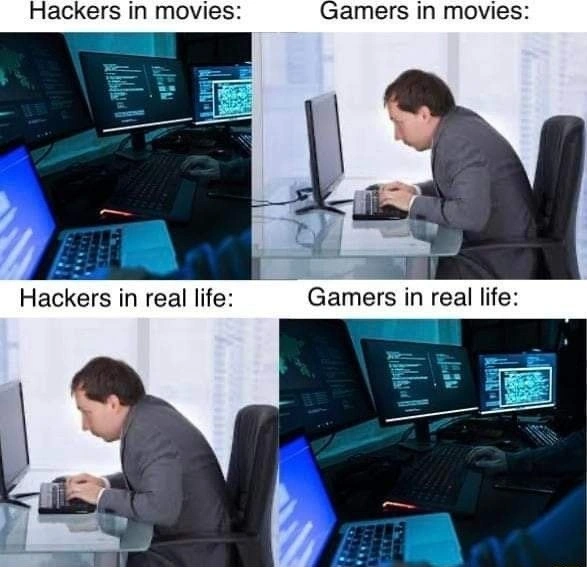
Movies often make everything look more exciting than it really is – and that’s what this meme is joking about. Imagine you watch a cartoon or movie about a computer expert. The movie might show them in a cool secret lair with lots of big screens, crazy glowing graphics, and the person typing incredibly fast like a wizard casting spells. It looks amazing and intense. Now, think about your own experience or someone you know who works on a computer for real. Maybe it’s a friend, a parent, or even you doing homework. In real life, using a computer usually just looks like... well, someone sitting at a normal desk, often in a regular lit room, staring at a screen and typing calmly. Not so wild, right? That’s the hacker side of the joke: in movies they’re like superheroes with gadgets, in real life they’re more like an ordinary person working at their desk.
Now take video gamers. In an old TV show or movie, a person who plays video games might be shown as a goofy character: hunched over a tiny screen, maybe in a messy room, looking kind of uncool. But if you peek into the room of a real avid gamer today, it can look like a space station! They might have a fancy computer with colorful lights, a huge curved monitor (or several monitors side by side), and a super comfy chair. It’s actually pretty cool and futuristic-looking. This is the opposite of what the movies used to show.
So the meme is funny because it flips what you’d expect: it says, actually, in real life the gamer has the flashy setup and the hacker is the one who might look kind of plain at first glance. It’s like saying, “Surprise! The truth is the opposite of the stereotype.” Even if you’re not a tech expert, you know that movies use a lot of movie magic. They add extra sparkles and drama to make scenes fun to watch. But reality is often different. Here, that difference is used as a joke. You don’t need to know about computer code or anything to get it – it’s clear just from the pictures and labels. It’s a bit like how cartoons show a scientist in a lab with bubbling potions and lightning bolts, but a real scientist might just be quietly writing notes or mixing something in a simple flask. The emotion at the core of this meme is the humor of seeing the truth versus what people imagine. People who work with computers laugh because, to them, it’s so true: “Haha, movies got it so wrong, and real life turned out the other way around!”
In simple terms: Don’t believe everything you see in movies, especially about computers. Real life might not look as flashy, but it has its own surprises – in this case, the gamer is the one with the super cool gear! And that unexpected swap is what makes the meme silly and fun.
Level 2: Movies vs Reality 101
Let’s break down what’s happening in simpler terms. This meme compares how hackers and gamers are shown in movies versus what hackers and gamers are actually like in real life. The funny twist is that the portrayals are completely swapped around:
Hackers in movies: Usually shown as cool, shadowy figures in dark rooms with lots of high-tech screens. They have fancy interfaces with green text on black backgrounds (think of the scrolling code in The Matrix). These screens often show dramatic things like world maps with blinking lights, or endless lines of “hacking code” flying by. It’s basically a visual cliché to scream “tech genius at work!”. This is often called “Hollywood hacking”, where everything is exaggerated to look exciting. In movies, a hacker might furiously pound a keyboard and magically break into systems in seconds. They often use slick graphical user interfaces (visual programs with buttons and maps) that real hackers don’t actually use. Real hackers typically use command-line tools (text-based programs) or write scripts. The movie version is pure make-believe – it’s designed to look cool, not to be accurate. This concept of adding impressive-looking but impractical features for show is known as security theater in tech jargon (showing off “secure-looking” stuff that doesn’t necessarily make things secure, just like an actor on stage performing security).
Gamers in movies: Often shown as either comedic or nerdy characters. A movie might show a “gamer” as a guy in a messy room or office, slouched over a tiny computer or old TV, button-mashing or staring awkwardly. They might be portrayed as socially awkward, overly intense, or out of shape – basically a stereotype from an older time when playing video games wasn’t seen as mainstream. The equipment shown is usually pretty basic: maybe one small monitor, a standard keyboard, nothing flashy. In films, this image is used to emphasize that the gamer is a bit of a loner or an oddball. It’s not very flattering and often not up-to-date with how gaming really is now.
Hackers in real life: The truth is often much less thrilling than the movies. A real-life hacker (or more accurately, a professional security researcher, IT specialist, or programmer) is usually just an ordinary person working at a computer. They might be at a normal desk in an office or at home, with maybe one or two monitors that look like any other computer setup. They are not surrounded by futuristic holograms or green glowing text. In fact, real hacking is done with real tools and lots of careful work: using programming, running command-line tools (which often just show white text on a black screen, no fancy graphics unless they make their terminal green for nostalgia!), reading documentation, and patiently finding weaknesses in systems. Many of these folks have jobs at companies, so they might even wear business-casual clothes (like the grey suit we see in the meme’s “real life hacker” image) and work daytime hours. They look like any other office worker because fundamentally, they are office workers — just ones who specialize in computer security or coding. The meme shows the real-life hacker hunched forward at a single monitor in a bright office, which is funny because it’s such a normal, almost boring scene compared to the movie version. It reminds junior developers or new IT students that real-world IT work is not as visually dramatic as TV shows make it seem.
Gamers in real life: This is where reality flips the script. Today’s real gamers (especially enthusiasts) often have very impressive computer setups. It’s common to see a gaming “rig” (a term for a gaming computer and its setup) that includes multiple large monitors, a powerful PC with glowing LED lights, a fancy keyboard and gaming mouse, and sometimes decorative lights all over the room. Gamers do this for practical reasons (like having one screen for the game and another for chat or stats) and for style — it’s cool and immersive. Gaming has become a huge culture: people stream their gameplay online, join global tournaments, and build custom PCs as a hobby. GamingCulture often prides itself on cutting-edge hardware. So ironically, a real-life gamer’s desk might look closer to the high-tech movie hacker’s desk than even a real hacker’s desk does! In the meme’s bottom-right panel, we see exactly that: “gamers in real life” have the multi-monitor, high-tech command center look. It’s humorous because if you walked into a room like that, you might think, “Wow, is this person some kind of CIA hacker?” but nope, they’re probably raiding a dungeon in an online game or streaming on Twitch.
So, why is all this funny and what does it teach us? It’s highlighting the difference between Hollywood stereotypes and real life. People new to tech might wonder: do hackers really sit in the dark with 10 screens? Do gamers really use puny computers? The answer: not usually! Movies and TV often get these things wrong or oversimplify for the story. RealWorldVsIdeal (or rather, real world vs “reel” world) is a common theme in tech humor. This meme is a playful correction: hackers and gamers in reality often look very different from how the media portrays them. It’s a relatable point for anyone who’s started working with computers and noticed “Hmm, my job isn’t as cinematic as they made it seem in Insert_Hacker_Movie_Name.” Also, note the guy’s posture in the meme: posture and ergonomics are real concerns. Both hackers and gamers in real life might spend long hours at the computer, and if they’re not careful, they might end up sitting like that hunched man in the picture, which is something many of us have caught ourselves doing. It’s a small reminder: fancy gear or not, we’re all human and our backs can ache if we slouch too much!
To sum up these basics: The meme uses two pictures and swaps their labels to poke fun at stereotypes. Hacking in movies is all spectacle, but in reality it’s often plain. Gaming in movies is shown as dorky or plain, but in reality it can be quite spectacular. Understanding this gives new developers or tech enthusiasts a more realistic expectation: don’t believe everything you see on screen. The truth of tech life is a bit more...normal-looking (even if the work itself can be challenging and exciting in its own way). And that’s exactly why tech folks chuckle when they see this meme – it’s a humorous little reality check.
Quick Comparison Table: Just to drive the point home, here’s a side-by-side glance at the portrayal vs reality for hackers and gamers:
| Role | Movies Stereotype (On-Screen) | Real Life (Actual) |
|---|---|---|
| Hacker | Dark room, multiple monitors, green code everywhere, dramatic “I’m in!” moments. | Regular office/home, maybe 1-2 monitors, normal coding/hacking using real tools (often quietly and methodically). |
| Gamer | Plain setup, single small monitor, portrayed as slouched nerd with no life. | High-end PC setup with dual or triple monitors, colorful LED lights, advanced gaming gear, possibly a streaming mic – looks super high-tech. |
Level 3: Green Text & Grey Cubicles
In this meme, our expectations do a 180 flip. It highlights how Hollywood hacking cliches clash with everyday reality in tech. On the top-left, we see “Hackers in movies” depicted with the classic cinematic flair: a dimly lit room awash in eerie blue glow, multiple monitors displaying green-on-black code, flickering maps of the world, and cryptic terminals. This over-the-top setup is pure security theater – a flashy visual trope directors use to scream “Hacker at work!” to the audience. In contrast, the bottom-left panel (“Hackers in real life”) shows a very ordinary scene: a guy in a plain corporate office, wearing a grey suit, squinting and hunched so far forward that his nose almost touches a small monitor. It’s the polar opposite of glamorous. For anyone in HackerCulture or IT, this inversion lands as sharp satire. We cringe-laugh because we’ve all seen those unrealistic movie UIs with glowing encryption progress bars and obnoxious 3D firewalls, and we know that actual cybersecurity work rarely looks like a sci-fi battle station.
Now look at the right side: “Gamers in movies” (top-right) versus “Gamers in real life” (bottom-right). Movies often portray GamingCulture with a chuckle – the gamer is shown much like our hunched office hacker: a lone nerd in a brightly lit, boring room, face inches from a tiny, outdated monitor. It's the stereotype of a socially awkward desk jockey. But the meme’s punchline is that real life is exactly the reverse. Today’s gamers, especially enthusiasts and streamers, frequently invest in high-end battlestations: multiple monitors, custom-built PCs with neon blue LED monitor glow, sleek keyboards, and maybe a giant RGB mouse pad for good measure. In other words, the setup that movies unrealistically give to “hackers” is actually closer to what real gamers have, while real-world hackers (like many software engineers or security analysts) might be stuck with a standard-issue workstation in a cubicle and one modest screen. It’s a perfect monitor_setup_swap gag.
This resonates with developers and IT folks because it underscores a running joke: Hollywood almost always gets tech wrong. The meme pokes fun at that disconnect. In reality, a penetration tester or security engineer’s day might involve running scripts, reading logs, and writing exploit code on a normal laptop – not frantically typing on five monitors of animated code rain. And many hardcore gamers do have setups that look like mission control. (Visit any Twitch stream, and you'll likely see more neon than in a Tron sequel.) The humor also touches on IndustryTrends_Hype: hacking is hyped up as this sexy, dramatic endeavor on screen, whereas real hacking can be painstaking and methodical. Meanwhile, video gaming, once dismissed, has exploded into a mainstream industry with professional eSports players and streamers – and their gear has leveled up accordingly.
The sarcastic humor here also lies in the posture_ergonomics_issue on display. Both the “movie gamer” and the “real hacker” are represented by the same stock photo of a man in an office slumping towards his screen, illustrating poor ergonomics. It’s a tongue-in-cheek detail: in truth, anyone – whether a coder, an office worker, or a gamer – might end up in that hunched pose after hours at a desk (your chiropractor would not approve!). Hollywood, of course, never shows their elite hackers complaining about back pain or squinting at code under fluorescent lights, but real tech workers know the struggle is real. RelatableDevExperience? Absolutely. We laugh because we’ve caught ourselves in that exact hunch over a bug at 2 AM or during a marathon gaming session, looking far less cool than any movie character.
This meme cleverly inverts stereotypes to highlight their absurdity. It reflects a shared understanding in the tech community: that movie magic consistently trumps accuracy. Whether it’s the infamous hollywood_hacking_cliche of “I’m in!” after a few furious keystrokes on a glowing GUI, or the one-note portrayal of gamers as basement-dwelling gag characters, the reality often doesn’t match. By swapping the roles, the meme delivers a wink and nod: “If you want to see a multi-monitor light show, don’t visit a hacker’s lair – check out a gamer’s room. And if you want to see someone awkwardly glued to a screen in a bland office, that might just be your friendly neighborhood security analyst.” For seasoned developers and IT pros, this contrast is instantly recognizable and hilariously on point. We’ve spent years explaining to friends and family that real hacking looks more like careful scripting and patience – nothing at all like the nonsensical code waterfall Hollywood loves. And we’ve also seen how gaming has evolved from an underground hobby to a high-tech spectacle with all the RGB trimmings. The meme’s joke lands because it’s grounded in these truths, exposing how far off the mark pop culture can be. It’s a bit cathartic, too: every time we see yet another movie scene with “ultra hacker mode” engaged (complete with beeping servers and animated skull logos), we now have this witty shorthand to say, “Yeah…no, real life is the exact opposite of that.”
Description
A four-panel meme that humorously subverts the cinematic stereotypes of hackers and gamers. The top-left panel, labeled 'Hackers in movies:', depicts a classic Hollywood hacking setup: a dark room, multiple monitors glowing with complex code and graphics. The top-right panel, 'Gamers in movies:', shows a man in a drab suit hunched over a single, basic office computer. The bottom half of the meme flips these stereotypes. 'Hackers in real life:' shows the same bland office setup from the top-right panel. In contrast, 'Gamers in real life:' displays the elaborate, multi-monitor 'battlestation' from the top-left panel. The joke is that in reality, it's often dedicated gamers who have the high-tech, visually impressive computer rigs, while many real-world cybersecurity professionals and developers work on standard, unassuming corporate equipment. It's a classic expectation vs. reality trope that resonates with anyone in the tech and gaming communities
Comments
18Comment deleted
Hollywood thinks hacking requires a Mission Control setup. In reality, the most damaging zero-day is usually found by a guy in a grey cubicle with a single 1080p monitor and a dangerously high caffeine dependency
Corporate budget 101: drop six figures on a 3-D threat-map so the board “feels secure,” stick the pentester hunched over a lone 19″ monitor running tmux, and let the gamer in finance hoard dual 4090s that could rainbow-table our entire password policy before lunch
The security researcher's dual monitor setup is for documentation and Stack Overflow, while the gamer's six monitors are for Discord, Twitch chat, game wiki, build calculator, hardware temps, and somewhere in there, the actual game
Hollywood's greatest hack isn't breaking into systems - it's convincing everyone that security researchers work in neon-lit lairs with 47 monitors while gamers use a single Dell from accounting. In reality, the InfoSec team is debugging OAuth flows in fluorescent-lit cubes while the gaming enthusiast next door has a $15K RGB shrine running three 4K displays, mechanical keyboards with per-key lighting profiles, and enough cooling to host a small data center. The real irony? Both are probably running the same terminal emulator, just with different color schemes
Movies: One keystroke hacks the Gibson. Reality: Six terminals to strace that elusive deadlock across microservices
Movies think hacking needs a 3D world map and four ultrawides; in reality it’s one tmux pane and a curl into a misconfigured S3 bucket - the only Grafana wall is in the gamer’s room
Hollywood: hackers glow in RGB and gamers use Outlook; reality: hackers fight CAB approvals over VPN while gamers have tighter latency SLOs and better observability than our prod
годно Comment deleted
Но баян к сожалению Comment deleted
you as well Comment deleted
Хорошо, договорились Comment deleted
please only use english in this chat! Comment deleted
как скажешь Comment deleted
warning 1/3 for @Kekl0ver Comment deleted
klas Comment deleted
Oh wow such automation much accuracy Comment deleted
He just said "OK") Comment deleted
Oh, Austrian man is back at assaulting Russians again Comment deleted